
- Release Year: 2024
- Platforms: Windows
- Publisher: DPADFTW
- Developer: DPADFTW
- Genre: Action
- Perspective: Diagonal-down
- Game Mode: Co-op, Single-player
- Gameplay: Jetpack, Shooter
- Setting: Futuristic, Sci-fi
- Average Score: 100/100
Description
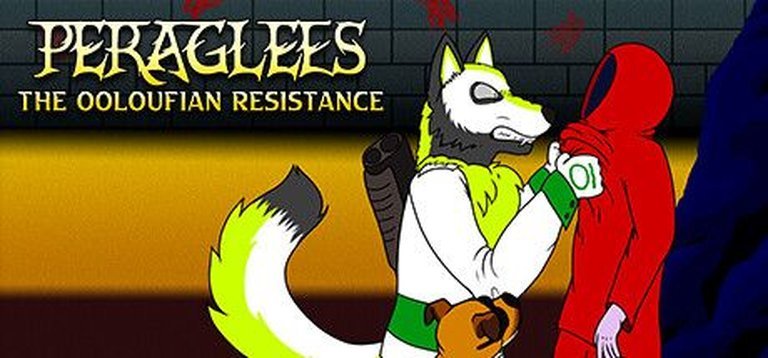
Peraglees: The Ooloufian Resistance is a 2D scrolling top-down shooter set in a futuristic sci-fi universe known as the Fennyverse. Players take on the role of a member of the Ooloufian Resistance, engaging in fast-paced bullet-hell action to destroy enemy fleets, dodge relentless fire, and collect power-ups in a desperate mission to prevent total annihilation.
Where to Buy Peraglees: The Ooloufian Resistance
PC
Peraglees: The Ooloufian Resistance Reviews & Reception
store.steampowed.com (100/100): A very funny arcade game! 10/10 pixel art. Tasty Chicken :3
Peraglees: The Ooloufian Resistance: A Nostalgic Masterpiece Forged in the Fandom Trenches
Introduction: A Pixelated Phoenix from the Crowdfunding Ashes
In the sprawling, often-saturated landscape of indie gaming, certain titles emerge not merely as products, but as manifestos. Peraglees: The Ooloufian Resistance stands as one such audacious declaration. Released into Early Access in March 2024 and achieving its 1.0 launch in April 2025, this game is a deliberate, loving, and technically proficient love letter to the golden age of arcade shooters. Developed and published by the singular entity DPADFTW, it defies easy categorization, bridging the gap between a hyper-focused “furry fandom video game” and a brutally challenging, mechanically rich run-and-gun experience. This review posits that Peraglees is a significant, if quiet, landmark: a game that proves deep mechanical reverence and modern accessibility can coexist, and that a niche aesthetic can house universally compelling gameplay. Its legacy will be defined not by blockbuster sales, but by its status as a cult classic that perfectly captures the spirit of 16-bit mayhem while addressing its historical frustrations with contemporary empathy.
Development History & Context: One Developer’s Odyssey with Clickteam Fusion
The story of Peraglees is, at its core, the story of DPADFTW, a solo or tiny team operation whose public persona is the developer “KAOTIX Fury.” The game emerged from a successful Kickstarter crowdfunding campaign, a critical first step that provided the financial runway for a vision that would have been impossible under a traditional publisher’s expectations. This origin story immediately frames the game as a passion project—a creative endeavor unshackled from shareholder pragmatism but burdened with the weight of backer expectations.
The technological foundation is the Multimedia Fusion / Clickteam Fusion 2.5 engine. This choice is profoundly revealing. In an era of Unity and Unreal, Fusion represents a conscious return to the tools that birthed classics like No One Lives Forever and Castle Crashers. It’s a deliberate constraint, a digital analog to the hardware limitations of the SNES and Sega Genesis. The developer’s own patch notes reveal the crucible of this choice: a monumental decision in build 2.0.0194 to “remake the whole engine from scratch,” noting that “not a single line of code is the same as early access version 1.” This isn’t iterative development; it’s a philosophical reset. The first EA version was built with limitations, particularly in controls. The rewrite, dubbed the “Chicklit Engine V2.0,” was a quest for purity—to achieve “bug free” smoothness and fully leverage X-INPUT support, transforming the game from a keyboard/joystick hybrid into a true twin-stick shooter. This engine overhaul, documented painstakingly in Steam community updates, is the game’s hidden development narrative: a lone (or small) developer sacrificing months to rebuild their creation on a solid foundation, a testament to indie perseverance.
The 2024/2025 release window placed Peraglees in a fascinating context. It arrived amid a strong retro revival (Shovel Knight Dig 3, * River* City Girls 2), but positioned itself uniquely. While most revivals focus on platformers or RPGs, it targeted the overhead scrolling run-and-gun subgenre, a category with fewer modern representatives (think Crimson Land or Blood * Bros). Its competition wasn’t other indie darlings, but the ghosts of arcade cabinets—Gundam* Wing: Endless Waltz, Metal Slug, and Ikari Warriors. Its success would depend not on innovation for its own sake, but on authentic replication with modern quality-of-life.
Narrative & Thematic Deep Dive: Furry Lore Meets Arcade trope
On the surface, the plot is archetypal: the evil Old Whiplin has conquered the Fennyverse, and it falls to the Ooloufian heroes to liberate it. The protagonists are KAOTIX Fury, his brother Slade, and their two “bow-wow companions” (anthropomorphic canine characters). This is where the furry fandom element becomes inextricable from the identity. The game is explicitly marketed as “the first furry fandom video game to kick-ass and chew fur!” This is not an incidental aesthetic; it’s a core design pillar and primary marketing hook. The narrative, therefore, functions on two levels:
- The Generic Arcade Script: A clear, motivation-neutral framework. You are the good guys; they are the bad guys. You traverse nine unique planets (Peraglees, Gnome 8, Ye Fenny, Calypsia, Popped De Ping, Pum Pum, Emigrey, Kulschrank Kuchen, Freenigh), each culminating in a boss battle against Whiplin’s lieutenants. The “Original Mode” expands this with a world hub and quest structure, adding a layer of light RPG progression to the linear arcade run.
- The Furry Canon: For its intended audience, these characters and the world of the “Fennyverse” exist within a broader, pre-existing or co-created fandom mythology. The patch notes, which meticulously document cutscenes for each planet (“Added arcade mode Emigrey cutscene”), suggest a world built with care beyond gameplay utility. The “Romance” tag on Steam further hints at character relationships (likely between the Fury brothers and/or their companions) that provide emotional stakes beyond galactic conquest.
Thematically, Peraglees is about resistance and brotherhood. The core trio—KAOTIX, Slade, and the two unnamed dogs—represent a found family unit under existential threat. The “Helper buddy system” in co-op is not just a gameplay mechanic; it’s a direct thematic parallel. If a player falls in 2-player mode, the other can revive them, ensuring “the players game” continues. This system explicitly rejects the “game over for all” penalty of classic arcade co-op, instead incentivizing persistent partnership. The narrative of resistance is mirrored in the design philosophy of cooperative resilience.
The dialogue and presentation, while minimal in-game, are supported by the “announcer title screen vox” and character “win animation poses,” building personality within the constraints of a shooter. The villains—the Goblin invaders, the various planet-specific bosses (like “The Evil Good Shepherd” on Gnome 8)—are classic arcade archetypes (silly, memorable, visually distinct) given a furry-adjacent twist. The true thematic depth lies in the player’s relationship to the past: the game is about the resistance against the erosion of a certain gaming feel—precision, difficulty, replayability—as much as it is about the Ooloufians’ fight against Whiplin.
Gameplay Mechanics & Systems: The Refined Arcade Crucible
Peraglees operates on a deceptively simple premise: shoot everything, dodge everything, survive. Its genius is in the layering of systems that reward mastery.
Core Loop & Perspective: Players navigate scrolling, diagonal-down levels (a classic Rolling Thunder/Commando perspective) in a 2D scrolling shooter. The screen constantly scrolls (or is scrollable), pushing players forward and creating perpetual pressure. The loop is: move > shoot > dodge > collect power-ups (Oreient) > repeat > defeat boss > advance.
Combat Arsenal & the Roll Mechanic: The game boasts 9 distinct weapons (Ooloufian Rifle, Spread, Chargrill Chester/Flamethrower, Rocket Launcher, SMG, Laser, Homing Missile, Cluster Launcher, Uzi Ripper), plus tactical tools: the Mega Bomb, Mines, and the pivotal Melee Roll. The roll is the keystone mechanic. It’s a dodge with i-frames, but also a melee attack that damages small enemies. Furthermore, as discovered in patch 2.0.0194, a kneel slide (standing still then rolling) places mines, creating a tactical, mobile area-denial tool. This transforms the roll from a defensive panic move into an offensive, resource-management engine. Weapon choice is situational: SMG for generalists, Flamethrower for swarms, Laser for bosses and vehicles, explosives for armor. The patch notes show meticulous balancing: increasing Laser damage, giving vehicles more health, tweaking splash damage. This is the work of a developer deeply engaged with the meta-game.
Progression & Modes: Progression is primarily session-based and skill-based, not character-based. You earn Oreient to upgrade your weapon’s power level during a run (up to 3 levels). The difficulty curve is managed via four static settings. The true brilliance is in the mode structure:
* Arcade Mode: The pure, traditional run. 9 planets, 11 bosses.
* Original Mode: A 45-level expanded campaign with a world map, quests, and mini-bosses, adding light Metroidvania-lite structure.
* Crisis Mode: Arena-based challenges, likely for veterans.
* Survival Mode: A “Vampire Survivors-like” horde mode, a popular modern roguelite twist that fundamentally changes the resource-collection dynamic.
* Boss Rush: The ultimate skill tester.
This variety demonstrates a desire to serve multiple player appetites: the purist (Arcade), the explorer (Original), the adrenalinian (Crisis), the power-fantasy grinder (Survival).
Vehicles & Mobility: The addition of 7 mountable vehicles (Jetski, Jeep, Motorbike, Jetpack, Tank, Turret, Flying Turret) is monumental. They alter physics, firepower, and resilience. Patch notes show vehicles being iterated: “The Jeep, Bike, and Flying Turret can now collide with enemies without exploding,” changing their role from fragile transports to mobile platforms. The Jetpack, in particular, adds a verticality absent from most overhead shooters. The vehicle HUD timer (yellow when you can’t roll off, red when low health) is a masterclass in clean, readable UI design.
Quality-of-Life & Accessibility: This is where Peraglees transcends its “retro” label. The patch notes and Steam description list an astonishing array of options:
* “Disable and enable 2-Player anywhere during gameplay.”
* “Helper buddy system.”
* “Multiple camera options for 1-Player mode.”
* “Streamer friendly moveable HUD.”
* “Colour blind friendly options.”
* “60 and 120fps mode.”
* Full control remapping and XINPUT support.
These are not just features; they are empathy codified. They acknowledge that the brutal difficulty of 80s/90s arcade games was often a product of hardware (finite lives, DIP switches) and design QoL blindness (no mid-run join, unfair sightlines). Peraglees retains the mechanical rigor but removes the punitive, arbitrary barriers, making its challenge feel fair and generous. You can adjust the camera to see more, or turn off the second player seamlessly if they need to leave. This is progressive design within a conservative genre.
World-Building, Art & Sound: The Fennyverse Rendered in 16 Bits
The “Fennyverse” is a world of sci-fi/fantasy hybrid. Planets have names like “Gnome 8,” “Popped De Ping,” and “Kulschrank Kuchen,” blending the cosmic with the whimsical and vaguely Germanic. This is a pastel-colored, expressive universe far from the grim darkness of Resistance or Terminator.
Visuals & Pixel Art: The game is a triumph of “incredible pixel art” by David Jones & Elizabeth Wright. It intentionally pursues a “16-bit” aesthetic, but one polished to a 2025 sheen. The use of CRT shaders is not just nostalgia porn; it’s an atmospheric filter that softens harsh pixels and adds scanlines, enhancing immersion. The patch notes reveal a developer obsessed with collision, layers, and visual clarity: “Fixed fence collision,” “Moved black smoke to layer 19,” “Optimised blood effects.” This focus ensures that the pixel art is not merely decorative but functional—enemies, bullets, and terrain are readable against the busy backgrounds. The “bow-wow companions” and furred characters are rendered with a charming expressiveness that makes the furry identity visually integral, not tacked-on.
Sound Design & Music: This is arguably the game’s secret weapon. The soundtrack is composed by Glyn Humphreys & Diives using a software emulation of the legendary YM2612 (FM synthesis, Genesis/Mega Drive) and SN76489 (PSG, Sega Master System) chips. This is a profoundly specific and authentic aesthetic choice. The music isn’t just chiptune-inspired; it’s technically accurate FM chiptune. Tracks like “Bioluminescence – Pum Pum Arcade Stage Theme” or “Tankin’ update – Gnome 8 Arcade Boss Theme” (as named in patches) are original compositions that capture the driving, melodic, sometimes frenetic energy of 90s arcade boards. The sound palette—explosions, weapon fire, retro “coin” sounds—is equally period-plausible. The “Lot’s of sound options” allow players to blend this FM soundtrack with modern understanding of volume balancing, a crucial bridge for contemporary ears.
Atmosphere: The combination of expressive, clear pixel art and driving, authentic FM music creates an atmosphere that is simultaneously warmly nostalgic and urgently kinetic. It feels like discovering a lost, perfect arcade cabinet from 1994 that was meticulously maintained. The “bow-wow” character designs add a layer of playful, inclusive charm that differentiates it from the muscle-bound heroes of Metal Slug or the gritty soldiers of Contra. The world feels held together by fun.
Reception & Legacy: The Cult Classic in the Making
Critical Reception: By traditional metrics, Peraglees is an invisible masterpiece. Metacritic has no critic scores (“tbd”). MobyGames has no approved critic reviews. This is the reality of a deeply niche title released by a micro-studio with no PR push. It exists outside the review cycle, sustained by word-of-mouth and community.
Commercial & Community Reception: Its Steam user reviews tell a different story. With 91% positive across 12 reviews at the time of writing, it has a devoted, satisfied niche audience. The curator and user tags are a map of its identity: “Bullet Hell,” “Shoot ‘Em Up,” “Pixel Graphics,” “Dog,” “Furry,” “Romance,” “1990’s,” “1980s.” These tags reveal a player base that appreciates the retro mechanics and the furry aesthetic. The Steam Community Hub is active, primarily driven by developer “KAOTIX Fury” posting detailed update logs and development VLOGs. This creates a direct, transparent relationship with its players—a rarity and a significant factor in its positive reception. Players see the engine rewrite, the bug fixes, the balance tweaks. They are co-conspirators in the game’s evolution, not just consumers. The “Bluesky” and “Discord” links on the store page further cement this community-focused development model.
Influence & Place in History: Peraglees will not shift industry paradigms. It will not sell millions. Its influence is niche but profound:
1. For the Furry Fandom: It is a proof of concept. It demonstrates that a game built around anthropomorphic characters can be a mechanically rigorous, critically well-executed arcade shooter, not merely a visual novelty. It elevates the aspirations of furry game development.
2. For the Run-and-Gun Genre: It is a genre-revival benchmark. Its commitment to authentic control, weapon variety, vehicle integration, and boss design, coupled with modern QoL, sets a standard for what a retro-inspired shooter should be. It respects the source material enough to challenge players, but respects them enough to offer tools to succeed.
3. For Indie Development: It is a case study in sustainable, transparent Early Access. The developer used the EA period not for vague hype, but for fundamental engineering (the engine rewrite) and community-integrated balancing. The patch notes are a textbook in clear communication. This model builds immense goodwill.
4. As a Curio: It is a fascinating artifact of online subculture meeting game design craft. Its existence is a direct result of Kickstarter’s ability to fund hyper-specific projects and Steam’s platform for direct developer-consumer connection. Its legacy will be as a beloved item in a specific digital library.
Conclusion: A Definitive Verdict for the Fennyverse and Beyond
Peraglees: The Ooloufian Resistance is not for everyone. Its aesthetic is specific, its genre is demanding, and its marketing embraces a subculture that remains misunderstood by the mainstream. To dismiss it on those grounds is to miss a masterclass in focused game design.
It is a flawed gem—some will find its pixel art too simple, its narrative too thin, its difficulty unforgiving. But within its chosen parameters, it achieves near-perfect execution. The Chicklit Engine V2.0 is a rock-solid foundation. The weapon and vehicle variety creates a depth of tactical consideration rare in the genre. The roll mechanic is a brilliant, multi-purpose core. The soundtrack is authentically evocative. And the suite of accessibility and QoL options demonstrates a developer who loves the arcade spirit but hates its historical cruelty.
Its place in history is secure as a cult classic of the highest order. It is the game you find by accident, the one your quirky friend insists you play, the one that becomes the benchmark you compare all other retro shooters to. Peraglees proves that you can build a game for a “bow-wow” audience and still make it rock-solid for anyone who loves a tight, punishing, rewarding shooter. It is a victory lap for the indie, passion-driven developer, and a testament to the enduring power of a well-tuned, pixel-perfect arcade experience. In the grand archive of gaming, it may be a footnote, but for its players, it is a beloved, ongoing saga—a perfectly executed piece of interactive nostalgia that respects the past while thoughtfully improving it. Rating: 4.5 out of 5 – A Must-Play for Genre Aficionados and the Curious Alike.