
- Release Year: 1998
- Platforms: Windows
- Publisher: Empire Interactive Entertainment
- Genre: Compilation
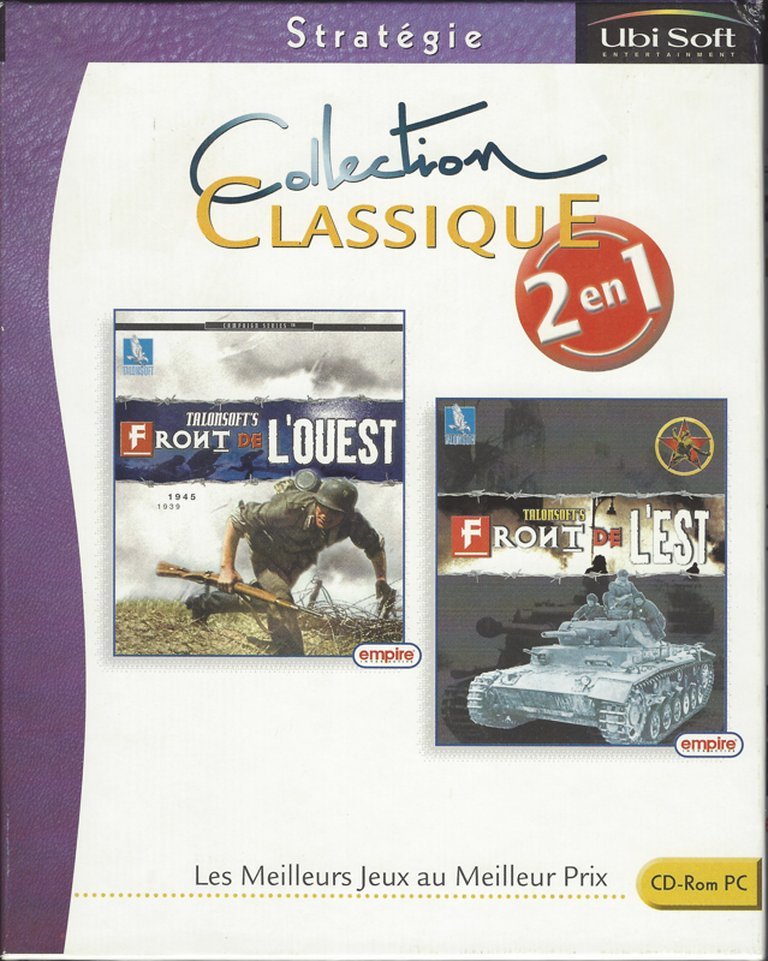
Description
Collection Classique: TalonSoft’s Front de l’Ouest / TalonSoft’s Front de l’Est is a 1998 Windows compilation that bundles TalonSoft’s East Front (1997) and TalonSoft’s West Front (1998), both part of the Campaign series. These computer wargames simulate key World War II theaters: East Front focuses on the Eastern Front, while West Front covers the Western Front and North African campaigns, providing strategic military simulations of major historical conflicts.
Collection Classique: TalonSoft’s Front de l’Ouest / TalonSoft’s Front de l’Est: Review
Introduction: The Digital General’s Desk
In the late 1990s, the personal computer wargame scene stood at a crossroads. The complex, often imposing hex-and-counter simulations of the 1980s and early 1990s, pioneered by studios like Strategic Simulations (SSI) and Avalon Hill, were being challenged by a new generation of titles that sought to marry historical depth with greater accessibility and creative freedom. Into thisarena stepped TalonSoft, a developer with a clear, if somewhat singular, vision: to create supremely detailed, yet remarkably flexible, operational-level simulations of World War II. The Collection Classique: TalonSoft's Front de l'Ouest / TalonSoft's Front de l'Est (1998), a French-market compilation of TalonSoft’s East Front (1997) and its sequel TalonSoft’s West Front (1998), represents not just a pair of games, but the crystallization of a specific design philosophy. This review argues that while the individual titles in the Campaign series were lauded for their unprecedented scenario and campaign editors and their rigorous unit databases, their true legacy lies in their role as powerful, user-driven historical sandboxes. They shifted the wargame from a pre-scripted experience to a co-creative platform, empowering players to become not just generals, but historians, designers, and myth-makers of the Second World War. The compilation, as a curated package, offers a comprehensive, if technically dated, window into a pivotal moment where deep simulation met the democratizing potential of PC creativity.
Development History & Context: From Battlegrounds to Campaigns
TalonSoft, Inc., founded in 1995 and based in Forest Hill, then White Marsh, and finally Baltimore, Maryland, carved its niche in the crowded wargame market with its Battleground series—faithful, if visually primitive, tactical simulations of 19th-century battles like Waterloo and Gettysburg. By the mid-1990s, however, the studio recognized a shifting landscape. The PC was becoming more powerful, and audiences, while still niche, were demanding more dynamic and expansive World War II simulations than the static, single-battle focus of Battleground.
The genesis of the Campaign series, beginning with East Front in 1997, was a direct response. As documented on abandonware-focused sites, TalonSoft’s leadership, particularly producer Jim Rose and key programmer John Tiller, pivoted to the Eastern and Western Fronts with a new ambition. They leveraged an updated version of a proprietary engine to handle a far greater scale and complexity. The technological constraints of the era—late-1990s Windows PCs with limited 3D acceleration—meant the game relied on a classic hexagonal grid (each hex representing ~250 meters) and detailed, hand-drawn isometric sprites for units. This was a conscious trade-off: visual flair was sacrificed for the ability to simulate thousands of individual platoons and companies with precise statistics (attack, defense, movement, morale).
The gaming landscape was fierce. SSI’s Panzer General series had defined the “accessible operational” genre, while TalonSoft’s own The Operational Art of War (1998), developed by the legendary Norm Koger (hired in 1997), was critically lauded for its sheer depth. Against this backdrop, the Campaign series aimed for a middle ground: the historical fidelity of TOAW with a more approachable interface and, crucially, a powerful suite of editing tools. West Front, as the sophomore effort, benefited from a year of feedback and engine refinement, as noted by contemporaries like GameSpot, which called it “much improved” over the “disappointing” first title.
Narrative & Thematic Deep Dive: The Story We Write Ourselves
To discuss “narrative” in a TalonSoft Campaign title is to discuss history as a canvas, not a script. There is no overarching plot, no named protagonists, no scripted dialogue. Instead, the narrative is emergent, systemic, and entirely player-authored. The “story” is the operational history you create—the desperate holding action at Bastogne, the grinding attrition of the Hürtgen Forest, the dramatic breakout from Normandy.
The thematic core is one of command under uncertainty. The game simulates the “fog of war” through a limited visibility radius around units. Reconnaissance is not a passive state but an active, critical component of gameplay. This creates a constant tension between offensive momentum and the need to protect flanks, a perfect digital analog for the operational dilemmas faced by real commanders like Patton or Montgomery. The unit database itself is a thematic statement. It contains hundreds of order of battle (OOB) entries, from a humble German Landser squad to a formidable Tiger I tank platoon. Each entry isn’t just a number; it’s a distillation of historical research into armor thickness, gun velocity, and training quality. The theme here is material determinism—the understanding that the outcome of battles was shaped as much by the quality and quantity of equipment as by tactical brilliance.
The compilation’s true narrative genius lies in its editor suite. The Scenario Editor, Map Editor, Campaign Editor, and especially the OOB Editor transform the player from consumer to historian-designer. You can recreate the Battle of Kursk with painstaking accuracy, or you can ask “what if?”—what if the Germans had more Panthers at the Battle of the Bulge? What if the Allies had prioritized the capture of Antwerp? This counterfactual exploration is the deepest narrative layer, engaging players in the great debates of military history. The game doesn’t tell you the story of the Western Front; it gives you the tools to tell any story that can be mapped onto a hex grid.
Gameplay Mechanics & Systems: The Engine of History
At its core, East Front and West Front are turn-based, hex-grid wargames simulating platoon-to-corps level combat. The core loop is deceptively simple: move units (each with a movement point allowance), engage in direct fire or assaults, manage supply and artillery, and end the turn to watch the computer resolution of the opposing side’s actions. However, depth explodes from this foundation.
- Scale and Organization: A defining feature is the
exquisite granularityof command. You can control a single squad of infantry (represented by a single hex) or an entirePanzer Corps(spanning dozens of hexes). Theunit databaseis staggering, with research from figures like Joseph Miranda and Joseph Hummel ensuring historical accuracy in unit composition and capabilities. - The Editor Arsenal: This is the series’
crowning achievement. The four integrated editors are unparalleled for their time. TheMap Editorallows terrain sculpting (rivers, roads, bocage, desert). TheScenario Editorplaces units, sets objectives, and configures victory conditions. TheCampaign Editorstrings scenarios together with force persistence (units carry losses and experience), enabling the creation ofmulti-year strategic campaigns. TheOOB Editoris the most powerful, letting users define theforce structureof any nation for any date, a tool forabsolute historical control. - Combat and Progression: Combat is resolved via a
modified dice rollfactoring in unitstrength, morale, terrain, and support(artillery, air power). Experience is tracked, creating veteran units. There is no traditional “character progression”; instead,unit effectivenessis the measure of a commander’s skill. Supply lines arecritically important—isolated units suffer rapid attrition. - Interface and Flaws: The
user interfaceis functional but dated, requiring significantclicks and menusto manage large forces. TheAIis competent for basic scenarios but struggles withoperational depthand complex multi-front defenses, makingmultiplayer(via LAN or early internet) the preferred mode for many. A noted flaw, especially in East Front, wasperformance issueswith large scenarios and a sometimesclunkyreinforcement system, issues largelyrefinedin West Front.
World-Building, Art & Sound: The Look and Feel of War
The atmosphere of the Campaign series is one of cold, functional pragmatism. The art, led by Stephen Langmead, avoids cinematic grandeur for clarity and information density. The isometric view provides a clear, if stylized, view of the battlefield. Unit sprites are detailed enough to distinguish a Panzer IV from a Sherman, a critical feature for gameplay. The hex grids are overlaid with terrain textures—the muddy fields of Normandy, the dusty tracks of North Africa, the dense forests of the Ardennes—that effectively communicate movement penalties and cover bonuses.
The sound design is minimal, almost rudimentary. You hear the crack of artillery, the rumble of tanks, and the staccato of machine guns. There is no dynamic soundtrack, no voice-overs. This austerity reinforces the game’s simulationist ethos; it is a toolshed, not a movie. The introductory videos, created by Tim Kipp and Brian Weber, are typical of the era: FMV sequences with archive footage and maps that set the historical stage but offer no interactive narrative.
Ultimately, the world-building is not in pre-rendered cutscenes but in the player's mind. The accurate unit counters, the terrain-based movement costs, and the logistical constraints work together to create a believable operational reality. When you see your paratroopers held up by unexpected German armor in the Market Garden scenario, or your Soviet tank army mired in spring mud during the Vistula-Oder Offensive, the game’s systems are world-building in their purest form—creating a coherent, reactive historical model that feels authentic.
Reception & Legacy: A Cult Classic’s Journey
At launch, the Campaign series occupied a critical middle ground. East Front (1997) received respected but muted reviews, praised for its ambition and editors but criticized for interface issues and AI weaknesses. West Front (1998) was the breakthrough. Critics from PC Gamer (90%), CNET Gamecenter (9/10), and Computer Gaming World (4/5) noted its significant polish and improved playability. It was nominated for GameSpot's 1998 Wargame of the Year, though it lost to TalonSoft’s own The Operational Art of War Vol. 1, a testament to the studio’s formidable year.
Commercially, it was a solid success. According to TalonSoft head Jim Rose, West Front’s early sales were on track to surpass East Front’s ~90,000 units. By February 2000, the entire Campaign series had sold over 250,000 copies globally—a strong figure for a niche genre, achieved through retail distribution (handled in Europe by Empire Interactive, which published this compilation) and word-of-mouth in wargaming circles.
Its legacy is complex and profound. Directly, it spawned sequels: East Front II: The Russian Front (1999), Rising Sun (Pacific Theater, 2000), and Divided Ground (Middle East, 2001). The editorial tools became the series’ defining hallmark, influencing later TalonSoft titles and setting a standard for user-generated content in wargames. More broadly, it represented a peak of the "high-detail, editor-driven" wargame model. As the industry moved towards 3D graphics, real-time elements, and streamlined interfaces in the 2000s, the hex-based, turn-based, data-heavy approach of the Campaign series began to feel archaic. Yet, in the resurgence of interest in grand, complex strategy games (exemplified by Gary Grigsby’s War in the East and the Command: Modern Operations series), the design principles' of *East* and *West Front*—uncompromising historical detailpaired withunprecedented creative tools—are seen as alost golden ageby many hardcore grognards. The games arecult classics, preserved on sites like theInternet ArchiveandAbandonware France, remembered for theirsheer, unadulterated depth`.
Conclusion: The General’s Will and the Historian’s Craft
Collection Classique: TalonSoft's Front de l'Ouest / TalonSoft's Front de l'Est is therefore more than a simple repackaging of two late-90s wargames. It is a time capsule of a specific, ambitious design philosophy. West Front, in particular, stands as a high-water mark for TalonSoft’s Campaign series—a game that refined its predecessor's promising but rough framework into a powerful, if demanding, simulation tool. Its strengths are immense: a peerless editor suite that turns players into designers, a deeply researched unit database that serves as a digital encyclopedia of WWII equipment, and a clear, functional interface that, while not beautiful, effectively manages operational complexity. Its weaknesses are equally products of its time: a dated aesthetic, a challenging learning curve, an AI that cannot match human ingenuity, and a lack of modern quality-of-life features.
Its place in history is secure but specialized. It did not redefine the wargame genre for the masses; that role belonged to more accessible titles like Panzer General. Instead, it defined a sub-genre: the historian's wargame. It catered to the player who wanted not just to fight battles, but to understand and re-imagine them**. This compilation, by providing both the Eastern and Western Fronts, offers the mostcomprehensive digital sandboxTalonSoft ever built for WWII. For thededicated grognard, themodder, or theserious student of military history, this collection remains atreasure trove. It is amonument to the idea that a game’s greatest story is not the one told by its developers, but the one conjured by the general's will in the quiet, clicking hours of a winter night, as another hypothetical Ardennes offensive unfolds on a hexagonal map. It is, ultimately, a classic' not of mainstream appeal, but ofuncompromising, player-empowering design`.
This review is based on the original 1998 releases of *TalonSoft’s East Front and TalonSoft’s West Front, as compiled in the 1998 French market release “Collection Classique: TalonSoft’s Front de l’Ouest / TalonSoft’s Front de l’Est” published by Empire Interactive Entertainment.*