
- Release Year: 2002
- Platforms: Windows
- Publisher: NStorm, Inc.
- Developer: NStorm, Inc.
- Genre: Action
- Perspective: Behind view
- Game Mode: Single-player
- Gameplay: Arcade
- Setting: Christmas, Fantasy, North Pole
Description
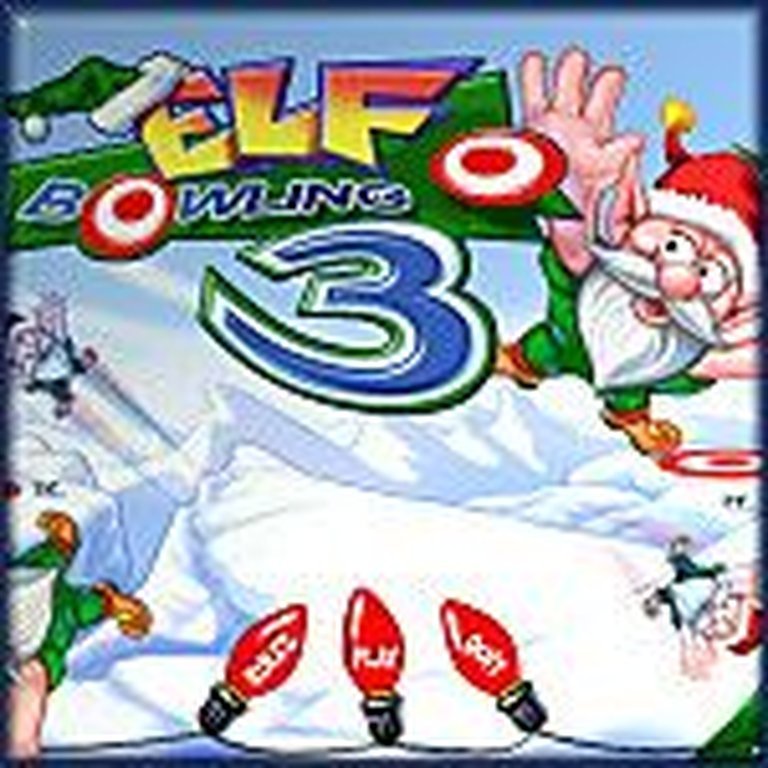
Elf Bowling 3 is a comedic, arcade-style target game set in the North Pole where Santa Claus, faced with drunken reindeer sabotaging his sleigh, trains elves to fly by launching them from a bra sling at floating balloons on a mountainside. Players aim with the mouse to maximize points, avoid reindeer collisions, and strategically use presents across ten tries per level, all wrapped in silly holiday humor as part of the shareware Elf Bowling series.
Gameplay Videos
Where to Buy Elf Bowling 3
PC
Elf Bowling 3 Free Download
Elf Bowling 3 Reviews & Reception
retro-replay.com : Overall, the gameplay loop is remarkably engaging given its absurd premise.
Elf Bowling 3: A Historian’s Dissection of a Holiday Oddity
Introduction: The Reindeer Are Drunk and the Bra Is Out
In the sprawling, often bizarre taxonomy of video game history, few titles encapsulate the weird, viral, and commercially amorphous spirit of the early 2000squite like Elf Bowling 3. Emerging from the shadow of its infamous predecessor—a game so ubiquitous it was mistaken for a global cyber-threat—this 2002 sequel represents a pivotal, and some would say precipitous, moment in a franchise that refused to simply bowl quietly into the sunset. As a piece of interactive ephemera, Elf Bowling 3 is a study in contrasts: it leverages a legendary brand while utterly abandoning the core mechanic that made that brand famous; it trades on irreverent holiday humor that feels both timeless and dated; it exists as a shareware time capsule at a moment when digital distribution was rapidly evolving. This review will argue that Elf Bowling 3 is not merely a failed experiment but a crucial artifact, demonstrating the strain of a viral phenomenon trying to manufacture novelty, the logistical limits of a low-budget studio, and the cultural anxieties of a gaming medium flirting with mainstream, casual acceptance. Its legacy is not one of quality, but of pure, unadulterated concept—a game whose premise is almost more interesting than the act of playing it.
Development History & Context: From Web Design Firm to Viral Vortex
To understand Elf Bowling 3, one must first trace the lineage of its creators and the bizarre corporate journey that birthed it. The entire franchise originated not in a dedicated game studio, but within NVision Design, a Dallas-based web design and multimedia company. In 1999, co-founders Dan Ferguson and Mike Bielinski created the original Elf Bowling as a promotional tool for their email marketing division, NStorm, Inc., with a production cost of approximately $70,000. The goal was simple: create a lightweight, executable “advergame” that could be easily attached to emails to demonstrate NVision’s capabilities and attract clients.
The result was a perfect storm of pre-social media virality. Released on November 12, 1999, as a ~1 MB .exe file, Elf Bowling spread like digital wildfire through email chains in December 1999, peaking at an estimated 900 downloads per second. It became a pervasive office and home holiday distraction, racking up millions of players. However, this success was nearly derailed by a persistent malware hoax. Chain emails warned that ElfBowl.exe contained a virus scheduled to activate on Christmas Day, a claim thoroughly debunked by Symantec and other antivirus firms. The executable only performed a benign HTTP ping to nstorm.com for download tracking, but the rumor significantly hampered its spread and cast a long shadow over the series’ reputation for digital safety.
The corporate landscape shifted quickly. NVision’s parent company, Vectrix Business Solutions, acquired NStorm in 1999 but filed for Chapter 11 bankruptcy. In October 2001, the Elf Bowling and Frogapult IPs were sold at bankruptcy auction to Commotion Interactive, Inc., with Matthew Lichtenwalter, CEO of both NStorm and Commotion, at the helm. Elf Bowling 3 (2002) was thus a product of this new, post-bankruptcy NStorm—a subsidiary trying to capitalize on a fading but still-recognizable viral hit while operating under different financial and creative constraints. It arrived in a PC gaming landscape dominated by the rise of broadband (making large downloads feasible), the maturation of the casual “bejeweled-clone” market, and the lingering memory of the original’s scandalous spread. As a $19.99 shareware title offering a 60-minute trial, it represented a direct attempt to monetize a legacy built on free distribution, a fundamental shift in business model that would prove contentious.
Narrative & Thematic Deep Dive: Santa’s Descent into Madness (and Lingerie)
The narrative of Elf Bowling 3 is a masterclass in absurdist escalation, a logical yet unhinged extension of the original’s “elves on strike” premise. The setup, as provided in the game’s own description, is a cascade of holiday dysfunction: Santa has returned to the North Pole, only to find that the reindeer have raided Dingle Kringle’s “hooch stash” and become “soused.” They are now “out of control” and useless for sleigh-pulling. Santa’s solution? Not rehab, not a stern talking-to, but a bizarre aerial training regimen for the elves.
The central, indelible image is Santa taking “one of Mrs. Claus’ bras, hook[ing] it between two trees” to create a slingshot. This is not merely a comedic prop; it is the game’s entire narrative and mechanical thesis. It weaponizes domesticity (Mrs. Claus’s intimate apparel) and transforms it into a device of Elf cruelty. The thematic undercurrents are remarkably dark: Santa, usually the benevolent patriarch, here schemes a dangerous, demeaning activity for his workers under the guise of “training.” The elves are not volunteers; they are cannon fodder in a desperate, improvised plan to save Christmas.
The character of Dingle Kringle, Santa’s ne’er-do-well elder brother introduced in Elf Bowling 2, remains a narrative anchor, his “hooch” directly causing the reindeer’s rampage. This ties the game into the series’ increasingly complicated family melodrama, though Elf Bowling 3 itself uses Dingle more as a plot catalyst than an active participant. The elves themselves, whose personalities were defined by taunts (“Is that all the balls you got, Santa?”, “Who’s your daddy?”) and the iconic “Elf elf, baby!” dance in the original, are here reduced to silent, physics-based projectiles. Their thematic role is purely sacrificial—the punchline to Santa’s desperate, unhinged plan.
The dialogue and humor, sparingly delivered in generic text prompts or presumed elf exclamations upon impact, rely on crude, scatological, and sexually suggestive gags. The very notion of the “bra sling” is the punchline. This aligns with the series’ evolution toward increasingly sophomoric humor, a stark contrast to the more playful, mischievous tone of the 1998 original. The theme is no longer just “elves vs. Santa” but “Santa’s utterly unhinged, improvised, and mildly misogynistic solutions to minor logistical problems.” It’s a darkly comic parody of holiday crisis narratives, where the solution is always more chaos and bodily harm for the smallest, most vulnerable employees.
Gameplay Mechanics & Systems: The “Elf Sling” Simulator
Elf Bowling 3 constitutes a complete genre departure from the traditional ten-pin bowling of its predecessors. It is, as described, a target-tossing game, akin to a cross between Midget Tossing and lawn darts, with the elf as the projectile. This is the game’s most defining and controversial mechanical shift.
Core Loop: The player aims a bra-slingshot against a fixed, flip-screen backdrop of a snowy mountainside dotted with floating, point-valued balloons (bullseyes, 100, 200, 300 points). Using the mouse, the player moves an arrow left/right to set the horizontal launch angle. A vertical line moves up and down a power meter; stopping it at the desired height determines launch force. Clicking fires the elf.
Primary Objective: Score as many points as possible in ten tries per level. The critical failure condition is the “two bullseye” rule: you must land at least two elves directly on the central bullseye target per level, or the game ends immediately. This creates a constant, tense pressure—a single bad shot can truncate the session, forcing a restart from Level 1.
Progression & Complexity:
* Level 1: Pure introduction. Only static balloons are targets.
* Level 2 Onwards: Two major systemic additions:
1. Reindeer Hazards: Intoxicated reindeer fly across the screen. Hitting one “knocks [the elf] from the sky,” causing a random, uncontrolled descent. The elf might land on a target for points, or miss entirely. This introduces a major risk/reward dynamic and disrupts pure accuracy runs.
2. Presents: Collectible items appear. Their effects are varied: some grant point bonuses, others provide a protective shield that nullifies a reindeer collision, allowing the elf to continue on its intended trajectory.
Mechanical Nuance: The description mentions subtle wind currents and shifting target positions in later levels, adding a layer of compensatory skill. The “moving power meter” timing is the primary skill ceiling—mastering consistent power for different distances is key. However, the physics feel rudimentary; elf trajectories are largely parabolic and predictable, with the chaotic element coming almost solely from the reindeer randomizers and the bullseye requirement.
Flawed Systems: The most significant design criticism lies in the bullseye requirement. For a game focused on scoring, forcing the player to stop after two perfect shots creates an anti-climactic, restrictive ceiling. It prioritizes a harsh, binary “progression” gate over the satisfaction of a long, high-scoring string of varied shots. The ten-shot limit compounds this, making each level feel less like a sandbox and more like a high-stakes mini-game. The shareware limitation (60-minute trial) exacerbates this, as players can easily complete the entire game within the trial, rendering the purchase proposition weak unless they are deeply compelled by leaderboard chasing.
Innovation? The innovation is purely conceptual: the audacious swap of a bowling ball for an elf and a lane for a mountainside, and the introduction of the bra as a slingshot. Mechanically, it’s a very simple point-and-click launch game with two added variables (reindeer, presents). Its “innovation” is in its premise, not its systems.
World-Building, Art & Sound: Festive Facade on a Shoestring
Visual Direction & Setting: The game presents a cartoonish, fixed-perspective North Mountain. The aesthetic is pure, unadulterated early-2000s casual PC game. The colors are bright and festive—candy-cane trees, snow-dusted slopes, vibrant balloons—but rendered with a limited palette and simple 2D sprites. The elves are tiny, generic, almost blob-like figures with exaggerated running or flailing animations. The “bra sling” is a crude, pink, two-tree-hung graphical element that is both the focal point and a testament to the low-fi charm. The background art receives subtle variations across levels (icy caves, twilight hues), but the core asset set is minimal and recycled. This simplicity echoes the original Elf Bowling‘s style, feeling less like a crafted world and more like a series of themed backdrops for the action.
Sound Design: Audio is functional and repetitive. Sound effects are limited to: the twang of the bra launch, elf shrieks/cries upon impact or collision, a pop for balloons, a reindeer bellow, and perhaps a jingle or two for presents. There is no musical score, only ambient wind or silence. The soundscape is sparse and repetitive, contributing to the “arcade” feel but also underscoring the low production values. It’s not immersive; it’s purely feedback-driven.
Contribution to Experience: The art and sound do not build a “world” so much as they establish a fleeting, humorous context. The visuals scream “cheap holiday card,” and the sound effects are punchlines. Together, they create an atmosphere of deliberate, low-stakes silliness. There is no attempt at realism or depth. The experience is meant to be disposable, a chuckle between email checks. This aligns perfectly with the game’s origins as an email attachment and its shareware model. It’s not meant to be absorbed; it’s meant to be used and discarded, like a party favor. The aesthetic, therefore, is not a liability in its intended context—it’s an asset, signaling its own inconsequential, fun-only nature.
Reception & Legacy: A Critical and Commercial Whimper
Launch Reception (2002): Critical reception was overwhelmingly negative to lukewarm. The two aggregated critic scores tell the story: GameHippo.com (60%) and VictoryGames.pl (20%), averaging a paltry 40%. The GameHippo review is telling: it acknowledges the “silliness and randy jokes” and that it “may evoke a couple of laughs the first time,” but crucially notes it “doesn’t relate to bowling really” and that the humor is “not as much as in the previous two Elf Bowling games.” The VictoryGames.pl review is brutal, stating the trial version’s 60-minute limit is “in zupełności wystarczy aby ukończyć grę i usunąć ją” (“more than enough to finish the game and delete it”), and that the $19.99 price is “wcale nie jest warta” (“not at all worth it”).
Player Reception: MobyGames shows a similar ambivalence with an average 2.5/5 from 2 ratings. This suggests a small, disengaged player base, likely consisting of series completists or the curious who downloaded the shareware, found it mildly amusing for an hour, and moved on.
Position in the Series: Elf Bowling 3 is widely seen as the first major misstep. The original was a beloved viral oddity; Elf Bowling 2 (Elves in Paradise) at least attempted a novel shuffleboard mechanic with some strategic depth. Elf Bowling 3 abandoned the bowling identity entirely for a simpler, less skill-intensive, and significantly less charming minigame. Reviews and series retrospectives (like Wikipedia’s) consistently highlight this entry as the beginning of the franchise’s “decline in innovation and production values.” Its premise, while memorable, was not robust enough to sustain a full game, leading to the formulaic additions of reindeer and presents that felt like thinly veiled padding.
Industry Influence: The game itself had none. It did not spawn clones. Its influence is purely as a data point in the lifecycle of a viral brand. It demonstrates the difficulty of extending a phenomenon built on a single, brilliant, simple joke (Elf Bowling 1) into a sustainable franchise. The subsequent series (Super Elf Bowling, Bocce Style, Air Biscuits, etc.) became a parade of desperate mechanics (fart-powered flight, bocce balls), Cementing Elf Bowling 3 as the transitional entry that set this tone of mechanical desperation. It stands as a cautionary tale about sequel-itis without a core identity.
Modern Legacy & Preservation: Today, Elf Bowling 3 exists almost exclusively in the realm of abandonware. It is preserved on sites like My Abandonware and the Internet Archive. It is not on Steam or GOG (though occasionally appears on wishlists). Its modern life is as a nostalgic curiosity or a punchline in discussions of “so bad it’s good” or “worst games ever” lists, often lumped with the infamous Elf Bowling 1 & 2 DS port. The 2007 direct-to-video film adaptation, Elf Bowling the Movie: The Great North Pole Elf Strike, which received scathing reviews (1.8/10 on IMDb) and was panned for its animation and writing, represents the final, bizarre commercialization of the IP, a project so disconnected from the game’s simple origins that it ironically highlights the game’s own narrative poverty. Elf Bowling 3 is a forgotten middle chapter in a story that ended in a cheap CGI movie.
Conclusion: The Bra That Broke the Camel’s Back
Elf Bowling 3 is not a good game by any conventional metric. Its mechanics are shallow, its length is artificially gated by a brutal bullseye requirement, its humor is puerile, and its production values are negligible. Yet, as a historical document, it is fascinating. It is the moment the viral, free, mysterious Elf Bowling was formally inducted into the commercial, shareware, franchise machine. It represents the collision of an organic internet phenomenon with the demands of monetization and sequelization—a collision it lost spectacularly.
The game’s true significance lies in what it reveals about its era: the struggle to monetize viral freeware, the perception of “casual” games as disposable content, and the peril of mistaking a brilliant concept for a sustainable gameplay loop. The image of elves being launched from Mrs. Claus’s bra is iconic in its absurdity, but the act of launching them quickly becomes a repetitive, low-skill chore exacerbated by punitive progression rules. It is the perfect embodiment of a franchise that had its lightning-in-a-bottle moment in 1999 and then spent the next decade trying, and failing, to recapture that magic with diminishing returns.
In the grand tapestry of video game history, Elf Bowling 3 is a minor, frayed thread. It is not a lost classic, nor is it an infamous disaster like E.T. It is something quieter and more common: a failed pivot. It is the game that proved you cannot build a series on a single, brilliant, viral joke. It is the game that swapped bowling for tossing, depth for shock value, and charm for crassness, all in the name of selling a $20 shareware package. Its place in history is secure not as a game to be played, but as a case study—a warning about the perils of mining a concept dry, and a somber monument to the day Santa Claus truly lost the plot, reaching for his wife’s undergarments instead of his list.