
- Release Year: 2008
- Platforms: PlayStation 2, Wii, Windows, Xbox 360
- Publisher: dtp entertainment AG, Techland Sp. z o.o.
- Developer: 49Games GmbH
- Genre: Sports
- Perspective: 3rd-person
- Game Mode: Hotseat, Single-player
- Gameplay: Boosts, Quick Time Events, Rhythmic motions
- Setting: Olympic Games
Description
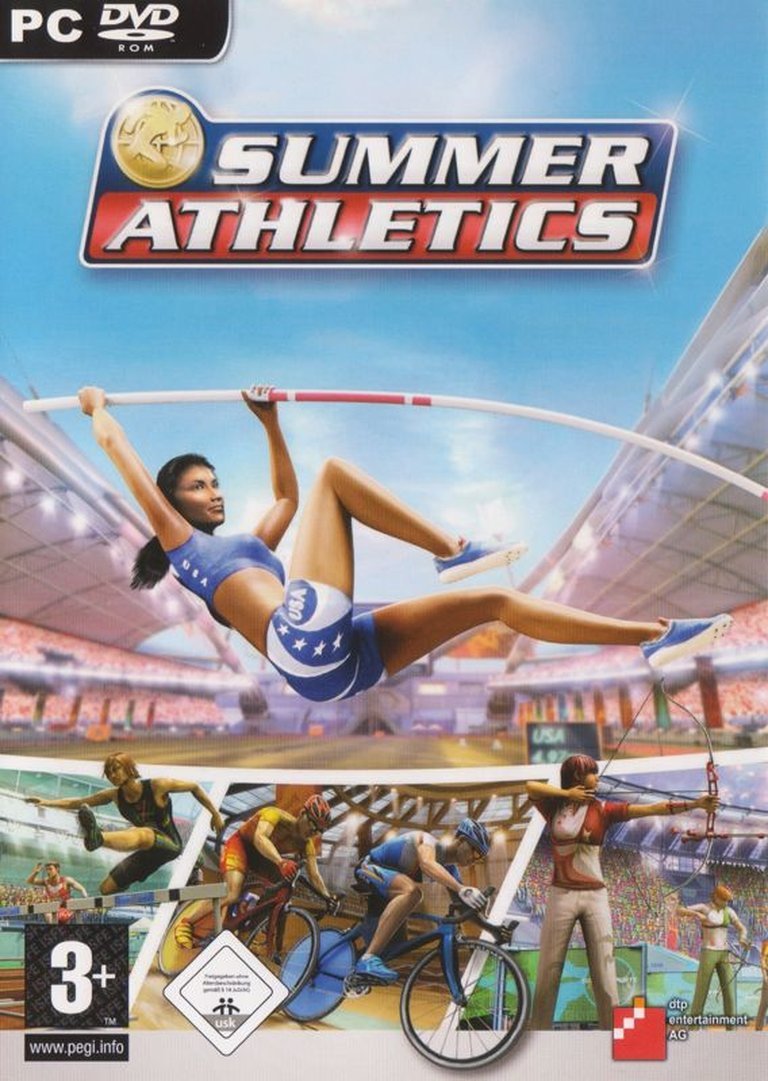
Summer Athletics: The Ultimate Challenge is a sports game that compiles 26 events from the Olympic Summer Games into seven disciplines, including swimming, jumping, throwing, cycling, running, platform diving, and archery. Players use rhythmic motions and quick-time events tailored to their input device, progressing through a career mode with stat upgrades or enjoying an arcade mode with performance-boosting features.
Gameplay Videos
Summer Athletics: The Ultimate Challenge Reviews & Reception
ign.com : Unfortunately, there’s not a whole lot about the game that’s worthy of praise.
Summer Athletics: The Ultimate Challenge Cheats & Codes
Playstation 2
| Code | Effect |
|---|---|
| 903C8C98 0C0F22CE | |
| 903A86D8 0C0F08FB |
Summer Athletics: The Ultimate Challenge: Review – A Budget Olympian’s Bittersweet Medal
Introduction: The Unlicensed Challenger
In the summer of 2008, as the world’s attention turned to Beijing, the video game industry presented two dueling visions of athletic competition. On one side stood Beijing 2008, the glossy, officially licensed spectacle from SEGA, brimming with star power and production value. On the other, emerging from the German studio 49Games and publisher dtp entertainment, was Summer Athletics: The Ultimate Challenge—a scrappy, unlicensed contender that proudly wore its budget origins on its sleeve. Its thesis was audacious: what if an Olympic game prioritized raw, intuitive, multiplayer fun over spectacle and pedigree? For a certain audience, it succeeded brilliantly. For everyone else, it was a frustrating and visually barren misstep. This review argues that Summer Athletics is a fascinating, deeply flawed case study in design trade-offs—a game that correctly identifies the soul of arcade athletics but fails to build a compelling world around it, ultimately securing a silver medal in a competition it never truly aimed to win.
1. Development History & Context: The Quick-Sprint to Market
The Studio and the Vision
Developed by 49Games GmbH, a Hamburg-based studio with a niche in family and sports titles (including the Winter Sports series), Summer Athletics was conceived as a direct, low-cost alternative to the official Olympics games. The developers’ stated goal, as reported in pre-release coverage like IGN’s E3 2008 hands-on, was to create motion controls that “imitated the natural motions of each individual event.” This philosophy prioritized physical mimicry over abstract button-mashing, aiming for a skill-based system where technique trumped raw speed. It was a deliberate throwback to the tactile feel of classics like Track & Field, but updated for the motion-control era.
Technological Constraints and Market Timing
The game’s development was almost certainly rushed to meet the 2008 Beijing Summer Olympics window. This is evident in its disparate visual quality, lack of online multiplayer across all platforms (a major shortcoming in 2008), and a presentation that feels skeletal. The studio had to create a unified control scheme that worked across four platforms with different input paradigms: keyboard/mouse, standard gamepad, and the Wii Remote/Nunchuk. The solution was a core loop of rhythmic button presses or stick rotations combined with contextual quick-time events (QTEs). While this ensured consistency, it also led to a homogenized feel where the thrill of a 100m dash and the precision of archery shared too much mechanical DNA. The game was released in late July/August 2008 for Windows, PlayStation 2, Xbox 360, and Wii, directly competing with Beijing 2008.
The Gaming Landscape of 2008
This was the peak of the Wii’s mainstream popularity and the era of casual party games. It was also a time when the track & field genre was seeing a quiet resurgence, with Konami’s New International Track & Field for DS being a critical darling. Summer Athletics entered a crowded field defined by the official license (Beijing 2008), the Nintendo behemoth (Wii Sports), and a legacy of arcade classics. Its strategy was clear: undercut the competition on price (reportedly ~$25 vs. $50 for Beijing 2008) and boast more intuitive, physical controls. It was a budget-priced, no-license, multiplayer-first pitch.
2. Narrative & Thematic Deep Dive: The Absence of Story
To call the narrative in Summer Athletics “thin” would be an exaggeration; it is virtually non-existent. There is no plot, no characters with agency, and no overarching drama. The “story” is the pure, unadorned pursuit of athletic glory, framed only by the sterile structure of a career ladder.
The “Ultimate Challenge” as Theme
The game’s subtitle, The Ultimate Challenge, is presented with zero irony. The career mode is a literal climb: win events to earn Experience Points (XP), spend XP to increase your athlete’s stats (Speed, Strength, Technique, Stamina), and progress through three tiers—Amateur, Pro, and Summer Athletics—to earn the right to compete in the fictional, namesake games. This creates a meta-game of character progression, but it exists in a thematic vacuum. There are no rival athletes with personalities, no Olympic Village drama, no national pride beyond a generic flag selection. The “challenge” is purely numerical and statistical, a grind against an anonymous AI or a scoreboard.
Contrast with Licensed Rivals
This austerity stands in stark contrast to Beijing 2008, which, for all its gameplay faults, included opening ceremonies, athlete profiles, and national anthems. Even Mario & Sonic at the Olympic Games (2007) infused its events with the vibrant personality of its iconic characters. Summer Athletics offers no such narrative scaffolding. Its world is a collection of bland, generic arenas populated by featureless clones. The theme is not “the Olympic Spirit” but “the Athletic grind.” For a solo player, this makes the career mode feel like a sterile spreadsheet exercise, a point hammered home by multiple critics (Gamezone, PC Games, IGN) who noted the solo experience rapidly loses its luster.
3. Gameplay Mechanics & Systems: Rhythm, QTEs, and the Boost
The core of Summer Athletics is its unified gameplay abstraction. Every event, from swimming to javelin, operates on a similar foundational loop, tailored by input device.
The Core Loop: Rhythm and Reaction
- Rhythmic Maintenance: To keep your athlete moving, you must perform a continuous rhythmic input. On keyboard, this is often alternating two keys (e.g., for swimming, pressing two keys alternately). On a gamepad, it typically involves rotating analog sticks. On the Wii, it involves swinging the remote and/or nunchuk in a consistent pattern. This is the “base” state.
- QTE Action Points: At specific moments, an on-screen prompt (often a button icon) appears. Hitting it at the right moment triggers a special action—a powerful stroke, a release, a jump start. Success depends on timing.
- Stat-Based Modifiers: Your athlete’s trained stats (Speed, Strength, etc.) influence the effectiveness of both the rhythm (how fast you move) and the QTEs (how much power you generate).
This system is not event-specific simulation. You don’t perform a breaststroke; you perform the game’s breaststroke rhythm. You don’t aim an archery shot with analog precision; you stabilize a wobbling bow via a rhythm/QTE hybrid. The philosophy is accessible abstraction.
Arcade vs. Pure (Realistic) Modes
A key differentiator from Beijing 2008 is the Arcade Mode. Here, players can spend limited “boost” points to temporarily enhance performance—increasing speed, strength, or stability. This mode is explicitly designed for multiplayer imbalance and fun, letting less-skilled players compete by burning boosts at critical moments. The default Pure (Realistic) Mode removes these boosts, making stats and player skill paramount. Critics widely agreed that the Pure mode was the superior, more pure experience, but the Arcade mode was essential for chaotic party play.
Career Mode: The Grind
The career mode is a straightforward tournament ladder. After each event, you earn a fixed amount of XP, which you allocate stat-wise. The system is opaque; as IGN’s review meticulously noted, you don’t know the next event until after training, and the stat-to-rating conversion isn’t transparent. This creates a guessing-game meta-layer that feels more like a chore than a strategic choice. The difficulty spike from Amateur to Pro is brutal, often forcing players to replay earlier events purely to farm XP and raise their potential cap before attempting the Pro tier again—a glaring design flaw that highlights the mode’s lack of polish.
The Multiplayer Salvation
Where the game absolutely soars is in local multiplayer (Hot Seat/Split-Screen). Review after review—from Splashgames (80%) to Gamezone (79%) to Eurogamer.de (70%)—singles this out as the game’s raison d’être. The physicality of the controls, the trash-talk potential, and the shared exhaustion of mashing buttons or swinging controllers transform the game. The “forces” (as Gamezone put it) of rivalry and physical exertion “shut the happiness hormones out in liters.” Alone, the AI is too weak (early on) or too cheap (on Pro), the events feel repetitive, and the lack of online play (a universal criticism) isolates the experience. With friends, its simple, repetitive mechanics become a compelling test of endurance and camaraderie. As one reviewer noted, it successfully resurrects the spirit of old-school sports compilations like Decathlon or California Games.
4. World-Building, Art & Sound: The Skeleton in the Closet
This is the game’s most damning failure. While its gameplay attempts a kind of functional abstraction, its presentation fails to build any world at all.
Visuals: Functional and Forgettable
The game uses a simple, cartoonish 3D style that is technically adequate but utterly devoid of personality or atmosphere. Athletes are generic, animations are stiff and repetitive (the same victory pose for every event), and the venues are bland, texturized arenas that look like placeholder assets. Critics repeatedly used words like “hässliche” (ugly – 4Players), “mau” (poor – Looki), “lieblos” (careless – Gamona), and “ho-hum” (Atomic Gamer) to describe the look. There are no iconic landmarks, no dynamic crowds, no sense of place. You could be competing in Anywhere, Generic. The only visual highlights mentioned are minor water effects and reflections—small potatoes compared to the sweeping, licensed spectacles of Beijing 2008.
Sound: A Bare Minimum
The audio design is equally sparse. A generic, forgettable rock/electronic soundtrack loops in the menus. In-game, there’s often no music at all during events, just the sounds of effort and crowd murmur. The commentary is non-existent—a glaring omission for a sports game. As GameStar noted, background music was particularly missed in endurance events. The overall soundscape fails to build tension or excitement, contributing to the “dry” and “atmospheric-free” experience described by multiple outlets (Gamona, PC Games).
The Result: A Presentational Void
The combined effect is a game that feels existentially cheap. It has no identity, no vibe, no “Olympic” feeling whatsoever. It does not make you feel like an Olympian; it makes you feel like you’re operating a simulator. This is the ultimate irony: a game about the pinnacle of human athletic achievement presents itself with all the grandeur of a spreadsheet. For a title with “Ultimate Challenge” in its name, the world it presents is one of ultimate banality.
5. Reception & Legacy: The Divided Verdict
Contemporary Critical Reception (2008)
Summer Athletics received a mixed-to-negative reception, with a MobyGames average of 59% (35 critic reviews) and Metacritic scores ranging from 48% (Wii) to 71% (PC). The split was almost perfectly predictable:
* The Pros (80% – Splashgames, ~70% – many German outlets): Praised the intuitive, physical controls and the exceptional multiplayer fun. They saw it as a nostalgic return to simple, skill-based sports games where “Spielspaß” (gameplay fun) trumped graphics and licenses. The lower price point was frequently cited as a major selling point.
* The Cons (30-55% – IGN, GameSpot, Eurogamer, 4Players): Panned the abysmal presentation, awkward solo career mode, lack of online play, opaque stat system, and inconsistent event quality. They argued that without the Olympic license or visual polish, the game offered nothing to solo players and was a hard sell even as a party game without online. IGN’s 5.2/10 verdict, “Don’t bother going for the gold,” and GameSpot’s 3/10, “captures none of the passion,” became emblematic of the mainstream Western critical view.
The central comparison was always with Beijing 2008. The consensus, even among positive reviews, was that you chose based on priority: Gameplay & Controls = Summer Athletics. Presentation, License, & Content Volume = Beijing 2008. As Gamesmanía.de perfectly summarized, it was a “surprisingly even draw,” with neither game taking the gold.
Evolving Legacy and Influence
Summer Athletics did not spark a revolution. Its legacy is that of a cult favorite for a specific niche and a cautionary tale about prioritization.
1. The “What-If” Case Study: It demonstrated that a license-free sports game could compete on gameplay alone but would be crippled without a compelling package. Every review that praised its controls lamented its lack of online features or better presentation. It’s a classic “two steps forward, one step back” scenario.
2. The Budget Party Game Archetype: It carved a small niche as a cheap, physical, couch multiplayer game. On platforms like Wii, where it served as one of the few non-Wii Sports athletic collections, it found a modest audience. Its model of “fewer events, better controls” influenced later budget sports titles, though few tried to compete directly with the licensed giants.
3. A Fading Footprint: The series continued with Summer Athletics 2009 and Winter Sports 2: The Next Challenge, suggesting a small but sustainable budget brand for dtp/49Games. However, it never achieved the recognition or sales of the official Olympics games or Nintendo’s party staples. Today, it is a footnote—a game remembered primarily by critics and completionists as a competent-but-flawed alternative that was ultimately outclassed by Mario & Sonic at the Olympic Games on the family front and Beijing 2008 on the simulation front.
6. Conclusion: The Silver Medal of Compromise
Summer Athletics: The Ultimate Challenge is a game defined by its compromises and its context. It is not a bad game at its core; its control philosophy—prioritizing rhythmic technique over button-mashing—is genuinely innovative and satisfying, especially with friends. It understands that the magic of Track & Field was in the physical exertion, not the virtual spectacle.
However, it is a profoundly incomplete product. Its barren world, broken career mode, and baffling lack of online play in 2008 are not minor flaws; they are fundamental failures in delivering a “complete” package. It asks players to endure a soulless, repetitive solo grind for the sake of a few hours of local multiplayer bliss. That is a trade-off many are unwilling to make.
Final Verdict: Summer Athletics wins its gold medal in one event: Local Multiplayer Mechanics. But it fails to podium in Presentation, Solo Gameplay, Content Depth, and Technical Polish. It remains a fascinating “what-if”—a glimpse of a parallel timeline where the Olympic license meant nothing and gameplay was king. In our history, it is a competent, budget-priced curiosity, a game best recommended with a caveat: “If you have three friends, a couch, and a deep love for button-mashing, you’ll find a medal here. Otherwise, look elsewhere.”
Historical Placement: It sits at the end of the arcade-sports lineage (tracking back to Hyper Olympic/Track & Field) and the beginning of the motion-control party game boom. It is a bridge that few crossed, a well-intentioned but poorly executed attempt to marry classic design with modern controls without the budget for the modern trimmings. Its Moby Score of 6.2 is generous, earned entirely on the strength of its multiplayer intent, but its 59% critical average is a fair reflection of a game that reached for the gold but stumbled on the final lap.