
- Release Year: 2016
- Platforms: Nintendo Switch, PlayStation 4, Windows, Xbox One
- Publisher: Wired Productions, Ltd.
- Developer: Caged Element Inc.
- Genre: Action, Driving, Racing
- Perspective: First-person, Behind view
- Game Mode: Online PVP, Single-player
- Gameplay: Pick-ups, Racing, Vehicle Customization, Vehicular combat
- Setting: Futuristic, Sci-fi
- Average Score: 75/100
- VR Support: Yes
Description
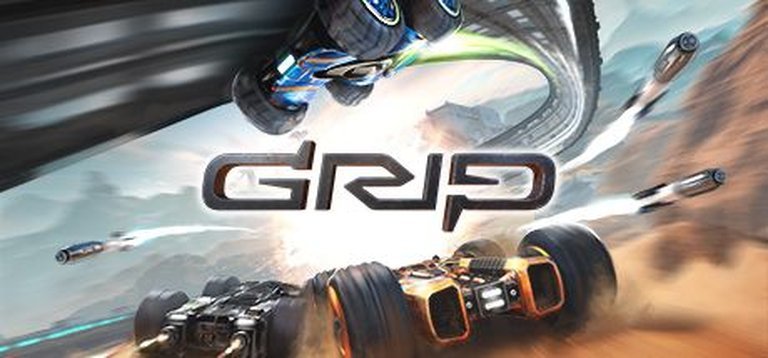
GRIP: Combat Racing is a futuristic racing game that merges high-speed anti-gravity racing with vehicular combat. Set in illegal tournaments across hostile planets and industrial environments, players control weaponized cars capable of driving on walls and ceilings, using pick-ups for offensive and defensive items to outmaneuver opponents in a blend of speed, aggression, and survival.
Gameplay Videos
Where to Buy GRIP: Combat Racing
PC
GRIP: Combat Racing Free Download
GRIP: Combat Racing Mods
GRIP: Combat Racing Guides & Walkthroughs
GRIP: Combat Racing Reviews & Reception
metacritic.com (71/100): Minor issues aside, Grip: Combat Racing is a great experience for both veterans of arcade combat racers as well as those who are willing to learn the genre.
jpswitchmania.com : GRIP is a high-speed, high-intensity, gravity-defying action racer with awesome power-ups and weapons, along with a unique wall/ceiling-crawling mechanic that sets it apart from its combat racing brethren.
opencritic.com (69/100): It’s not likely to set the world on fire and will appeal mostly to the nostalgia of older PC gamers, but does enough to be more than a pretty paint job on top of old ideas.
GRIP: Combat Racing: A Flawed But Furious Homage to a Lost Genre
Introduction
In the mid-2010s, as the racing genre largely splintered into hyper-realistic sims and whimsical kart racers, a void echoed for a specific kind of arcade experience—one defined not by cartoonish caricature but by pure, unadulterated velocity and vehicular mayhem. GRIP: Combat Racing emerged from this void not as a revolution, but as a deliberate, heartfelt resurrection. It is the spiritual successor to the cult-classic Rollcage series of the late 1990s, a game that tasked players with piloting cars that could defy gravity, driving upside-down on ceilings and walls at impossible speeds. Developed by the Canadian studio Caged Element, a team including veterans of the original Rollcage games, GRIP promised to update that iconic formula for a new generation. Its thesis is audacious: to marry the white-knuckle speed of futuristic racers like WipEout with the brutal, weaponized chaos of Twisted Metal. The result is a game of magnificent contradictions—a title that can feel like a lost classic one moment and a frustrating, inconsistent mess the next. It is a game that lives and dies by its physics, its track design, and its commitment to a vision so specific it either captivates utterly or repels completely. This review will argue that GRIP is a flawed gem, a game whose technical and design rough edges prevent it from achieving elite status, yet whose core moment-to-moment gameplay remains one of the most exhilarating and unique experiences in modern arcade racing.
Development History & Context
The genesis of GRIP is inseparable from its predecessor. The project was spearheaded by Chris Mallinson (Game Director) and Robert Baker (Technical Director & Principal Programmer), with Baker having direct experience on the original Rollcage titles at Attention to Detail in the late 90s. Their shared passion for that unique brand of “upside-down” racing was the catalyst. In August 2015, a Kickstarter campaign was launched with a steep goal of CA$657,000. It raised only about US$154,000 before being canceled. However, the campaign served its purpose as a proof-of-concept and a community builder. The team pivoted, announcing an Early Access release on Steam for February 2, 2016. This Early Access period, which lasted until the full 1.0 launch on November 6, 2018, was crucial. As Mallinson stated in a 2018 interview, the “GRIP community has been vital to development,” providing feedback on vehicle balancing and core mechanics through a bustling Discord server. This iterative, community-focused development cycle is a hallmark of many successful indie projects, but it also set an expectation of refinement that would later prove contentious.
Technologically, the game was built in Unreal Engine 4, a significant leap from the proprietary engines of the Rollcage era. This provided modern graphical capabilities and tools but also introduced new complexities, particularly in simulating the game’s signature chaotic physics. The core challenge, as Mallinson noted, was “the physics of the car… the dramatic changes in downforce… and direct contact with the floor itself.” The team aimed for a sense of speed approaching Mach 1 (the in-game cap is 767 mph) while maintaining a tactile, predictable connection between player input and vehicle response—a notoriously difficult balancing act.
The gaming landscape of 2016-2018 was defined by the consolidation of major franchises and the rise of “games as a service.” Against this backdrop, GRIP’s philosophy was refreshingly old-school. It was a complete, standalone product with a clear scope. As Mallinson declared, “no in game gambling with microtransactions and no pay to win.” All future tracks and arenas were promised as free updates, with only cosmetic DLC available for purchase. This stance, while principled, also meant the game had to stand on its initial content alone, which would become a point of critique regarding long-term engagement.
Narrative & Thematic Deep Dive
Unlike many modern racing games that eschew plot entirely, GRIP presents a surprisingly dense, if pulpily delivered, lore. The official wiki and in-game descriptions paint a picture of a dystopian evolution. It begins with “illegal street racing scene… in the early 21st century,” which escalates as “major players with big egos” militarize the sport. The pivotal moment is the hijacking of the scene by a pirate TV network called GRIP. This broadcaster, funded by “gambling income and black-market TV subscriptions,” creates a paradox: the drivers, the true risk-takers, are exploited by a media entity profiting from their violence. A “fierce fighting broke out between the two groups,” resulting in a deal where drivers finally get a cut, but with a vicious twist—the prize pool is split among finishers, incentivizing destruction over racing.
This narrative framework, summarized as “money corrupts, and in GRIP it corrupted absolutely,” provides a grim thematic core. The racing is no longer sport; it is a televised bloodsport where competitors are explicitly armed “to destroy your rivals along the way.” The escalation continues as “the military intervention was just killing it” for the drivers, forcing the entire spectacle off-world to “exotic planets” where they can battle without government interference. The final stage is a galactic phenomenon, with organizers “crashing exotic planets and bulldozing environments to create improvised race tracks.”
In practice, this lore is delivered through brief text prologues to tournament tiers and the game’s aggressive aesthetic. The “campaign” is a “tiered, tournament-based” ladder, but it lacks character, cutscenes, or a protagonist. You are an anonymous driver rising through the ranks of this brutal circuit. The theme of spectacle commodifying violence is potent but underdeveloped. It exists more as a justification for the game’s mechanics than as an explored narrative. The “rivals” you beat are faceless NPCs with names like “K ripper” or “Vandal.” The story serves its purpose: it provides a reason for the madness, rooting the high-speed chaos in a cynical, capitalist dystopia. It’s a missed opportunity—the lore is richer than what most racing games offer, yet it remains entirely peripheral to the player’s experience, a backdrop for action rather than a driver for it.
Gameplay Mechanics & Systems
At its heart, GRIP is a fusion of two sub-genres: anti-gravity racing and vehicular combat. Its defining mechanical innovation is the “double-sided” vehicle physics. Every car can drive on its wheels or its roof with equal facility. If you flip upside-down, you simply keep going. This isn’t a gimmick; it is the foundational principle of track design. Tracks are engineered as three-dimensional labyrinths where ceilings are as valid as floors, and vertical surfaces aretransition zones. The sensation of catching a jump, hitting a wall at the perfect angle, and seamlessly transitioning to the ceiling without losing momentum is the core thrill.
This is complemented by a pick-up system for weapons and power-ups, scattered along the track. There are nine distinct items:
* Offensive: Homing Missiles, Machine Guns, explosive Rockets/Mines, and the unique “Rapier” rail-gun.
* Defensive: Shields, Speed Boosts, and the “Vampire” leech weapon.
* Utility: A “Trick” item that gives points for stunts.
Combat is direct and physical. Hits cause visible damage, and destruction is cinematic. The weapon balance is generally sound—most feel impactful but not overwhelmingly cheap, though some reviews note some items fire with a slight delay that can feel unresponsive at top speed.
The game modes are robust and define the game’s structure:
1. Race Modes:
* Classic Race: Standard lap-based racing with weapons.
* Ultimate Race: A point-based mode where damage dealt scores points, encouraging aggressive play over pure speed.
* Elimination Race: The racer in last place is eliminated every 30 seconds. This creates immense pressure and is a true test of consistency.
* Speed Demon: Weapons disabled. A pure speed trial.
* Time Trial: Solo clock attack.
2. Specialized Modes:
* Arena: On dedicated, enclosed maps, players battle to score the most kills. This is pure, Twisted Metal-style deathmatch.
* Carkour: Obstacle-course runs on specialized tracks, testing mastery of jumps, wall-rides, and precision. These are punishing and rewarding in equal measure.
The progression system is tiered. Completing races and challenges in the campaign earns XP, leveling up your “driver” rank. This unlocks visual customization: paint jobs, decals, tires, and rims for your garage. Crucially, it does not unlock performance upgrades. All 15 vehicles (from 5 manufacturers, 3 classes: Agile, Balanced, Heavy) are available from the start in terms of stats. Customization is purely aesthetic, which maintains competitive balance but can make the progression feel less meaningful than a traditional upgrade tree.
Innovations and Flaws:
* Innovative: The “Reset” button. Instead of a long fall animation when you leave the track, pressing Reset instantly respawns you a short distance back. Reviewers like those at N For Nerds noted its evolution from a convenience to a tactical tool—used to dodge missiles or reposition.
* Flawed Physics & AI: This is the game’s most-criticized aspect. The chaotic physics, while enabling amazing stunts, can also produce “muddy” outcomes. Hitting a small divot at 700 mph can launch you into the abyss, feeling like a punishment for a minor error. More pervasive is the rubber-banding AI. Opponents are almost always impossibly close, and a single mistake can see you bombed from first to last by a homing missile that seems to have perfect lock-on, regardless of your defensive items. As Use a Potion! summarized, “unfair rubber-banding AI… is the main offender.”
* Track Design: Tracks are praised for their inventiveness, multiple paths, and verticality (4Players.de calls them “irrwitzigen Streckenführung”—insane track layouts). However, this complexity can be a liability at speed. As Twinfinite and NintendoWorldReport noted, tracks can be visually confusing, with sudden banked turns and branching paths that are impossible to parse on a first lap, leading to “blind-sided” crashes. The brilliance of the design is also its greatest source of frustration.
* Presentation: The campaign structure is called “dröge” (drab) by PC Games (Germany). It’s a bare-bones ladder with little narrative glue or presentation flair, making it feel like a grind rather than a journey.
World-Building, Art & Sound
GRIP’s presentation is a study in functional, high-impact sci-fi. The setting is a “galactic” circuit across “4 exotic planets” (Liddo 5, Norvos, etc.). The environments are a mix of industrial wastelands, alien cities, and icy tundras, all rendered in a stylized, high-contrast aesthetic. The goal is clarity over photorealism. Tracks are clearly delineated with bright neon barriers, warning lights, and distinct color palettes for each planet. This is essential; at the speeds the game reaches, the player needs to be able to read the track microseconds ahead. The vehicle designs are “armored,” with a brutalist, tank-like quality contrasting with sleek “Airblade” variants. The art direction successfully creates a cohesive, gritty “future junk-yard” vibe.
The sound design is critical. Engine roars are deep and aggressive. Weapon sounds are punchy and satisfying, from the thwump of a missile launch to the metallic crunch of a collision. The soundtrack, however, is a defining feature. A licensed, 24-track electronic compilation spans techno, trance, and drum and bass. It’s not dynamic (it plays on a loop), but its relentless, high-BPM energy perfectly matches the game’s tempo. It’s a love-it-or-hate-it element, but for many, it’s an iconic part of the GRIP experience, creating an “adrenaline-spike” atmosphere.
The frame rate and performance were a major development focus, with targets of 60fps on consoles. This largely succeeded on PS4, Xbox One, and PC. The Nintendo Switch port, however, was a severe misfire. Reviews were universally harsher for that version (4Players.de gave it 37%), citing “low resolution,” “not ruckelfrei” (not smooth/choppy), and “technical weaknesses” that sabotage the speed and precision the game demands. The Switch version stands as a cautionary tale about porting a high-speed, physics-intensive game to less powerful hardware without significant re-engineering.
Reception & Legacy
GRIP’s launch was a critical Rorschach test. Its aggregate scores tell a story of polarization:
* Metacritic: PC (74), PS4 (71), Xbox One (69), Switch (61).
* MobyGames: 6.9/10 from 21 critics.
* Steam User Score: “Very Positive” (87% from 2,210 reviews), indicating a significant gap between critical and player reception.
Critical Consensus: The game is a brilliant, fast, and inventive racer undermined by inconsistent implementation. The highest praise (4Players.de 86%, PlayStation Universe 8.5/10) celebrates its success in capturing the Rollcage spirit and its sheer, unadulterated fun. The criticism (Push Square 6/10, Twinfinite 2/5, GameCentral 5/10) centers on the campaign’s exhaustion, AI “cheating,” track confusion, and a perceived lack of depth beyond the initial thrill. As Push Square succinctly put it, it has a “solid framework, but it still feels like it’s missing something.”
Player Reception: The Steam user base is far more positive. The “Very Positive” badge suggests that for a dedicated segment, the game’s flaws are either tolerated or overcome through mastery. The joy of perfecting a wall-ride, winning a chaotic elimination race, or dominating in an arena match outweighs its irritations. This points to a cult classic in the making—a game not for everyone, but deeply cherished by its audience.
Legacy and Influence: GRIP’s primary legacy is as a faithful custodian of a dead sub-genre. It proved there was still an appetite for the gravity-defying, weaponized racing of the late 90s. It did not spawn a wave of imitators, but it provided a definitive, modern take on the Rollcage formula. Its influence is more spiritual than direct. It stands alongside titles like Redout as a beacon for the “hardcore arcade racer” niche. Its commitment to local split-screen (up to 4 players, a rarity) and its stated opposition to predatory monetization are part of a broader indie ethos that many appreciate.
The game’s lifecycle post-launch included a VR update, numerous free track additions, and a steady stream of cosmetic vehicle DLC packs (Cygon, Nyvoss, Pariah, Terra, Vintek kits). This ongoing support helped sustain its community but didn’t fundamentally alter the core experience. It remains a game defined by its 2018 launch state.
Conclusion
GRIP: Combat Racing is a paradox. It is a game that achieves thrilling, brain-melting moments of perfect synergy between speed, gravity, and combat, moments where it feels like the greatest arcade racer ever made. It is also a game that can—and will—infuriate with physics that feelrandom rather than deterministic, AI that feels punitive rather than challenging, and track designs that are clever but often visually indecipherable at its insane velocities.
Its place in history is secure, but niche. It is not a forgotten masterpiece rediscovered; it is a deliberate, modern reconstruction of a specific feel. It succeeds in its primary mission: to be a spiritual successor to Rollcage. For those who remember that series with fondness, or for gamers who crave a racing experience with zero concessions to realism or casual accessibility, GRIP is essential. Its flaws are not the sins of cynicism or corporate interference, but the inevitable scars of a small studio attempting an audacious technical feat on a limited budget.
The final verdict is one of qualified, passionate endorsement. GRIP is not a perfect game. It is not even a consistently great game. But in its best moments, piloting an “Airblade” vehicle along the curved ceiling of an alien chasm, missiles screaming past your windshield, it achieves a state of pure, kinetic euphoria that few games replicate. It demands patience, forgiveness, and a willingness to learn its idiosyncrasies. For those willing to meet it on those terms, GRIP delivers a white-knuckle ride unlike anything else. It is the furious, flawed, and unforgettable child of a genre many thought had died.