
- Release Year: 2006
- Platforms: Windows
- Publisher: Atari Interactive, Inc., THQ Nordic GmbH
- Genre: Compilation
- Game Mode: LAN, Online PVP, Single-player
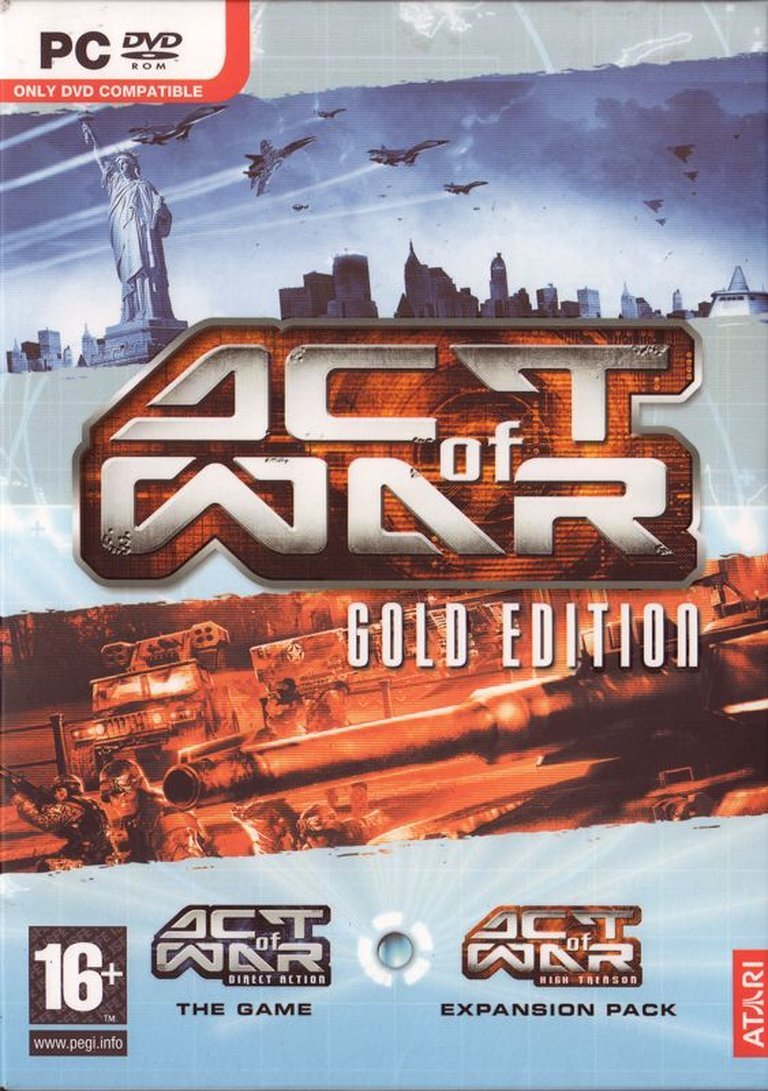
Description
Act of War: Gold Edition is a compilation of the real-time strategy games Act of War: Direct Action and its expansion High Treason, set in a near-future world of global military conflicts. The games immerse players in tactical combat with a story crafted by military thriller author Dale Brown, featuring spectacular battles, atmospheric campaigns, and cinematic presentations through live-action cutscenes and machinima sequences.
Where to Buy Act of War: Gold Edition
PC
Act of War: Gold Edition Mods
Act of War: Gold Edition Reviews & Reception
techraptor.net : So how does Act of War hold up? Very well.
Act of War: Gold Edition Cheats & Codes
Act of War: Gold Edition
Press Enter while playing the game in single player mode.
| Code | Effect |
|---|---|
| fortknox | Additional $1,000 |
| keyholemaster | Full map |
| yeepeekaye | Launch a super weapon (nuclear bomb) at the pointer |
| ineedalltechnos | Unlock entire tech tree and unlimited cash |
| motherrussia | Russian T-80 tank |
| coolihaveanewcar | CIA Armored SUVs |
| swatatyourorders | S.W.A.T. Member |
| greenjelly | British cop |
| blackhawkdown | SA12 Anti-Aircraft Missile Launcher |
| duckhunt | Duck |
| ymca | U.S. Police officer |
| coolimthepresident | President of The United States of America |
| bringoutthedead | British Ambulance |
| bigbrother | Camera Mode. |
Act of War: Gold Edition: Review

Image: European cover art for Act of War: Gold Edition, encapsulating its blend of military realism and thriller aesthetics.
1. Introduction: The Thunder of a Forgotten War
In the mid-2000s, the real-time strategy (RTS) genre was a battlefield of its own, with titans like Command & Conquer, Company of Heroes, and Dawn of War vying for dominance. Into this crowded arena stepped Eugen Systems’ Act of War, a title that sought to marry the pulse-pounding tension of a Tom Clancy or Dale Brown techno-thriller with the strategic depth of classic RTS gameplay. Act of War: Gold Edition, bundling the 2005 base game Direct Action and its 2006 expansion High Treason, represents an ambitious, if flawed, crystallization of that vision. As a compilation, it offers a complete narrative journey across dozens of missions, but it also bears the scars of a rushed expansion and technical limitations that prevented it from achieving greatness. This review dismantles the game piece by piece, arguing that Act of War: Gold Edition is a fascinating historical artifact—a game that captured the zeitgeist of post-9/11 military anxiety with audacious storytelling and innovative mechanics, yet ultimately faltered under the weight of its own ambition and the era’s technical constraints. It stands not as a genre-defining masterpiece, but as a cult classic whose strengths in atmosphere, faction design, and cinematic flair are perpetually at odds with its gameplay inconsistencies.
2. Development History & Context: Forging a Modern War Myth
The Studio and Its Vision
Act of War was developed by Eugen Systems, a French studio with a pedigree in historical and modern wargames, later renowned for the Wargame and Steel Division series. At the helm was designer Alexis Le Dressay, who spearheaded a project that broke from the studio’s earlier, more conventional RTS titles. The defining collaboration was with Dale Brown, a retired U.S. Air Force captain and bestselling author known for hyper-detailed military techno-thrillers. Brown was tasked with crafting the game’s narrative, lending it an aura of authenticity that was rare for the genre. This partnership signaled Eugen’s intent: Act of War was not merely a game but an interactive novel, where strategy served a story.
Technological Constraints and the FMV gamble
The mid-2000s were a transitional period for PC gaming. RTS titles were moving away from full-motion video (FMV) cutscenes toward in-engine cinematics, but Act of War doubled down on live-action film, shooting over an hour of footage in Montreal in 2004. This was an expensive, risky move in an era where digital distribution was nascent and DVD-ROMs were standard. The live-action was complemented by machinima-based pre-rendered cutscenes—a technique where gameplay was recorded and post-processed—which allowed for dynamic camera work but exposed the game’s graphical limitations. The technological constraints were stark: the Gold Edition famously suffers from a 3 GB RAM limit, a relic of 32-bit architecture that would later hinder modern compatibility (a issue mitigated by GOG.com’s re-release). This technical ceiling affected everything from resolution (capped at 1360×1024) to AI pathfinding, creating persistent friction between the game’s cinematic aspirations and its mechanical execution.
The Gaming Landscape of 2005-2006
When Direct Action launched in March 2005, the RTS genre was in flux. Company of Heroes (2006) and Dawn of War (2004) had raised the bar for tactical cover systems and hero units, while Command & Conquer: Generals (2003) popularized a more action-oriented, faction-diverse approach. Act of War entered this landscape with a promise of “ultra-realistic” combat—a term that meant destructible environments, wounded soldiers susceptible to capture, and a hard avoidance of “all-around-effective” units. It was a deliberate counterpoint to the sometimes arcadey feel of its peers, aiming for a grounded, military-simulation vibe. However, this realism came at the cost of accessibility, and the game struggled to carve out a niche between the hardcore wargamers and the broader RTS audience.
3. Narrative & Thematic Deep Dive: A Techno-Thriller in Real-Time
Plot Structure and Pacing
The narrative of Act of War is a sprawling, globe-trotting conspiracy that unfolds across two campaigns. Direct Action begins with a terrorist bombing of an oil facility in Houston, escalating to attacks on the World Energy Forum in London and a massive assault on San Francisco. This sets up the central mystery: a shadowy group, the Consortium, is manipulating events to create an oil monopoly. High Treason expands the scope, featuring political assassinations, naval battles, and a climax in Washington D.C. with a space-based superweapon. The pacing is relentless, reminiscent of a summer blockbuster, with each mission serving as a set-piece that introduces new units and terrain while advancing the plot. The use of live-action FMVs between missions provides exposition and character moments, creating a episodic structure that feels more like a TV series than a traditional RTS campaign.
Characters and Dialogue
The protagonist, Major Jason Richter of Task Force Talon, is a classic military hero: disciplined, rebellious when necessary, and driven by a sense of duty. His arc involves defying presidential orders to pursue the Consortium, positioning him as a rogue agent within the system. The antagonist, Yegor Zakharov, is a charismatic oligarch with a private army—a villain straight from Dale Brown’s playbook, embodying the fear of corporate-state collusion. Supporting characters like Arthur Kingman (CEO of TransGlobal Energy) and various military officers are sketched with broad strokes, their dialogue often veering into campy B-movie territory (“Fighting in a city is like fighting in a kitchen—everything is a weapon!”). Yet, this cheesiness is part of the charm, evoking the earnest, over-the-top tone of 1980s action films. The voice acting, while serviceable, lacks the gravitas of later titles, but the narrative’s sincerity keeps it engaging.
Themes: Oil, Power, and Paranoia
At its core, Act of War is a polemic on resource scarcity and geopolitical instability. The inciting incident—gasoline prices hitting $7 per gallon—grounds the story in near-future plausibility, reflecting mid-2000s anxieties about peak oil and Middle East dependence. The Consortium represents the ultimate expression of neoliberal conspiracy: oil companies using terrorism as a tool to monopolize the market. This ties into broader themes of military-industrial complex critique and the erosion of national sovereignty. Task Force Talon, as a black-ops unit, operates in the gray area between legal and extralegal, questioning the ethics of pre-emptive war. The game doesn’t delve deeply into these themes—it’s too busy with explosions—but the framework is there, giving the campaign a coherence missing from many RTS stories that merely string skirmishes together.
Narrative Integration with Gameplay
Where Act of War shines is in how its plot dictates faction availability and mission design. Early missions have Richter using only Task Force Talon units, emphasizing stealth and precision, which aligns with the story’s covert ops vibe. Later, the full might of the U.S. Army is unleashed for all-out warfare, mirroring the shift from police action to total war. The Consortium’s dual nature—undercover mercenaries versus high-tech reveal—is not just a gameplay mechanic but a narrative device, slowly unveiling the true scale of the threat. This synergy between story and systems is rare for its time and elevates the campaign beyond a mere tutorial.
4. Gameplay Mechanics & Systems: Precision and Chaos
Core Gameplay Loops
Act of War operates on a conventional RTS foundation: gather resources (primarily money generated by capturing buildings), build bases, produce units, and engage in combat. However, it subverts several genre norms. Resource management is streamlined—there’s no traditional resource gathering; instead, income comes from controlling key structures, encouraging aggressive map control. This shifts focus from economic macro to tactical micro, suiting the campaign’s mission-based design where scenarios often have preset constraints.
Combat Systems and Unit Design
The combat is where the game’s “realistic” philosophy manifests:
– Wounded Soldiers and POWs: Units that are critically injured are incapacitated, bleeding out unless healed by medics or captured by enemy infantry. Capturing POWs grants immediate cash and, if held in a prison, recurring income. This adds a humanitarian layer—reckless infantry charges can financially benefit the enemy—and demands careful unit preservation.
– Destructible Environments: Buildings can be damaged or destroyed, and barricades can be erected by engineer units. Urban combat becomes a brutal, room-by-room affair where holding structures is key to both defense and economy. This wasn’t just cosmetic; it fundamentally changed how players approached city maps, making them dynamic puzzle boxes.
– Faction Specialization: The three playable factions—U.S. Military, Task Force Talon, and Consortium—are built around asymmetrical balance rather than rock-paper-scissors homogeneity.
– U.S. Military: A conventional force with units like Marines, M1 Abrams tanks, and AH-64 Apaches. Its unique mechanic is the DEFCON system: to access advanced units and upgrades, players must spend money to raise alert levels from DEFCON 3 to 1, representing a slow escalation of force. This creates a deliberate pacing but can feel restrictive in fast-paced matches.
– Task Force Talon: Elite, tech-heavy units such as the Global Hawk drone (reconfigurable for recon or anti-tank), S.H.I.E.L.D. exosuit infantry, and the modular Spinner Tank. They are versatile but prohibitively expensive, requiring precise micromanagement. As TechRaptor notes, the AI struggles with these units, and losing them early is often catastrophic.
– Consortium: Operates in two modes: Undercover (using cheap, customizable infantry like AK-74-wielding mercenaries and scavenged vehicles) and Revealed (unlocking high-tech units like the YF-23 stealth aircraft and Akula cloaked tank with railguns). This duality forces players to adapt strategies based on alert status, though in campaigns, the reveal is scripted.
– Air Power: Instead of direct dogfights, aircraft are launched via command menu to target areas, automatically deploying payloads en route. This abstracts air combat, reducing micromanagement but introducing risks from enemy anti-air along flight paths.
User Interface and Innovations
The UI is functional but cluttered, with a bottom-heavy HUD that can obscure action. In High Treason, quality-of-life improvements like area-based healing/repairs (select a zone, and nearby support units respond) were welcome. The addition of naval combat in High Treason—with aircraft carriers, submarines, and missile boats—expanded the battlefield to coastal maps, though ship pathfinding was notoriously poor, sometimes leaving vessels unresponsive. Mercenaries, purchasable from outposts, added another economic layer but came with upkeep costs that strained mid-game budgets.
Flaws and Frustrations
- Pathfinding: Vehicles, especially in urban environments, often behaved erratically—circling or getting stuck on obstacles—a problem TechRaptor compared to the infamous AT-AT walkers in Star Wars: Force Commander. This could lead to costly delays during artillery barrages.
- Difficulty Spikes: High Treason is infamous for its brutal missions, even on standard difficulty. The AI would flood the map with units, leading to grinding wars of attrition. Stealth missions—where a single unit must infiltrate—clashed horribly with the RTS controls, feeling slapdash and unfair.
- Audio Bugs: A critical issue in High Treason involved audio cutting out during naval battles, forcing restarts—a game-breaking flaw that suggested rushed QA.
- AI Limitations: The AI’s poor handling of Task Force Talon’s advanced units and its tendency to turtle or rush mindlessly reduced multiplayer depth.
5. World-Building, Art & Sound: The Spectacle of Near-Future War
Setting and Atmosphere
Act of War envisions a fractured 2010s where oil scarcity has crippled the global economy. The campaign hops from the anti-globalization protests of London to the tech-hub siege of San Francisco, from Egyptian refineries to the snowbound streets of Moscow, culminating in a White House occupation. This globe-trotting scope, rare for RTS campaigns of the era, reinforces the theme of interconnected threats. The atmosphere is one of constant crisis, aided by the live-action FMVs that portray politicians, soldiers, and conspirators in a grainy, documentary-like style, blurring the line between game and news footage.
Visual Direction
In-game graphics, while dated today, were impressive for 2005. Units are detailed, with authentic design based on real-world and speculative military hardware (e.g., the fictional Spinner Tank resembles a modernized M1 with modular turrets). Explosions are volumetric and satisfying, and the destructible buildings—with crumbling walls and fires—add visceral impact. The machinima cutscenes, though limited by engine capabilities, allowed for cinematic camera sweeps that enhanced storytelling. However, the fixed resolution cap and lack of widescreen support (without mods) mar the modern experience. High Treason introduced shader effects that improved lighting and textures, a visual upgrade that helped the compilation feel less archaic.
Sound Design and Music
The soundtrack, composed by Marc Canham and Jonathan Williams and performed by the Nimrod Studio Orchestra, is a standout. It mixes tense, ambient tracks for stealth missions with bombastic, driving themes for large-scale battles, evoking the scores of Michael Bay or Tony Scott. The sound design is immersive: the rumble of tank tracks, the whine of drone engines, and the crack of sniper fire are all distinct. A clever touch, highlighted by TechRaptor, is the audio “fog of war”—the sound of trees and cars being run over hints at enemy movements, creating genuine tension. Unfortunately, High Treason‘s audio bugs undermine this, with sound cutting out during naval engagements, breaking immersion entirely.
Synthesis: How Elements Create Experience
The marriage of live-action FMVs, orchestral score, and realistic unit design creates a cohesive military thriller aesthetic. Players aren’t just commanding abstract units; they’re directing a narrative where every mission has cinematic stakes. The destructible environments and POW mechanics reinforce the brutality and moral ambiguity of modern warfare. Yet, technical hiccups—pathfinding, audio bugs—often puncture this immersion, reminding players of the game’s underlying simulation limitations. It’s a game that wants to be a movie but is constrained by its medium.
6. Reception & Legacy: A Blaze of Glorious Failure
Critical Reception at Launch
Act of War: Direct Action debuted to generally favorable reviews, scoring 82/100 on Metacritic. It was praised for its ambitious narrative, intense combat, and fidelity to military realism. PC Games (Germany) awarded it 84%, noting that new features in the Gold Edition would interest multiplayer strategists. GameStar (Germany) gave it 80%, comparing it to a Hollywood blockbuster: spectacular and fast-paced but lacking depth, recommending it for players seeking “spectacular battles and atmospheric campaigns” over tactical complexity. It was a runner-up for Computer Games Magazine‘s top 10 of 2005, a testament to its impact despite niche appeal. However, the expansion High Treason received more mixed reactions, with critics citing overwhelming difficulty and technical issues.
Commercial Performance and Evolution of Reputation
Commercially, Act of War underperformed. As TechRaptor notes, it was “not a big commercial success at the time,” likely due to its competition and the steep learning curve. The 3 GB RAM limit became a death knell as operating systems advanced, rendering the game obsolete on newer PCs until digital re-releases. GOG.com’s Gold Edition (priced at $9.99) revitalized it by modernizing compatibility, introducing a new generation to its charms. Today, its reputation is polarized: nostalgic fans remember it fondly for its campaigns and soundtrack, while others see it as a flawed curio. On MobyGames, it holds an 82% critic score and a 4.2/5 player rating from just four votes—indicating a small but dedicated following.
Influence on the Industry and Eugen Systems
Act of War did not spawn imitators in the way Dawn of War popularized hero units or Company of Heroes revolutionized cover systems. Its primary innovations—POW mechanics, DEFCON escalation, faction duality—were too niche to become genre standards. However, it laid groundwork for Eugen Systems’ later successes. The studio refined its RTS formulas with the Wargame series (2012-2016), which adopted similar unit customization and Cold War realism, and Steel Division (2017), which expanded on destructible terrain and combined arms. The spiritual successor Act of Aggression (2015) directly revisited Act of War‘s concepts with improved mechanics, proving the core ideas had merit. In the broader industry, Act of War serves as a cautionary tale about ambition versus polish—a game that prioritized cinematic storytelling over iterative gameplay refinement.
Cult Status and Preservation
As a historical artifact, Act of War: Gold Edition is a time capsule of mid-2000s military gaming culture. Its collaboration with a bestselling author, use of FMVs, and focus on near-future speculation reflect an era when RTS games aspired to be more than just multiplayer skirmish engines. Its preservation through GOG.com ensures it remains accessible, allowing historians to study its blend of narrative and strategy. It may not be “essential” gaming, but for scholars of the RTS genre, it represents a bold, if imperfect, experiment in interactive thriller design.
7. Conclusion: The Final Verdict
Act of War: Gold Edition is a paradox: a game that soars in ambition but stumbles in execution. Its strengths are undeniable: the Dale Brown-scripted narrative is engaging and thematically rich; the faction designs are cleverly asymmetrical, encouraging diverse strategies; the urban combat and POW mechanics add layers of tactical depth rarely seen in RTS campaigns; and the sound design, from the orchestral score to the atmospheric audio cues, remains top-tier. These elements combine to create a campaign experience that feels more like a guided military thriller than a series of disconnected missions.
Yet, its flaws are crippling. Pathfinding issues plague unit movement, especially in tight cityscapes; High Treason‘s difficulty spikes and stealth segments feel punitive rather than challenging; audio bugs and AI limitations mar multiplayer and later missions. The technical constraints of its era—the RAM cap, resolution lock—are now mitigated but were damning at the time. Compared to contemporaries like Company of Heroes or Dawn of War, it lacks the polish and balance to compete in multiplayer, and its single-player, while lengthy, is uneven.
In the grand tapestry of video game history, Act of War: Gold Edition occupies a fascinating middle ground. It is not a forgotten gem waiting for rediscovery, nor a deservedly obscure failure. Instead, it is a cult classic—a game that resonates with a specific audience: military history buffs, fans of techno-thrillers, and RTS enthusiasts willing to overlook jank for the sake of atmosphere. Its legacy is twofold: as a stepping stone for Eugen Systems’ later mastery of the genre, and as a testament to the era’s audacious, FMV-fueled storytelling dreams. For $9.99 on GOG.com, it’s a worthwhile pilgrimage for the curious, but its place in the RTS pantheon is firmly as an ambitious, flawed, and unforgettable footnote.
Final Score: 7/10 – A compelling but uneven campaign saved by its narrative vigor and faction creativity, held back by persistent technical issues and an unbalanced expansion.