
Description
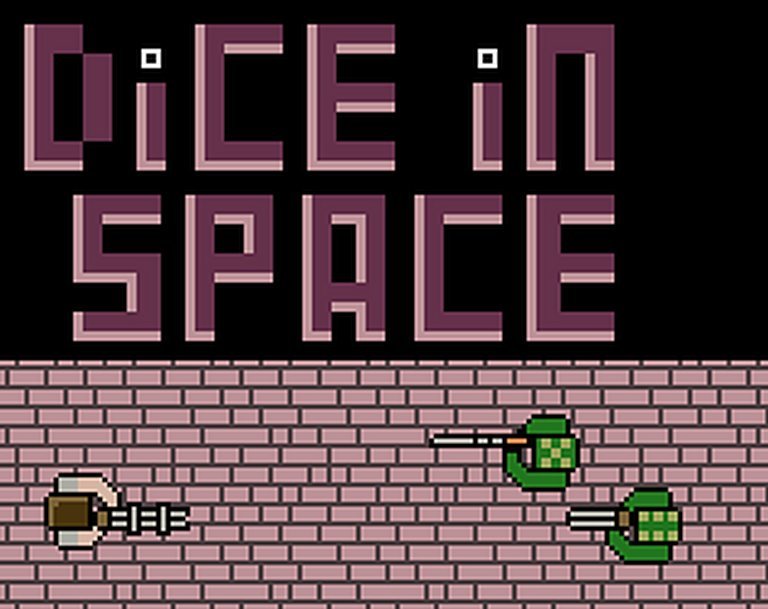
Dice in Space is a top-down 2D scrolling shooter set in the vastness of space, where players engage in fast-paced combat against waves of enemies. The unique gameplay mechanic centers on rolling dice to dynamically swap weapons whenever ammo is depleted, with new dice collected every two waves to strategically enhance survival chances in this free-to-play arcade-style experience.
Dice in Space: A Microscopic Masterpiece in the vast Cosmos of Gaming
Introduction: A Whisper in the Void
In the sprawling, multi-billion-dollar cosmos of the video game industry, where galaxies of marketing budgets and star-studded development teams dominate the headlines, there exist quiet, unassuming nebulae of creation. These are the game jam projects—tiny, intense bursts of creativity that condense the essence of design into a single, potent mechanic. Dice in Space, a submission to the 2022 GMTK Game Jam, is precisely such a celestial body: a minute, freeware top-down shooter whose entire conceptual universe orbits around a single, brilliant, and profoundly simple idea. It is not a game that will be found on any “Game of the Year” shortlist, nor will it generate memes or spawn a franchise. Its legacy is not one of commercial or critical monument, but of pure, unadulterated game design clarity. This review posits that Dice in Space‘s value lies not in its scope, but in its role as a perfect, portable case study in how a constrained mechanic can generate a complete and satisfying gameplay loop, serving as a vital pedagogical tool and a refreshing antidote to the bloated scope that often plagues modern development.
Development History & Context: Born from Constraint
To understand Dice in Space, one must first understand the crucible from which it emerged: the Global Game Jam. The GMTK Game Jam, hosted by popular YouTuber Mark Brown, is a 48-hour event with a unique constraint—a theme announced at the start, which in 2022 was “Roll.” Within this tightly bounded timeframe, developers must conceptualize, prototype, and polish a playable game.
Dice in Space was created by a duo known as Jugan0 (programmer Justin Dugan) and Phonetyx (artist and composer N. Evans). Their credits on MobyGames reveal a team deeply embedded in the indie and collaborative scene, with Evans also contributing to the critically acclaimed Gibbous: A Cthulhu Adventure. Their prior experience informed a jam entry that, while simple, demonstrated a level of audio-visual polish uncommon in such a short timeframe. The technological constraint was the Unity engine, the ubiquitous tool of indie development, chosen for its rapid prototyping capabilities. The business model was, and remains, pure public domain/freeware—a direct upload to itch.io with no monetization, embodying the jam spirit of sharing creation freely.
The gaming landscape of mid-2022 was dominated by the release behemoths of Elden Ring and God of War Ragnarök, titles that would soon sweep the 26th D.I.C.E. Awards. In this context, Dice in Space is a deliberate counterpoint. While the industry celebrated multi-million-dollar productions with hundreds of credits, this game was forged by two people in two days. Its existence is a reminder that the fundamental joy of game design—finding a fun interaction and building a system around it—remains accessible and pure, untainted by the pressures of live-service models, DLC roadmaps, or shareholder expectations. It is a snapshot of indie development at its most essential.
Narrative & Thematic Deep Dive: The Story is the Mechanic
Dice in Space does not have a narrative in any traditional sense. There is no text, no dialogue, no cutscenes, and no explicit lore. The “year 2023” and the goal of reaching “New Earth” mentioned on the alternate “EnteleKey” itch.io page appear to be vestigial concepts from an earlier design iteration or a different project entirely, a common occurrence in jam evolution. The official description from its release page is ruthlessly functional: “Roll die to swap your weapon out for a new one once it runs out of ammo. Collect new dice every 2 waves, and try to last as long as you can!”
The theme, therefore, is not story-driven but systemic. The narrative is written not in words, but in the relentless, ascending cadence of waves and the desperate, strategic act of the dice roll. The player’s ship is the last human vessel (implied by “you are alone in space”), and “space ghosts” are the adversaries—a generic yet effective sci-fi antagonist. The “superior being” granting traits is the game’s core rule: the dice. The theme is pure existential survival against an uncountable, ever-growing horde, where your only ally is the merciless randomness of probability.
The genius is in the thematic resonance of the mechanic itself. In a universe governed by dice rolls, fate is literal and tangible. Every two waves, you are offered a new tool from a fractured pantheon of possibilities. Will you get a short-range powerhouse like the Chainsaw, or the wall-penetrating Phase Rifle? The tension between the known (your current weapon’s ammo count) and the unknown (the next roll’s outcome) is the game’s drama. The “dreadful space ghosts” are not just enemies; they are the inevitable consequence of entropy, the system demanding your resources be perpetually renewed through chance. You are not a hero with a story; you are a statistician in a death spiral, and the narrative is your final, glorious score.
Gameplay Mechanics & Systems: The Elegance of the Loop
The core gameplay loop of Dice in Space is a masterclass in minimalist design, consisting of three interlocking phases that create a perfect tension-release cycle:
-
The Grind (Combat): You control a small spaceship in a top-down, 2D scrolling arena (the view scrolls to follow the player). Using WASD for movement and the mouse to aim and shoot (or hold to fire), you must destroy incoming “space ghosts.” These enemies have simple, predictable paths but increase in number and speed with each wave. Your current weapon has a finite ammo count, visualized on the UI. Weapons like the Power Rifle and Deagle offer multi-target capabilities, the Chainsaw requires risky close contact, the Phase Rifle ignores obstacles, and the Telestomp is a high-risk, high-reward teleport-kill. This phase is pure, satisfying action. The sound design, cobbled together from 20+ Freesound contributors, provides crucial audio feedback—the chug of the chainsaw, the pew of the rifle—that elevates the simple sprites into a tactile experience.
-
The Crisis (Ammunition Depletion): The loop’s timer is your ammo counter. As it dwindles, the sound of your weapon changes or ceases, and the player’s options rapidly shrink. Enemies continue to swarm. This creates a rising panic, a clear “oh no” moment where the comfortable rhythm of shooting is broken. The game forces you to transition from a state of offense to one of pure survival and positioning.
-
The Pivot (Dice Roll): Upon emptying your weapon, pressing Space triggers the core mechanic: a dice roll animation plays, accompanied by a specific sound effect (from contributor
andresix). This roll determines your new weapon for the next phase. The moment is fraught with meaning. A bad roll (e.g., getting another ammo-hungry weapon when surrounded) can be fatal. A good roll (getting a Telestomp to clear a cluster) is a tremendous relief and a new lease on life. Crucially, you collect a new die (and thus a new weapon option) every two waves, even if you haven’t emptied your current one. This introduces a profound strategic layer: Do I spend my precious ammo to force a roll now for a potentially better weapon, or do I conserve ammo to survive the next wave and get a guaranteed new option in two waves? This meta-decision transforms the game from a straightforward shooter into a resource-management puzzle about probability and timing.
Innovation & Flaws: The innovation is the seamless integration of a traditional RPG “loot drop” (the new weapon) with a literal, thematic representation of RNG (the dice roll). It makes the abstract concept of random number generation viscerally part of the player’s agency. The flaw is inherent to its jam nature: balance is rudimentary. Some weapons (Phase Rifle) are almost universally superior to others (Deagle), and the randomness can lead to unwinnable situations not due to player error, but sheer bad luck. There is no progression system beyond your skill at surviving longer. Yet, in a design exercise, this is not a flaw but a feature—the pure, unadulterated test of skill within a random system.
World-Building, Art & Sound: Atmosphere Through Abstraction
The setting is “space,” rendered in a minimalist 2D style. N. Evans’s pixel art is clean and functional. Your ship is a distinct shape, enemies are simple, vaguely spectral forms, and bullets are clear projectiles. The scrolling background features faint stars and perhaps a planet, but there is no elaborate parallax or detailed sprite work. This abstraction is powerful. The emptiness of the visual palette enhances the theme of isolation. You are truly alone against the void, represented by simple, repeating enemies.
The atmosphere is built almost entirely through sound. N. Evans’s music is a simple, pulsing, tense electronic track that loops, increasing in perceived urgency as the waves progress. The real star, however, is the cacophony of weapon sound effects. The judicious selection and layering of sounds from the vast Freesound library create a unparalleled auditory feedback loop. The crunch of the Chainsaw, the electrical hum of the Phase Rifle, the deep thump of the Telestomp—each weapon has a distinct sonic identity that makes choosing between them in the dice-roll moment a sensory decision as much as a tactical one. The sound of the dice themselves—a rattle and a definitive tap—is the most important sound in the game, the punctuation mark on every major decision. It is a masterclass in using externally sourced, low-cost assets to build a cohesive and immersive aural world.
Reception & Legacy: The Fame of the Obscure
By any commercial or mainstream critical metric, Dice in Space does not exist. It has no MobyScore (listed as “n/a”), only one known collector on MobyGames, and zero critic or user reviews on that platform or elsewhere. It will never be mentioned in the same breath as the winners of the 26th D.I.C.E. Awards—the polished, team-driven giants like Elden Ring or God of War Ragnarök. Its “reception” is a quiet hum among the niche community of GMTK Game Jam participants and viewers who seek out clever, concise design.
Its legacy, therefore, is one of influence through demonstration. It is a frequently cited example in discussions about “mechanic-first” design, game jam successes, and inventive uses of RNG. It proves that a compelling game can be built around a single, five-second interaction (the dice roll) by building a robust, escalating challenge system around it. It stands in fascinating contrast to the D.I.C.E. Awards’ category for “Outstanding Achievement in Game Design,” which in 2022 went to Elden Ring—a game of breathtaking, systemic complexity. Dice in Space achieves a different kind of design brilliance: compressive elegance. Where Elden Ring expands a player’s agency across a vast world, Dice in Space focuses it onto a single, critical moment, repeated under pressure.
Its influence is likely abstract and educational. It serves as a “hello world” for a specific design philosophy: take a random element, give the player control over when to engage with it, and build a steadily escalating pressure system that makes that engagement crucial. It can be studied in game design courses as a perfect “loop” diagram. Its legacy is secure not in canon, but in the toolkit of designers who understand that depth does not require breadth.
Conclusion: A Perfect, Powdery Gem
Dice in Space is not a “great” game in the way that the monumental titles celebrated at the D.I.C.E. Awards are great. It offers no profound narrative, no technical marvel, no artistic masterpiece. Its greatness is of a different, more academic order. It is a flawless execution of a constrained design prompt. In 48 hours, Justin Dugan and N. Evans created a game whose entire design document could fit on a index card, and which plays exactly as that document promises, delivering a tight, tense, and intellectually engaging experience every time.
It is a testament to the enduring power of the game jam ethos: that the purest form of game design is the discovery of fun. It finds that fun in the primal tension of a loaded die, in the relief of a perfect roll, and in the brutal math of survival. In an industry increasingly obsessed with scale, Dice in Space is a vital reminder that the cosmos of play can be explored just as meaningfully in a single, perfectly rendered system as it can in a universe of content. It is, in the end, a tiny, brilliant star—not because it outshines others, but because it burns with such focused, undeniable design energy. For any student or appreciator of game mechanics, it is an essential, and freely available, artifact.