
- Release Year: 2003
- Platforms: Windows
- Developer: Wojciech Olejniczak
- Genre: Action
- Perspective: Top-down
- Game Mode: Co-op, Single-player
- Gameplay: Shooter
- Average Score: 80/100
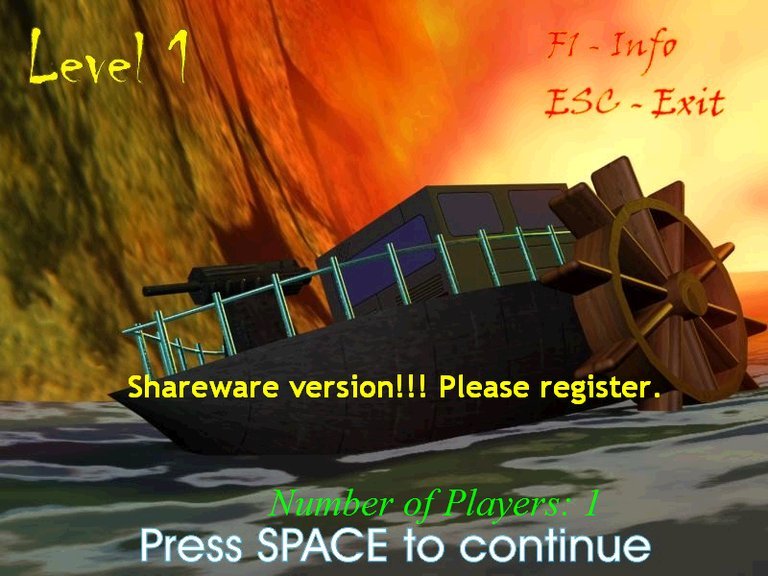
Description
River Raid eXtreme is a shoot ’em up game that modernizes the classic 1982 title, placing players in control of a fighter jet soaring along the River of No Return in a top-down, 2D scrolling perspective. The mission involves blasting enemy helicopters, planes, and tanks while collecting fuel depots to avoid running out of petrol, all in a high-risk raid behind enemy lines where a single collision with obstacles or river boundaries results in immediate loss of life.
River Raid eXtreme Reviews & Reception
digitpress.com (80/100): I could sit for hours and play, growing ever-frustrated by the monotony, but unable to drop the controller.
River Raid eXtreme: A Forgoken Stream in the River of Time
Introduction: The Canon and the Canonized
In the vast, crowded museum of video game history, certain titles are enshrined as foundational pillars. Activision’s 1982 River Raid, designed by the legendary Carol Shaw, stands as one such pillar—a game frequently cited as pioneering the vertically scrolling shoot-’em-up genre on home consoles, a masterpiece of constraint-driven design, and a commercial juggernaut that sold nearly a million copies on the Atari 2600. It is a game whose DNA can be traced through decades of succeeding shooters. Against this towering legacy, the 2003 Windows title River Raid eXtreme exists as a profound paradox: a faithful, yet almost completely anonymous, digital artifact. It is not a sequel, not a reboot, but a deliberate, homespun homage—a love letter typed on a keyboard by an unknown developer and released into the indifferent ether of early-2000s shareware. This review will dissect River Raid eXtreme not as a standalone classic, but as a fascinating case study in fan preservation, the democratization of game development tools, and the quiet, often unheralded, labor of keeping the flame of classic gaming alive outside the spotlight of commercial or critical acclaim.
Development History & Context: The Lone Developer and the GameMaker revolution
The story of River Raid eXtreme begins not with a corporate directive, but with a single individual. The MobyGames credits list only one person: Wojciech Olejniczak (F4jny). This is the very definition of a solo indie project, a stark contrast to the original’s development at Activision, where Carol Shaw benefited from a supportive (if male-dominated) ecosystem of peers like David Crane and Steve Cartwright. Olejniczak’s vision was simple: to recreate the essence of Shaw’s classic for a modern PC audience using the accessible GameMaker engine. GameMaker, first released in 1999, was the perfect tool for this endeavor—it allowed a single developer to create 2D games with relative ease, bypassing the need for complex, low-level programming that Shaw navigated on the Atari 2600’s 4KB of ROM.
The technological context of 2003 is crucial. The year saw the dominance of 3D graphics (the PlayStation 2, GameCube, and Xbox were in their prime), Google’s founding, and the rise of broadband. In this landscape, a deliberately retro, 2D scrolling shooter was a counter-cultural act. It wasn’t aiming to compete with Halo or Call of Duty; it was aiming for a niche audience of retro enthusiasts and casual PC gamers who remembered the joys of simple, addictive gameplay. The shareware business model—distributing the game for free with a request for payment—speaks to an era before Steam’s dominance, where distribution was decentralized and success was measured in community goodwill rather than sales charts. River Raid eXtreme was not developed to capitalize on a brand (the “River Raid” name had been dormant for 15 years), but likely to fulfill a personal passion project and share it with a small, interested community.
Narrative & Thematic Deep Dive: The Mission Persists, The Context Vanishes
The original River Raid was notable for its flimsy but effective narrative framing, delivered via a mock-serious “Pilot’s Manual” that painted the player as a commando on a “River of No Return” mission to destroy enemy infrastructure (tankers, fuel depots, bridges) in a conflict between “Irata” and “Cigami”—a transparent, playful anagram of “Atari” and the game’s developer. This narrative provided just enough context to make the shooting meaningful.
River Raid eXtreme retains zero narrative. There is no manual, no fictional backstory, no grand geopolitical conflict. The player is simply an airplane. The enemies are simply “enemy troops, such as helicopters, planes and tanks.” The river is just a river. This tells us more about the game’s purpose than any lore ever could. Olejniczak’s goal was not to reinterpret or expand Shaw’s world, but to mechanically replicate it. The “extreme” in the title is not a narrative promise of a grittier plot, but a dated-2000s adjective implying “more action” or “enhanced,” though the description provides no such enhancements. The theme is pure mechanics: the tension between aggression (shooting everything) and conservation (managing fuel), the eternal dance of risk and reward on a scrolling grid. The contemplative, almost meditative focus on the river’s endless, procedurally-identical (in the original) flow is the only “theme” that persists. The modern context of military Shoot-’em-ups like Raiden or even later Call of Duty is entirely absent; this is an abstraction, a return to the arcade root where “the enemy” is a faceless pattern of pixels to be cleared for points.
Gameplay Mechanics & Systems: A Faithful, Yet Static, Replica
Here, River Raid eXtreme reveals its core identity: a loving, unmodified port of the Atari 2600 version’s ruleset. The description is a perfect checklist of the original’s mechanics:
* Core Loop: Fly a jet down an endless, vertically scrolling river canyon.
* Movement: Left/right horizontal movement, accelerate/decelerate (up/down on keyboard).
* Combat: Single-shot firing. All enemies (helicopters, planes, tanks, boats) die in one hit.
* Primary Constraints:
1. Collision: Bumping into any enemy, river bank, or island means instant loss of one life.
2. Fuel: A constantly depleting meter. Refuel by flying over fuel depots (pink/red-and-white striped). Crucially, shooting a fuel depot destroys it, a critical strategic choice the player must make instantly.
* Checkpoints: Destroying a bridge awards 500 points and establishes a respawn point. Dying restarts the player at the last destroyed bridge.
* Progression: The river narrows over time, increasing maneuver difficulty. Fuel depots become sparser.
* Multiplayer: Supports 1-2 players in same-screen or split-screen? The spec lists “Same/Split-Screen” and “1-2 Players,” but the simple top-down nature suggests a more likely “take-turns” or “alternating” model, a common trait in early shooters and consistent with the original’s two-player mode.
Innovative or Flawed Systems? There are no innovations here. The “Extreme” modifier is a misnomer. The game is a preservation of the original’s systems. Any “flaws” are inherited from the 1982 design, viewed through a 2003 lens:
* Lack of Firepower: Only one missile on screen at a time, a limitation Shaw famously lamented in her design notes. This creates pacing but feels restrictive.
* Passive Enemies: Enemies follow fixed, simple paths; they do not fire back (in the original). The threat is purely collision-based. This was a design choice for simplicity on the 2600, but in a 2003 PC game, it highlights the game’s abstract, puzzle-like nature rather than a dynamic combat sim.
* No Final Boss/Ending: The game is an endless score-attack roguelike avant la lettre. For some, this is pure purity; for others, a lack of closure.
* Control Translation: The original’s precision was built around the Atari 2600’s stiff, digital joystick. Mapping this to a PC keyboard’s directional keys or a gamepad’s analog stick in 2003 would have been a critical test of the port’s fidelity. The description does not specify nuance, implying a direct, potentially clunky, translation.
The genius of Shaw’s original design—the perfect balance of speed control, fuel management, and route selection—is theoretically present. But without playing the eXtreme build, one must question if the “feel”—the instant response, the tension of the narrow passage—was perfectly captured by a third party two decades later.
World-Building, Art & Sound: A Study in Palette Reduction
The original River Raid‘s world was a masterpiece of suggestion. Using a limited color palette on the 2600, Shaw created a vivid, scrolling canyon: blue water, green banks, brown mountains, the red/white fuel depots, the multi-colored enemy ships and helicopters. It felt alive and dangerous. The sound design was iconic: a sharp “pew” for missiles, a satisfying explosion, and that unforgettable, piercing fuel warning buzzer.
River Raid eXtreme, being a 2003 PC game built in GameMaker, had vastly more graphical potential. The MobyGames screenshots show a clean, higher-resolution version of the same perspective. The river, banks, and simple geometric enemies are likely presented with smoother scrolling and less flicker than the 2600 original. However, the description provides no indication of artistic enhancement. It is almost certainly a faithful visual replica, prioritizing accurate gameplay replication over aesthetic reinterpretation. The mountains might be more detailed, the colors less banded, but the iconic, minimalist aesthetic is presumably intact. This is a blessing and a curse: it maintains the classic look, but misses an opportunity for a modern artistic reinterpretation (like the pixel-art upgrades seen in later compilations).
Sound design is the biggest unknown. The original’s audio was part of its charm. A 2003 remake could have:
1. Faithfully recreated the simple 2600 bleeps and bloops.
2. Added a simple, looping background track for atmosphere.
3. Fallen into the trap of generic, overbearing MIDi music that clashes with the arcade aesthetic.
Given the solo, shareware nature, option 1 or a silent version is most likely. The lack of any sound description in the provided materials suggests it was not a highlight.
The “world” of River Raid eXtreme is, therefore, the same world as 1982, but seen through a clearer, possibly less characterful, digital lens. It is a museum exhibit, carefully preserved but not revitalized.
Reception & Legacy: The Sound of One Hand Clapping
This is the most telling, and saddest, section. The MobyGames entry for River Raid eXtreme is a ghost town:
* MobyScore: n/a
* Player Ratings: 1 rating, scoring 0 out of 5.
* Reviews: Zero player or critic reviews. The page literally says “Be the first to review this game!”
* Collected By: Only 1 player has added it to their collection.
This data point is devastating. It means the game achieved absolute critical and commercial obscurity. It was not reviewed by major (or minor) gaming publications of 2003. It was not a hit on shareware portals. It did not spawn a community. It exists as a single entry in a database, associated with one solitary player. Its “legacy” is the legacy of a forgotten file on a forgotten hard drive.
Contrast this with the original River Raid:
* 1983: #2 best-selling Atari 2600 game, winner of The Video Game Update’s Game of the Year and the Arkie Award for Best Action Videogame.
* Retrospective: Consistently ranked in top 25/100 Atari 2600 lists (Retro Gamer, Brett Weiss’s book). IGN placed it #2 on their 2600 list. It is credited with popularizing the vertical scroller for home consoles.
* Cultural Footprint: Re-released in countless compilations (Activision Anthology, Atari 50). Subject of academic study (e.g., in Racing the Beam). Its designer, Carol Shaw, won The Game Awards Industry Icon Award in 2017.
* Sequels & Influence: Spawned River Raid II (1988), a planned but cancelled River Raid: The Mission of No Return for SNES, and countless homebrew hacks. Its design principles—scrolling, fuel management, checkpointing—informed an entire genre.
The “eXtreme” version represents a dead-end branch on the River Raid family tree. It was not an official sequel, not a licensed reboot, and not a influential indie hit. It is a curio, a proof-of-concept for one developer’s skills that vanished without a trace. Its existence tells us that even in the democratized era of GameMaker, standing out from the noise was—and is—immensely difficult. It is the antithesis of the original’s success: a game with perfect mechanics (presumably) but zero audience, zero marketing, and zero impact.
Conclusion: Verdict and Historical Placement
River Raid eXtreme (2003) is not a good or bad game; it is a nonexistent game in the cultural consciousness. Based on the provided data, it cannot be judged on its own merits because its merits were never experienced, discussed, or critiqued by any meaningful audience. It is a perfectly preserved fossil, a digital snapshot of what one fan thought the classic should look like on a PC in the early 2000s, subsequently buried by time.
Its place in video game history is as a footnote to a footnote. The main text is Carol Shaw’s 1982 masterpiece—a landmark of design, a commercial triumph, and a genre progenitor. The first footnote is its long, influential legacy of ports, compilations, and homages. River Raid eXtreme is the dust caught in the binding of that footnote: technically extant, utterly inert. It symbolizes the vast graveyard of shareware and indie projects that fuel the industry’s ecosystem but rarely achieve recognition. It demonstrates that perfect fidelity to a classic’s mechanics is insufficient without presentation, promotion, or luck.
For the historian, River Raid eXtreme is a valuable data point: evidence that the desire to preserve and recreate classic gaming experiences existed long before the modern “retro revival” and digital storefronts. It is a testament to the passion of lone developers like Wojciech Olejniczak. But as a game to be played, studied, or celebrated? It remains, like its own imagined river, a stream that flows into an empty sea, leaving no ripple, no mark, and no memory. Its true verdict is the silence that greets its name.