
- Release Year: 2020
- Platforms: Windows
- Publisher: Games Operators S.A.
- Developer: Psilocybe Games
- Genre: Role-playing
- Perspective: Diagonal-down
- Setting: Futuristic, Sci-fi
- Average Score: 55/100
Description
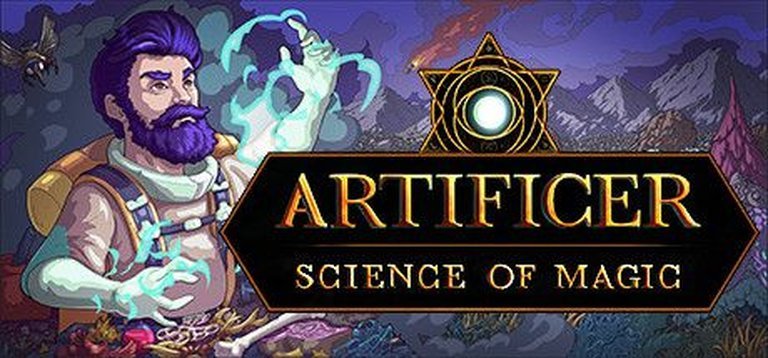
Artificer: Science of Magic is a sci-fi role-playing game where players control Science Officer Raymond Everett and his talking dog partner Salazar after they escape the HMS Hawking and crash-land on the mysterious planet Alcor. The game focuses on survival gameplay, blending scientific experimentation with magical elements to craft tools, manage resources, and navigate a hostile 2D scrolling environment in a bid to escape the planet, drawing inspiration from titles like Don’t Starve.
Gameplay Videos
Where to Buy Artificer: Science of Magic
Artificer: Science of Magic Guides & Walkthroughs
Artificer: Science of Magic Reviews & Reception
opencritic.com (90/100): It may still have a long way to go before it can be considered a “full-fledged” release, but there is no denying how wonderfully complete Artificer: Science of Magic already feels.
metacritic.com (20/100): As it stands, the game is a mess and should not have been released in its current form.
Artificer: Science of Magic: A Fractured Fusion of Genre, Ambition, and Alchemy
Introduction: The Unlikely Prognosis of a Cult Curio
In the vast, often homogenous ecosystem of indie survival-crafting games, Artificer: Science of Magic (2020) stands out not for its polish or its popularity, but for the audacious gap between its compelling core premise and its notoriously fractured execution. Developed by the obscure Polish studio Psilocybe Games and published by Games Operators S.A., this title arrived on Steam Early Access with a promise both familiar and tantalizingly fresh: a “Don’t Starve meets Harry Potter” scenario where a rigorous scientific mindset is forced to assimilate a world of tangible, deadly magic. Its critical reception was brutally succinct—a single 20% score from TheGamer labeling it “a mess”—while a parallel stream of user reviews and press impressions from its early access phase painted a picture of a game brimming with brilliant, idiosyncratic ideas buried under a landslide of jank. This review will argue that Artificer is a paradox: a profound failure of technical execution and design cohesion that simultaneously represents a fascinating, if unresolved, case study in genre hybridization, thematic depth, and the perils of premature release. Its legacy is not one of influence, but of caution—a monument to the gulf between conceptual genius and playable reality.
Development History & Context: Ambitious Roots in a Cramped Reality
The Studio and the Vision: Psilocybe Games, a tiny independent team, crafted Artificer as a passion project. The studio’s name itself hints at a psychedelic, experimental ethos, which directly informs the game’s most celebrated asset: its wildly original, hand-drawn art style. The core design vision, as gleaned from early descriptions and the game’s own text, was to deconstruct the binary between science fiction and fantasy. Instead of a space-faring engineer or a traditional wizard, players embody Raymond Everett, a classical scientist whose materialist worldview is violently confronted by a planet where alchemy, thaumaturgy, and divination are not mere superstition but functional, physical laws. This “science of magic” premise is the game’s foundational pillar.
Technological Constraints & The Early Access Gauntlet: Built in the Unity engine—a common but double-edged sword for indies—Artificer suffered from the classic pitfalls of a small team tackling an immense scope. The version reviewed by Vamers in July 2020 was explicitly a “Developer Build (0.7)”, months before its September 2020 “release.” This context is crucial. The game was launched into Early Access not as a polished alpha but as a rough, unstable proof-of-concept. The technological constraints manifested in the “finicky controls,” “awkward” interaction mechanics (needing to stand at precise angles), and “lack of adequate user interface,” as noted by the Vamers review. The decision to charge for this build, however, immediately alienated a segment of the audience expecting a more stable experience, leading to the stark disconnect between its intriguing ideas and its “should not have been released” critical verdict.
The Gaming Landscape of 2020: Artificer entered a market saturated with survival-crafting titles. The shadow of Don’t Starve (2013) loomed largest, a game that had perfected the grim, hand-drawn aesthetic and punishing, systemic survival loop. Artificer’s direct invocation of this lineage was both a smart hook and a fatal comparison. Where Don’t Starve was a masterpiece of tight, cruel consistency, Artificer felt inconsistent and unfinished. It also competed in a burgeoning “roguelite” space where mechanics were expected to be deep and reliable. Its simultaneous classification as “RPG,” “Adventure,” and “Roguelike” on Steam speaks to an identity crisis—was it a story-driven exploration or apermadeath challenge? This ambiguity, potentially a strength, became a weakness without a solid core experience to support it.
Narrative & Thematic Deep Dive: The Cartesian Crisis of Raymond Everett
The narrative of Artificer is skeletal but potent, serving more as thematic scaffolding than a traditional plot. The story begins with the catastrophic destruction of the research vessel HMS Hawking. Science Officer Raymond Everett and his canine companion, Salazar (a talking dog whose presence immediately signals a world where the “impossible” is mundane), eject in a pod and crash-land on Alcor.
The Central Dichotomy: Raymond’s entire character arc is one of forced epistemological revolution. He is a man who believes “magic is simply anything people have yet to understand through science.” Alcor is the universe’s refutation of this axiom. The planet is not merely technologically advanced; its reality operates on principles that defy physics as Raymond knows them—”laws-of-nature-defying alien plants and creatures,” “Iron Doors,” and “Strange Altars” that require mystical, not scientific, solutions. The gameplay—researching flora to unlock potion recipes, studying fauna to learn weaknesses, deciphering alien runes to read grimoires—is the literal process of Raymond having his worldview shattered and rebuilt. The theme is a profound one: the arrogance of scientific materialism when confronted with a truly alien ontology.
Dialogue & Environmental Storytelling: The narrative delivery is minimalist. Salazar provides sardonic, foul-mouthed commentary (a notable highlight for reviewers), offering a人格化的 counterpoint to Raymond’s more stoic scientific pragmatism. The primary narrative beats are found in the logbook objectives, which provide context for tasks like “tracing signals from potential survivors” or “curing diseases.” More poignant storytelling emerges from the environment: the crash sites of fellow crew members, their escape pods and remains offering powerful medkits and grim tales of failure. These moments create a “Lore-Rich” atmosphere (per Steam tags) without verbose exposition. The central tragedy is that this elegant thematic core—the scientist as reluctant magician—is so underexplored in dialogue and explicit plot progression that many players, like the Vamers reviewer, weren’t even certain if the game had a proper ending.
Gameplay Mechanics & Systems: A Brilliantly Conceived, Poorly Executed Loop
The gameplay is where Artificer‘s ambition and failure are most starkly visible. Its conceptual framework is stellar; its implementation is frequently maddening.
Core Loop & The Research Tree Innovation: The loop is: survive day/night cycle -> gather resources -> study objects/creatures -> earn Research Points -> play a minigame to unlock nodes on a sprawling research tree -> craft new tools, weapons, potions, and structures -> survive longer and explore further. The research minigames (card matching, pattern finding) are a genuinely innovative twist. Instead of passive knowledge gains, the player actively “puzzles” their way to understanding, making the act of learning mechanically engaging and thematically resonant. Unlocking a new alchemical recipe or a lodestone feels earned through cognitive effort, not just resource expenditure.
Crafting & “The Science of Magic”: The crafting system is the heart of the theme. The progression is not linear tech trees but a fusion. You start with basic stone axes and spears (science). But to progress, you must study Alcor’s unique life. Brew a potion from a glowing mushroom (alchemy). Craft a talisman from a monster’s crystalized organ (thaumaturgy). Build a divination device to locate resources. The “magic” is always presented as a comprehensible, recipe-based system—a scientist’s approach to the arcane. This is a masterstroke of design, making magic feel systematic and logical, which perfectly suits the protagonist.
Fatal Flaws in Execution: This brilliant loop is consistently undermined by:
1. Controls & Interface: The “awkward controls” and finicky interaction system are not minor bugs; they are fundamental gameplay breakers. Needing to perfectly align Raymond to chop a tree or open a chest injects frustration into every basic action. The lack of clear time-of-day UI (mentioned twice in reviews) is a cardinal sin in a survival game where night brings lethal threats.
2. Opaque Progression & Balancing: The game’s refusal to “hold your hand” is taken to an extreme. While the logbook provides objectives, it offers little concrete guidance on how to achieve them. What specific plant cures the “fungal infection”? Which monster drops the “eye of insight”? The crafting recipes are hidden within the research tree, requiring guesswork or external wikis (which, as seen with the Fandom link, are sparse or non-functional). This borders on obscurity, not difficulty. Furthermore, the presence of “overpowered enemies in unexpected places” (Indie Hive) creates unfair spikes that punish exploration rather than reward it.
3. State of Completion: Playing the 0.7 build revealed a game lacking in polish, with missing content paths (the question of an “ending”) and inconsistent systems. The “potential” noted by TheGamer is palpable, but it remained just that—potential—at launch.
World-Building, Art & Sound: A Triumph of Sensory Design
If the gameplay is a fractured mosaic, the game’s aesthetic presentation is its unequivocal masterpiece.
Visual Direction & Art Style: The hand-drawn, sketchy aesthetic is immediately and persistently striking. As the Vamers review eloquently describes, it uses a “combination of contrasting winter colours: purples, blues, greys, and greens (with the occasional yellow and red).” This creates a pervasive, chilly, alien mood that is both beautiful and foreboding. The environments—swampy fungal terrain, botanical forests, derelict spaceship interiors—are rendered with a dense, gruesome specificity. The “eclectic plethora of distinct flora and fearsome fauna” are not just assets; they are characters in themselves, each designing inviting study (and combat). This style is compared to Legendary Gary, a high compliment for its unique, indie-artistic identity. It escapes the generic pixel-art or low-poly 3D traps of many survival games and establishes a powerful, original visual language.
Sound Design & Dynamic Soundtrack: The audio is hailed as “one of the most enthralling soundtracks I have heard in an indie title in a long time” (Vamers). It is a “beautiful drone and vocals” that dynamically shifts with the time of day and player situation. This procedural or cleverly mixed score does critical work: it heightens tension at dusk, creates eerie calm during exploration, and punctuates danger. Unlike Don’t Starve‘s deliberately repetitive, quirky soundtrack, Artificer‘s score feels alive and responsive, directly enhancing the atmospheric “need to survive.” The sound effects for creature cries, magical eruptions, and crafting actions are equally weighty and integrated into the world’s peculiar physics.
Synthesis: The art and sound do the heavy lifting of world-building that theplot and UI fail to do. They sell the mystery and menace of Alcor. The visual and auditory cohesion makes the planet feel real, dangerous, and worth deciphering, which is the primary driver that kept Vamers playing “just one more day” despite the frustrations.
Reception & Legacy: The tale of Two Metrics
Launch Critical Reception: The professional critical reception was near-universally negative, but it’s critical to note its paucity. Based on a single critic score from TheGamer (20%), the “Moby Score” is listed as “n/a.” Metacritic has “tbd” scores. This indicates the game existed largely outside the mainstream critical gaze. The one published critic review was damning, acknowledging the “interesting” ideas but declaring the current form “a mess” and “not recommended.” This review perfectly encapsulates the consensus for those who engaged with it professionally: potential utterly squandered by poor execution.
User & Early Access Reception: The Steam user reviews tell a more complex story. With 79 reviews at a “Mixed” (60% positive) overall rating, a significant portion of players were willing to forgive the roughness. Tags like “Great Soundtrack,” “Lore-Rich,” “Atmospheric,” and “Addictive” appear prominently, directly echoing the Vamers praise. This suggests a small, dedicated niche audience found the game’s heart compelling enough to withstand its flaws. The “Early Access” label provided a fig leaf, allowing players to view it as a “project” rather than a finished product. The fact that it was still being actively worked on (as of the latest Steam update history) kept a glimmer of hope alive.
Industry Influence & Legacy: Artificer has had no discernible mainstream influence. It did not spawn clones nor significantly shift the survival genre’s trajectory. Its legacy is that of a cautionary tale and a cult footnote. It demonstrates the danger of marrying a brilliant, novel core mechanic (the research-based magic system) with a foundation of sloppy controls and opaque progression. For scholars of game design, it serves as a case study in “conceptual integrity”—a game whose theme is perfectly reflected in one major system (research/crafting) but completely betrayed by its fundamental interface. It is also a testament to the power of aesthetic presentation; its art and sound are frequently cited as its saving grace, proving that sensory appeal can sustain interest in a mechanically troubled product. It will likely be remembered in niche forums and by a handful of players who championed its unique vision, but it will not appear in “best of” lists or directly inspire major studio projects.
Conclusion: A Flawed Spellbook
Artificer: Science of Magic is not a “good” game by any conventional measure. Its controls are frustrating, its UI often hostile, its balance questionable, and its state at launch was undeniably that of a messy, incomplete prototype. A professional critic cannot recommend it in its current form; the 20% score, while harsh, is defensible from a standpoint of functional playability.
However, to dismiss it entirely is to ignore the terrifyingly good idea at its core. The fusion of scientific research and magical practice is a conceptual gem. The world of Alcor, conveyed through its stunning, hand-drawn art and its dynamic, emotive soundtrack, is a memorable and distinctive setting. For the player willing to fight the interface, the reward is a unique epistemological fantasy: the thrill of being a Descartes-style figure, systematically reverse-engineering a new reality.
Its place in video game history is secure, but it is a place in the annex—the section labeled “Fascinating Failures” and “What Could Have Been.” It is a monument to the vast chasm between a brilliant design document and a shipped product. Artificer proves that a game can have a soul—a powerful, intriguing thematic soul—and still be a broken vessel. It is a lesson in humility for developers and a curio for historians: a potent spell cast with a cracked wand, whose effects are mesmerizing but whose form is fundamentally unstable. Until (and unless) Psilocybe Games undertakes the monumental task of a 1.0 overhaul, Artificer will remain exactly what its title ironically suggests: a fascinating study in magic whose scientific application remains frustratingly, fundamentally flawed.