
- Release Year: 2011
- Platforms: Macintosh, Windows
- Developer: Terry Cavanagh
- Genre: Adventure
- Perspective: First-person
- Game Mode: Co-op
- Gameplay: Environmental puzzles, Exploration
Description
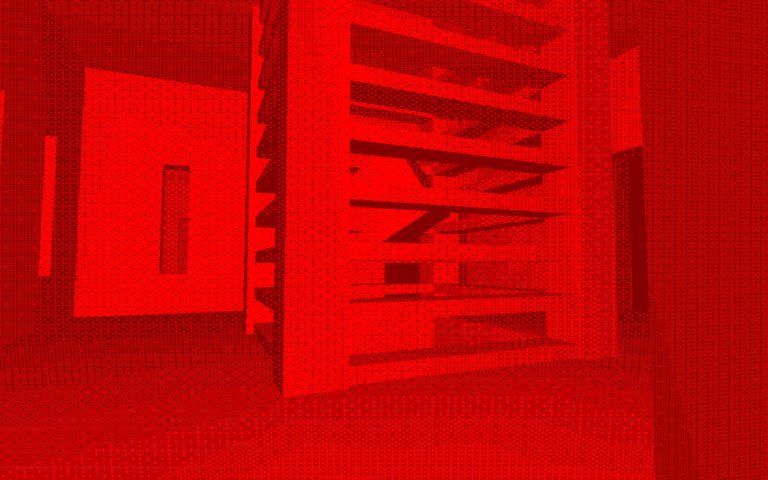
At a Distance is a first-person exploration game crafted for two players on separate machines, where the movement of one player dynamically alters the environment seen by the other, affecting obstacles and pathways to make traversal more challenging or manageable. Originally developed for NYU’s No Quarter Exhibition in 2011 and released as a free download, the game emphasizes interconnected perspectives and requires two computers to experience its unique cooperative or competitive mechanics.
Where to Buy At a Distance
PC
At a Distance: Review
Introduction: The Solitude of Shared Screens
In the landscape of video games, where multiplayer often means cooperative missions or competitive deathmatches, At a Distance emerges as a quiet, profound anomaly. Created by Terry Cavanagh for the NYU Game Center’s 2011 No Quarter Exhibition, this free-to-download title is not about fighting side-by-side but about experiencing parallel realities. It is a game that weaponizes separation, using the physical and informational divide between two players as its core mechanic. Released in December 2011 for Windows and Mac, the game requires not just two players, but two separate computers placed side-by-side. The fundamental premise is deceptively simple: the movement of one player directly and irrevocably alters the environment seen by the other, creating a dynamic puzzle of empathy and deduction. This review will argue that At a Distance is a landmark in interactive design—a minimalist, networked experiment that uses its severe technological and spatial constraints to explore themes of isolation, perception, and fragile connection. It is less a traditional game and more a mediated social experience, a digital pas de deux where the music is made by the silent understanding between two isolated minds.
Development History & Context: An Academic Exercise in Connection
At a Distance was born from a specific academic and exhibition context. Terry Cavanagh, already an established indie developer known for titles like VVVVVV and later Super Hexagon, created the game specifically for the NYU Game Center’s No Quarter Exhibition in 2011. This event showcases games from students, alumni, and faculty, often highlighting experimental and avant-garde work. The project was a deliberate departure from Cavanagh’s more mechanically intense platformers, aiming instead for a “game about solitude in shared experiences,” as stated on its official site.
The technological landscape of 2011 was one of burgeoning indie accessibility. The Unity engine, which the game was built in, was becoming a powerhouse for small teams due to its flexibility and decreasing cost. However, implementing real-time networking between two separate instances of a game on different machines—without a central server—was a non-trivial challenge. The credits reveal a collaborative effort to solve this: Mike Hergaarden provided the Unity Networking Code, and Sophie Houlden contributed C# scripting. The visual style, utilizing a distinctive dither shader (attributed to Jarrad Woods, credited as Farbs) and a “Standard DOS Font,” consciously evokes a retro, lo-fi digital aesthetic, likely a pragmatic choice that also reinforced a theme of stark, code-based reality.
This period (2011) was a watershed for indie games, with digital distribution on Steam and Humble Bundle allowing experimental titles to find audiences. The critical success of narrative-driven “walking simulators” like Dear Esther (2012) was on the horizon, but At a Distance prefigured that movement by focusing entirely on experiential and environmental narrative with zero traditional plot. Its requirement for two physical machines was both a technical necessity and a philosophical statement: the players are not in the same world, reinforcing the theme of isolated perception. The game was released as a free download later in December 2011, maintaining its status as an academic/art piece rather than a commercial product. Its closest thematic cousin from the same era might be The Unfinished Swan (2012) in its exploration of perception, but At a Distance’s innovation lies in making the perceptual shift inter-player rather than intra-player.
Narrative & Thematic Deep Dive: The Story of Two Singularities
At a Distance possesses no conventional narrative. There are no characters with backstories, no dialogue, no cutscenes, and no text logs to collect. Its “story” is the emergent experience of two players navigating a shared-but-separate puzzle. The game’s genius is in how its mechanics generate a narrative of cooperation, frustration, and epiphany.
Thematic Core: Solitude in Shared Experience. The official description explicitly states the game is “about solitude in shared experiences.” This is its central thesis. Two people are engaged in the same task, on the same physical table, yet they occupy utterly different informational planes. One player’s actions are a mystery to the other, creating a fundamental solitude even in proximity. The game forces players to communicate not through voice or text (the game has no chat function), but through the interpretation of environmental clues—the shifting architecture, the appearance or disappearance of platforms, the sudden introduction of hazards or aids.
Environmental Storytelling & Emergent Plot. The world itself is a minimalist, abstract space rendered with simple geometry and the dither shader. There are no explained sectors, no names like “The Array” (a term from the unrelated game Distance). The environment is a pure playground of light and shadow, platforms and voids. The “plot” is the players’ collective struggle to understand the rule set: “When I move here, a bridge appears for you,” or “When I jump, a blade vanishes from your path.” The narrative is written in the shared “aha!” moments, the gasps when a seemingly impossible gap becomes traversable because the other player found a hidden switch, and the sighs when a miscommunication leads to a fatal fall. It is a story written in real-time, with the players as both authors and protagonists.
Dialogue Absence and Communication. The lack of a traditional dialogue system is paramount. Players cannot type or speak through the game. All communication must happen verbally, outside the game, or through the game world itself. This forces a raw, unmediated form of cooperation. The game becomes a Rorschach test for partnership: do you work together seamlessly, or does the frustration of not knowing what your partner sees breed tension? The theme of “solitude” is most acute in the moments of failed coordination—the player who cannot see why their partner is stuck, feeling helplessly isolated in their own visual stream.
Contrast with Contemporary “Walking Simulators”. Unlike Dear Esther or Gone Home, which use environmental details to tell a pre-scripted story of personal trauma or family drama, At a Distance’s environment tells a story of systemic interaction. The narrative is not about what happened in this space, but about what is happening now between the two occupants. It is a living, reactive narrative shaped entirely by player input, making it a precursor to more complex asynchronous multiplayer narratives but in an aggressively minimalist form.
Gameplay Mechanics & Systems: The Architecture of Asymmetry
The gameplay of At a Distance is a masterclass in systemic design. Its entire structure revolves around one core, networked rule, from which all complexity emerges.
Core Gameplay Loop: A Symbiotic Puzzle. The loop is simple: Player A navigates their first-person environment to reach a goal (typically a portal or terminal). Their movement—position, rotation, sometimes jumping—is transmitted in real-time to Player B’s instance of the game. This data directly manipulates Player B’s environment: creating or removing walkable platforms, activating or deactivating deadly obstacles (like buzzsaws or lasers), or altering lighting and spatial geometry. Conversely, Player B’s movements affect Player A’s world. The goal is for both players to navigate their respective, shifting spaces to reach their own endpoints, often requiring precise timing and spatial reasoning based on the other’s actions. There is no single “path”; the path is co-created in real-time.
Challenges and “Combat”: Systemic Obstacles. There is no combat in a traditional sense. The challenge is environmental and cognitive. “Hazards” are static objects (spikes, lasers) that can be toggled on/off by the partner’s location or action. The “difficulty” scales not through enemy AI but through the increasing complexity of the environmental puzzles. Later “levels” (the game is a series of abstract chambers) require intricate choreography: one player must hold a position to keep a bridge stable while the other crosses, then swap roles. The tension comes from the real-time pressure and the misalignment of information.
Progression and Structure. There is no character progression, no skill trees, no unlocks. Progression is purely cognitive and cooperative. The game is a sequence of vignettes or challenge rooms. Completion of one space seamlessly transitions to the next, often with a changed palette or new mechanic element. The lack of traditional progression systems reinforces the purity of the core puzzle; the only “power-up” is the players’ improving ability to read each other’s intent through environmental feedback.
User Interface & Innovation. The interface is diegetic and minimalist. The HUD, if it exists, is projected onto the in-game environment (like a car’s rear window in Distance, but here it’s even more abstract). The innovation is not in the UI but in the absence of a shared UI. There is no minimap showing the partner’s position, no ping system. The only feedback is the direct visual consequence of their movement in your world. This is a radical design choice that enforces the theme of limited perception. The game’s true “interface” is the physical space between the two monitors and the players’ voices as they try to bridge the information gap.
Flaws and Frictions. The game’s greatest strength is also its potential weakness: its absolute dependence on a cooperative, communicative partner. A mismatched pair (one competitive, one easily frustrated) can lead to a negative experience. There is no single-player mode; the game literally cannot be “played” alone. This makes it a highly situational experience, not a portable entertainment product. Its replayability is high in the sense that different partner dynamics create new narratives, but the puzzle solutions themselves are fixed once discovered.
World-Building, Art & Sound: The Aesthetics of Isolation
The world of At a Distance is not a place with a name or a history. It is a series of liminal, non-spaces—floating geometric configurations in a void, lit by stark, directional lights.
Visual Direction & Atmosphere. The graphics are intentionally crude and beautiful. The dither shader creates a patterned, pseudo-retro texture on all surfaces, reminiscent of early 3D acceleration or high-contrast print. This aesthetic serves two purposes: it is a low-overhead visual style suitable for a 2011 indie project, and it creates a sense of unreality, like a wireframe simulation or a dream. The environments are sparse: monolithic platforms, endless black drop-offs, grids of deadly spikes. There is no “scenery porn”; every visual element is functional. The atmosphere is one of clinical isolation, cold and computational. The first-person perspective amplifies the feeling of being alone in your own head (and your own screen). The only “animation” is the movement of the player avatar (a simple floating point or geometric shape) and the environmental responses.
Sound Design & Music. Stian Stark’s original soundtrack is crucial. Without voice acting or ambient diegetic sound (like wind or machinery), the music carries the emotional weight. It is likely an ambient, electronic, or minimalist score—based on Stark’s other work and the game’s tone—that swells during moments of navigation and perhaps dips into tension or silence during puzzle-solving. The soundscape would be the sole shared auditory element, a constant bridge between the two isolated visual experiences, reminding players they are part of a duet even when their eyes see only their own reality. It masks the awkward silence that might otherwise fall between two people silently solving a puzzle and reinforces the game’s meditative, sometimes eerie mood.
Contribution to Overall Experience. The art and sound do not build a world; they build a condition. They create a sensory deprivation chamber where the only meaningful input is the other player’s indirect influence. The stark visuals prevent distraction, forcing focus on the systemic relationship between your actions and your partner’s world. The music provides the emotional glue, the shared heartbeat that persists even when the visual information is completely at odds. Together, they create a uniquely anxiety-inducing and intimate experience, where the bond between players is forged in the crucible of mutual incomprehension.
Reception & Legacy: A Cult Classic of Connection
At a Distance was not a commercial release by any standard. It was a free download for a niche audience interested in experimental game design. Its reception, therefore, is not measured in sales but in critical and peer recognition within the indie and academic game scenes.
Initial Reception (2011). The game’s debut at the NYU No Quarter Exhibition was its primary launchpad. It was recognized as a standout piece of interactive art. It became a finalist at Indiecade 2011 and a Game of the Show Nominee at Eurogamer Expo 2011—significant accolades for an experimental, non-commercial title. Mainstream gaming press coverage was minimal (as reflected by its n/a MobyScore and lack of critic reviews on Metacritic), but within circles that value design innovation, it was praised. Rock Paper Shotgun called it “phenomenally clever, to the point of dastardliness,” highlighting its ability to make players feel the “outer limits of the experiences videogames can offer.” Tap Repeatedly’s quote about a “sensation I used to have as a kid when I didn’t understand what a game was” perfectly captures its alienating yet compelling nature.
Evolution of Reputation. Over time, At a Distance has become a cult classic and a frequent citation in discussions about asymmetric multiplayer, communication games, and the “walking simulator” genre’s boundaries. It is often mentioned in the same breath as other two-player “separate reality” games like the later Keep Talking and Nobody Explodes (2015), though that game uses a verbal manual rather than environmental influence. Its influence is more thematic and conceptual than mechanical; it proved that a game could be entirely about the space between players. In academic papers on game studies, it is likely analyzed as a case study in mediated interaction and joint attention.
Influence on the Industry. Direct lineage is hard to trace, as the game remained obscure. However, its DNA can be felt in:
1. Asymmetric Co-op Design: Games like It Takes Two (2021) or A Way Out (2018) use different perspectives and abilities, but At a Distance’s pure, systemic separation—where one’s movement is the currency—remains rare.
2. Experiential Multiplayer: The rise of “silly” or “party” games like Fibbage or Codenames online focuses on social deduction and communication, but At a Distance is a puzzle first, social second. Its influence is more likely seen in small, iterative indie experiments than AAA titles.
3. Walking Simulator Expansion: It showed that the contemplative, environment-focused pace of walking simulators could be applied to a multiplayer context, not just solo narrative delivery.
Its biggest impact may be as a historical artifact—a bold, early-2010s proof-of-concept that games could explore the phenomenology of shared isolation. It sits alongside other Terry Cavanagh works (like the punishing precision of Super Hexagon) as an example of his range: from tests of twitch skill to tests of empathy and patience.
Conclusion: A Singular, Essential Experiment
At a Distance is not a game for everyone. Its requirement for a dedicated, patient partner and its lack of conventional rewards make it an acquired taste. Yet, within the canon of video game history, it occupies a crucial, fascinating niche. It is a game that dismantles the very notion of a “shared screen” and rebuilds multi-player interaction from the ground up, using network latency and physical separation as creative tools rather than technical obstacles.
Its themes of solitude in companionship have only grown more resonant in an era of digital connection and social fragmentation. The game’s genius is its economy: one rule, one aesthetic, one core experience, from which a vast space of emotional and intellectual gameplay emerges. It is a silent conversation, a dance of shadows across two separate rooms. While Terry Cavanagh would later achieve broader fame with VVVVVV and Super Hexagon, At a Distance remains his most philosophically rigorous and forward-thinking design—a game that asks not “What can we do together?” but “How do we know what the other sees?” In doing so, it transcends being a mere puzzle game and becomes a subtle, powerful meditation on the limits of perception and the fragile bridges we build to cross them. For any student of game design or anyone fascinated by the expressive potential of interactive systems, At a Distance is an essential, haunting experience: a quiet masterpiece from the margins that redefines what multiplayer can mean.