
- Release Year: 2006
- Platforms: Windows
- Publisher: NBG EDV Handels- und Verlags GmbH & Co. KG
- Genre: Compilation
Description
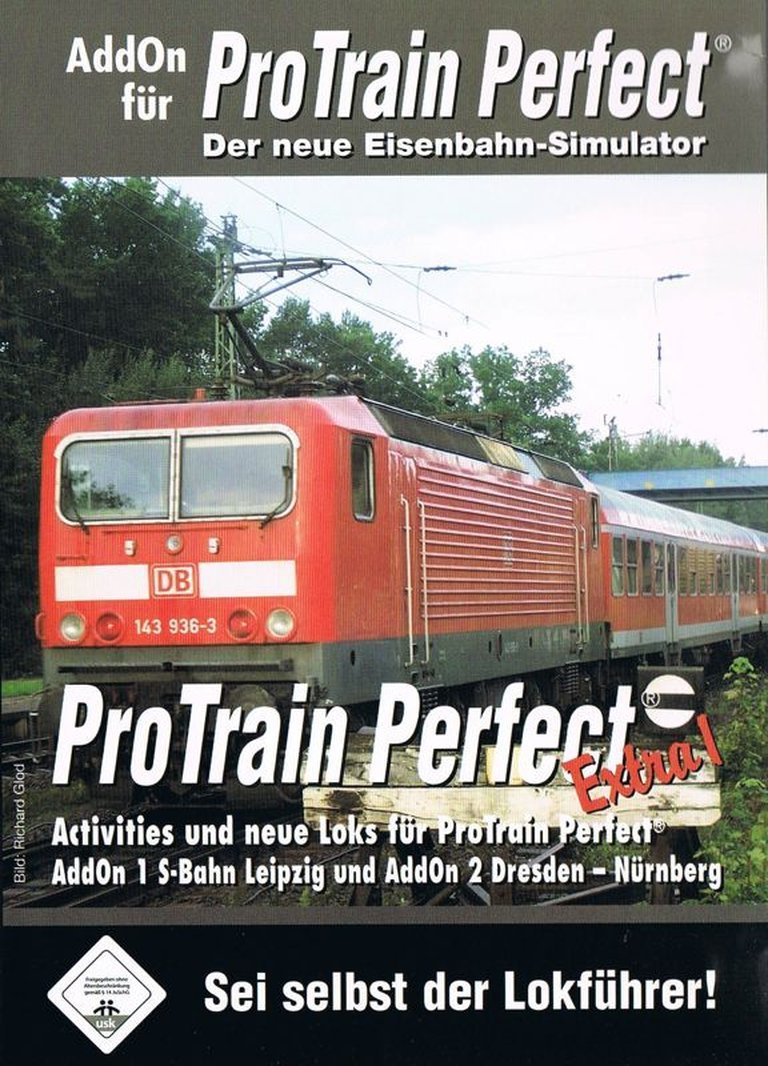
ProTrain Perfect Extra 1 is a compilation release that bundles two add-on packs for the train simulation game ProTrain Perfect. It features ProTrain Perfect AddOn 1: S-Bahn Leipzig, focusing on the Leipzig commuter rail network, and ProTrain Perfect AddOn 2: Dresden-Nürnberg, simulating operations on the mainline route between Dresden and Nuremberg, both set in Germany.
ProTrain Perfect Extra 1: A Niche Compilation in the annals of Train Simulation
Introduction: A Product of Its Time and Place
Released on October 11, 2006, for Windows, ProTrain Perfect Extra 1 stands not as a standalone game but as a curated collection within a specific regional ecosystem of train simulation. Published by NBG EDV Handels- und Verlags GmbH & Co. KG, this compilation bundles two add-ons—ProTrain Perfect AddOn 1: S-Bahn Leipzig and ProTrain Perfect AddOn 2: Dresden-Nürnberg—for the German-localized version of Trainz Railway Simulator 2006, known as ProTrain Perfect. My thesis is this: ProTrain Perfect Extra 1 is a fascinating historical artifact, a snapshot of the early-mid 2000s “regionalization” strategy of the Trainz franchise. It represents a period of intense third-party collaboration and localized content creation, offering deep, authentic German route simulations but doing so with the technical foundations and limitations of a transitional engine (Auran Jet) that was already feeling its age. Its value is not in pioneering simulation mechanics but in its preservation of a specific rail-fan niche and its role in the complex, distributed lifecycle of the Trainz series.
Development History & Context: The “ProTrain” Phenomenon
To understand ProTrain Perfect Extra 1, one must first understand the Trainz series’ publishing history and the phenomenon of “regional releases.” Developed by the Australian studio Auran (later N3V Games), the Trainz series, beginning in 2001, was built on a powerful premise: a robust 3D simulation coupled with unprecedented user-generated content tools. However, Auran frequently partnered with local publishers for distribution, marketing, and crucially, the creation of region-specific add-on packs.
The German market was a prime target. The publisher Blue Sky Interactive (and its associated label NBG Multimedia) had a established reputation in the simulation space, particularly with the ProTrain series of add-ons for Microsoft’s Train Simulator. When Trainz Railway Simulator 2006 (TRS2006) launched globally in late 2005/early 2006, Blue Sky/NBG secured the German rights and rebranded the core game as ProTrain Perfect. This was more than a translation; it was a rebranding to leverage their existing community and retail presence.
ProTrain Perfect Extra 1 is a product of this partnership. Released in October 2006, it is a “compilation” (as categorized on MobyGames) of two of the earliest route add-ons created for the German version. The technological context is the Auran Jet engine, a significant but aging step from its predecessor. TRS2006 was a “transitional release,” noted in historical chronicles for introducing the vital Content Manager Plus (CMP) database tool but suffering from “teething troubles” and visuals that were already being criticized as dated compared to competitors. The game’s ambitious “iTrainz” online chat feature and the nascent Download Station (DLS) for user content were gestating within this framework. ProTrain Perfect Extra 1 was built on this stable-yet-strained foundation, inheriting its capabilities and its bugs.
Narrative & Thematic Deep Dive: The Simulation is the Story
Unlike narrative-driven games, ProTrain Perfect and its add-ons have no conventional plot, characters, or dialogue. The “narrative” is emergent, authored by the player through the operational simulation of German rail networks. The thematic core is one of prototypical authenticity and operational immersion.
The two included routes construct a specific geographic and operational narrative:
1. S-Bahn Leipzig: This add-on focuses on the dense, frequent-stop commuter rail network around Leipzig. The theme is urban and regional connectivity—the pulse of daily passenger service. The “story” is told through the precise replication of station layouts, overhead line equipment (catenary), signaling systems (likely PZB/ZUB), and the specific classes of electric multiple units (EMUs) like the Class 143 “Buchfink” or Class 182 “Vectron” that serve this network. The player’s narrative is one of adherence to a strict timetable, managing dwell times at platforms, and navigating the complex junctions of a major rail hub.
2. Dresden-Nürnberg: This route covers a major long-distance and freight corridor across Eastern Germany. The theme expands to mainline operation, featuring a mix of high-speed lines, mountainous terrain (the Ore Mountains/Erzgebirge), and historic cities. The “story” involves the challenges of gradient management on freight trains, high-speed passenger runs (InterCity/ICE), and the historical layering of tracks—from modernized lines to preserved segments. It represents the arteries of German heavy rail, contrasting with the capillaries of the Leipzig S-Bahn.
The underlying theme across both is precision and systems mastery. There is no hero’s journey; the satisfaction comes from understanding and perfectly executing the complex ballet of German railway signaling, speed restrictions, and locomotive handling (especially in CAB mode with its realistic physics including wheel slip and weight distribution). The “narrative” is the player’s personal mastery over these intricate, real-world systems.
Gameplay Mechanics & Systems: A Refinement, Not a Revolution
Gameplay is inherited directly from TRS2006, with no unique mechanics added by this compilation. The analysis must focus on the state of these systems in 2006.
-
Core Loop: The player operates in three primary modes:
- Driver: The core experience. Choose a locomotive, a consist (train), and a pre-made “Session” (a scenario with objectives) or drive in “Free Roam.” Two control paradigms exist:
- DCC Mode: Simplified, dial-based control akin to a model railroad controller. Accessible to novices.
- CAB Mode: A full, realistic cabin simulation with detailed controls (separate horn, air brakes, dynamic brakes, sanders), authentic physics, and the need to manage momentum, especially on grades. This is the hardcore simulation mode.
- Surveyor: The powerful route editor. Shape terrain, lay track (with complex junction placement), place scenery, buildings, and industries, and script Driver Sessions. ProTrain Perfect Extra 1 provides no new Surveyor tools but offers new, high-fidelity German route baselines to build upon or explore.
- Railyard: A showroom to view all acquired rolling stock.
- Driver: The core experience. Choose a locomotive, a consist (train), and a pre-made “Session” (a scenario with objectives) or drive in “Free Roam.” Two control paradigms exist:
-
Innovative/Flawed Systems:
- Content Manager Plus (CMP): This was TRS2006’s flagship new feature—a database-driven manager for the ever-growing library of user and add-on content. It was a significant step up from TRS2004’s simpler system, allowing for better filtering and organization. However, forum archives and modern retrospectives note it could be clunky and was sometimes prone to database corruption, a significant flaw for a game built around content expansion.
- PaintShed: The bundled tool for “reskinning” locomotives. It was accessible but limited, relying on pre-made paint templates. Its inclusion was a nod to the creativity of the community.
- iTrainz & iPortal: Early attempts at in-game online functionality and content sharing. These were innovative for 2006 but poorly implemented, unreliable, and quickly eclipsed by the web-based Download Station (DLS).
- The “ProTrain Perfect” Lock-in: A critical quirk of the German regional version. As noted in forum discussions (e.g., Auran forums), the ProTrain Perfect (TRS2006) core game and its official add-ons often used a different, proprietary asset format (
.jafiles) with built-in, non-editable content. To use ProTrain Perfect Extra 1 routes and rolling stock in a modern Trainz version (like TS12 or TRS2019), users had to manually copy these.jafiles into the newer game’s “builtin” folder and input the original serial number. This DRM-ish lock-in created compatibility headaches and a fragmented content ecosystem, a direct legacy of the regional publishing deals.
-
User Experience: The gameplay is a double-edged sword. For a German railfan in 2006, having meticulously recreated routes for the S-Bahn Leipzig and the Dresden-Nürnberg corridor was a dream. The operational procedures, signage, and stock were authentic. For outsiders, the lack of English documentation (the game is German-language only per its USK 0 rating and publisher) and the dense, specialist jargon created a high barrier to entry. The tutorials, while “refined” compared to TRS2004, still assumed a baseline interest in rail operations.
World-Building, Art & Sound: Authenticity Over Aesthetics
The visual and auditory presentation of ProTrain Perfect Extra 1 is a product of its engine and its regional focus.
-
Visual Direction & Setting: The graphics are unmistakably mid-2000s. Textures are low-resolution by modern standards, with noticeable repetition and “grey and yellow squares” as one reviewer noted. The Auran Jet engine’s terrain rendering was functional but not beautiful. The art was in accuracy, not beauty. The value lay in the faithful 3D modeling of German-specific infrastructure: the precise shape of German platform canopies, the specific design of signal gantries (H/V signals), the unique look of German stations, and the rolling stock liveries (DB red and white, various regional colors). The world-building was an act of archaeological digital modeling, prioritizing prototypical correctness over graphical fidelity. The routes themselves—the cityscape of Leipzig, the valleys of the Elbe Sandstone Mountains between Dresden and the Czech border, the flatlands of northern Bavaria—were recreated with a surveyor’s eye for track layout and topography, not a painter’s eye for ambiance.
-
Sound Design: This is where the simulation often shone. The soundscape was a cacophony of authentic German locomotive noises: the distinctive whine of a Class 143 EMU’s traction motors, the chuffing of a steam locomotive (if included), the clatter of diesel-hydraulic locomotives like the V200, and the precise, recorded sounds of German horns ( Pfeife ) and bells. The sound of wheels on jointed track versus continuous welded rail, the squeal of brakes on a tight curve—these auditory cues were critical for immersion and operational feedback. The sound design served the simulation’s core need: to make the player feel the machine they were operating.
Reception & Legacy: A Cult Artifact in a Fragmented Franchise
ProTrain Perfect Extra 1 itself was never reviewed by major Anglophone outlets. Its reception must be inferred from its constituent parts and the legacy of the TRS2006/ProTrain Perfect line.
- Contemporary Reception: The base Trainz Railway Simulator 2006 received mixed or average reviews (Metacritic 65/100). Critics praised its “abundance of new content, control system, and refined tutorials” but heavily criticized its “visuals, camera settings, and technical issues.” As PC Zone bluntly stated, “things haven’t moved on much since the 2004 version.” For the German ProTrain Perfect version, the reception was likely similar but filtered through a lens of national pride—the German rail content was a major selling point for the local audience, potentially outweighing graphical complaints for the core fanbase.
- Commercial Context: It existed within a thriving “ProTrain Perfect” series. The MobyGames group listing shows a steady stream of German-specific add-ons (S-Bahn Berlin, various “Aufgabenpacks” or task packs) from 2006 through at least 2011. Extra 1 was an early compilation, likely aimed at getting new customers up to speed with the expanding add-on lineup. Its commercial life was tied to the physical media (CD-ROM) era and the retail presence of NBG/Blue Sky.
- Legacy & Influence: Its legacy is twofold:
- Regionalization Precedent: It exemplifies the franchise’s successful, if messy, localization strategy. For years, the most detailed route content for specific countries (Germany, France, the UK) came not from the global Auran releases but from these regional partners. ProTrain Perfect became synonymous with high-quality German rail content for Trainz.
- Community & Preservation: It is a direct ancestor of the modern Trainz community’s content obsession. The intricate modeling of German infrastructure in these add-ons became the basis for countless hours of user-created scenarios. As seen in forum threads from 2012, dedicated fans were still trying to extract and port ProTrain Perfect 2 assets into newer games like TS12. ProTrain Perfect Extra 1 is part of this preserved heritage, a piece of the “built-in” content puzzle that enthusiasts seek to migrate forward.
- The “Dead End” of Regional Formats: It also represents a dead end. The
.jafile format and regional lock-in created compatibility walls. While the core Trainz engine evolved (to TRS2009, TS2010, T:ANE, TRS2019, TRS2022), the old regional add-ons became stranded. Their legacy survives only if manually ported by experts, making ProTrain Perfect Extra 1 a museum piece that requires curatorial effort to experience on modern systems.
Conclusion: A Specialist’s Relic
ProTrain Perfect Extra 1 is not a game for the generalist. It is a specialist’s compilation, a time capsule of the Trainz series’ most prolific and fragmented era. Its “extra” content—the Leipzig S-Bahn and the Dresden-Nürnberg corridor—was, for its time, arguably the best digital representations of these networks available to a PC user. The gameplay is the pure, unadulterated Trainz experience of 2006: a potent mix of operational simulation and creative world-building hampered by aging graphics and technical quirks.
Its historical importance lies in its context, not its content. It is a testament to the power of third-party development and regional partnerships in expanding a simulation platform’s scope. It highlights the tensions between community creation and commercial packaging, between authentic detail and user accessibility. For the train simulation historian, it is an essential study in how niche markets were served. For the modern player, it is a curiosity—a window into a world where getting German trains to run properly required manual file copying and serial number juggling. Its final verdict is one of cult significance, not universal acclaim. It is a 7/10 masterpiece for the German rail enthusiast of 2006, and a 5/10 technical curiosity for today, valued primarily for the pieces of digital rail heritage it contains and the story it tells about the complex, global lifecycle of a beloved simulation series.