
- Release Year: 2002
- Platforms: Windows
- Publisher: ITE Media ApS (Interactive Television Entertainment)
- Developer: ITE Media ApS (Interactive Television Entertainment)
- Genre: Action
- Perspective: Behind view
- Game Mode: Single-player
- Gameplay: Arcade, Collecting, Minigames, Obstacle avoidance
- Setting: Fantasy
Description
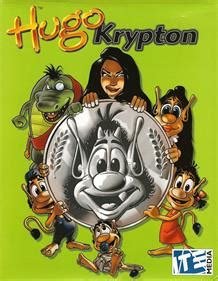
Hugo: Krypton is a 2002 action game set in a fantasy world, featuring eight diverse minigames where players control the titular troll Hugo to collect various items while navigating obstacles and dangers in scenarios like saving rabbits, airport chaos, and virus karate.
Hugo: Krypton: A Digital Museum Piece Capturing a Franchise at the Crossroads
Introduction: The Last Gasp of a European Phenomenon
In the vast, ever-expanding museum of gaming history, certain titles exist not as groundbreaking innovations but as precise temporal artifacts—snapshots of a specific studio’s philosophy, a franchise’s evolution, and an era’s technological constraints. Hugo: Krypton (2002) is precisely such an artifact. Released for Windows by Interactive Television Entertainment (ITE Media), this compilation assembles eight minigames culled from the publisher’s “Play and Learn” series. Its existence speaks to a transitional moment: the waning days of the CD-ROM boom, the decline of a once-dominant European children’s media franchise, and the final breaths of a development model based on efficient asset reuse. This review argues that Hugo: Krypton is less a game to be evaluated on its own merits and more a crucial minigame compilation swan song, a digital time capsule that encapsulates both the enduring appeal and the inevitable creative stagnation of the classic Hugo formula at the dawn of the new millennium.
Development History & Context: The Calm Before the Storm
The Studio and Its Legacy: By 2002, ITE Media (formerly Silverrock Productions) was a veteran studio, having shepherded the Hugo franchise from its 1990 interactive TV show origins into a multi-platform gaming juggernaut. Under the creative direction of founders Ivan Sølvason and animator Niels Krogh Mortensen, the company had produced over thirty Hugo titles, selling millions of copies, particularly in Germany and Denmark. The core development ethos was one of pragmatic efficiency: a robust 2D sprite engine, a library of recurring hazards (rolling boulders, gaping chasms, swinging ropes), and a proven structure of minigames feeding into endgame puzzles. This model allowed for rapid, cost-effective production of localized titles for the European market.
Technological Constraints and the CD-ROM Era: Hugo: Krypton is a product of the tail end of the CD-ROM’s reign as the premium PC gaming medium. Its compilation nature—collecting eight disparate minigames from previous “Play and Learn” releases—was a perfect fit for the format, offering perceived value through volume. The game’s technical specifications are firmly of its time: a 2002 Windows release, likely built on an updated version of the proprietary 2D engine used since the early 1990s. There is no evidence of 3D acceleration; the “behind view” and “arcade” genres listed on MobyGames point to pre-rendered or simple 2D backgrounds with sprite-based characters. This was a budget title in every sense, designed for low-end PCs common in homes and schools across Europe.
The Gaming Landscape and Franchise Position: 2002 was a pivotal year. The PlayStation 2, GameCube, and Xbox defined the “big budget” landscape. Meanwhile, the mobile gaming revolution was nascent (the App Store wouldn’t launch for five years). For ITE, the pressure was mounting. The classic Hugo formula, while still commercially viable, was showing its age. The company had attempted a 3D reboot with Hugo: The Evil Mirror earlier that same year, and the Agent Hugo espionage series was on the horizon (2005). Hugo: Krypton represents a safe, backward-looking cash-in—a way to package and sell existing, proven content to the still-significant audience of families with older PCs, before the full-scale shift to 3D on consoles and, eventually, mobile. It was released just as parent company Olicom A/S was investing heavily ($22 million) to expand ITE into the US and Asian markets, a gambit that would ultimately fail and lead to ITE’s sale and downsizing by 2006. Krypton is a game born of a company looking inward, recycling its most reliable assets.
Narrative & Thematic Deep Dive: A Story in Fragments
The Hugo franchise is narratively defined by a simple, powerful dynamic: the good-hearted troll Hugo versus the vain, evil witch Scylla (Afskylia in Danish). Scylla’s motivation is eternal youth, often achieved by kidnapping Hugo’s wife Hugolina and their three children—Rut (the clever eldest), Rat (the adventurous middle child), and Rit (the infant). Hugo: Krypton, as a compilation, does not present a single, cohesive narrative. Instead, it offers eight narrative vignettes, each a self-contained scenario from the broader Hugo mythos, each tied to a specific “Play and Learn” theme.
- Save the Rabbits (from The Magic Oak): Hugo must rescue enchanted rabbits, likely a twist on the “save the children” motif.
- Airport (from The Magic Journey): A departure into a human, technological environment. Hugo navigates an airport, a setting rarely seen in the forest-centric series, suggesting a “journey” or “learning about the world” theme.
- Roman Empire (from The Bewitched Rollercoaster): This minigame transplants Hugo into a historical, ancient setting. The theming suggests Scylla’s magic has scattered Hugo’s family or created chaos across time and space—a common trope in later Hugo titles like The Bewitched Rollercoaster itself, where Rat and Buzzy travel through eras.
- Moon Landing (from The Bewitched Rollercoaster): Another sci-fi/historical anachronism. Hugo in a space suit on the lunar surface is a striking visual contrast to the usual troll forest, indicating the compilation’s eclectic sourcing.
- Virus Karate (from The Secrets of the Forest): Likely a metaphor for fighting a magical plague or sickness inside a computer/body, fitting the “Secrets of the Forest” plot where Scylla turns bunny children to stone.
- Insect Hunting (from The Secrets of the Forest): Directly tied to gathering ingredients for an antidote in the forest.
- Snow Avalanche (from The Forces of Nature): Part of a natural disaster storyline where Scylla’s magic causes environmental chaos.
- Tomato Battle (from The Forces of Nature): A comedic, chaotic food-fight scenario, probably involving Kikurian creatures from Volcano Island.
Thematic Synthesis: The collection reveals Hugo’s narrative elasticity. While the core rescue mission remains implied, Krypton’s minigames span whimsical fantasy (insects, rabbits), historical pastiche (Rome), technological futurism (airport, moon), and elemental chaos (avalanche). This eclecticism is the compilation’s primary narrative strength—it showcases the franchise’s ability to slot Hugo into any背景 for the sake of an educational or action-based minigame. The overarching theme is adaptation and resilience: Hugo is not just a forest troll but an every-hero, capable in any environment Scylla’s mischief creates. The “Krypton” title itself is a fascinating, almost meta-textual choice. “Krypton” evokes Superman’s destroyed homeworld—a place of immense power lost to catastrophe. Here, it likely brands the collection as a “planet” or “world” of diverse challenges, but the name subtly hints at the fragility of ITE’s own empire at that moment.
Gameplay Mechanics & Systems: The Engine of Repetition
Core Loop & Structure: Hugo: Krypton is a pure minigame compilation. There is no overworld, no persistent character progression, and no unifying narrative flow between selections. The player selects one of the eight minigames from a simple menu. Each minigame is a standalone arcade challenge with the following universal mechanics:
* Objective: Collect a specific item (rabbits, airport luggage, Roman coins, moon rocks, virus cores, insects, avoiding/triggering avalanches, collecting/hurling tomatoes) or reach a goal within a time limit.
* Perspective: “Behind view” or fixed-angle side-scrolling/top-down, a holdover from the TV show’s need for clear visibility.
* Controls: “Direct control” via keyboard (likely arrow keys and one or two action buttons for jump/use). The simplicity is absolute, aimed at children.
* Hazards: Collision with any obstacle (mine cart, bird, rock, enemy insect, avalanche debris, tomato) results in an immediate loss of a life or instant failure, restarting the minigame.
* Success: Typically involves collecting a quota of items or surviving until a timer expires, after which a score is tallied.
Innovation or Flaw? By 2002, these mechanics were profoundly behind-the-times. The industry was moving toward 3D exploration (The Legend of Zelda: The Wind Waker), physics-based interaction (Max Payne), and complex RPG systems (Baldur’s Gate II). Krypton offers none of this. Its “innovation” is purely in the context of the Hugo brand: the comfort of familiar, tight, skill-based challenges. The flaw is the lack of evolution. Minigames like “Virus Karate” and “Tomato Battle” are thinly veiled reskins of earlier “Axe Throwing” or “Snowball” minigames from Hugo Gold (1998), simply with new sprites and sounds. The compilation is a testament to asset recycling; the “Roman Empire” minigame likely uses the same engine and collision logic as “Moon Landing,” differing only in background graphics.
Endgame Absence: Crucially, the description does not list any of the classic Hugo endgames (Rope, Key, Lightning Bolt). These were the strategic, memory-based puzzles that capped off a sequence of minigames and provided the narrative payoff (rescuing the family from Scylla’s lair). Hugo: Krypton includes only the action-oriented “adventure” minigames themselves. It is a compilation