
- Release Year: 2009
- Platforms: Macintosh, Windows
- Publisher: Big Fish Games, Inc, Frogwares Game Development Studio, Morphicon Limited
- Developer: Frogwares Game Development Studio
- Genre: Adventure
- Perspective: First-person
- Game Mode: Single-player
- Gameplay: Hidden object, Puzzle elements
- Setting: Mansion, Supernatural
- Average Score: 72/100
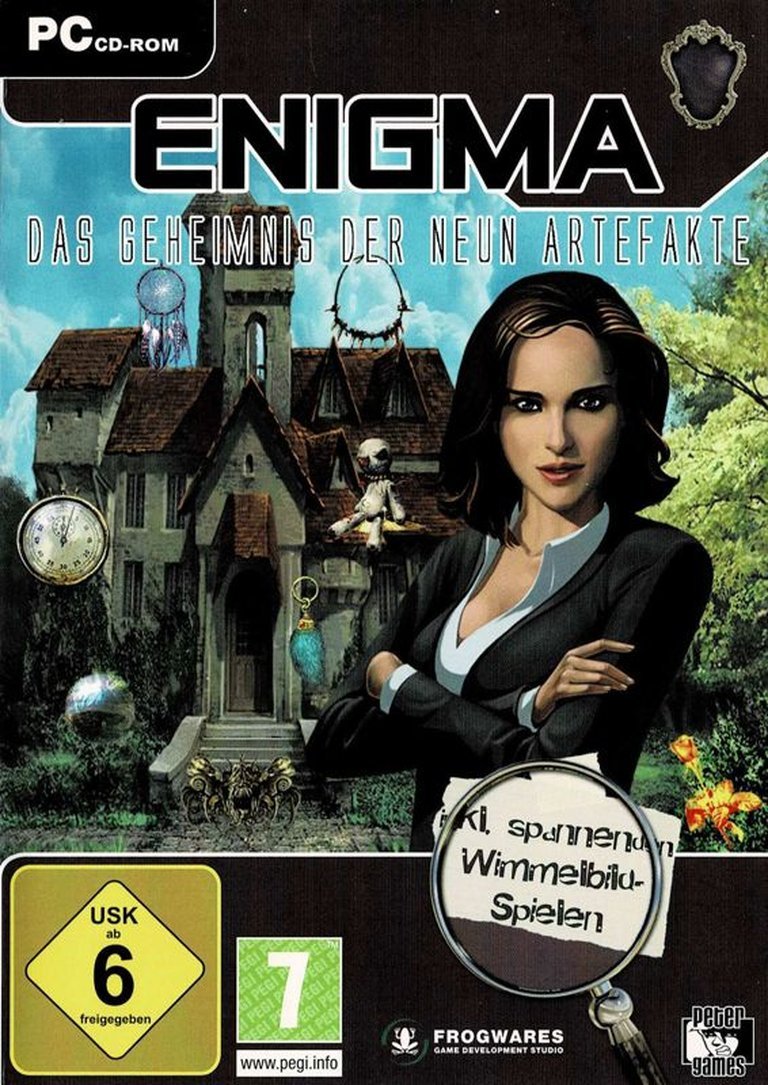
Description
In ‘Department 42: The Mystery of the Nine’, players assume the role of Alice Wright, an agent for a secret government agency that handles supernatural cases. When nine powerful amulets vanish from the magically fortified Grimstone Mansion after a catastrophic fire, Alice is tasked with retrieving them through a blend of hidden object searches and puzzle-solving across atmospheric, static locations in this horror-themed adventure game.
Gameplay Videos
Where to Buy Department 42: The Mystery of the Nine
Department 42: The Mystery of the Nine Free Download
Department 42: The Mystery of the Nine Guides & Walkthroughs
Department 42: The Mystery of the Nine Reviews & Reception
jayisgames.com (90/100): Department 42: The Mystery of the Nine is a great game no matter which angle you view it from.
gamezebo.com : Letâs get this out of the way â shortly after booting up Department 42: The Mystery of the Nine, a new hidden-object game (“HOG”) exclusive from Big Fish Games, I was prepared to give it a solid “A” for its challenging and polished game-play, interesting story, adventure game-like puzzles and outstanding production values.
Department 42: The Mystery of the Nine: A Hybrid Noir
Introduction: The X-Files of Hidden Object Games
In the late 2000s, the casual gaming market was a bustling frontier dominated by simple hidden object games (HOGs) and light adventure hybrids. Into this landscape stepped Frogwares, a studio already revered for its gritty, narrative-driven Sherlock Holmes adventures, with an audacious pitch: Department 42: The Mystery of the Nine. Released in July 2009, this title attempted to fuse the meditative, item-hunting core of casual gaming with the atmospheric storytelling and puzzle complexity of its premium siblings. The result is a game of striking contradictions—visually sumptuous yet mechanically finicky, narratively ambitious yet episodically constrained. As a piece of interactive genre history, it stands as a pivotal, if imperfect, bridge between the casual and hardcore adventure divides, and its legacy is one of both innovation and frustration. This review argues that Department 42 is a fascinating case study in ambition realized within strict genre boundaries, a game whose greatest strengths—its dark, paranormal tone and brilliantly integrated mini-games—are often undermined by a frustratingly precise interaction model, ultimately cementing its status as a cult classic rather than a genre-defining masterpiece.
Development History & Context: Frogwares’ Casual Gambit
To understand Department 42, one must understand Frogwares in 2008-2009. The Ukrainian studio, founded in 2002, had built its reputation on the Adventures of Sherlock Holmes series—dense, first-person investigative games with intricate plots and realistic 3D environments. By 2008, with Secret Mission: Mata Hari and the Kaiser’s Submarines and Dracula: Origin in the pipeline, Frogwares simultaneously ventured into the burgeoning casual market with The Last Case of Benedict Fox (2008) and Department 42 (2009). This was a calculated diversification. The casual market, dominated by publishers like Big Fish Games (which published Department 42 alongside Morphicon), offered lower development costs, faster turnover, and a massive, underserved audience of primarily female players seeking relaxing, story-light gameplay.
Technologically, Department 42 reflects its era and target platform. It eschews the 3D environments of Frogwares’ Sherlock titles for pre-rendered, hand-painted 2D backdrops—a standard for casual HOGs that allowed for staggering visual detail on modest hardware (Pentium 4, 1GB RAM). The “Glimmer” system, where interactive hotspots subtly shimmer, was a direct response to casual players’ frustration with opaque pixel-hunting. The game was built on a proprietary engine optimized for static scenes and simple inventory interactions. Development constraints were clear: maintain a low price point ($9.99 on Steam), ensure playability on a wide range of PCs, and design for a “no pressure” experience (no timers, skip functions for puzzles). Yet, within these constraints, Frogwares infused the game with its signature aesthetic and design philosophy, resulting in a product that feels more like a condensed Sherlock Holmes than a typical casual filler title. Its 2009 release placed it alongside giants like Mystery Case Files and Hidden Expedition, but its thematic grit and puzzle density set it apart.
Narrative & Thematic Deep Dive: Paranormal Procedural
Department 42 presents a premise ripe for serialized storytelling: a clandestine U.S. government agency (“Department 42”) investigates and contains supernatural threats. The player assumes the role of Agent Alice Wright, tasked with retrieving nine powerful, malevolent amulets scattered after a fire at the magically warded Grimstone Mansion. The narrative is structurally case-based, with each artifact retrieval forming a self-contained episode with its own setting, supporting characters (often spectral), and localized mythos.
The plot’s backbone is the MacGuffin chase, but the writing—through notes, diaries, and ghostly dialogues—imbues each case with a distinct folklore flavor. Case 1 (Fang of the Packleader) introduces the core mechanics through a werewolf curse, blending Alchemical processes (mixing blood, saliva, tears) with a tragic personal narrative. Case 2 (Dreamcatcher) delves into Native American spiritualism, featuring a shaman, a Moon Lady, and a sacred grove polluted by litter—a subtle environmental theme. Case 3 (Sleepsand) engages with Haitian Vodou (the spirit Legba) and Appalachian folk magic, requiring the player to brew a potion to cleanse a roadstone altar. Cases 4 through 8 span a car crash temporal anomaly (Stopwatch), a casino haunted by a Lucky Ghost (Rabbit’s Paw), a Kabbalistic golem (Sphere of Life), a haunted dollhouse (Flaming Rose), and a psychic tarot mystery (Mirror of Dreams).
Thematically, the game explores balance and restoration. Each artifact is a force of chaos (werewolf curse, nightmares, time distortion), and the player acts as a restorative agent. The cure for the werewolf isn’t destruction but distillation—a potion that restores humanity. The “Dreamsand” purifies a corrupted spirit. The “Flaming Rose” absolves a ghost’s regret. Even the puzzles often involve repairing something broken: reassembling amulets, restoring runes, fixing machinery. This positions Department 42 not as a destroyer, but as a careful custodian of natural and supernatural order. Alice Wright is a procedural hero; her dialogue is minimal (a notable flaw), but her actions consistently align with a pragmatic, scientific approach to the paranormal—using silver pendants to locate blood, following precise ritual instructions, solving logic puzzles to bypass magical locks. The final case, Case 9 (Eye of Evil), ties the threads together, revealing the artifacts were originally tools of a greater evil and must be used to seal a portal in the rebuilt Grimstone Mansion. The narrative’s weakness lies in its fragmentation—there is no overarching villain or escalating threat until the finale, making the nine cases feel like a anthology rather than a serialized season. Yet, this also allows for a diverse tour of global occult archetypes, from Celtic runes to alchemy to tarot, presenting a “best of” supernatural horror handbook.
Gameplay Mechanics & Systems: The Hybrid Engine
Department 42’s core loop is a meticulously designed, if rigid, hybrid of two dominant casual genres: the Hidden Object Scene (HOS) and the Adventure Puzzle.
-
The Hidden Object Scene (HOS): The bread and butter. Players navigate static, screens where they must find a list of items (typically 12-16) against elaborate, thematically appropriate backgrounds (a smoky bar, a messy trailer, a misty cemetery). The “Glimmer” effect—a subtle sparkle over interactive zones—is a crucial UX feature, guiding players to new HOS or inventory interaction points. Critically, each HOS contains one Key Object that advances the plot and is added to inventory for later use. The object lists are randomized per playthrough, ensuring replayability within a case, but the Key Object remains constant. This design cleverly merges the scavenger-hunt fun of HOGs with the purposeful item-retrieval of adventure games.
-
Adventure Sections & Inventory Puzzles: When not in an HOS, the player explores static screens, using a cursor that changes to indicate possible actions (hand for take, wrench for use, spyglass for zoom). Inventory items are dragged and dropped onto environmental hotspots to solve puzzles. These are often multi-step sequences: e.g., find a handle (HOS) → attach to fridge (adventure) → get ice slab → place on chopping block → use ice pick → retrieve knife. This creates satisfying “aha!” moments tied directly to prior exploration.
-
The Mini-Game Ecosystem: This is where Department 42 truly shines and differentiates itself. There are approximately 20 distinct mini-games, most seamlessly integrated into the narrative as “in-world” activities:
- Deciphering Puzzles: Like the werewolf rune cipher, where players match letters to symbols to reconstruct a potion recipe. It’s a linguistic logic puzzle that feels diegetic.
- Mechanical Puzzles: The “Skull Mirror Puzzle” (Case 1) requires deducing a 3-digit code from environmental clues (reminders like “1=2”, “2=2*triangle”). It’s a deductive reasoning task.
- Tile-Matching Games: The Othello/Reversi variant against Legba (Case 3) and the “36” dice game with the Shaman (Case 2). These introduce a light strategy element.
- Assembly Puzzles: Reconstructing the broken eagle amulet (jigsaw), assembling the Roadstone magic symbol, or the Runic Chest (placing runes so rows/columns add to 15). These are pure spatial/logic challenges.
- Pattern Recognition: The “Spot the Difference” photo puzzle (Case 7) and the Card Recall mini-game in the Mirror of Dreams case, where players must memorize and replicate a fading card pattern—a test of short-term memory.
- Logic Grids: The final “Sigil Elimination” puzzle (Case 9) is a sophisticated variant where colored sigils must be collided (like SameGame) to clear the board in a limited number of moves, requiring forward planning.
The genius is that these aren’t jarring interruptions; they are framed as the “real” work of the agent—decoding runes, negotiating with spirits, repairing magical devices. The skip button (yellow, on a timer) is a generous accessibility feature, acknowledging that not all players will enjoy or succeed at every puzzle type.
-
Flaws & Friction: The primary mechanical flaw, heavily noted in the GameZebo review and walkthrough discussions, is hyper-sensitive click detection. In HOS, items often require clicking on a specific pixel cluster, not just the general object (e.g., the corkscrew’s handle vs. its shaft). This transforms a relaxed activity into a test of frustration. The cursor’s “skinny finger” tip must be precisely positioned. Coupled with randomly generated item lists, some scenes can devolve into tedious pixel-hunting. A secondary flaw is the inability to right-click to return inventory items to the scene, forcing players to either use them or manually drag them back to the inventory bar—a small but persistent UI annoyance.
-
Progression & Pacing: The game is divided into nine cases, each with a self-contained map of 2-3 locations (e.g., “Crime Scene,” “Bar,” “Werewolf’s Lair”). Objectives are listed at the bottom, and a map allows fast travel. Progress is gated by completing required tasks, which often circle back: a Key Object from HOS A unlocks a puzzle in location B, whose reward then enables a new HOS in location C. This creates a natural, looping progression that prevents getting permanently stuck, as the game constantly opens new avenues.
World-Building, Art & Sound: A Hauntingly Detailed Canvas
Frogwares’ artistic pedigree is on full display. The game’s visual direction uses painted 2D backdrops of remarkable density and atmospheric lighting. The Grimstone Mansion ashes, the moonlit werewolf’s lair, the mist-shrouded Native American reservation, the grim industrial car dump—each locale has a distinct, saturated color palette and meticulous object clutter that tells a story. The “Glimmer” effect is not just functional but atmospheric, like magical residue on important objects. Character portraits for ghosts and NPCs are beautifully rendered, though animations are limited to basic fades and simple movements.
The sound design complements the visuals perfectly. A low, ambient drone often underscores scenes, punctuated by subtle environmental sounds (crickets, wind, creaking wood). The musical score, while not memorable as a standalone album, effectively builds tension and unease, leaning on minor chords and sparse instrumentation. Sound cues are used well—the hiss of the fire extinguisher, the clink of the alchemist’s glassware, the echo in the mansion halls. Together, art and sound create a cohesive, immersive horror-mystery tone that is rare in casual games, which often opt for bright, cheerful aesthetics. This is a game about dread and mystery, and its presentation fully commits to that.
Reception & Legacy: A Cult Classic’s Path
Upon release, Department 42 met with modest critical reception. The sole critic score on MobyGames (70% from GameZebo) summarized the consensus: praise for its “challenging HOG with adventure puzzles,” “great mini-games,” and “attractive graphics,” but criticism for “confusing items,” “clicking precision,” and the inability to play as a male protagonist (a curious, minor note reflecting early 2000s gender inclusivity debates). Player ratings are similarly mixed (2.8/5 on MobyGames), with common praise for its depth and complaints about finicky interactions.
Commercially, as a shareware/digital download title from Big Fish Games, it likely sold respectably within the casual ecosystem but did not achieve breakout success. Its legacy is therefore niche but influential:
1. Hybrid Genre Pioneer: It demonstrated that a casual HOG could support complex, non-timed puzzle integration without alienating its core audience. The mini-game variety became a template for later Frogwares titles and influenced other studios to enrich their HOGs with more substantial puzzles.
2. Atmospheric Benchmark: It set a new standard for visual and tonal maturity in casual adventures, proving that “casual” did not necessitate “cartoonish” or “lighthearted.”
3. Studio Identity Bridge: For Frogwares, it was a successful experiment that allowed them to fund their premium Sherlock Holmes projects. The detailed art and puzzle design sensibilities honed here would later refine their flagship series.
4. Cult Endurance: Today, it is remembered fondly by adventure game enthusiasts who appreciate its dense puzzles and mood. Walkthroughs are still actively maintained on sites like Jayisgames and GameZebo, and it is frequently cited in “underrated casual adventures” lists. Its flaws—especially the click detection—are part of its character, a cautionary tale about the importance of UX polish even in narrative-focused games.
Conclusion: A Flawed Gem of the Casual Renaissance
Department 42: The Mystery of the Nine is not a flawless masterpiece. Its episodic structure dilutes narrative tension, its click detection can provoke genuine anger, and its protagonist is a silent cipher. Yet, to dismiss it on these grounds is to overlook its considerable achievements. Within the tight confines of the 2009 casual market, Frogwares delivered a game of surprising depth, weaving a global tapestry of supernatural folklore, a bestiary of cleverly integrated mini-games, and a consistently oppressive, beautiful atmosphere. It respected players’ intelligence, demanding logical deduction, pattern recognition, and careful observation.
In the grand canon of video game history, it does not rank alongside the era’s seminal titles. But in the specific sub-history of the adventure game’s evolution into the casual space, it is a significant milestone. It proved that casual games could be moody, complex, and mechanically varied without losing accessibility. It stands as a testament to Frogwares’ versatility and a reminder that genre boundaries are meant to be bent. For the patient player willing to forgive its pixel-perfect demands, Department 42 offers a rich, nine-chapter paranormal procedural that remains a haunting and engaging experience over fifteen years later. Its place is secure as a cult classic—a game whose ambition slightly outstripped its execution, but whose heart, art, and puzzle-craft were unquestionably in the right place.
Final Verdict: 3.5 out of 5
An atmospheric, puzzle-rich hybrid adventure held back by frustratingly precise interactions. A must-play for genre enthusiasts, a cautionary tale for designers.