
- Release Year: 1997
- Platforms: SEGA Saturn, Windows
- Publisher: SEGA Enterprises Ltd., Sega Sports Japan, Tec Toy Indústria de Brinquedos S.A.
- Developer: Sega Sports Japan, SIMS Co., Ltd.
- Genre: Sports
- Perspective: Diagonal-down
- Game Mode: Single-player
- Average Score: 95/100
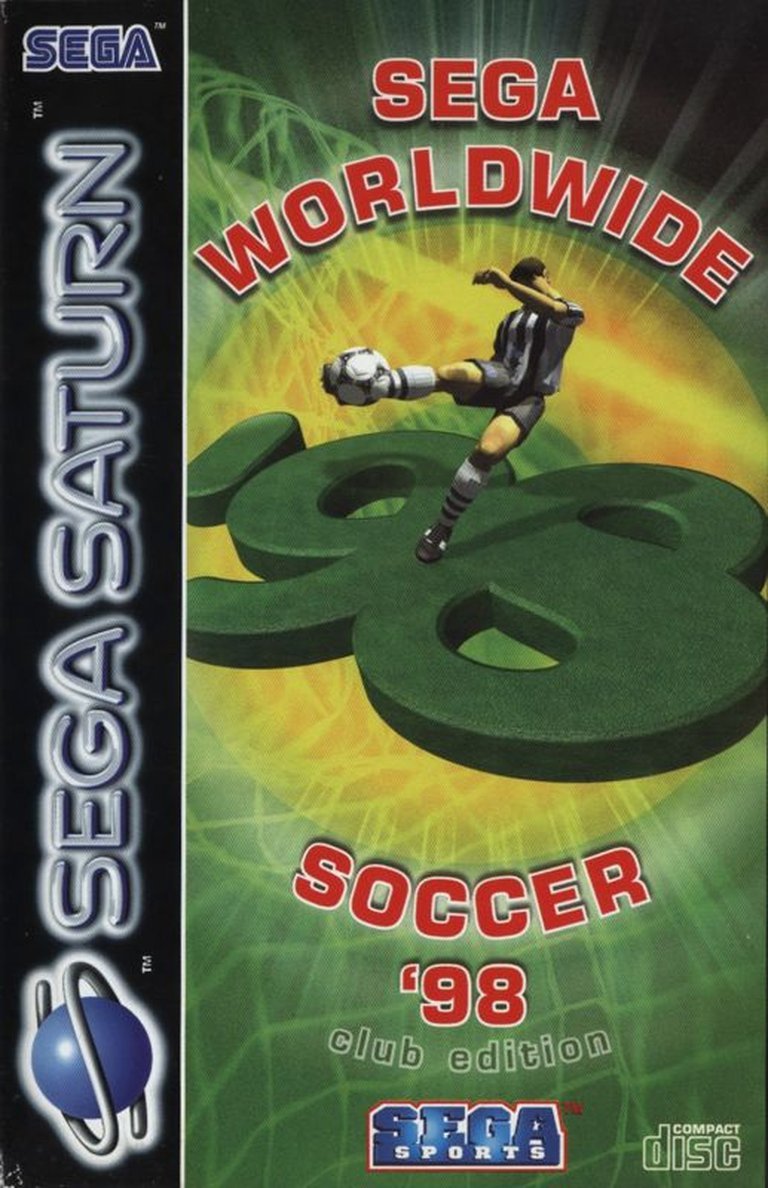
Description
SEGA Worldwide Soccer ’98 is a soccer simulation video game for the SEGA Saturn and Windows that expands on its predecessor by adding club teams from England, Spain, and France, bringing the total to 60 club teams alongside 48 international teams. It features two new stadiums, improved animations, faster gameplay, and commentary by Gary Bloom and former England international Jack Charlton, with modes including Friendly matches, Club exhibitions, and Worldwide Cup, though it lacks full licensing except for the English league.
Gameplay Videos
SEGA Worldwide Soccer ’98 Patches & Updates
SEGA Worldwide Soccer ’98 Mods
SEGA Worldwide Soccer ’98 Reviews & Reception
thesaturnjunkyard.blogspot.com (95/100): SWWS ’98 is undoubtedly the best Saturn soccer game around.
sega-zone.com (95/100): WWS ’98 is undoubtedly the best Saturn soccer game around.
SEGA Worldwide Soccer ’98: The Beautiful Game, Frozen in Time
Introduction: A contender for the crown, forever caught in the shadow of giants
In the pantheon of 1990s football video games, the late 1990s are remembered as a violent, tectonic shift in the landscape. It was the era where EA Sports’ FIFA series began its relentless march toward global domination, and where Konami’s International Superstar Soccer (ISS) on the Nintendo 64 carved out a revered niche with its deep, simulation-minded gameplay. Trapped in this crossfire, on a console fighting for its life, was Sega’s SEGA Worldwide Soccer ’98 (WWS ’98). It is a game that embodies a critical paradox: a title often dismissed at the time as a merely iterative “update” yet fervently revered by a核心 cohort of Sega Saturn enthusiasts as arguably the console’s greatest pure sports experience, and perhaps one of the most fun football games ever made. This review will argue that WWS ’98’s legacy is not one of revolutionary design, but of perfected execution within a specific, Arcade-oriented philosophy. It is a masterclass in “feel”—in the tactile joy of passing, the satisfying crack of a long shot, and the free-flowing rhythm of a match—that was tragically out of step with the industry’s accelerating push toward bureaucratic realism. To understand WWS ’98 is to understand a specific moment where Sega’s arcade DNA produced a football game of sublime, timeless playability, forever preserved on a fascinating, failed console.
Development History & Context: The Last Stand on the 32-Bit Battlefield
Developed by SIMS Co., Ltd. in collaboration with Sega Sports Japan, WWS ’98 was not a ground-up creation but a deliberate, focused iteration. It utilized the exact same core game engine as its predecessor, Sega Worldwide Soccer ’97. This was not a secret; it was a stated design philosophy. In an era where annual sports releases were expected to overhaul graphics and mechanics, Sega chose a different path: to refine, to polish, and to expand the package around a gameplay foundation they believed was already exceptional. The development was reportedly rushed, a common tale in the twilight years of the Saturn’s commercial life, leading to a notorious technical flaw: the English commentary stutter. As documented on Wikipedia, the English sentences were longer than their Japanese counterparts, requiring more sound buffer memory. Due to the rushed schedule, this issue was never fixed, resulting in Gary Bloom and Jack Charlton’s commentary cutting in and out with a robotic staccato—a charming, if jarring, artifact of its production constraints.
The game’s most significant conceptual addition was the inclusion of club teams from England, Spain, and France, a total of 60 club sides supplementing the 48 international teams. Crucially, only the English Premier League featured real player names (a late-era licensed coup), while the Spanish and French leagues used fictionalized names. This was facilitated by a robust in-game name editor, a hallmark of the series that allowed users to manually correct or customize rosters—a quiet nod to the hardcore fan neglected by official licensing. The game also featured a high-profile spokesperson in US international Cobi Jones, whose advisory role lent stateside credibility. Musically, it boasted a score by the esteemed Richard Jacques, a Sega stalwart whose work on Saturn titles like Sonic R and Nights into Dreams… was iconic.
The context of its November 1997 (NA) / October 1997 (EU) release was one of Saturn isolation. The console was commercially struggling against the PlayStation and N64, and third-party support was evaporating. Football gamers on Saturn had few options: Sega’s own series, and ported versions of FIFA that often lagged behind their console counterparts. WWS ’98 entered a ring where International Superstar Soccer 64 (released earlier in 1997) had already set a new benchmark for depth and realism on Nintendo’s platform, and where FIFA: Road to World Cup 98 was looming on the horizon for multiple systems, including Saturn. Sega’s task was not to reinvent, but to provide the definitive football experience for Saturn owners, leveraging the console’s unique strengths.
Narrative & Thematic Deep Dive: The Simulation of Spectacle
Unlike narrative-driven games, sports titles construct their “story” through simulation, atmosphere, and the emergent tales of each match. WWS ’98’s “narrative” is the ritual of football itself, meticulously reconstructed through three interconnected pillars: Authenticity through Licensing, The Authority of Commentary, and The Arcade Spectacle.
-
Authenticity through Licensing (and its Limits): The game’s most potent thematic tool is its partial embrace of reality. The inclusion of the real English Premier League—with correct player names, kit colors (to a point), and stadiums—was a monumental draw. It wasn’t just a list of teams; it was a direct portal to the具体 culture of 1990s English football. For a European player, seeing “Manchester United,” “Liverpool,” and “Arsenal” with players like Eric Cantona and Alan Shearer (names accurate to the period) was a powerful validation. This stood in stark contrast to the fully fictional “World” teams. The thematic tension arises from the limits of this license. No official badges, no stadium licenses (except generic replicas), and the omission of the Spanish and French leagues’ real names created a hybrid reality. This reflected the messy, transitional state of football video game licensing at the time—a world of “MNM” for Manchester United downstream from EA’s exclusive deals. The name editor thus becomes a crucial narrative tool, a DIY kit for enhancing authenticity, allowing the player to “complete” the simulation Sega couldn’t afford to build.
-
The Authority of Commentary: The commentary duo of Gary Bloom and Jack Charlton is the game’s primary narrative voice. Bloom, the seasoned professional from Football Italia, provides the steady, excitable play-by-play. Charlton, the 1966 World Cup winner, is the “expert analyst,” meant to lend gravitas and tactical insight. Their dynamic is the game’s attempt to mimic the television broadcast experience. However, the stuttering audio bug fundamentally undermines this. Charlton’s lines, in particular, often cut out mid-sentence, robbing him of any authority and rendering his contributions disjointed and unintentionally comical. This technical failure fractures the illusion of a seamless broadcast, constantly reminding the player of the game’s digital, limited nature. It creates a bizarre dichotomy: the desire for a realistic,TV-style presentation is perpetually at odds with the reality of Saturn’s hardware constraints and development rush.
-
The Arcade Spectacle: Counterbalancing the push for authenticity is the game’s undeniable arcade soul. This is expressed in the slick, over-the-top goal celebration animations (players running “like headless chickens”), the vibrant, clean stadium visuals, and the fast, forgiving physics. The game doesn’t simulate the frustration of a 0-0 draw; it simulates the thrill of a 5-4 thriller. The removal of the scoreboard FMVs from WWS ’97—a quintessentially arcade, fun-first feature—was a puzzling step back toward “serious” simulation, a move critics and fans (like the Saturn Junkyard blogger) lamented as a loss of personality. The theme, therefore, is a game caught between two impulses: the documentarian impulse (real leagues, real commentators) and the arcade impulse (fast gameplay, spectacle). It ultimately leans into the latter, where its lasting love is rooted.
Gameplay Mechanics & Systems: The “Feel” is Everything
If WWS ’98 has a thesis, it is this: Football is fun first, simulation second. Its genius lies in a deceptively simple control scheme that yields immense depth.
-
Core Controls & The “Feel”: The mapping is elegant. A = Shoot/Slide Tackle, B = Pass/Shoulder Charge, C = Lob/Volley, X = Bring Goalkeeper out. The right shoulder button is the pivotal sprint button. This simplicity is deceptive. Mastery comes from learning the nuanced differences between a B-pass (short, crisp) and a C-lob (arching, long), and the situational use of the shoulder charge versus a slide tackle. The game’s pace is deliberately accelerated compared to both ISS64 and FIFA. Players sprint with urgency, passes zip, and shots fly. This creates a fluid, end-to-end rhythm that prioritizes attacking play and reactive defending. The ball physics are predictable and smooth, allowing for precise through-balls and satisfying curling efforts.
-
The Flaws in the System: This emphasis on fun comes at the cost of certain “sim” elements, which critics rightly flagged.
- Goalie AI: Universally cited as a weak point. Keepers are either spectacular on close-range shots or comically inept on lobs and long-range efforts, creating an unbalanced scoring meta.
- Tactical Rigidity: The inability to make in-game tactical substitutions or formation changes during breaks in play (a major EGM complaint) was a glaring omission compared to rivals. Management is confined to pre-match menus.
- Referee Leniency: As noted in the Saturn Junkyard review, the referee is unusually forgiving, reducing the strategic tension of managing disciplinary issues.
- AI Repetition: While teams feel different in skill, the core AI patterns are shared, leading to a sense of playing the same “brain” with different jersey colors over a long club league season.
-
Game Modes: The suite is comprehensive: Friendly, Club Exhibition, Worldwide Cup (international), Club League (for the licensed leagues), Cup Tournament, and Penalty Shootout. The Club League mode is the star, offering a full season’s worth of matches with promotion/relegation logic (for the English league at least). The longevity here is immense, a key part of its addictive quality.
World-Building, Art & Sound: A Vibrant, Imperfect Saturn Showcase
-
Visuals & Presentation: WWS ’98 is a masterclass in 2D sprite-based football on the Saturn. Using the same rotational sprite technology as its predecessor, player models are large, detailed, and racially accurate—a specific improvement over ’97 that critics praised. Animations for dribbling, shooting, and tackling are fluid and expressive. The seven stadiums (five from ’97 plus two new ones) are beautifully rendered with detailed stands, floodlights, and pitchside advertising hoardings. Weather (rain) and time of day (day, night) affect the visuals, with wet pitches visibly darker. The presentation is clean, with sharp menus and a slick intro sequence set to Richard Jacques’ iconic, synth-driven theme. The infamous stadium rotation during commentary reveals ugly texture pop-in, a minor but noticeable Saturn limitation.
-
Sound & Music: Jacques’ soundtrack is a highlight—upbeat, melodic rock/tracks that perfectly suit the arcade tone. The commentary, when it works, is superb. Gary Bloom’s voice is the sound of 90s football broadcasting. Jack Charlton’s contributions are less frequent and, due to the stutter, less impactful. The stuttering bug is the singular major audio flaw, a constant reminder of the development crunch that soured an otherwise excellent soundscape. The crowd noise is generic but effective, rising and falling with the action.
Reception & Legacy: The “Updates That Mattered” Debate
Contemporary reception was markedly mixed, largely hinging on the “updates vs. innovation” debate.
- The Critical Divide: Scores ranged from 55% (EGM) to 95% (Consoles Plus). The consensus among major outlets (EGM, Sega Saturn Magazine, GamePro) was that the changes from ’97 were too insubstantial. The addition of club teams was welcome, but the core gameplay, graphics, and persistent flaws (goalie AI, no in-game tactics) were seen as unchanged. EGM’s John Ricciardi’s quote—”pretty much the same game as last year with some annoying faults”—became a refrain. Sega Saturn Magazine‘s verdict, “little to justify purchasing… if you already own the ’97 edition,” was lethal for sales momentum.
- The Exceptionalists: Next Generation stood out, arguing that “Sega has made a wise decision to leave well enough alone… stuffed enough little features… to make it a worthy update.” This view has gained retrospective traction. Game Informer (9/10) and the French publication Consoles Plus (95%) were overwhelmingly positive, focusing on the sublime playability.
- The Cult of the Saturn Junkyard: In the years since, a powerful revisionist appreciation has emerged, epitomized by the passionate Saturn Junkyard article. This perspective reframes the “lack of change” as a virtue: Sega perfected a beloved engine instead of breaking it. The game’s “feel,” its pure, unadulterated fun, is held up as superior to the more complex, sometimes sluggish, simulations of ISS64 and later FIFAs. Its low cost and high availability on the collectors’ market has only burnished this reputation. It is seen as the last great football game on the Saturn, a console whose library was otherwise abandoned by major sports publishers.
Its legacy is therefore paradoxical. Commercially and critically in 1997/98, it was seen as a disappointing iteration, contributing to the narrative of Sega’s mismanagement of the Saturn. Historically, it is remembered not as a trendsetter, but as the culmination of an arcade-football ideal that faded with the transition to 3D polygons and exhaustive licensing wars. It represents a “what if” scenario: what if Sega had continued this refined, fun-first approach on the Dreamcast instead of outsourcing the series? Games like UEFA Dream Soccer (2000) tried to fill that void but never captured the same magic. WWS ’98 is the pinnacle of a specific design philosophy that valued immediate, joyous play over years-long franchise modes and statistical depth.
Conclusion: A Flawed Masterpiece of a Bygone Era
SEGA Worldwide Soccer ’98 is not the best football game of 1997. That title arguably belongs to International Superstar Soccer 64. It is not the most influential, nor the most feature-rich. Its commentary stutters, its goalies are dumb, and you cannot tweak tactics at halftime. Yet, to reduce it to a footnote—a mere “update”—is to miss its profound, enduring achievement.
It is, in the purest sense, a masterpiece of game feel. From the moment you press the sprint button and your player surges forward, to the crisp thwack of a perfectly timed pass, to the euphoria of a curled shot rippling the net, it operates on a wavelength of pure, uncomplicated joy. It understands that the beauty of football lies in its flow, its speed, and its capacity for last-minute drama, and it engineers its mechanics to service that drama relentlessly.
Its legacy is locked to the Sega Saturn, a console synonymous with idiosyncratic, passionate, and often flawed exclusives. Within that library, it stands shoulder-to-shoulder with Nights into Dreams… and Panzer Dragoon II as a title that leveraged the hardware’s specific strengths (2D sprite scaling, audio channels) to create an experience impossible on its rivals. For historians, it is a vital case study in iterative design and platform-specific optimization. For players, it is a time capsule of a simpler, more immediately gratifying approach to sports gaming.
The verdict is this: SEGA Worldwide Soccer ’98 is a flawed, incomplete, and technically compromised masterpiece. It is the greatest football game you can play on a Sega Saturn, and one of the most pleasurable 30-minute bursts of virtual sport ever crafted. Its status as a “classic” is not despite its limitations, but because of its unwavering commitment to a single, brilliant idea: that a football game should, above all else, be an absolute blast to play. In an era increasingly obsessed with simulation minutiae, that defiant, arcade-hearted spirit is why we still speak its name with reverence.