
- Release Year: 2016
- Platforms: Windows
- Publisher: iam8bit, Inc.
- Genre: Special edition
- Average Score: 85/100
Description
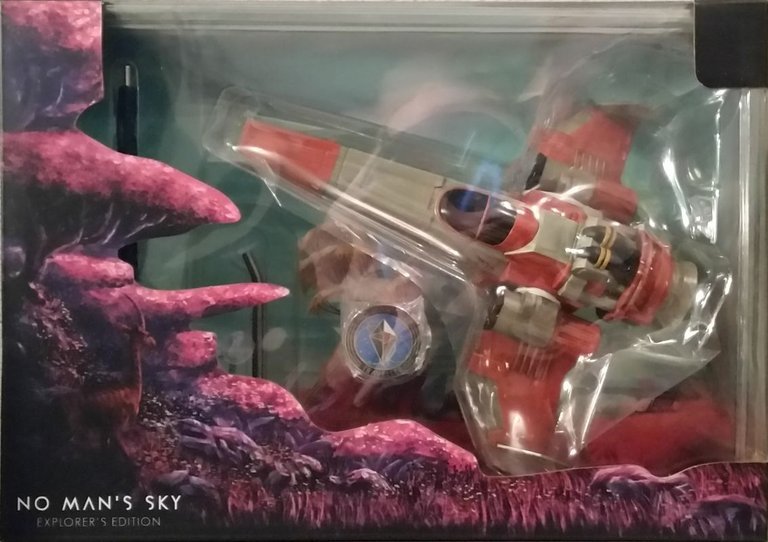
No Man’s Sky: Explorer’s Edition is a limited-run special edition of the acclaimed action-adventure survival game, set in a vast procedurally generated universe with over 18 quintillion planets, each featuring unique ecosystems, flora, and fauna. Players explore, mine, trade, and combat to survive while uncovering the mystery of The Atlas, and this edition enhances the experience with exclusive physical collectibles like a hand-painted ship replica, hard-enamel pin, and Atlas Traveller’s Log, packaged in a limited edition box for dedicated fans and collectors.
No Man’s Sky: Explorer’s Edition Reviews & Reception
metacritic.com (100/100): No game, film, book or otherwise has been more effectively in capturing what the experience of exploring the universe must be.
metacritic.com (80/100): It brings a relaxing gameplay design that is geared more towards exploration, rather than sci-fi action.
metacritic.com (75/100): Hello Games’ procedural dream is becoming a reality, but we’ll probably need to wait months/years to see the process completed.
metacritic.com (70/100): Hello Games achieved what they set out to do by crafting a massive galaxy for players to explore.
metacritic.com (70/100): No Man’s Sky’s journey across a massive proc
metacritic.com (100/100): Anybody who reviewed it negatively before 2024 should come back and try it again. It’s delivered on everything people want and more.
ign.com : This ambitious universe is big and often beautiful, but too frequently dull.
No Man’s Sky: Explorer’s Edition Cheats & Codes
PC
Open the console by pressing the tilde (~) key and enter the cheat codes.
| Code | Effect |
|---|---|
| give_all | Provides a substantial amount of every resource in the game. |
| money 99999999 | Grants the maximum amount of in-game currency (99,999,999). |
| unlock_all_tech | Enables all technology modules for suit, ship, and multitool. |
| free_crafting | Allows crafting items without resource costs. |
| god_mode | Makes the player invincible to damage from enemies and environment. |
| upgrade_ship | Instantly upgrades the ship to the highest level. |
| spawn_item [item name] [quantity] | Spawns the specified item in the desired quantity by replacing placeholders. |
| set_weather [weather type] | Changes the planet’s weather to the specified type (e.g., clear, stormy, rainy). |
| photo_mode | Activates photo mode, pausing the game and removing the HUD for screenshots. |
No Man’s Sky: Explorer’s Edition: A Celestial Time Capsule from the Brink of Infinity
Introduction: The Promise and the Paradox
In the pantheon of video game sagas, few narratives are as compelling, turbulent, and ultimately redemptive as that of No Man’s Sky. The Explorer’s Edition is not merely a collector’s bundle; it is a physicalartifact crystallizing a pivotal moment in gaming history—the chaotic, hopeful, and deeply flawed launch of a title that dared to sell a universe. Released in a limited run of 10,000 copies alongside the PC version in late 2016, this special edition, curated by iam8bit, exists at the intersection of astronomical ambition and terrestrial disappointment. It represents both the zenith of pre-launch hype (“a game with 18 quintillion planets!”) and the nadir of player trust following a launch marred by missing features and poor communication. This review will dissect the Explorer’s Edition not as a standalone product, but as a lens through which to understand No Man’s Sky’s tumultuous journey: from its origins in a tiny studio’s dream, through the fiery crucible of its 2016 debut, and into its astonishing, decade-long metamorphosis into one of gaming’s most profound comeback stories. The thesis is clear: the Explorer’s Edition is a poignant, beautiful, and ironic monument to a game that was both vastly over-promised and, against all odds, eventually over-delivered.
Development History & Context: The Dream of a Billion Suns
No Man’s Sky was the brainchild of Sean Murray and Hello Games, a small British studio previously known for the Joe Danger series. Murray, inspired by the optimistic sci-fi covers of the 1970s and 80s (artists like Chris Foss) and the exploratory spirit of classics like Elite and Star Control II, wanted to create a game that captured that same sense of wonder and scale. The technical achievement was staggering: a procedurally generated, deterministic universe of 18 quintillion planets, built from a single 64-bit seed using algorithms that could mimic geological and biological forms. This was not a “sandbox” in the traditional sense, but a mathematical cosmos where every atom was calculated in real-time as the player approached.
The context of its development is crucial. Hello Games was a team of about a dozen, operating under immense pressure and with Sony Interactive Entertainment providing promotional muscle. The narrative they sold was intoxicating: a small indie team using clever math to create a universe vaster than any AAA megaproject. The 2014 E3 reveal, where the game “stole the show,” set expectations at stratospheric levels. However, this very scope became a trap. As noted by developers like Kate Compton (who worked on Spore‘s procedural systems), the game suffered from a form of “procedural oatmeal”—the engine could generate infinite planets, but from a finite set of artistic assets and rules, leading to a feeling of repetitive novelty. The Explorer’s Edition itself, with its focus on a single, tangible ship replica, ironically highlights this tension: it celebrates the unique, the crafted object (the hand-painted metal ship) within a system designed to mass-produce procedural uniqueness.
Narrative & Thematic Deep Dive: The Simulation, the Atlas, and the Traveller
At launch, No Man’s Sky‘s narrative was thin, cryptic, and easily missed—a point of major criticism. The Explorer’s Edition‘s inclusion of the “Atlas Traveller’s Log” and Fisher Space Pen directly engages with this lore, framing the player as a “Traveller” on a purposeful, if enigmatic, journey. The core plot, unraveled through monoliths, interfaces, and alien encounters, posits a shocking revelation: the entire galaxy is a simulation managed by a dying AI, The Atlas. The Travellers are its creations, tasked with exploration to grant the universe meaning and delay its heat death.
The themes are profound: existential exploration, the nature of creation vs. creator, and the search for purpose in an infinite, seemingly indifferent cosmos. The narrative is not about saving a princess, but about confronting the nature of reality itself. The choice at the galaxy’s core—to restart the simulation or reject it—is a meta-commentary on the player’s own role: are you a participant in a cycle, or an agent of finality? The Artemis/Apollo/-null- subplot adds a layer of tragic humanity, a echo of lost connection that the Traveller can potentially rectify. The Explorer’s Edition‘s logbook, intended as a “mystery item,” perfectly mirrors this in-game artifact: it’s a physical record for a digital journey, a tool for documenting the infinite, directly tying the collector’s act to the Traveller’s core mechanic of “uploading” discoveries to The Atlas.
Gameplay Mechanics & Systems: The Eternal Loop and Its Evolution
The base gameplay loop at launch was brutally simple, and for many, monotonous: Survive, Mine, Craft, Travel, Repeat. Players managed hazardous environments with exosuit protections, mined resources with the multitool, crafted upgrades from blueprints, and fueled their ship for hyperspace jumps toward the galactic center. The four pillars—exploration, survival, combat, trading—were present but shallow.
- Exploration: The grand promise. The procedural generation created breathtaking vistas and bizarre creatures, but as New Scientist and critics noted, it quickly revealed its combinatorial limits. You might see 10,000 variations on a “pine tree with eyes,” but after a while, you saw the pattern. The thrill of “first discovery” and naming flora/fauna was potent but finite.
- Survival & Crafting: A resource-management treadmill. Inventory slots were painfully limited, forcing constant juggling. Crafting required hunting for specific blueprints, often the most grindy part of the loop. The survival elements were more nuisance than deep challenge.
- Combat: Rudimentary. Fended off Sentinels (the planetary police) with a multitool; space combat with pirates was functional but simplistic.
- Trading & Economy: A basic free-market system where resource values fluctuated by system. It encouraged cargo-hauling but lacked depth.
The Explorer’s Edition contains no gameplay advantages. The “Omega Horizon” ship was a pre-order exclusive cosmetic, a flashier vessel for those who wanted to traverse the cosmos in style from day one. This is key: the edition was never about mechanical exploration, but thematic and aesthetic ownership.
The game’s legendary redemption arc is written in its updates. Each major patch—Foundation (base-building), Pathfinder (exocraft, permadeath), Atlas Rises (story expansion, rudimentary co-op), Next (full multiplayer, fleet management), Beyond (VR), Origins (biome overhauls), and Voyagers (customizable capital ships)—systematically addressed launch criticisms. The gameplay evolved from a solitary survival hike into a vast, social, creative sandbox. Base-building became intricate; frigate fleets could be commanded; settlements could be managed; living ships and mechs added new traversal paradigms. The core loop remained, but it was now padded with purpose: building empires, curating fleets, hunting for specific ship designs, and, most importantly, playing with others.
World-Building, Art & Sound: The Aesthetic of Infinite Solitude
No Man’s Sky’s enduring power lies in its aesthetic cohesion. The visual direction, guided by artists like Grant Duncan and Jake Golding, embraced a stylized, vibrant sci-fi realism. Planets were not photorealistic but felt plausible—amber deserts, cerulean oceans, neon fungal forests. The color palette was often saturated, evoking those iconic 70s/80s book covers. The procedural generation, while repetitive in assets, could still conjure moments of breathtaking, alien beauty that felt genuinely new.
The sound design was equally pivotal. The ambient soundtrack, co-created by 65daysofstatic and audio designer Paul Weir, was itself procedurally generated from samples, ensuring the music shifted seamlessly with the environment—droning, atmospheric tones on barren worlds, more rhythmic pulses on inhabited ones. It was a masterclass in using audio to sell scale and loneliness. The Explorer’s Edition‘s physical components—the pin, the logbook—are direct aesthetic extensions of this world. The hand-painted cast metal ship (1:35 scale) is not just a model; it’s a translation of the game’s digital, procedural geometry into a singular, crafted physical object. It’s a testament to the idea that even in an infinite, algorithmic universe, one can possess a specific, meaningful artifact. The “Fisher Space Pen” is a nod to real-world exploration tools, bridging the gap between our history and the game’s fictional one.
Reception & Legacy: From Pariah to Paragon
The Explorer’s Edition launched into a firestorm. No Man’s Sky’s initial Metacritic scores were middling (PS4: 71, PC: 61). The backlash was immense and multi-faceted:
1. Missing Features: Promised multiplayer, complex space stations, and meaningful alien interactions were absent. The infamous “sticker controversy” (covering the PEGI online icon on the PS4 limited edition) symbolized the deception.
2. Technical Issues: The PC launch was particularly rough, with crashes and poor performance.
3. Communication Blackout: Hello Games went silent for months after launch, allowing negative narratives to dominate. Murray later admitted they underestimated player count (500,000+ at launch vs. an expected 10,000) and were overwhelmed.
4. The “Bullshotting” Paradigm: The game became the poster child for marketing that showcased features not present at launch. This directly influenced industry practices; The Game Awards and Valve’s Steam storefront policies changed to require more representative footage.
Yet, the legacy of No Man’s Sky is defined by its response. Hello Games adopted a policy of silence followed by massive, free updates. They listened, rebuilt, and expanded. By its 5-year anniversary, Steam reviews had swung from “Overwhelmingly Negative” to “Mostly Positive.” By 2024, they were “Very Positive.” It is now consistently cited as the greatest redemption arc in gaming (IGN, TechRadar, TheGamer). Its influence is twofold:
* As a Cautionary Tale: It became the “post-No Man’s Sky world” benchmark for managing hype. Studios like Compulsion Games (We Happy Few) and Novaquark (Dual Universe) explicitly cited it as a reason to embrace early access and transparent communication.
* As a Template for Live Service: Its model of large, free, transformative updates (akin to Minecraft or Destiny) proved that a game could be reborn without paid DLC or sequels, purely through sustained developer commitment.
The Explorer’s Edition now exists in this context. It is a curio from the eye of the storm. For collectors, it’s a beautiful, rare item. For historians, it’s a snapshot of a game at its most vulnerable and hyped moment—a physical embodiment of promises made and broken, sitting alongside the digital version that would, through sheer persistence, become something wonderful.
Conclusion: Verdict and Place in History
The No Man’s Sky: Explorer’s Edition is not a review of the game as it is today (a sprawling, cross-platform, VR-capable universe teeming with features), but a historical document of the game as it was promised and as it launched. Evaluated on its own merits as a collector’s item, it is exceptional. The hand-painted ship replica is a work of art, the diorama backdrop evokes the game’s iconic vistas, and the physical logbook and pen are thoughtful, thematically perfect inclusions. The £150/$150 price tag (at launch) reflected its limited, premium nature.
However, its value is now entirely molecular and historical. In 2016, buying this edition was an act of faith in a vision that the shipped software did not fulfill. Today, it is a poignant relic from the dawn of a legend. It represents the peak of a particular kind of gaming ambition—the “infinite universe” dream—and the catastrophic consequences of allowing that dream to outpace reality.
Final Verdict: As a game component, 0/5. As a piece of gaming history and a collector’s artifact, 5/5. The Explorer’s Edition is a beautiful, ironic, and ultimately poignant time capsule. It captures No Man’s Sky at its most controversial, standing in stark contrast to the serene, content-rich universe it would eventually become. It is not just a special edition of a video game; it is a monument to hubris, hardship, and hard-won redemption. For the historian, it is indispensable. For the fan, it is a cherished trophy of a journey both digital and literal. For the industry, it remains the ultimate lesson in the perils of hype and the power of perseverance. The game finally achieved the “infinite universe” it promised, but the Explorer’s Edition will forever be the artifact from the moment it was just a promise written in the stars—and on a sticker-covered box.