
- Release Year: 2003
- Platforms: Macintosh, Windows
- Publisher: CASHFLOW Technologies, Inc.
- Developer: Quicksilver Software, Inc.
- Genre: Strategy, Tactics
- Perspective: 3rd-person
- Game Mode: Hotseat, Online PVP, Single-player
- Gameplay: Asset Management, Board game, Trading, Turn-based
- Average Score: 0/100
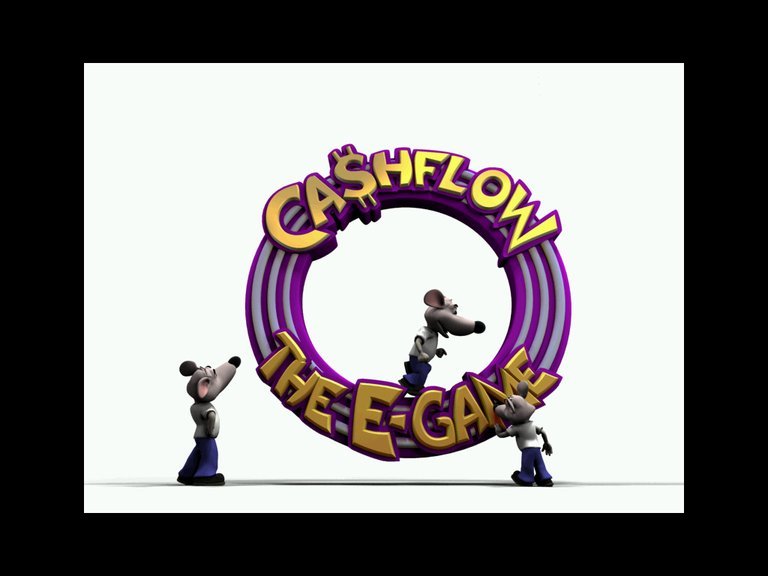
Description
Ca$hflow: The E-Game is a digital adaptation of the Cashflow 101 board game, designed to teach financial literacy through interactive gameplay. Players engage in turn-based strategy by trading properties and stocks, managing assets versus liabilities, and striving to escape the ‘rat race’ by generating passive income to afford their chosen dream, with support for up to five players via hot seat or online multiplayer.
Ca$hflow: The E-Game Reviews & Reception
myabandonware.com (0/100): Not a complete cashflow 101 game.
Ca$hflow: The E-Game: A Definitive Review of Gaming’s Financial Liturgical
Introduction: The Rat Race, Digitized
In the early 2000s, as the video game industry raced toward increasingly complex 3D worlds and cinematic narratives, a quiet, unassuming title arrived with a radically different mission. Ca$hflow: The E-Game (2003) was not about saving princesses, conquering galaxies, or scoring virtual goals. It was a meticulously crafted, licensed digital translation of Robert Kiyosaki’s Cashflow 101 board game—a tool designed to teach players of all ages the language of money, the distinction between assets and liabilities, and the path to financial freedom. Developed by Quicksilver Software and published by Kiyosaki’s CASHFLOW Technologies, this game stands as a fascinating, isolated artifact: a serious “edutainment” product grounded in a specific financial philosophy, released into a market obsessed with pure entertainment. My thesis is this: while Ca$hflow: The E-Game is severely limited by its board-game roots, early 2000s technological constraints, and a near-total lack of mainstream recognition, it represents a pivotal, if flawed, experiment in using interactive mechanics to simulate economic reality. It is less a “game” in the traditional sense and more a persistent, modular financial simulator, whose true legacy lies in its prescient alignment with today’s trends in “serious games” and financial literacy apps, even as its execution remains trapped in the clunky aesthetics of its time.
Development History & Context: From Boardroom to Hard Drive
The genesis of Ca$hflow: The E-Game is inextricably linked to the cultural phenomenon of Robert Kiyosaki’s 1997 bestseller, Rich Dad Poor Dad. By the early 2000s, Kiyosaki’s brand had expanded into a multi-media empire of books, seminars, and board games. The Cashflow 101 board game was its interactive core, allowing players to experience the emotional rollercoaster of the “Rat Race”—the cycle of working for a paycheck only to be drained by expenses—and the triumph of escaping it via passive income from assets.
The Studio & The Vision: The development duties fell to Quicksilver Software, Inc., a studio with a pedigree in strategy and simulation titles (notably the Master of Orion series). The project was spearheaded by Executive Producer William C. Fisher and Producer Cory Nelson, with Creative Director Rantz A. Hoseley guiding the vision. The core design mandate was fidelity: this had to be an “accurate computer recreation” of the board game. The creative principles were directly provided by Robert Kiyosaki, his wife Kim Kiyosaki, and co-author Sharon Lechter, ensuring the game’s financial lessons remained doctrinally pure to the “Rich Dad” philosophy.
Technological Constraints & The 2003 Landscape: Released in 2003 for Windows and Macintosh on CD-ROM (with a hybrid PC/Mac disc structure, as noted on My Abandonware), the game was a product of its technological moment. The era was defined by:
* Storage & Loading: CD-ROMs meant long load times between turns and a reliance on disc swapping (as one abandonware user noted getting stuck at an “insert CD” prompt, hinting at a multi-disc installation issue).
* Graphics: The MobyGames entry lists its “Art” style as “Full Motion Video (FMV)” and its “Perspective” as “3rd-person (Other).” Credits reveal a team including 3D modellers (Nick Eberle, Scott Godfrey), 3D animators (Jason Kruse, Frank Peak), and 2D artists (Irene Macabante, Oscar Guzman). This suggests a hybrid aesthetic: a 3D-rendered game board or token perspective, likely static or minimally animated, viewed in third-person, possibly overlaid with FMV sequences for events or instruction—a common but dated technique for “presentation” in early 2000s strategy games.
* Gameplay Paradigm: The turn-based, hot-seat multiplayer model (supporting 1-5 offline players, 2-5 online) was a natural fit for adapting a board game but was already feeling archaic compared to the rising popularity of real-time strategy and online multiplayer shooters.
* Market Context: 2003 was the era of Warcraft III, Half-Life 2, and Star Wars: Knights of the Old Republic. The educational/strategy space was dominated by PC-centric titles like The Sims 2 (life simulation) and Civilization III. A direct, unapologetic board game adaptation from a self-help guru was an extreme niche product, relying entirely on direct marketing to an audience already invested in Kiyosaki’s teachings.
Narrative & Thematic Deep Dive: The Absence of Story as a Storytelling Choice
Ca$hflow: The E-Game presents a unique narrative challenge: it possesses no traditional narrative. There is no plot, no character arcs, no dialogue-driven quest. Its “story” is the systemic, procedural narrative of economic life itself, framed by two potent metaphors:
- The Rat Race: This is the antagonistic state. Players begin here, working a “Job” card for a salary, then immediately facing monthly expenses (taxes, mortgages, debts, “surprises” like car repairs). The narrative tension is the constant pressure of outflows exceeding inflows, a metaphor for living paycheck-to-paycheck.
- The Fast Track/Financial Freedom: This is the heroic goal. Players choose a “Dream” (e.g., a boat, world travel) at the start, assigned a monthly cost. The victory condition is generating enough passive income (from assets like stocks, real estate, businesses) to cover all expenses and the Dream’s cost. The narrative climax is the moment a player’s passive income stream surpasses their total expenses, officially “escaping the Rat Race.”
Characters & Dialogue: The “characters” are the players themselves and the cards they draw. Dialogue is non-existent in a dramatic sense. Instead, the game’s “voice” is the dry, instructional language of financial statements and opportunity cards. A “Stock Market” card might read: “You bought 10 shares of XYZ Corp at $20. It’s now $35. Sell?” This is the entire dramatic exchange. The themes are delivered not through plot, but through systemic reinforcement:
* Assets vs. Liabilities: The core mechanic. Buying a rental property (asset) creates a monthly income stream. Buying a new TV (liability) creates a monthly expense. The game structurally punishes liability accumulation and rewards asset acquisition.
* Passive Income as Power: This is the ultimate heroic metric. Active income (salary) is finite and taxed heavily in the game. Passive income is presented as the key to liberation.
* Risk & Opportunity: The random card draws simulate market volatility and life’s unpredictability. A “Business Opportunity” card might offer a high-risk, high-reward venture, teaching assessment of risk versus reward.
The thematic depth comes from the brutal simplicity of these systems. By removing story dressing, the game forces players to confront the cold, mathematical logic of Kiyosaki’s philosophy. It is not a tale of individual heroism but of strategic position within an economic ecosystem.
Gameplay Mechanics & Systems: The Board Game, Elevated (and Burdened)
The game is a direct translation of a board game, and this defines every system. Understanding this is key to evaluating its design.
Core Loop: 1) Roll/Move a token around a track of tiles. 2) Land on a Tile and follow its instruction: draw a “Paycheck” (for employed players), “Market” (stock opportunity), “Opportunity” (business/real estate deal), “Doodad” (liability expense), or “Baby” (increased monthly expenses). 3) Update Financial Statement (Assets, Liabilities, Income, Expenses). 4) Pass Passive Income collected from owned assets. 5) Next player. Repeat until one player’s passive income > total expenses + dream cost.
Key Systems Deconstructed:
* Financial Statement as the UI: The most critical interface is the player’s balance sheet and income statement. The game’s educational power lies in making the player own this document. Every transaction is manually entered (or auto-calculated by the game), providing immediate feedback on how a decision impacts net worth and cashflow. This is the game’s greatest innovation for its purpose.
* The Double-Edged Sword of Randomness: The dice roll and card draw introduce chaos, replicating the unpredictability of life and markets. However, it also introduces significant luck dependency. A player can be hamstrung by a string of “Doodad” expenses before getting a chance to buy assets, while another might leap ahead with a cheap, high-yield business opportunity early. This can feel unfair, undermining the sense that financial acumen alone is rewarded.
* Multiplayer Dynamics: Hot-seat and online play are the intended experiences. The social, competitive pressure of seeing another player buy a valuable asset before you can is a powerful motivator. However, the system has no AI opponents for solo play. The single-player experience is essentially a race against your own previous performance or a purely theoretical benchmark, stripping away the competitive narrative tension.
* Progression & “Leveling Up”: Character progression is not individual but financial. “Leveling up” means moving from low-paying jobs (via “Small Business” or “Opportunity” cards) to higher-salary jobs, and more importantly, from having no assets to building a portfolio. The meta-progression is the shift from active to passive income dependence.
Innovations & Flaws:
* Innovative (for its goal): The seamless integration of a functional financial statement into the core game loop was groundbreaking for an edutainment title. It gamified bookkeeping.
* Flawed: The board-game translation means high downtime between player turns, especially with 4-5 players. The digital medium fails to streamline the core loop beyond basic automation of calculations. The FMV elements (hinted at in credits) are likely simple video clips for events, adding to the “interactive presentation” feel of the early 2000s but offering little interactivity.
* Flawed: The systems are shallow. Once you understand the optimal strategy (aggressively acquire any asset that yields passive income above its cost, avoid all “Doodads”), the game becomes a repetitive grind of card draws, with little emergent complexity. The depth is in the financial literacy, not the game mechanics.
World-Building, Art & Sound: The FMV Aesthetic of Pragmatism
The game’s world is the abstract space of the Cashflow board, but its presentation is firmly rooted in the FMV-heavy style of early 2000s “serious games.”
- Visual Direction & Setting: The “3rd-person (Other)” perspective suggests an isometric or top-down view of a colorful, stylized game board. The art, credited to a team under Irene Macabante (UI/2D) and Oscar Guzman (Concept/2D), would have aimed for bright, clear, non-threatening visuals. The goal was clarity, not immersion. The “board” itself is the world—a linear track of tiles against a static background. FMV sequences, if fully implemented, would have been low-resolution, full-motion video clips of a narrator (likely Kiyosaki himself or a stand-in) explaining concepts or reacting to major events, a style popularized by titles like The 7th Guest but here used for instruction.
- Atmosphere: The atmosphere is not one of excitement or adventure, but of focused tension and gradual empowerment. The sound design, by Brian Williams, would have been functional: upbeat, corporate-jazz or inspirational music during decision phases, perhaps a tense sting when landing on a “Doodad” tile. The goal was to create a “conference room” or “workshop” vibe, not a fantasy realm. The sound of coins clinking or cash registers ringing upon receiving passive income would be the primary auditory reward.
- Contribution to Experience: This aesthetic serves the educational purpose first. The visuals must not distract from the financial statements. The world is deliberately bland because the real “world” being explored is the player’s own understanding of an income statement. The FMV elements attempt to inject Kiyosaki’s charismatic authority into the sterile board, bridging the gap between dry simulation and motivational seminar. It’s a world built for cognitive processing, not emotional escapism.
Reception & Legacy: The Obscure Prophet
Critical & Commercial Reception at Launch: Data is almost non-existent. MobyGames shows only one player rating (3.3/5) and zero critic reviews. This speaks volumes. The game existed almost entirely outside the traditional gaming press’s radar. It was not sold in mainstream retailers but through direct marketing, bookshops, and seminars. Its commercial success is opaque but was likely modest, sustained by the evergreen sales of the Rich Dad brand rather than gaming industry acclaim. The single low-ish rating on an archival site like abandonware, coupled with user comments about installation issues (“missing another iso”), points to a product with technical roughness and a very specific, forgiving audience.
Evolving Reputation & Influence: Ca$hflow: The E-Game has not so much evolved in reputation as it has been contextualized.
1. As a Historical Artifact: It is now seen as a primary example of the early “serious games” movement—games explicitly designed for purposes other than entertainment. It predates the widespread use of the term and the more polished examples that followed.
2. Within the Cashflow Series: Its credits link it directly to Ca$hflow 202: The E-Game (2004, likely a more advanced version) and Ca$hflow for Kids at Home (2003). This reveals a conscious franchise strategy to create age-tiered financial education software, a model later perfected by platforms like ABC Mouse but rare in gaming.
3. Industry Influence: Its direct influence is minimal due to its obscurity. However, its conceptual DNA can be seen in later games:
* Life Simulation Games: Titles like The Sims series (with its bills and career tracks) and Two Point Campus (managing budgets and income streams) echo the core tension of managing expenses vs. generating revenue.
* “Tycoon” & Management Sims: Games like RollerCoaster Tycoon or Software Inc. require balancing income and outflows, a direct descendant of the cashflow mechanic.
* Modern Financial Literacy Apps: The gamification of stock trading (e.g., Wall Street Survivor) and budgeting tools (e.g., YNAB‘s philosophy) share the same goal of making financial management interactive and outcome-driven.
* The game’s existence highlights a persistent market niche: using interactive systems to teach practical, adult skills—a space now occupied by VR training simulations and professional esports management games.
Its obscurity underscores the chasm between educational intent and gaming culture. It was not made for gamers; it was made for financial students. This segregation is a key part of its legacy.
Conclusion: A Flawed but Foundational Artifact
Ca$hflow: The E-Game is an unequivocally poor game by any conventional metric of fun, engagement, or technical polish. Its turn-based pacing is slow, its reliance on luck can be frustrating, its presentation is dated, and its systems lack depth. Playing it today, especially with the installation hurdles noted by abandonware users, is a chore.
However, to dismiss it on these grounds is to miss its profound historical significance. It is a foundational text in the “serious games” canon. It successfully, if clunkily, translated a complex financial philosophy into an interactive system where learning was the core reward loop. The act of balancing that sheet, of watching passive income tick up, was the gameplay. It predated the explosion of “gamification” in education and corporate training by a decade.
Its ultimate verdict is one of qualified reverence. It is not a title to be enjoyed for its entertainment value but to be studied for its audacious premise. In an industry still wrestling with how to meaningfully tackle subjects beyond combat and collection, Ca$hflow: The E-Game stands as a early, unwavering beacon. It proved that a game’s world could be a spreadsheet, and its “adventure” could be the journey from financial illiteracy to literacy. For that, it earns its place in history—a 6/10 as a playable experience, but a 9/10 as a crucial, if rough, prototype for a more purposeful kind of play. It is the digital equivalent of a well-worn copy of Rich Dad Poor Dad sitting on a shelf: not flashy, but undeniably transformative for those who engage with it on its own terms.