
- Release Year: 1997
- Platforms: Macintosh, Windows
- Publisher: Flammarion, Tivola Publishing, Inc., Tivola Verlag GmbH
- Developer: Gyoza Media
- Genre: Adventure, Educational
- Perspective: 1st-person
- Game Mode: Single-player
- Gameplay: 360° exploration, Interactive fiction, Linear progression, Point-and-click, Puzzle-solving
- Setting: Deserted Island, Historical adaptation
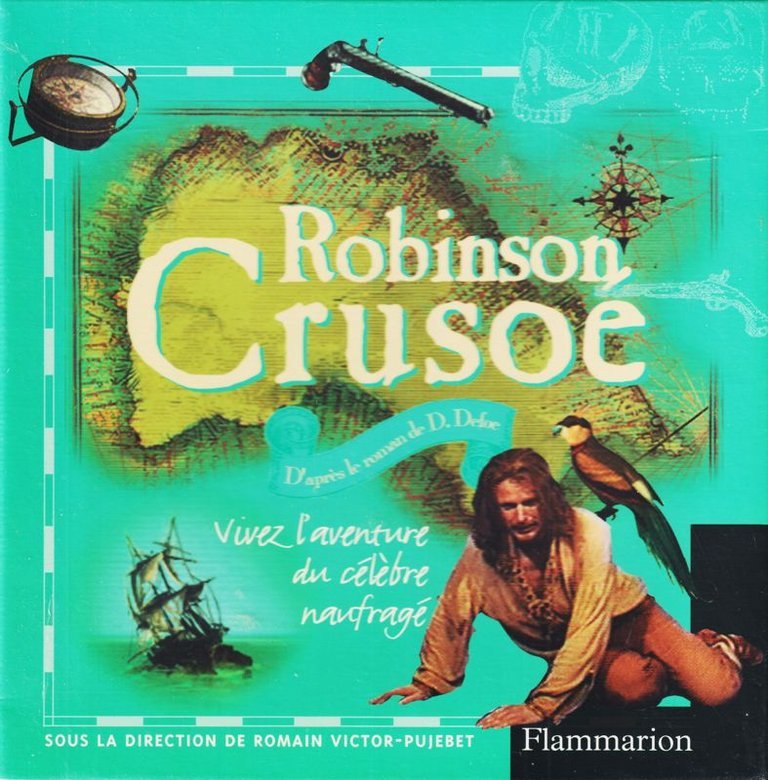
Description
Robinson Crusoe is a 1997 educational adventure game that reimagines Daniel Defoe’s 1719 novel as an interactive experience. Players explore a first-person, 360-degree panoramic island setting, solving puzzles and progressing through a narrative that blends gameplay with a narrated guide book featuring animated illustrations and voice acting by Martin Jarvis, emphasizing reading and decision-making skills.
Gameplay Videos
Where to Buy Robinson Crusoe
PC
Robinson Crusoe (1997): A Digital Robinsonade in the Shadow of Myst
Introduction: The solitary island in a sea of Myst clones
In the mid-1990s, the point-and-click adventure genre was undergoing a profound metamorphosis. The runaway success of Cyan’s Myst (1993) shifted the paradigm from inventory-based comedic puzzles to atmospheric, first-person exploration in rendered worlds. Into this landscape stepped Robinson Crusoe (1997), a title that wore its literary heritage as both a badge of honor and a fundamental design constraint. Developed by the French studio Gyoza Media and published by Flammarion and Tivola, this was not merely another Myst-clone; it was an explicit, almost didactic, attempt to translate Daniel Defoe’s 1719 novel—the supposed progenitor of the English novel and the “Robinsonade” genre—into an interactive CD-ROM experience. This review argues that Robinson Crusoe (1997) is a fascinating, deeply flawed, and historically significant artifact. It represents a pivotal moment where the burgeoning “edutainment” sector attempted to leverage the immersive potential of CD-ROM technology for literary adaptation, creating a hybrid “interactive book” that prefigured later academic discussions about games as tools for subject formation. Its legacy is not one of commercial or critical triumph, but as a case study in the aspirations and limitations of translating print realism into digital interactivity, a endeavor that would find its truer heir in sandbox games like Minecraft.
Development History & Context: Flammarion’s digital library and the Myst paradigm
The game emerged from a specific European context. Flammarion, a venerable French publisher, and its subsidiary Tivola were actively expanding into multimedia educational software in the 1990s, adapting classics like The Three Musketeers and Around the World in 80 Days. Gyoza Media, the developer, was thus tasked with a clear directive: create an immersive, faithful, and pedagogically sound experience based on a cornerstone of the Western canon. The design vision, credited to Romain Victor-Pujebet and Didier Hochart, was to split the experience into two interlaced halves: a linear, first-person “adventure” and a non-linear “interactive book.”
Technologically, the game was a product of the CD-ROM era’s capabilities and constraints. It employed 360º panoramic views—a direct descendant of Myst‘s node-based navigation—rendered with a “gritty but realistic-ish” aesthetic, as recalled by a player on Reddit. The use of pre-rendered QuickTime panoramas speaks to the limitations of real-time 3D in 1997 but also to a desire for painterly, illustrated quality that would align with a book’s aesthetic. The decision to include full narration by the acclaimed British actor Martin Jarvis (noted in the credits and the German review’s praise for Jürgen Vogel) was a significant production value, aiming to bridge the gap between listening to a story and being inside it. This duality—”adventure” for doing, “interactive book” for reading—was its core innovation and, ultimately, its core structural problem, creating a schism rather than a synthesis between narrative consumption and ludic agency.
Narrative & Thematic Deep Dive: Faithful framing, fragmented experience
The game’s narrative is inextricably tied to Defoe’s novel, serving as a direct adaptation. The player experiences Crusoe’s arc: shipwreck on the “Island of Despair,” the initial despair and salvaging, the slow mastery over the environment (building a shelter, cultivating crops, hunting), the discovery of cannibals, the rescue and relationship with Friday, and the eventual rescue and return to civilization. Thematic elements from the novel—economic imperialism, religious providence, the fear of the other (cannibals), and the sovereign alone on his island—are all present as backdrop.
However, the game’s structure fundamentally reshapes the narrative’s psychology. In the novel, we receive Crusoe’s retrospective, journal-like narration, a confessional text rich with introspection, calculation, and spiritual reasoning. The game strips this away, replacing it with immediate, enacted experience. The “interactive book” component allows the player to read and listen to the original text (narrated by Jarvis), but this functions more as a guide or a parallel artifact than as an integrated narrative voice. The player’s Crusoe is silent and acted upon by the environment and puzzles, not a speaking subject reflecting on his condition. This creates a thematic dissonance: the game mechanically simulates Crusoe’s survival labor but largely evades his moral and spiritual labor. The famous footprint scene is likely rendered as a puzzle or environmental hook, severing it from its profound psychological function in the novel as a crisis of sole authorship and a terrifying encounter with the Other. The game captures the what of Crusoe’s adventure but misses the why and how of his consciousness, reducing a complex spiritual autobiography to a survival scenario.
Gameplay Mechanics & Systems: Linear puzzles in an open-seeming world
Gameplay is bifurcated, reflecting the “interactive book + adventure” design.
1. The Adventure Portion (First-Person Panorama): This is the primary interactive layer. The player navigates 360-degree static panoramas (similar to Myst but with a more grounded, island-specific art style). Interaction is point-and-click. The core loop is: explore a location, find inventory items, use them on environmental puzzles to unlock the next location or necessary tool, and progress the plot. Critically, as noted in the MobyGames description, it is “more linear” than Myst. Players “have to perform certain tasks to move forward.” This linearity is a direct result of the narrative adaptation—the game must shepherd the player through the novel’s plot points. Puzzles are contextual: using salvaged tools to build something, finding food sources, solving simple logical challenges related to survival (e.g., purifying water, crafting a trap). There is no combat system in the adventure mode; conflict with cannibals is handled through scripted sequences or puzzle solutions (e.g., setting a trap). The “Survivor” difficulty mentioned in the unrelated 2015 Adventures of Robinson Crusoe game is not present here; the 1997 version is purely puzzle-driven. Progress is saved via a “bookmark” system, a practical solution for the CD-ROM era’s limited save slots.
2. The Interactive Book Portion: This acts as a digital companion. Players can read the text of the novel (or excerpts), listen to Jarvis’s narration, and click on animated illustrations. Crucially, these illustrations contain “clues to solve the adventure puzzles.” This is the integration mechanism: the book is a hint system and a lore repository. A player stuck on a puzzle in the adventure mode might consult the book to see an animated depiction of a tool or animal that provides a solution. This mechanic is innovative for its time, attempting to make the act of reading the source material a ludic act in itself—a meta-commentary on using literature as a strategy guide. However, it fractures the experience, forcing the player to shift mental modes from active puzzle-solver to passive reader.
The result is a game that feels neither a pure adventure nor a true interactive novel. The puzzles are generally logical and tied to the survival theme but are often simple and lack the intricate, multi-step logic of a classic Myst. The linearity removes the sense of open-ended exploration that defines the Robinsonade fantasy. The UI is functional but dated, with inventory and book access via a simple toolbar.
World-Building, Art & Sound: A painterly, atmospheric island
The game’s greatest strength is its atmosphere. The 360-degree panoramas, while static, are richly painted with a watercolor-esque or gritty oil-paint texture that evokes an illustrated edition of the novel rather than a photorealistic 3D world. This artistic direction, overseen by Brigitte Milon, successfully creates a sense of place—the beach with the wrecked ship, the dense jungle, the looming cave, the fortified “castle.” The color palette is earthy and muted, reinforcing the survivalist tone.
The sound design is minimal but effective. Ambient island noises (waves, birds, insects) provide backdrop. The standout is Martin Jarvis’s narration. His “spröden Ton” (dry, economical tone), as the German review notes, is perfectly suited to Crusoe’s pragmatic, unromantic character. It lends a gravitas and a direct literary lineage that the visuals alone cannot achieve. Olivier Pryszlak’s original music is sparse and moody, primarily used in the interactive book sections or during pivotal moments, avoiding melodrama and supporting the earnest, educational tone. Together, the art and sound craft an island that feels isolated and real within its stylistic limitations, successfully avoiding the cartoonish or overly fantastic. It feels like a place Defoe might have described, not a fantastical Myst age.
Reception & Legacy: A modest critical footprint with profound theoretical echoes
Contemporary Reception: The game received mixed to positive reviews from a very small pool of critics, averaging 71% on MobyGames. The German review from Feibel.de (83%) was enthusiastic, praising the enhanced synergy between book and game and the perfect casting of the narrator. Tech with Kids (80%) appreciated the cinematic overlay of actors into scenes and the connection it fostered. However, Just Adventure (50%) found it a “mishmash,” suggesting its hybrid nature was its core flaw, failing to satisfy either adventure gamers or readers. Its commercial performance was niche, tied to the educational and “edutainment” markets in Europe.
Historical Legacy & Academic Relevance: Robinson Crusoe (1997) faded into obscurity, overshadowed by Myst and its sequels, and by the sheer volume of later Robinsonade games (from the\simulation-focused Robinson’s Requiem (1994) to the modern board game Robinson Crusoe: Adventures on the Cursed Island (2012)). However, its significance is resurrected by academic analyses like Phillip Lobo’s “Novel Subjects: Robinson Crusoe & Minecraft and the Production of Sovereign Selfhood” (2019). Lobo positions Defoe’s novel as the first “formal realist” text, creating a “bare subject” in a sovereign, solitary position. He argues that Minecraft is the true spiritual successor to this project, using procedural generation, resistance, and excess to create a world for the player’s sovereign self-constitution. The 1997 Robinson Crusoe game sits fascinatingly between these two poles.
It is a failed, clunky attempt to encode Defoe’s realist project into game mechanics. Its linearity and prescribed puzzles are the opposite of Minecraft‘s open-ended freedom. Yet, its very conceit—the player becoming Crusoe through enacted survival tasks and textual reference—directly embodies Rousseau’s pedagogical prescription from Émile: “Let him think he is Robinson himself.” It tries to make the novel a “game-of-self.” Its failure highlights the difficulty of translating a retrospective, introspective narrative into an experiential, forward-moving game. Its legacy is as a cautionary tale and a prototype: it shows that the ludic longing within literary realism (the desire to “play in the world” of the text) requires systems that offer genuine agency and world-shaping, not just linear puzzle-solving. The “interactive book” model proved less sustainable than the open-world simulation model that Minecraft would perfect.
Conclusion: A noble, constrained shipwreck of an idea
Robinson Crusoe (1997) is not a lost classic. Its gameplay is linear, its puzzles undemanding, its technological execution dated even for 1997. It does not stand the test of time as a fun or engaging game in the way Myst does. However, to dismiss it as merely another forgettable Myst-clone is to miss its historical and theoretical importance. It is a deliberate, scholarly attempt to forge a new kind of digital artifact: an “interactive book” that respects its source not by merely animating it, but by forcing the player to perform its central acts of survival and resource management, using the text itself as a tool.
Its true verdict lies in the academic discourse it inadvertently fueled. It represents a moment when the video game industry explicitly, if clumsily, grappled with the novel’s legacy of producing a “sovereign self.” The game’s shortcomings—its lack of systemic depth, its pre-scripted narrative path—highlight what is required for such a project to succeed: a world that reacts dynamically to the player’s will, a set of needs that generate authentic dilemmas, and a removal of the authorial hand that so clearly guides Gyoza Media’s Crusoe. In this light, Robinson Crusoe (1997) is a fascinating shipwreck. It is the Sea Venture stranded on the shores of game design, its survival a testament to a bold idea—the digital Robinsonade—but its ultimate fate a reminder that the true “Island of Despair” for this concept was the technological and design limitations of its era. The subject it produces is not the bare, creative sovereign of Rousseau’s dream or Minecraft‘s reality, but a constrained agent following a well-worn path through a beautifully painted but utterly static island. It is, in the end, a compelling artifact of an ambition that would take another decade and a blocky, procedurally generated world to truly realize.