
- Release Year: 1996
- Platforms: DOS, Macintosh, Windows
- Publisher: Interplay Entertainment Corp., Ozacq1, Inc., SunTendy Interactive Multimedia Co., Ltd., Virgin Interactive Entertainment (Europe) Ltd., Virgin Interactive Entertainment, Inc.
- Developer: Milestone s.r.l.
- Genre: Driving, Racing
- Perspective: 1st-person, Behind view
- Game Mode: LAN, Single-player
- Gameplay: Arcade, Automobile, Drifting, Off-roading, Rally, Track racing, Vehicle simulator
- Setting: Africa, Europe, North America
- Average Score: 75/100
Description
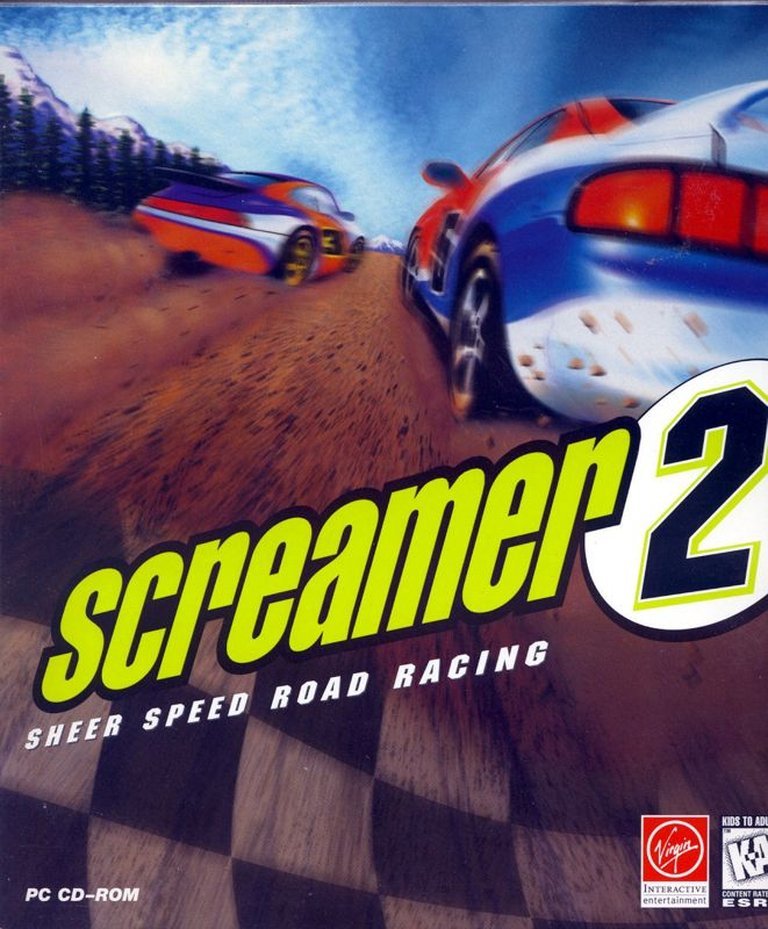
Screamer 2 is an arcade-style rally racing game set in diverse international locations such as England, Switzerland, Egypt, and Colombia. Players choose from four rally cars with distinct handling characteristics (e.g., rear-wheel drive for speed, front-wheel for ease) and navigate tracks that feature slippery conditions and dynamic obstacles like birds and cows, focusing on high-speed, slide-filled gameplay and split-screen multiplayer action.
Gameplay Videos
Where to Buy Screamer 2
Screamer 2 Free Download
PC
Screamer 2 Patches & Updates
Screamer 2 Reviews & Reception
mobygames.com : the playability that is just FUN is still there.
oldpcgaming.net : The driveability is one of the greatest in computer game history.
gamesreviews2010.com (75/100): Screamer 2 is a timeless racing game that offers an adrenaline-pumping and challenging rally racing experience.
Screamer 2 Cheats & Codes
PC
Enter codes at the main menu.
| Code | Effect |
|---|---|
| chmpa | All championships |
| mrtrk | All tracks |
| tacar | Black Claw car |
| tbcar | The Aphrodite car |
| tccar | The Hornet car |
| tdcar | The Thunder car |
| aphrodite | Turbo mode |
| TACARTBCARTCARTDAR | gain all of the bonus cars |
Screamer 2: The Unrefined Brilliance of a Rally Pioneer
Introduction: The Slide Heard ‘Round the PC World
In the pantheon of 1990s PC racing games, few titles captured the sheer, unadulterated fun of arcade rally racing with the visceral intensity of Screamer 2. Released in late 1996 by Virgin Interactive and developed by the then-nascent Italian studio Milestone, the game arrived at a pivotal moment. The PC market was flooded with realistic sims like Grand Prix 2 and Need for Speed, while console gamers enjoyed the lush stylings of Sega Rally Championship. Screamer 2’s thesis was bold: it would marry the jaw-dropping graphical fidelity of a next-gen arcade title with the chaotic, slide-obsessed handling of a rally beast, all on a PC platform that often struggled to keep up. Its legacy is that of a cult classic—a game whose technical achievements were swiftly matched, but whose raw, unpredictable driving feel remains a touchstone. This review argues that Screamer 2 is less a perfectly crafted masterpiece and more a brilliant, flawed diamond: a game whose passionate, almost violent, focus on a single experience—the art of the power slide—elevates it above its considerable shortcomings.
Development History & Context: From Graffiti to Gravel
Screamer 2’s genesis is a story of a studio finding its voice and a publisher taking a calculated risk. The original 1995 Screamer, developed by Graffiti, was a straightforward Ridge Racer homage—high-tech futuristic cars on smooth, looping tracks. For the sequel, Virgin Interactive switched developers to Milestone s.r.l., a small Italian team led by director Antonio Farina and programmer Stefano Lecchi. The mandate was clear: pivot to the wildly popular rally genre, inspired by the success of Sega Rally Championship on the Saturn.
This shift was profound. The six glossy roadsters of the first game vanished, replaced by a focused garage of four rally cars: two Rear-Wheel Drive (RWD), one Front-Wheel Drive (FWD), and one 4-Wheel Drive (4WD). The change wasn’t just cosmetic; it represented a fundamental redesign of the game’s physics and philosophy. The tech constraints of 1996 were severe. A “Pentium 166” was the recommended CPU, and the game’s revolutionary SVGA graphics—with texture-mapped polygons, detailed scenery, and a claimed 60 FPS in low-res mode—were a breathtaking but demanding sight. Milestone engineered a custom 3D engine (with contributions from Simone Balestra and Antonio Martini) that prioritized speed and visual spectacle over absolute precision, a decision that would define everything that followed.
Narrative & Thematic Deep Dive: Rally as a Global Tour
Screamer 2’s “narrative” is not told through cutscenes or dialogue but through its geography and atmosphere. It presents rallying as a global, almost anarchic, spectacle. The six tracks are more than backdrops; they are antagonistic characters:
* Switzerland: A high-speed, tight, twisty tarmac ribbon through alpine forests. It rewards precision and punishes hesitation.
* Finland: A snow-slicked, flat-out frozen lake and forest stage where control is a fleeting illusion. The “slippery” nature isn’t a visual effect but a fundamental, hair-trigger physics state.
* Egypt: A gritty, sandy stage through ancient ruins where camels and palm trees become lethal obstacles.
* Colombia: A muddy, rainforest stage with dense foliage and sudden hazards like birds bursting from the undergrowth.
* England: A classic green-and-muddy country lane stage.
* The United States (California): A desert stage with long, sweeping jumps and dusty trails.
The theme is pure, unadulterated competition against nature and machine. There is no story of a lone driver’s rise; instead, the player is injected directly into a world championship where the environment is the primary opponent. The cars, each with a team livery (though the MobyGames credits note “real differences” are minimal beyond visuals), feel like tools for survival, not extensions of a persona. The “plot” is written in tire smoke and the sound of a 360 spin that somehow doesn’t end your race.
Gameplay Mechanics & Systems: The Cult of the Power Slide
To understand Screamer 2 is to understand its core, defining mechanic: the power slide. This is not a nuanced weight transfer or a simulated tire friction model. It is a brutal, binary, and spectacular event. The technique—as described in the Old PC Gaming review—involves braking sharply while turning into a corner, then immediately hitting the gas to recover from the resultant skid. Executed correctly, it’s a ballet of destruction; failed, it’s a spin into the scenery.
Core Gameplay Loop:
1. Select Car: The choice is less about variety and more about selecting your preferred poison. RWD cars (like the iconic Lancia Delta Integrale) are “deadly fast but also deadly hard to drive,” as the player review perfectly states. FWD is “easy to drive but not that fast.” 4WD is the balanced middle.
2. Choose Event: Championship (unlock tracks), Time Attack, or Free Run.
3. Race: 3-4 laps against 3 AI opponents (in Championship) or the clock. The AI is noted for being “ultraharte” (ultra-hard) yet “fair,” making “occasional mistakes,” as Next Generation highlighted.
4. Tuning (The Garage): A simplistic pre-race menu allows tweaking of handling, tire pressure, etc. It’s a nod to depth that feels necessary due to the game’s inherent difficulty, as the PC Games (Germany) review noted mastery requires “many, many training hours.”
5. Repeat: Immediately after a race, you’re back in the menu, ready to retry the same stage, chasing the perfect slide.
Innovations & Flaws:
* Innovative Feel: The driving model is its own beast. Cars rarely travel straight. They are constantly on the edge, initiating slides that can be caught and ridden. This creates a constant, white-knuckle tension missing from more accessible racers. It’s not “realistic,” but it is convincing in its own logic.
* Critical Flaws: The same model is a double-edged sword. GameSpot and Online Gaming Review (OGR) cited “sloppy control” and “a loose control scheme” that requires “acclimatizing.” The line between exciting and frustrating is paper-thin. The handling is so sensitive to surface changes (asphalt to mud to snow) that it demands near-memorization of track layouts.
* Structural Flaws: Criticized in multiple reviews (PC Games, Gameplay Benelux) is the tiny car selection (4 cars, with 2 feeling very similar) and the meager track count (6 distinct environments, repeated in different weather/lighting). The lack of a full track overview map, as Gamesmania.de wished, makes learning the courses a trial by fire.
World-Building, Art & Sound: A Technical Marvel Marred by Audio
Visuals & Atmosphere:
For 1996, Screamer 2’s graphics were nothing short of a revelation. The SVGA engine rendered lush, detailed environments with a sense of speed previously unseen on PC. The tracks are dense with life: birds flush from trees in England, cows amble across Colombian roads, and helicopters buzz over Egyptian deserts. The “unbelievable level of detail,” as one player review enthused, created a lived-in world. The variety between the blinding white of Finland and the ochre dust of Egypt is stark and effective. Even today, with pre-rendered background scenery, the foreground geometry and texture work have a blocky, charming authenticity. The 3DFX patch mentioned in source material was a lifeline, allowing the game to shine with hardware acceleration—a critical reason for its contemporary acclaim.
Sound Design:
This is Screamer 2’s Achilles’ heel. The consensus across MobyGames, player reviews, and critics is unanimous and scathing. The engine sounds are described as “hideous, high-revving whistle[s]” and “plain crash-bump-crash effects.” There is no sense of torque, no roar that matches the visual chaos. The sound engine feels like an afterthought next to the graphical powerhouse. The musical soundtrack, a generic techno beat, is noted as “very good” and “appropriate” (PC Multimedia & Entertainment), but it cannot compensate for the impoverished on-track audio feedback that breaks the immersion the visuals work so hard to build.
Reception & Legacy: Critical Darling, Commercial Footnote
Contemporary Reception (1996-1997):
Screamer 2 was a major critical success, particularly in Europe. Scores were stellar: PC Zone (93%), Pelit (92%), Gamesmania.de (90%), and a swath of 84-89% ratings from German and Scandinavian magazines. The praise consistently centered on three pillars: graphics, speed, and addictive gameplay. Next Generation hailed it as “one of the first PC racing games to achieve console-like frame rates and outstanding arcade control.” PC Action declared it a “sauschwer” (damn hard) but addictive experience that “makes you want to play again and again.”
The criticisms were equally consistent: the high hardware requirements (a Pentium 166 was a premium CPU in 1996), the punishing difficulty, the lack of content (few tracks/cars), and the abysmal sound. GameSpot’s 7/10 review succinctly summarized it: a “good game marred only by sloppy control,” saved by “gorgeous graphics, incredible sound [likely a misprint for ‘soundtrack’], and abundant multi-player options.” The split-screen multiplayer was a universally praised feature, turning the intense rally into a “demolish’em derby” where collisions and chaos reigned supreme due to the lack of a damage model.
Long-Term Legacy & Influence:
Screamer 2’s legacy is paradoxical. On one hand, it was a stepping stone, not a milestone (pun intended). Its graphics were quickly eclipsed by Need for Speed II: SE (1997) and the wave of 3DFX titles. Its arcade rally handling, while influential in spirit, was refined and bested by Codemasters’ Colin McRae Rally (1998), which offered a more nuanced yet still accessible feel. Milestone itself pivoted away from pure arcade racing, eventually finding its true legacy decades later with the acclaimed, simcade Ride and MotoGP series.
Yet, Screamer 2’s cult status endures. It occupies a specific niche: the last great “pure arcade” rally game on DOS before the genre bifurcated into hardcore sims (Richard Burns Rally) and pedestrian arcade titles (Test Drive series). Its “wild slides” remain a uniquely punishing, yet rewarding, physical experience for the hands. The player review from 2002—stating “the playability is still strongly there”—is the ultimate testament. The core loop of mastering the un-masterable slide on a track that feels alive with detail is an experience no amount of graphical advancement has rendered obsolete. It is remembered fondly not as a perfect game, but as a ferociously personality-driven one. It knew exactly what it was—a high-speed, high-friction, high-fun rally romp—and executed that vision with breathtaking technical swagger, even if the audio and content cards were lacking.
Conclusion: A Flawed Masterpiece of Pure Velocity
Screamer 2 is a game of magnificent contradictions. It is a graphical tour de force paired with an audio embarrassment. It offers a driving model of profound depth and infuriating inconsistency. It provides a global tour but confines you to six tracks. It is a game that demands you earn its fun through spilled digital sweat.
In the grand timeline of racing games, Screamer 2 is not the inventor of a new mode nor the ultimate refinement of an old one. Instead, it is the definitive expression of a specific, arcade-racing id: the joy of holding a car on the absolute limit of adhesion, of seeing the world blur in SVGA polygons, of surviving a 360 spin at 120 mph. It is the last gasp of an era where a small Italian studio could out-polygon the big publishers on raw ambition alone.
Its place in history is secure as the game that proved PC racing could match a Saturn or PlayStation for visual spectacle and visceral feedback. It is a beloved artifact of the 3DFX/Voodoo rush, a game that made your hardware scream in both performance and delight. Screamer 2 may have lost its “teeth” graphically, as the player review noted, but the bite of its handling—that glorious, slide-obsessed, “style over substance” core—ensures it forever retains its soul. For anyone seeking the unfiltered, unpolluted adrenaline of arcade rally, Screamer 2 remains a cheap, essential, and brilliantly flawed time capsule.