
- Release Year: 1999
- Platforms: Windows
- Publisher: Expert Software, Inc.
- Developer: Gunnar Games, Inc.
- Genre: Strategy, Tactics
- Perspective: Diagonal-down
- Game Mode: Hotseat, LAN, Single-player
- Gameplay: Board game, Turn-based
- Average Score: 60/100
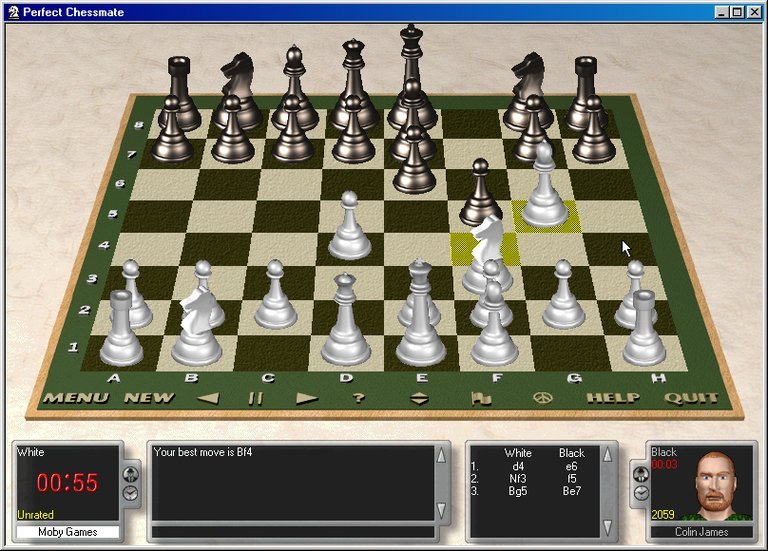
Description
Perfect Chessmate is a 1999 Windows chess game developed by Gunnar Games, designed to educate and challenge players through a blend of learning tools and competitive features. It offers tutorials, move hints, and classic game analysis for skill development, alongside rated AI opponents with unique backstories, local and network multiplayer, and customizable 3D or 2D chessboard themes. With options for hints, narration, and profile management, it serves as both an accessible learning platform and a serious competitive simulation.
Perfect Chessmate Free Download
Perfect Chessmate Reviews & Reception
myabandonware.com (60/100): This game does, for some reason often get labeled a virus by virus scanning software.
Perfect Chessmate Cheats & Codes
Perfect Chessmate PC
At the players menu type in E, R, C, P.
| Code | Effect |
|---|---|
| E, R, C, P | The queen moves like a knight. |
Perfect Chessmate: Review
Introduction: The Silent Scholar of the Digital Chessboard
In the sprawling library of computer chess, where titans like Chessmaster and Fritz dominated the bestseller lists, a quiet, diligent student worked in the corner: Perfect Chessmate. Released in 1999 by Gunnar Games and published by Expert Software, this title was not designed to awe with cinematic graphics or revolutionary 3D boards. Instead, it was forged with a singular, pedagogical purpose: to be a comprehensive tool for learning, improving, and appreciating the ancient game of chess. Its legacy is not one of blockbuster sales or cultural midnight launches, but of a meticulously crafted educational instrument that offered a depth of features often overlooked in its more commercially prominent peers. This review argues that Perfect Chessmate represents a significant, if understated, milestone in the genre of serious game-based learning—a “chess toolkit” that prioritized player development over spectacle, and whose thoughtful design warrants recognition as a cult classic of instructional software.
Development History & Context: The Gunnar Games Philosophy and the Late-90s Board Game Boom
To understand Perfect Chessmate, one must understand its developer, Gunnar Games, Inc., and its ecosystem. Gunnar was not a mainstream studio but a specialist producer of “brain games” and classic board/card simulations, primarily for the burgeoning Windows 95/98 casual and family market. Their portfolio, as evidenced by shared credits on titles like Bicycle Poker, Manx TT SuperBike, and Ultimate Mahjongg, reveals a pattern: licensed or classic game adaptations targeting a niche but steadfast audience. Perfect Chessmate (1999) was the capstone of a lineage that included Expert Chess (1994) and Championship Chess (1995), representing an iterative refinement of their chess engine and interface philosophy.
The late 1990s was a paradoxical time for computer chess. On one hand, brute-force engine strength had reached superhuman levels, making games like Fritz and Chessmaster formidable opponents. On the other, the market was saturated, and the focus for many developers shifted from pure engine power to user experience and pedagogy. This was the era that saw the rise of comprehensive learning suites, annotated grandmaster games, and sophisticated tutorials. Perfect Chessmate entered this landscape not as a powerhouse engine to dethrone Fritz, but as an environment. Its development, led by Product Manager Trevor Talbird, Lead Programmer Jamie Nye (a veteran on dozens of titles), and specifically Chess Engine Programmer Richard C. Leinecker, suggests a dedicated team where the chess logic was a specialized component, not the sole focus. The technological constraints were those of late-90s Windows: 2D/early 3D acceleration, MIDI sound, and dial-up networking. The game’s visual choice of fixed/flip-screen and diagonal-down perspective was a pragmatic, low-overhead solution that prioritized clarity over immersion, a conscious design decision rather than a technical limitation.
Narrative & Thematic Deep Dive: The Drama of the AI Persona
A chess game has no traditional narrative in the sense of a plot-driven adventure. Yet, Perfect Chessmate ingeniously constructs a subtle narrative framework around its core activity: the anthropomorphization of its AI opponents. This is the game’s most unique and overlooked narrative device. Instead of abstract “Level 1-10” difficulty settings, the player selects from a roster of AI opponents, each with a name, a-rated skill level, and a brief backstory.
These backstories are not elaborate paragraphs but evocative fragments that grant the CPU player an identity. Consider the thematic implications: you are not just adjusting a “strength” slider; you are challenging “Mikhail, the Tactician,” a player who prefers complex, sharp positions, or “Anna, the Endgame Specialist,” whose prowess shines when few pieces remain. This transforms the opponent from a cold algorithm into a character. It frames each game as a duel between distinct chess philosophies and personalities, lending a quasi-competitive, almost RPG-like context to the match. The narrative is emergent, written not by a scriptwriter but by the player’s experience against these defined styles. The game’s title, “Perfect Chessmate,” becomes a thematic quest—the pursuit of the “perfect game” against these personified challenges.
This approach also deeply informs the game’s underlying theme: chess as a humanistic pursuit. By giving the AI profiles, the game implicitly argues that chess mastery is not just about calculation but about style, approach, and psychology. The learning tools and move tips then serve as the dialogue in this narrative—the mentor guiding the player to understand not just what to play, but why a certain type of opponent would play it. It’s a sophisticated, if minimalist, layer of theming that elevates the software from a simple board simulator to a coached dueling ground.
Gameplay Mechanics & Systems: The Ultimate Chess Toolkit
Perfect Chessmate’s brilliance lies in the exhaustive, player-centric design of its mechanical systems, which can be deconstructed into three interconnected pillars: the Learning Environment, the Competitive Framework, and the Technical Interface.
1. The Learning Environment (Pedagogical Engine):
This is the game’s raison d’être. It provides a sandbox where every mistake is an opportunity.
* Move Tips & Hints: The most immediately striking feature is the visual hint system. The board illuminates with color-coded squares: yellow for legal moves, red for capture squares, and other colors (user-programmable) for strategic warnings or suggestions. This isn’t just a “show me the best move” cheat; it’s a spatial reasoning aid that teaches piece mobility and board geometry.
* Tutorials & Classic Games: The inclusion of a curated list of classic historical games (though specifics aren’t listed in sources, the feature is highlighted) positions the game as a museum and lecture hall. Players can study famous battles, not in isolation, but with the same tools available in their own games—the ability to pause, rewind, and analyze.
* Undo/Redo Without Penalty: This is a critical, player-friendly design choice. In a learning context, the fear of “wasting” a move is a barrier. Perfect Chessmate removes that barrier entirely, encouraging experimentation and blunder-checking without consequence. This aligns perfectly with its educational mission.
2. The Competitive Framework (Structured Play):
For the player ready to test their knowledge, the game offers a robust competitive ecosystem.
* AI Opponent Roster: As detailed in the narrative section, the AI is not monolithic. Each opponent has a distinct strength rating (Elo-like system implied) and playing style profile, allowing for graduated challenge.
* Rated Games & Player Profiles: The creation of multiple player profiles with persistent ratings is a significant feature for the time. It allows family members or students to track individual progress separately. The “Rated Game” mode is the crucible: it strips away all training wheels—no hints, no take-backs—and simulates a serious, timed (or at least “real-time” in the context of play) tournament condition. Stakes are clear: win, gain rating; lose, lose “a significant amount of points.” This risk/reward structure adds genuine tension.
* Multiplayer: Local and network (LAN/internet) play supports both ranked and unranked matches. The note that internet play is now “obsolete” is a poignant artifact of its time, highlighting the pre-matchmaking, direct-IP-connection era of online gaming.
3. Technical Interface & Customization:
* Board & Piece Selection: The option for multiple themed boards, including both 3D and simplified 2D sets, addresses a key usability issue: visual clarity. The source specifically notes that “some of the pieces blend in with each other in the 3D environments,” demonstrating the developers’ awareness of potential player frustration and their provision of a practical alternative.
* Narration System: A fully customizable audio cue system. Default narration only announces captures and castling—the two most critical tactical events. But it can be reprogrammed to narrate every move or silenced. This is an exceptional accessibility and preference feature, catering to both visually-oriented and auditory learners, or those wanting a quieter experience.
* Audio CD Support: The ability to use personal audio CDs instead of the bundled MIDI soundtrack (discussed below) shows forward-thinking customization, allowing players to set their own mood for study or competition.
Flaws & Quirks: The most significant modern flaw is the obsolete online functionality. Furthermore, the reliance on MIDI for music dates the audio experience, and as noted on My Abandonware, the CHESS.EXE file often triggers generic antivirus flags—likely a false positive due to its packing or age, but a barrier to modern installation.
World-Building, Art & Sound: Austere Atmosphere for austere Mind
The world of Perfect Chessmate is, intentionally, the world of a chessboard. There is no fantasy realm, no sci-fi backdrop, no animated mascot. The “world-building” is the creation of a mental space for concentration.
- Visual Direction & Atmosphere: The “fixed/flip-screen” and “diagonal-down” perspective is the classic, information-dense chess interface. It maximizes board visibility and menu accessibility. The various themed boards (wood, marble, etc.) are purely cosmetic, but their inclusion, especially the 2D alternatives, shows a focus on functional aesthetics—the board must first and foremost be readable. The atmosphere is one of quiet study, akin to a library carrel or a tournament hall’s silent focus. The lack of distracting animations or flashy effects is a deliberate design choice to minimize cognitive load.
- Sound Design: This is where the game reveals a touch of unexpected class. The sound effects are indeed minimal—menu clicks and the satisfying “clack” of a piece moving. This purism is appropriate; the board should be the focus. However, the music is a standout feature.
- Curated by Steve Newton, the soundtrack consists of ten classical MIDI arrangements spanning Renaissance (Milan, Attaingnant) to Baroque (Bach) to Romantic (Chopin).
- The selection is not random. Pieces like Bach’s “Prelude and Fugue in C minor” evoke structural complexity and counterpoint—the very essence of chess strategy. Chopin’s “Mazurka in B flat Opus 7” provides a more lyrical, energetic contrast.
- The option to loop a single track or play sequentially, plus support for audio CDs, treats the music not as mere background noise but as an auditory environment that a player can curate to match their mental state—calm for study, energetic for fast games. It’s a sophisticated touch that elevates the experience from a utility to a crafted ambiance.
Reception & Legacy: The Cult of the Dedicated Tool
Perfect Chessmate existed in the immense shadow of the Chessmaster series (which was in its 6000/7000/8000 incarnations during this period) and the engine specialists like Fritz. Its publisher, Expert Software, was known for value-priced titles, not blockbuster marketing campaigns. Consequently, critical and commercial reception was minimal to non-existent.
- At Launch: The game has no critic reviews on Metacritic, and MobyGames shows only a single collector. This indicates it was a quiet, shelf-space title, likely sold in software bundles, computer stores’ “strategy” sections, or via direct response ads. It would have been discovered by earnest players seeking a serious tool, not by the mainstream audience drawn to the Chessmaster brand or the “play against Kasparov” marketing of Fritz.
- Modern Reputation & Legacy: Today, it is pure abandonware, preserved on sites like My Abandonware and the Internet Archive. Its reputation exists in a niche community of retro strategy game enthusiasts and chess software historians. Its legacy is threefold:
- The Pedagogical Prototype: It represents a specific design philosophy: a chess game as a complete learning system. Its combination of undo/redo, visual move hints, AI personalities, and classic game library was remarkably holistic for its time and price point.
- The AI Persona Precursor: The concept of giving AI opponents names, stats, and backstories to denote playing style can be seen as a direct antecedent to the “coach” or “personality” features in later Chessmaster titles and modern chess apps that offer “aggressive” or “defensive” bot profiles.
- A Lesson in Obscurity: Its fate illustrates the brutal economics of the genre. In a market dominated by a few flagship series, even a well-designed, feature-rich product from a smaller studio can vanish without a trace, remembered only by a handful of users and archivists. Its current playability is hampered only by false-positive antivirus alerts and dead network code—digital decay that underscores the fragility of software history.
Conclusion: A Quiet Masterpiece of Utility
Perfect Chessmate is not the greatest chess engine ever written. It is not the most beautiful or famous chess game ever made. But within its modest aspirations, it is arguably a perfect execution of its intended purpose. It is a dedicated, no-frills, brilliantly systematized tool for improvement. Its genius is in its clarity of vision: it knows it is a chessmate, not a chess spectacle. The visual hint system, the persona-driven AI, the fully sandboxed learning modes, and the curated classical soundtrack all serve a single goal—to lower the barriers between the player and a deeper understanding of the game.
Its historical significance lies not in shifting industry paradigms, but in being a superb example of a “deep utility” game, a category that is often overshadowed by narrative-driven or graphically ambitious titles. It is a testament to the idea that a video game’s value can be measured in the quality of the mental space it creates, not the spectacle it projects. For the serious student of chess history—both the game itself and the history of its digital simulations—Perfect Chessmate is an essential, if quiet, study. It is a digital heirloom, a silent tutor that asks for nothing but your attention, and in return, offers nothing less than a better understanding of the 64 squares. It deserves to be remembered not as a lost competitor, but as a perfected instrument.
Final Verdict: 4.5 out of 5 Stars. An indispensable, peacefully austere monument to the art of learning, sadly marred by technical obsolescence but immortal in its thoughtful design.