
- Release Year: 2006
- Platforms: Windows
- Publisher: Atari Deutschland GmbH
- Genre: Compilation
- Game Mode: Single-player
- Average Score: 88/100
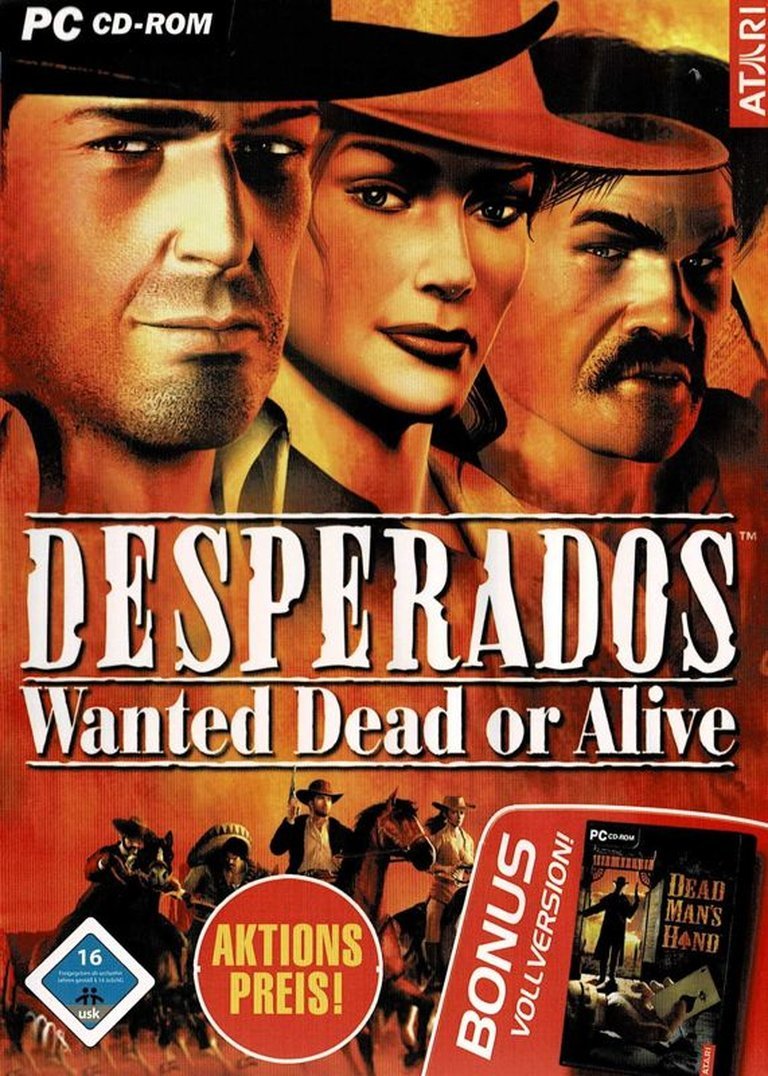
Description
Atari TwinPack: Desperados: Wanted Dead or Alive / Dead Man’s Hand is a 2006 Windows compilation that bundles two Western real-time tactics games. Desperados: Wanted Dead or Alive, set in 1881 post-Civil War America, follows bounty hunter John Cooper and his partners as they undertake a mission to stop a gang of train bandits in the southern United States. Dead Man’s Hand continues the Western tactical gameplay with additional adventures in the lawless frontier era.
Atari TwinPack: Desperados: Wanted Dead or Alive / Dead Man’s Hand Reviews & Reception
myabandonware.com (91.2/100): It’s one of the best games I’ve ever played
Atari TwinPack: Desperados: Wanted Dead or Alive / Dead Man’s Hand: A Bifurcated Legacy of the Wild West in Real-Time Tactics
Introduction: The Double-Barreled Legacy of a Bygone Era
In the mid-2000s, the video game industry’s memory was shortening, digital distribution was nascent, and physical retail shelves were cluttered with compilations. Among them, the Atari TwinPack: Desperados: Wanted Dead or Alive / Dead Man’s Hand (2006) stands as a curious and crucial artifact. It represents not just a value proposition but a historical preservation effort, bundling two titles from a niche but influential subgenre: the isometric, real-time tactics (RTT) Western. While Desperados: Wanted Dead or Alive (2001) is a recognized classic—often hailed as the genre’s pinnacle outside of Commandos—its partner, Dead Man’s Hand (2004), remains a shadowy counterpart, a game noted more for its existence than its execution. This review will dissect this compilation not as a cohesive package, but as a time capsule revealing two divergent paths of early 2000s tactical game design. My thesis is that the TwinPack’s true value lies in its unintentional contrast: it preserves a masterpiece (Desperados) alongside a fascinating failure (Dead Man’s Hand), together illustrating the creative vitality and commercial pitfalls of adapting the stringent, brain-burning RTT formula to the mythic landscapes of the American frontier.
Development History & Context: From Commandos to Canyons
The Spellbound Vision and Technological Shackles
Both games were developed by Spellbound Entertainment, a German studio that carved its niche by meticulously adapting the Commandos: Behind Enemy Lines formula to distinct settings. Desperados (internally codenamed Death Valley) was a deliberate pivot. Initial concepts, as documented on the Desperados Wiki, included fantastical elements like zombies, inspired by the Wild Wild West film. This was jettisoned for a grittier, historically grounded Western, a setting that demanded a different visual and narrative language than Commandos’ WWII backdrop. The technological constraint was the pre-rendered 3D isometric engine, a cost-effective solution for detailed, static backdrops (ghost towns, canyons, fortresses) that allowed for cinematic framing but limited dynamic interactions. The 2001 PC market was dominated by 3D accelerators, yet Spellbound’s choice reflected a prioritization of artistic craft and tactical clarity over cutting-edge rendering.
Dead Man’s Hand, released three years later, ostensibly built upon this foundation. However, its development context is murkier. Published by Atari (who had acquired Infogrames, Desperados’ original publisher), it arrived as a niche Xbox/PC title during a transitional period where the RTT genre was being eclipsated by real-time strategy (RTS) and first-person shooters. Spellbound was expanding, working on Desperados 2 concurrently, and Dead Man’s Hand may have been a stopgap or a console-oriented iteration. The technological leap is minimal; it uses a similar engine but with modest visual upgrades, suggesting a constrained budget and a directive to capitalize on the Desperados name without the same creative leadership (Jean-Marc Haessig, Desperados’ director/designer, is not credited for Dead Man’s Hand in available sources).
The Gaming Landscape: A Genre at a Crossroads
The early 2000s was the golden age of isometric tactical games. Commandos, Robin Hood: The Legend of Sherwood, and Jagged Alliance defined a style: slow-paced, planning-intensive, punishingly difficult. Desperados entered this landscape as a breath of fresh air—a Western that was neither arcade shooter nor dull simulation. Its success (Metacritic 78/100, “generally favorable reviews”) proved the setting had legs. By 2004, when Dead Man’s Hand launched, the RTT genre was stagnating. Commandos 3 had moved to 3D with mixed results, and players’ attention was shifting. Dead Man’s Hand’s simultaneous Xbox release was a bid for console relevance, a platform where the precise, mouse-driven RTT genre traditionally floundered. This context is essential: it explains Dead Man’s Hand’s probable design compromises and its ultimate obscurity.
Narrative & Thematic Deep Dive: Vengeance and Betrayal vs. Vague Notoriety
Desperados: A Shakespearan Saga in the Southwest
Desperados’s narrative is its secret weapon, a rarity in a genre typically dismissive of plot. Set in 1881, it begins as a simple bounty hunt: the legendary gunfighter John Cooper is hired by railroad magnate Twinnings & Co. to stop train robberies and capture the ghostly “El Diablo.” What unfolds is a 25-motion-picture-like saga of conspiracy, loyalty, and betrayal. The plot is a masterclass in serialized storytelling within a game structure. Each mission acts as a chapter, introducing characters and escalating stakes:
- The Gathering of the Gang: Cooper’s recruitment of his crew—the explosive slave Sam Williams, the cynical doctor-sniper-lockpick Doc McCoy, the seductive gambler Kate O’Hara, and later the vengeful teenage Mia Yung and the redeemed bandit Pablo Sanchez—is not a menu selection but a narrative journey. Each rescue mission establishes their motivations and skills organically.
- The Web of Intrigue: The story pivots when the seemingly helpful Marshal Jackson is revealed as the true El Diablo. The twist is earned through meticulous clues: Smith’s suspicious behavior, the ambush on Sanchez’s hideout, Jackson’s relentless manhunt. The narrative tension derives from Cooper being framed for murder, forcing the team into a constant state of evasion while hunting the real villain.
- Themes of Justice and Family: Unlike the archetypal, solitary cowboy, Cooper’s journey is about forged family. The team bickers, saves each other, and suffers losses (the Chinaman’s death, Mia’s trauma). The theme is that justice in the lawless West is a collaborative, often personal, endeavor. The final confrontation in the “Gates of Hell” cave is a cathartic mix of gunfight and familial vindication.
The writing, delivered through well-acted (if occasionally cheesy) in-engine cinematics and dialogue, thrives on Western tropes subverted. The “femme fatale” Kate is more than a distraction; her gambling skills are a core gameplay mechanic. The “Indian sidekick” trope is avoided; Mia is a Chinese-American orphan with a pet monkey, a figure of specific historical (and often overlooked) presence.
Dead Man’s Hand: A Story Lost in the Chaff
In stark contrast, Dead Man’s Hand’s narrative is virtually undocumented in the provided sources and widely considered an afterthought. The title references the poker hand (two black aces and two black eights) associated with Wild Bill Hickok’s murder, signaling a game more interested in iconography than narrative. From scant information and its placement as a console port, one infers a plot: presumably another bounty hunt, likely involving the titular “Dead Man’s Hand” gang or a conspiracy. The critical failing is the absence of the cinematic transitions, character-driven missions, and plot twists that defined Desperados. Reviews for the original Desperados (from GOG/MyAbandonware) consistently praise its “great story” and “grasping tale,” while Dead Man’s Hand is rarely mentioned in such contexts. It represents the genre’s potential soulless iteration: taking the mechanics without the soul, the setting without the story. Where Desperados used the West to explore themes, Dead Man’s Hand seems to use it as mere aesthetic dressing for more levels and shootouts.
Gameplay Mechanics & Systems: The Precision Engine of Tactical Westerns
Desperados: The Refined RTT Art Form
Desperados is a landmark in RTT design. Its brilliance lies in information hierarchy and character synergy.
- The Cone of Vision (Spyglass): This is the seminal innovation. Every NPC has a colored cone representing their state of alertness: green (calm), yellow (suspicious), red (spotted). Pink indicates attraction to Kate; black denotes berserk rage from Mia’s blowpipe. This system replaced abstracted “alert levels” with intuitive, spatial storytelling. Planning an assault became a puzzle of manipulating sightlines and sound radii.
- Character-Specific Abilities: Each of the six playable characters has five unique actions, creating a combinatorial explosion of solutions:
- Cooper: Knife throw (silent takedown), revolver (3 shots, quick-action programmable), lasso (non-lethal capture), horse riding, watch (distraction).
- Sam: Dynamite (area damage), snake (distraction/attack), shovel (digging), whiskey (drunkenness inducement), horse riding.
- Doc: Sedative dart (silent KO), rifle (long-range), medical kit (heal), lockpick, horse riding.
- Kate: Seduction (lure), pistol, fan (distraction), gambling (contextual), horse riding.
- Sanchez: throwing knives, machete (melee), intimidation (fear aura), rope (restrain), horse riding.
- Mia: Blowpipe (dart causing black cone/berserk), barefoot (silent movement), alarm bell (diversion), pet monkey Mr. Leone (key fetch/tripwire).
This design encourages role specialization and constant switching. A mission might require Doc’s sniping from a tower, Sam’s dynamite to breach a wall, Kate’s seduction to clear a room, and Mia’s stealth to deactivate an alarm—all orchestrated in real-time or paused via the brilliant Quick Action system.
- Quick Action: This allowed queueing complex actions (e.g., “run to point A, then throw knife at target B”) and executing them instantly. It was a godsend for managing multiple characters under pressure, turning real-time into managed sequential turns.
- Environmental Interactivity: Horses were mobile platforms. Objects could be dropped on heads. TNT barrels and structures added demolition layers. The environment was a tactical toolset.
- The “Ghost” Run: The most revered mechanical nuance was the possibility of completing missions without firing a lethal gunshot. This “pacifist” or “non-lethal” challenge, celebrated in user reviews, was baked into the design: most enemies could be KO’d, lured, or scared. This elevated the game from tactical exercise to puzzle-platformer.
Dead Man’s Hand: The Sloppy Sequel
Dead Man’s Hand largely inherited this framework but with critical regressions, based on player recollections and its reputation:
- Loss of Polish: The cone-vision system remained, but AI was reportedly dumber and less reactive. The satisfying “thwack” of a knife or the visual clarity of Desperados’ pre-rendered sprites gave way to a less readable, possibly 3D-modelled environment (on Xbox). User reviews frequently cite clunky controls and unresponsive mechanics in later Desperados titles, and Dead Man’s Hand is the likely progenitor of these issues.
- Diluted Character Roster: While likely featuring a similar gang, there’s no evidence it introduced new, mechanically distinct characters on par with Mia or Sanchez. The character system, the series’ heartbeat, felt static.
- Console Compromises: Designed for Xbox’s gamepad, the precise point-and-click interface of Desperados was likely compromised, leading to the frustration noted in PC ports of other console-oriented tactics games. The strategic depth suffered for accessibility.
- Mission Design: Without the narrative integration of Desperados, missions in Dead Man’s Hand likely felt like disconnected tactical sandboxes, lacking the “movie scene” continuity that made each Desperados level feel consequential.
The TwinPack, therefore, bundles a masterclass in RTT design with a case study in franchise dilution. Playing them back-to-back highlights how easily intricate systems can be degraded by shifting priorities.
World-Building, Art & Sound: Cinematic Western vs. Functional Frontier
Desperados: Painting the West with Pre-Rendered Grandeur
Desperados’s aesthetic is deliberately cinematic. Using pre-rendered 3D backgrounds (a la Final Fantasy VII), Spellbound created a series of breathtaking, storybook-like vistas: the dust-blown streets of El Paso, the moonlit Louisiana bayou, the claustrophobic ghost town of Deadstone, the grand hall of Fortezza prison. Each mission’s backdrop is a static painting teeming with life—citizens going about routines, animals wandering, environmental storytelling in every saloon sign and crate. The isometric perspective provides a God’s-eye view of the narrative, making the player feel like a director framing a spaghetti western shot.
The sound design is equally evocative. The soundtrack, composed by Michael Anarp, Serge Mandon, and Giovanni Vindigni, is a blend of sparse, twangy guitar, mournful harmonica, and tense percussive builds that swell during alerts. It never overwhelms but constantly underscores the genre. Sound effects are crisp: the snap of a whip, the clink of a bottle, the thwump of a dynamite stick. The voice acting, while uneven, sells the archetypes—Cooper’s gravelly drawl, Doc’s weary cynicism, Sam’s folksy humor. Together, they create an atmosphere of earnest, genre-loving immersion. The world feels lived-in and dangerous.
Dead Man’s Hand: The Aesthetic of Oblivion
Documentation on Dead Man’s Hand’s art and sound is scarce, a symptom of its lower profile. Based on limited footage and the era’s technical trends, it likely moved towards real-time 3D environments, sacrificing the painterly detail of Desperados for more polygons but less artistic cohesion. The Western aesthetic would have been generic—dusty towns, canyons, saloons—without the same level of environmental narrative or cinematic presentation. The sound, while presumably competent, lacks the memorable, thematic quality of its predecessor’s score. This artistic downgrade reflects its development as a quicker, more commercially minded product. The world feels like a tactical arena, not a storybook. This loss of atmosphere is a key reason for its historical obscurity; it had no visual or auditory identity to compete with the iconic imagery of Desperados or the broader Western genre.
Reception & Legacy: A Tale of Two Games
Desperados: The Critically-Adored Cult Classic
Desperados was released to generally favorable reviews (Metacritic 78/100). Critics praised its:
* Genre Perfection: “A Commandos in the wild west” was a common refrain, but most agreed it surpassed its inspiration in narrative integration and character variety.
* Atmosphere and Story: Reviews from IGN (8.1/10), GameSpy (83%), and PC Gamer (81%) highlighted its cinematic story and immersive Western feel.
* Depth and Replayability: The multiple solution paths, the “ghost run” challenge, and the intelligent AI were repeatedly cited. Next Generation’s review notably gave it an extra star “just for being that rare Western-themed game that does justice to its source.”
Commercially, it was a solid success in Europe, particularly Germany, but remained a niche title in the US. Its legacy, however, grew through word-of-mouth and digital re-releases. The 2018 “Modernized” update (adding Windows 10 compatibility, Mac/Linux ports, foreign dubs, and the demo mission) by THQ Nordic was a critical act of preservation, fixing the notorious speed issues on modern systems that plagued earlier Steam/GOG versions. This version cemented its status as a “Good Old Game”—a title preserved for posterity. Its influence is seen in the meticulous, character-driven design of the acclaimed Desperados III (2020), which explicitly iterated on its predecessor’s systems.
Dead Man’s Hand: The Forgotten Foot Soldier
Dead Man’s Hand received scant critical attention and minimal commercial impact. It is not listed on Metacritic in the provided sources. Its legacy is one of obscurity and disappointment. It is remembered, if at all, as:
1. A proof-of-concept for a console RTT Western that failed to find an audience.
2. A victim of the genre’s decline and Atari’s erratic publishing.
3. A souvenir for completionists in the Desperados series, often bundled to add perceived value to compilations like this TwinPack or the later Desperados: Complete Collection.
Its existence likely delayed Desperados 2: Cooper’s Revenge (2006) by diluting the brand and exhausting Spellbound’s resources. When Spellbound eventually shut down, it was working on the cancelled multiplayer title Desperados Gangs—a project whose ambition contrasted sharply with the safe, iterative (and failed) Dead Man’s Hand.
The TwinPack Itself: A Curious Artifact of Mid-2000s Retail
Released in March 2006, this compilation arrived after Desperados 2 and before the series’ decade-long hiatus. Its purpose was clear: inventory management for Atari. By pairing the acclaimed but aging Desperados with the obscure Dead Man’s Hand, Atari could clear stock and market a “2-for-1” value proposition to budget-conscious PC gamers. From a preservation standpoint, it succeeded inadvertently—it kept Desperados in circulation. From a consumer standpoint, it was a mixed bag that required separating the wheat from the chaff. Its place in history is as a transitional object, a physical disc representing the end of an era for both a great game and a faltering franchise experiment.
Conclusion: The Verdict on a Divided Duo
The Atari TwinPack: Desperados: Wanted Dead or Alive / Dead Man’s Hand is not a single entity to be judged as one. It is a dual biography in a single box. Desperados: Wanted Dead or Alive stands as one of the finest real-time tactics games ever made, a title that married the cerebral tension of its genre to the romantic, visceral mythos of the American West. Its narrative depth, character synergy, and atmospheric world-building created an experience that transcended its mechanics, earning its status as a preserved classic.
Dead Man’s Hand, by contrast, is a cautionary tale. It demonstrates how a solid foundation can be squandered through a lack of vision, narrative disregard, and likely corporate meddling. It is a functional but forgettable tactics game, a ghost in the machine of the Desperados name.
Together, this TwinPack is invaluable. It allows us to play these two paths side-by-side and understand what made Desperados great and why its sequel-within-a-compilation failed. For the historian, it’s a perfect case study. For the player, it is a worthwhile purchase only as a convenient, physical archive of Desperados—a game whose historical importance and enduring playability justify enduring the presence of its lesser companion. In the museum of video game history, Desperados deserves a pristine wing; Dead Man’s Hand is a footnote in the same gallery, a reminder of the many roads not taken. This compilation, therefore, earns its keep not as a balanced pair, but as the imperfect container for a masterpiece.
Final Verdict: 8/10 – A historically significant bundle, graded on the strength of Desperados: Wanted Dead or Alive (9/10) and the novelty/failure of Dead Man’s Hand (5/10). The TwinPack is essential for scholars and fans of the genre, but casual players should seek the standalone, modernized version of Desperados and ignore its companion.