
- Release Year: 2004
- Platforms: Macintosh, Windows
- Publisher: Aspyr Media, Inc., Focus Multimedia Ltd., Russobit-M, THQ Inc.
- Developer: AWE Games
- Genre: Adventure
- Perspective: 3rd-person
- Game Mode: Single-player
- Gameplay: Point-and-click, Puzzle
- Setting: Aquatic, Underwater
- Average Score: 87/100
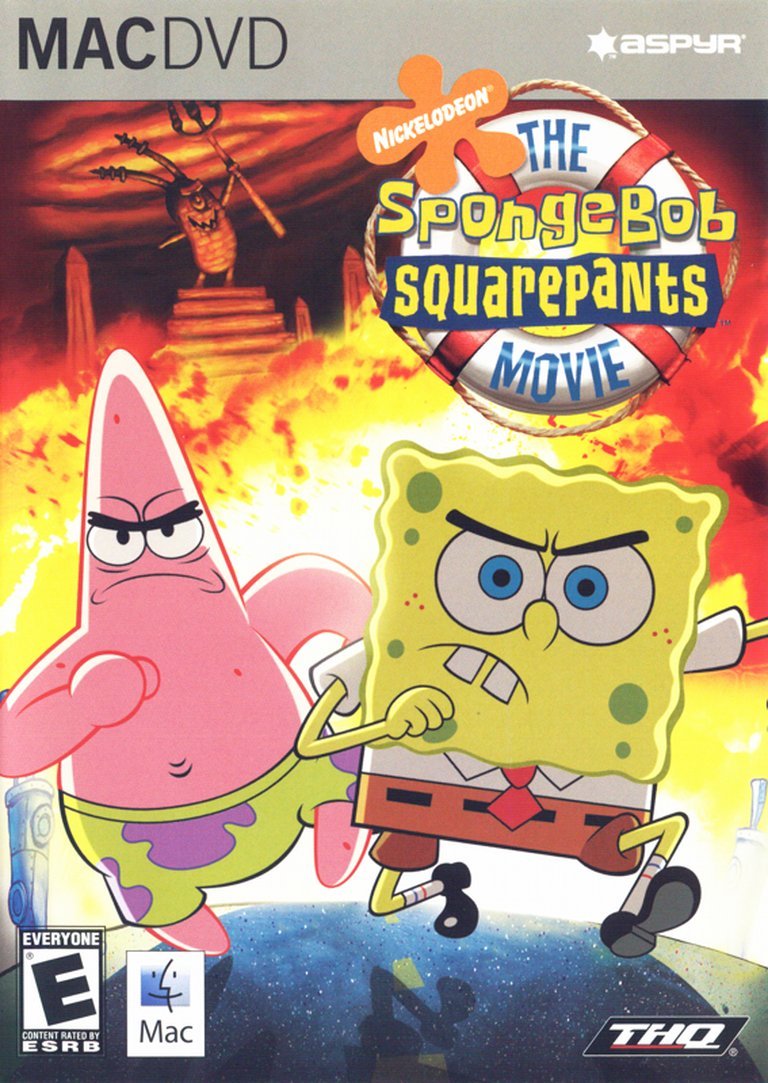
Description
Based on the 2004 animated film, ‘The SpongeBob SquarePants Movie’ video game transports players to the aquatic world of Bikini Bottom in a point-and-click adventure. Players control SpongeBob and friends as they solve puzzles, engage in interactive conversations, and navigate through full-motion video segments that adapt the movie’s story, with all-new dialogue voiced by the original cast. However, the game is noted for its slow movement, tedious travel, and unskippable voiceovers, making it primarily targeted at young fans of the series.
Gameplay Videos
The SpongeBob SquarePants Movie Free Download
The SpongeBob SquarePants Movie Mods
The SpongeBob SquarePants Movie Guides & Walkthroughs
The SpongeBob SquarePants Movie Reviews & Reception
metacritic.com (74/100): a solid single player game that will keep players busy for hours.
imdb.com (100/100): Challenging at times, but still loads of fun.
jake-s-entertainment-reviews.com : a great game based on a beloved movie.
The SpongeBob SquarePants Movie Cheats & Codes
PC
Press F12 at the main menu, then type the code.
| Code | Effect |
|---|---|
| PLANKTON | Opens 4 bonus dresses |
| awegames | Play any chapter |
Game Boy Advance
Enter codes via CodeBreaker or GameShark device.
| Code | Effect |
|---|---|
| 0000BAC1 000A | CodeBreaker mastercode |
| 10008440 0007 | CodeBreaker mastercode |
| 830071C8 03E8 | Invulnerability |
| 8300704C 0258 | Unlimited Time |
| 33006FC8 0009 | Unlimited Tin Cans |
| 33001444 00FF | Unlimited Lives |
| 830070AC 03E7 | 999 Shells |
| 730038A8 0008 | Unlimited Time (Bonus Levels) |
| 830038A8 0009 | Unlimited Time (Bonus Levels) |
| 73003970 0008 | Unlimited Time During Races |
| 83003970 0009 | Unlimited Time During Races |
| 43007594 0202 | Have All Levels Unlocked |
| 0000003D 0002 | Have All Levels Unlocked |
| Clam, SpongeBob, Robot With Dog Face, Clam, King Neptune, SpongBob | Password for Shell City level four |
| Red Guy, Queen, King, Patrick, Bob, Queen | Password for Advanced level |
| Chum Bucket Helmet, Chum Bucket Helmet, Ice-Cream Monster, Jellyfish, King Neptune, SpongeBob | Password for Level select |
| Patrick, SpongeBob, Bucket Hat, Jellyfish, Neptune, SpongeBob | Password to start at last level in easy mode with all levels unlocked |
GameCube
For button sequences: Pause game and hold L+R, then enter sequence. For Action Replay codes: Enter via Action Replay device.
| Code | Effect |
|---|---|
| Y, Y, X, Y, X, X, Y, Y | Unlock all moves |
| Y, Y, Y, Y, X, Y, Y, Y | Unlock Cave SpongeBob costume |
| X, Y, X, X, Y, X, Y, Y | Show all ? as tasks |
| Y, Y, X, Y, X, X, Y, X | Upgrade all moves |
| X, X, X, X, Y, X, Y, X | Maximize health |
| X, X, Y, Y, X, Y, Y, X | Double manliness points |
| YYYYXYYY | SpongeBob Caveman costume |
| YYYYXYYX | SpongeBob Ripped Pants costume |
| YYYYXYXY | Goofy Goober Patrick costume |
| YYYYXYXX | Patrick Caveman costume |
| R1X9-HWAP-ABFAQ | Action Replay mastercode |
| PZ3T-1ZQC-9DVU4 | Action Replay mastercode |
| HH8K-MP3M-TU0TM | Infinite Health |
| 682E-3GQM-UFPYM | Infinite Health |
| K1BC-MQPJ-5610K | Infinite Health |
| JGGZ-GKF5-6PGBF | Infinite Health |
| DY4N-7A3Q-E13R0 | Press L+R+Z To Die |
| 16HZ-VW1D-DJKAZ | Press L+R+Z To Die |
| 9YEB-AVH5-CGQ9W | Press L+R+Z To Die |
| AGH9-0NRR-FWRXZ | Press L+R+Z To Die |
| TE8V-AQQV-VQC3E | Press Y To Add Manliness |
| HDX3-0A2G-29Q6J | Press Y To Add Manliness |
| 9A1G-QATJ-JZ8XD | Press Y To Add Manliness |
| M7P3-4YGX-AYVDB | Infinite Upgrade Points |
| D8HM-MKT4-MJC89 | Infinite Upgrade Points |
| JYA5-YZZ4-36A5D | SpongeBob: All Upgrades |
| Y1F8-N8XQ-XH9MV | SpongeBob: All Upgrades |
| PEW3-H8PD-7462E | SpongeBob: All Upgrades |
| M14H-ERN5-05F7U | Patrick: All Upgrades |
| FFWQ-EBZK-E750Z | Patrick: All Upgrades |
| V79N-KR1D-BRYNZ | Patrick: All Upgrades |
| A6MB-YF8B-Q4D3T | Hold L+A For Super Jump |
| 76EK-MH2G-H5MHU | Hold L+A For Super Jump |
| 5HRZ-Z4HE-YKHY1 | Hold L+A For Super Jump |
| DVU9-GJDP-16FZG | Hold L+A For Super Jump |
| QPG5-GWH7-BQ5AM | Hold L+A For Super Jump |
The SpongeBob SquarePants Movie: A Deep-Dive Review of an Absorbent Adaptation
Introduction: More Than Just a Tie-In
In the early 2000s, the licensed video game was a genre synonymous with rushed development, cynical cash-grabs, and disposable entertainment. Yet, alongside the avalanche of Shrek and Harry Potter titles, a curious anomaly emerged from the murky depths of Bikini Bottom: The SpongeBob SquarePants Movie video game. Based on the 2004 film that itself was a surprise critical and commercial hit, this multi-platform release—spanning consoles, PC, and handhelds—presented a fascinating case study in adaptation. It was not a single game but a fractured collection of experiences, each tailored to its hardware’s perceived audience, from 3D platformers to a point-and-click adventure. This review argues that The SpongeBob SquarePants Movie game is a significant, if deeply flawed, artifact of its time: a game that successfully transplanted the anarchic spirit and humor of its source material into interactive form, yet was ultimately strangled by technological constraints, uneven design philosophy, and the fundamental difficulty of translating cinematic sprawl into engaging gameplay. Its legacy is one of potential glimpsed but not fully realized, a compelling “what if” that remains a cult favorite for a specific generation of fans.
Development History & Context: A Studio Splintered
The game’s development history is a map of early-2000s licensing pragmatism. Unlike a single, unified vision, the project was fractured across studios, each receiving a mandate suited to their platform’s “typical” audience.
- Heavy Iron Studios (PS2, Xbox, GameCube): The primary developer, fresh off the well-received SpongeBob SquarePants: Battle for Bikini Bottom, was tasked with creating a 3D platformer that would “be a meaty game,” as Official Xbox Magazine noted. They utilized the same RenderWare engine as Battle for Bikini Bottom, allowing for asset reuse but also visual and mechanical familiarity. The goal was clearly to provide a substantial “core” gaming experience for console owners.
- AWE Games (Microsoft Windows): For the PC, developer AWE Games pivoted dramatically. eschewing 3D action, they created a traditional point-and-click adventure—a genre in decline but still holding niche appeal. As the GameBoomers review highlights, this resulted in “a traditional adventure game in just about every possible way,” complete with inventory puzzles, dialogue trees, and a rational save system. This was a conscious deviation targeting a perceived “family” or “older fan” PC audience.
- WayForward Technologies (Game Boy Advance): The GBA version was a 2D side-scrolling platformer with Metroidvania-lite elements (path selection, password saves), a genre perfectly suited to the handheld’s capabilities and the era’s expectations.
- Aspyr Media (Mac OS X): A port of the PC version, released later, catering to the smaller Mac gaming market.
Technological & Temporal Constraints: All versions were developed on a tight schedule to sync with the film’s theatrical and home media release (October/November 2004). This short development cycle is palpable in the final products. The console versions, while visually competent for the RenderWare engine, show heavy asset recycling from Battle for Bikini Bottom. The PC version’s “slideshow” FMV sequences—using stills from the film with clip art and narration—are a clear cost-cutting measure. The PS3 port in 2012, handled poorly by a different team, became infamous for severe input lag and audio desync, leading to its swift removal from the PlayStation Store, a stark footnote on the perils of legacy ports.
The 2004 Gaming Landscape: The title released amid a crowded holiday season dominated by Half-Life 2, Halo 2, and World of Warcraft. Licensed games were still fighting a reputation for laziness. Against this backdrop, The SpongeBob Movie game’s relative quality—especially the console version’s ambitious scope—was noteworthy. It competed not just with other kid-oriented games, but with the lingering ghost of Battle for Bikini Bottom, which had set a high bar for 3D SpongeBob platformers.
Narrative & Thematic Deep Dive: Compressing a Hero’s Journey
The film’s plot—a classic hero’s journey where naive SpongeBob and Patrick must travel to Shell City to retrieve King Neptune’s crown and save Mr. Krabs—is the game’s backbone. However, the method of storytelling varies wildly by version and reveals the adaptation’s central tension.
- Console/Handheld Versions: The narrative is delivered primarily through in-game cutscenes and extensive FMV “slideshow” sequences. These slideshows, narrated by the iconic French Narrator, use stills from the film, game-specific illustrations, and clip-art objects. As the MobyGames user review astutely notes, “Some of the huge moments in the movie are only glanced over by the narrator.” The climactic “Goofy Goober Rock” sequence, a pivotal emotional beat in the film, is reduced to a quick slideshow mention in the game. This compression turns a feature-length narrative into a series of level set-pieces, losing the film’s thematic throughline of “proving you’re a man” (or in SpongeBob’s case, proving maturity isn’t about age).
- PC Version: As a point-and-click adventure, the story is inherently more fragmented but allows for greater environmental storytelling and character interaction. The eight-chapter structure follows the film’s beats but inserts original puzzles and dialogue. The review from GameBoomers praises the “engaging story” and “lots of dialog-based character interaction,” noting that “all-new dialogue was written for this game, and it’s pretty darn good,” with the original cast (minus a few) returning. This version better preserves the show’s signature rapid-fire, absurdist humor through constant interaction.
- Thematic Core: All versions retain the core theme: innocence and optimism versus cynical world-weariness. SpongeBob and Patrick’s childlike wonder contrasts with the grim, industrial landscapes of the Trench and Planktopolis. The “Manliness Points” system in the console version is a direct, if literal, translation of the film’s central metaphor. The game, especially the console version, repeatedly emphasizes that their “kid” qualities—SpongeBob’s earnestness, Patrick’s simple loyalty—are their greatest strengths, culminating in the final boss where rock and roll (the pure, childish joy of Goofy Goober) defeats Plankton’s mind-control authoritarianism.
Gameplay Mechanics & Systems: A Tale of Three (or Four) Games
The game’s identity is schizophrenic, dictated by platform.
-
Console (PS2/Xbox/GC): 3D Platformer with Adventure Flair. This is the most significant version. Gameplay is a mix of:
- Linear Platforming: Navigating 3D levels with fixed camera angles. SpongeBob and Patrick have unique moves (SpongeBob’s Karate Spin, Patrick’s Cartwheel) upgraded via “Manliness Points” collected from glowing weights. The progression system is dual-layered: Goofy Goober Tokens (earned by completing main objectives and side challenges) unlock new areas and story progression, while Manliness Points upgrade health (from 3 to 6 Krabby Patties) and move effectiveness. This creates a compelling risk/reward loop; skipping side tasks makes later platforming and boss fights harder.
- Diverse Minigames: The game’s greatest strength and weakness. It injects variety with:
- Patty Wagon Driving: A simplistic, often frustrating racing/collection segment. Critics like GameZone’s Louis Bedigian called its controls “not very accurate.”
- Sliding (Tub): A slower, more precise滑行 puzzle.
- Bungee Challenges: SpongeBob uses a hook to targetbash.
- Combat Arenas: Wave-based survival sections.
- SpongeBall & Floating Block Challenges: Mini-platforming gauntlets.
- Boss Fights: Four main bosses (Frogfish, Dennis x2, King Neptune) are straightforward pattern-recognition fights, with the final Neptune battle being notably more complex. As the Moby user review states, “Bosses are very easy for the most part.”
- The Flow Problem: The level structure is semi-open world but with heavy backtracking. After completing a level, you often return to a hub (like the Goofy Goober Ice Cream Parlor) to select the next, but must sometimes re-enter previous levels to access side challenges for tokens. This, combined with agonizingly slow character movement (the “snail’s pace” the user review lambasts), makes traversal a chore. The “Band-Aid” speed-up click is insufficient.
- UI & Interface: Simple and effective. Hovering over interactable objects labels them at the screen’s bottom—a “huge plus” that eliminates pixel-hunting frustration. The lack of a traditional life system (respawning at checkpoints) is forgiving but reduces stakes.
-
PC (Windows/Mac): Point-and-Click Adventure. A complete departure. This is a classic LucasArts/SCUMM-style game:
- Inventory-Based Puzzles: Core gameplay revolves around talking to NPCs, combining items (e.g., shrinking a giant sweater by dropping it in hot springs, as noted by 1UP and CGW), and using the right item on the right object in the right location.
- Dialogue & Interaction: The strength. The “amount of interactivity with people is immense,” with “linking conversations” that make the world feel alive. The new dialogue captures the show’s wit.
- Chapter Structure: Eight chapters, each a self-contained puzzle sequence connecting to the next via the slide-show narration.
- Flow: Unlike the console version’s sprawl, this is tightly paced but suffers from its own pacing issue: unskippable, slow voice acting. As the user review gripes, “there’s no way to skip it, and boy do they speak slowly,” turning repeated attempts at puzzles into an auditory endurance test.
- Challenge: Puzzles are “clever” but can lead to early “stuck points” for younger players, as Edutaining Kids noted. It requires logical thinking rather than reflexes.
-
GBA: 2D Platformer. A more straightforward, linear experience with lighter platforming, boss fights at the end of each world, and password saves. Criticized for repetitive gameplay and feeling like “only one playable character that’s been melded from two” (SpongeBob and Patrick shared a moveset).
World-Building, Art & Sound: Absorbing the Aesthetic
- Visuals & Art Direction:
- Console: Uses the same versatile RenderWare engine as Battle for Bikini Bottom. Character models are faithfully cartoony, and the color palette is vibrant, capturing Bikini Bottom’s psychedelic squalor. The new environments—the desolate Trench, the tourist-trap hell of Shell City, the totalitarian Planktopolis—are effectively stylized. However, the heavy reuse of BFBB assets (enemies, certain props) is glaring. The “Jellyfish with bucket helmets” mentioned in SpongePedia trivia is a perfect example of asset flip.
- PC: The 2D pre-rendered backgrounds and character sprites are clean and colorful, capturing the show’s style adequately for a 2004 PC adventure. The slide-show cutscenes are a major visual downgrade, feeling cheap compared to even the console’s in-engine cutscenes.
- GBA: pixel art is charming but limited by the hardware.
- Sound & Music:
- Voice Acting: A universal high point. Almost the entire film’s cast reprises their roles (Tom Kenny, Bill Fagerbakke, Clancy Brown, etc.). The new dialogue is well-delivered and in-character. The notable absence of David Hasselhoff is handled humorously in the console version (dolphin noises) and by a sound-alike in others. The user review rightly praises the “solid” voice work.
- Music: The soundtrack uses music from the film (including the iconic “Goofy Goober Rock” and “The Best Day Ever”) and new compositions. It’s generally peppy and fitting, though some tracks are forgettable. The PC version’s ambient music suits the adventure tone.
- Atmosphere: The console version’s level design—from the sun-dappled Jellyfish Fields to the oppressive, foggy Trench—does a commendable job of making players feel the journey’s progression from home to hostile unknown. The PC version builds atmosphere through environmental interaction and character chatter.
Reception & Legacy: A Mixed Splash
- Critical Reception (at Launch): Mixed to Positive (64% MobyScore, 67-75 Metacritic across platforms). Reviews were deeply split along platform and reviewer predisposition.
- Console Version Praise: GameBoomers (91%) and IGN (7.8/10) lauded its substantial, varied platforming and faithfulness. Official Xbox Magazine (8.9/10) called it “much more than a cheap commercialization.”
- Console Version Criticism: PC Action (64%), 1UP (50%), and CGW (50%) derided it for not being a true “play the movie” experience, criticizing the slow movement, backtracking, and reliance on slide shows. As 1UP succinctly put it: “Gameplay is essentially a series of one- or two-puzzle levels connected by long slide shows.”
- PC Version: Received slightly higher marks from adventure-focused outlets (Quandary 80%, Adventure Corner 69%) but was dismissed by action-focused reviewers. Criticisms centered on slow pace and low replayability (IMG noted “very little replay value”).
- GBA Version: The lowest-rated (53% on GameRankings), seen as repetitive and inferior to its console siblings.
- Commercial Performance: A significant success. The game shipped 2 million units across platforms, a strong number for a licensed title. The GBA version alone sold an estimated 780,000 copies, ranking #25 on Edge magazine’s “Century’s Top 50 Handheld Games” (by sales) in 2006.
- Evolving Reputation & Legacy:
- Cult Favorite: Among SpongeBob fans who grew up with it, the console version is fondly remembered for its ambitious scope, humor, and challenge. User reviews on Moby and Metacritic (averaging ~7.3/10) are more positive than many contemporaneous critic reviews, suggesting it connected with its target audience.
- Industry Influence: It stands as a high-water mark for Nickelodeon-licensed games of the mid-2000s, demonstrating that a movie tie-in could be a substantial game rather than a mini-game collection. It refined the formula from Battle for Bikini Bottom but failed to significantly evolve it, a dead-end as the industry moved towards open-world collectathons and narrative-driven experiences.
- The PS3 Port Infamy: The 2012 PS2 Classic port became a notorious example of lazy emulation. Its technical issues (input lag, audio sync, stretched aspect ratio) and subsequent removal from the PlayStation Store serve as a cautionary tale about preserving licensed software.
- Historical Position: It is not remembered as a classic like BFBB or the later SpongeBob: The Cosmic Shake. Instead, it’s a transitional title—the last gasps of the “movie game” as a potentially substantial 3D platformer before the genre was largely absorbed into bigger-budget, open-world iterations or relegated to mobile. Its multi-format approach, trying to be everything to every SpongeBob fan, is its most defining and problematic feature.
Conclusion: The Verdict on a Bygone Era
The SpongeBob SquarePants Movie video game is a fascinating, fractured relic. Its console version is a robust, if flawed, 3D platformer that captures the show’s manic energy and humor through varied gameplay segments and great voice acting. However, it is crippled by glacial movement speed, tedious backtracking, and the narrative dissonance of its slide-show scenes. The PC adventure version is a more focused, dialogue-rich experience that will delight point-and-click aficionados but frustrates those wanting interactive action. The GBA version is competent but forgettable.
Its place in history is as a proof of concept: a licensed game that genuinely tried to be a game first, with mechanics that reflected its characters and story. It succeeded more than most of its contemporaries but ultimately suffered from being pulled in too many directions—both by the demands of adapting a film and by the varying expectations of four different platforms. For historians, it’s a perfect case study in the constraints of mid-2000s licensed development. For players, it remains a love-it-or-hate-it experience: a game where the overwhelming charm of its source material and its occasional bursts of clever design perpetually battle against its mechanical lethargy and structural clumsiness. It is, in the end, very SpongeBob: absurd, energetic, heartfelt, and fundamentally flawed in ways that are both frustrating and strangely endearing. Final Verdict: 7/10 – A deeply absorbent but uneven adaptation, best experienced with lowered expectations and a love for the source material.