
- Release Year: 2020
- Platforms: Nintendo Switch, Windows
- Publisher: Surefire.Games, V Publishing
- Developer: Matrioshka Games
- Genre: Role-playing (RPG)
- Perspective: Diagonal-down
- Gameplay: Action RPG
- Setting: Fantasy
- Average Score: 69/100
Description
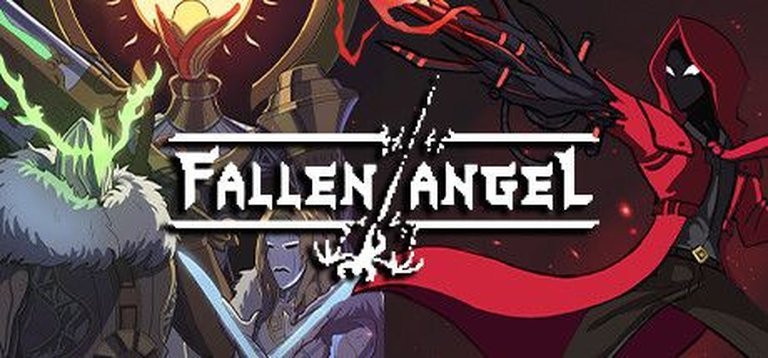
Fallen Angel is a 2D top-down action RPG set in a fantasy world inspired by biblical Apocrypha and infused with modern style, where players embody Lucifer as he battles through the strange and varied realms of Heaven. Featuring pixel art visuals, the game emphasizes fast-paced, strategic combat with lore-driven items and weapons, alongside a flexible character progression system that allows players to customize their combat approach.
Gameplay Videos
Where to Buy Fallen Angel
PC
Fallen Angel Cracks & Fixes
Fallen Angel Guides & Walkthroughs
Fallen Angel Reviews & Reception
metacritic.com (70/100): While I wouldn’t list Fallen Angel as my game of the year, it’s definitely entertaining while it lasts.
opencritic.com (68/100): Although Fallen Angel suffers from some annoying performance issues and long load times when reloading after death, it also does some things right.
rpgamer.com : Unfortunately, the challenge often feels unfair due to performance issues, as deaths lead to long load times and inconsistent frame rates that make the experience uneven.
Fallen Angel: A Concordance of ambition and execution in heaven’s war
Introduction: The weight of a myth, the lightness of a game
The tale of Lucifer’s fall is one of Western literature’s most enduring and philosophically rich narratives, a foundational myth explored in towering works from Dante to Milton. To take this story—a complex meditation on pride, free will, and the nature of tyranny—and distill it into the premise of a “symphony of pixel art and demon-fuelled action” is a bold, almost existentially daring act. It speaks to a deep desire within the indie game scene to wrestle with grand, canonical themes through the visceral, interactive language of gameplay. Fallen Angel (2020), developed by the student-turned-studio Matrioshka Games, arrives precisely at this crossroads. It is a game that clearly aspires to be more than the sum of its combat combos, aiming to fuse the aesthetic of 16-bit nostalgia with the structural freedom of a Souls-like and the narrative gravity of epic poetry. Yet, as the critical consensus and player reception reveal, the execution frequently stumbles under the weight of its own ambition, or worse, fails to fully grasp the magnitude of the myth it appropriates. This review will argue that Fallen Angel is a fascinating case study in potential unrealized—a game with a brilliant core combat loop, a stunningly varied world, and a premise dripping with latent power, but one ultimately hamstrung by a thin narrative, repetitive encounters, and technical roughness that prevent it from ascending to the status it clearly seeks.
Development History & Context: From dorm room to divine discord
The story of Fallen Angel is inseparable from the story of its creators. Born from the Entrepreneurial Game Studio at Drexel University, Matrioshka Games began as a student project, a fact that immediately contextualizes the game’s dual nature. The team, led by Lead Developer Hunter Wu and Lead Programmer Jordan Hoover, was tasked with transforming a academic exercise into a commercial product. This origin explains both the game’s rough edges and its remarkable scope. Using GameMaker Studio, a tool known for its accessibility but also its limitations with complex, large-scale 2D projects, the team attempted to build a non-linear, Metroidvania-inspired action RPG with multiple unique realms, a full combat system, and co-op play.
The game’s marketing, from its Kickstarter trailer in 2019 to its official Steam launch on October 22, 2020 (and a later Nintendo Switch port in July 2022 by V Publishing and Surefire.Games), heavily leaned into its high-concept hook: “What if you played as Lucifer, storming the varied, warped realms of a Heaven in chaos?” This positioned it in a crowded indie space of “Souls-likes” and “character-action” games, but with a unique mythological veneer. The development context is one of a small, passionate team (53 credited individuals, many likely wearing multiple hats) trying to punch above their weight class. The technological constraints of GameMaker are evident in the frame rate issues and long load times, particularly on the Switch port, noted by critics from RPGamer and Screen Rant. The team’s vision—a sprawling, open-ended world with divergent paths and strategic boss fights—sometimes outpaces the engine’s ability to render it smoothly. Yet, within these constraints, they achieved something visually distinct: a pixel-art style that, while occasionally muddled, aims for a detailed, atmospheric beauty found in each Archangel’s uniquely themed domain.
Narrative & Thematic Deep Dive: A paradise lost, and poorly told
The narrative framework of Fallen Angel is its most potent, and most squandered, asset. Drawing inspiration from John Milton’s Paradise Lost and various biblical Apocrypha, the game posits a post-rebellion, post-absence-of-God scenario. Lucifer, having been cast out, returns not to a monolithic Hell, but to a Heaven fracturing into warring fiefdoms ruled by insane, hyper-stylized Archangels. This is a genius premise. It promises a theological sandbox where the order of the cosmos has collapsed, allowing for cyberpunk Uriel, hedonistic Raphael, and mechanized Ramiel—each realm reflecting the distorted psyche of its ruler.
However, the game’s delivery of this premise is catastrophically thin. As Screen Rant’s Nicholas Straub witheringly notes, the famous, pathos-laden opening quote from Paradise Lost is “the only pathos in the entire game.” The subsequent story unfolds through scraps of environmental storytelling and brief, pre-boss barks. There is no meaningful dialogue tree, no significant character development for Lucifer beyond “angry rebel,” and no exploration of the philosophical stakes. The Archangels, while visually and thematically distinct, are reduced to “trite smack talk” before each fight. The choices presented at the end—to assume the Mantle of God or bring about the End—feel like an afterthought, with no observable impact on gameplay or world state, as pointed out by the Game Raven Review. NPCs in the hub, the Kingdom Come Hotel, offer sparse exposition but never react to the player’s progress.
Thematically, the game gestures at ideas of authority, freedom, and madness but lacks the narrative tools to examine them. It conflates “edgy” and “sacrilegious” with depth. The worlds show a “post-modern style” (high-tech constructs beside idyllic plains), suggesting a commentary on Heaven’s sterile perfection versus chaotic creation, but this is never vocalized or integrated into the plot. Where a game like God of War exudes “infectious reverence” for its sources, Fallen Angel treats its mythology as mere window dressing for a beat-’em-up, a sequence of cool-looking bosses to fight. The result is a story that feels less like a reinterpretation of myth and more like a generic “villain protagonist” arc with religious-themed set dressing, a profound disappointment given the richness of its source material.
Gameplay Mechanics & Systems: The scintillating core, the repetitive shell
It is in the real-time combat that Fallen Angel finds its salvation and its damnation. The core loop is, by most accounts, fast, fluid, and deeply satisfying in its early to mid stages. Players control Lucifer from a diagonal-down, 2D scrolling perspective, wielding a primary sword, up to three secondary ranged weapons (shotguns, grenade launchers, etc.), and special abilities unlocked via “monoliths” (the game’s skill tree equivalent). The combat encourages a “character-action” style—aggressive, aerial, combo-heavy. Mechanics like launching enemies, juggling them in the air, chaining claw/blade/gun attacks, and a versatile shadow dash for invincibility frames create a potent, skill-based system. The Pride Meter, which fills during combat to transform Lucifer into a more powerful demonic form, adds a crucial risk/reward dynamic.
The progression system, however, is a source of significant criticism. There is no traditional XP or leveling. Power comes from three avenues:
1. Accessories: Passive bonuses (increased damage, risky trade-offs like high damage at low health) found as drops or purchased from the late-game shop.
2. Weapons/Shields: Unique Archangel drops with powerful, cooldown-based special abilities (forcefields, fire walls).
3. Monoliths/Skills: Scattered throughout the world, offering new attacks (uppercuts, aerial slams) and stat boosts. The design forces meaningful choices, as you have more skill options than slots, encouraging build specialization.
The brilliance here is the emphasis on exploration. To become powerful, you must venture off the main path to find monoliths and weapon pedestals. This creates a rewarding loop of “I need a new ability to reach that platform” or “I need that weapon to counter this enemy’s shield.” The non-linear world map, opened from the start with waypoints, supports this “Metroidvania-lite” freedom. Players can tackle the five Archangel realms in any order, though some are clearly intended to be faced later.
Where the gameplay falters is in contentment and consistency. As Gamer Escape and Game Raven note, the combat variety stagnates. Once a preferred weapon combo and skill set is found—often a mix of melee and one powerful ranged option—the remainder of the 5-6 hour campaign can feel like a repetitive grind. Regular enemy variety is low within each realm, turning large sections into mindless mashing. Furthermore, the much-touted “Souls-like” difficulty is inconsistently applied. While boss fights are regularly praised as the game’s highlight—each Archangel having “unique mechanics and strategies to overcome”—some regular enemies possess absolute gimmick vulnerabilities (e.g., a shield only breakable by a specific, possibly missed grenade launcher), creating unfair, frustrating bottlenecks rather than thoughtful challenge.
The co-op mode is almost universally panned. As Screen Rant details, the second player controls a doppelganger with shared health and resources, which actively discourages complementary builds and turns the combat’s fluidity into a clunky, dependent mess. It feels like an add-on without consideration for how it alters the core balance.
Finally, the user interface and performance mar the experience. The Switch port’s 10-20 second load times after every death and unpredictable frame rate dips (noted by RPGamer) make the game’s difficulty feel punitive and unfair rather than demanding. On PC, issues like gun auto-aim targeting the wrong enemy or melee combos breaking (as reported by Gamer Escape) further chip away at the polish.
World-Building, Art & Sound: The heavens rendered in pixels
If the narrative is a missed opportunity, the world-building through art and sound is Fallen Angel’s greatest triumph. The game’s 2D pixel art is consistently praised as “gorgeous,” “detailed,” and “astounding.” Each of the Archangel realms is a visual spectacle:
* Raphael’s domain is a cyberpunk nightclub/rave, pulsing with neon and chaotic energy.
* Ramiel’s is a mechanized facility of gears, pipes, and cold steel.
* Others include lush green valleys, crumbling ruins, floating islands, and bathhouses overlooking modern cities.
This surreal, anachronistic collage successfully conveys a Heaven that is not unified but violently idiosyncratic. The environmental storytelling—broken machinery, overgrown temples—hints at the cataclysm without a single line of dialogue, achieving what the plot cannot.
The soundtrack is another high point. Composers, led by Nate Baldridge, deliver a “unique and satisfying” score that dynamically shifts with each realm’s theme. The boss music is particularly noted for its “old school game beat remix” energy, perfectly complementing the hectic fights. The combat sound design—swords clanging, explosions booming—has a satisfying, nostalgic low-bit crunch.
However, the voice acting is a notable misstep. While fully voiced, the delivery feels “too crisp and clear,” jarringly modern and out of place against the pixel aesthetic and low-key soundscape. It often gets drowned out, and the script it delivers is so sparse and clichéd that its inclusion feels like a wasted effort, a point Gamer Escape succinctly makes.
Reception & Legacy: A mixed reception, a quiet legacy
Fallen Angel’s reception was decidedly mixed, leaning negative among critics. On OpenCritic, it sits in the -1st percentile with a Top Critic average around 60/100 (based on the sampled scores: Gamer Escape 7/10, Screen Rant 3/10, RPGamer 3/5). The Steam user score is more forgiving at “Mixed” (68% positive from 118 reviews), suggesting that despite its flaws, the core combat and aesthetic resonate with a niche audience willing to overlook its issues, especially at its budget price point ($3.74-$14.99).
Critics converged on the same central dichotomy: brilliant combat and aesthetic versus weak narrative and technical flaws. Gamer Escape‘s final 7/10 verdict—”definitely entertaining while it lasts”—sums up the lukewarm praise. Screen Rant‘s scathing 3/10 review (“frustratingly squanders its powerful source material”) represents the other pole. Common praises were the boss design, combat fluidity, and visual variety. Common criticisms were the shallow story, repetitive grind, poor co-op, and performance issues.
In terms of industry influence, Fallen Angel’s legacy is likely to be quiet. It does not have the cultural impact or mechanical innovation to be cited as a major influence. It exists in the shadow of more polished and narratively cohesive titles in the “action RPG” and “Souls-like” genres. Its most significant contribution may be as a cautionary tale about premise vs. execution, demonstrating that a stellar high concept and competent moment-to-moment gameplay are not enough without a cohesive narrative structure and technical polish. It is a game more likely to be remembered by its small player base as a “hidden gem with flaws” than by the industry at large. Its 2022 Switch port, while expanding its audience, only amplified its performance problems, cementing its status as a PC-first experience with a questionable console adaptation.
Conclusion: A fallen star with a flickering core
Fallen Angel is a game of profound contradictions. It is a biblical epic played for visceral, button-mashing thrills; a student project with the scope of a AAA title; a game with worlds of thematic potential that remain unexplored. Its combat, in its best moments, is a masterclass in weightless, aerial, combo-driven action that rivals the best in the indie scene. Its art direction is a consistently inventive, surreal tour through a fractured Heaven. But these peaks are scourged by the plains of repetition, technical instability, and a narrative so sparse it feels disrespectful to its source material.
For the historian, Fallen Angel is a document of ambition straining against constraint—both technological and, perhaps, experiential. The team at Matrioshka knew what great games look like (the Devil May Cry-esque combat, the Souls-like world design, the Hyper Light Drifter-style ambiguity) but lacked the resources or perhaps the directorial focus to synthesize them into a cohesive whole. It tries to be a Metroidvania, a hack-and-slash, a narrative RPG, and a co-op brawler all at once, and in doing so, it masters none completely.
Verdict: Fallen Angel is not a forgotten classic, but a compelling curio. Its place in history is not on a pedestal, but in a case labeled “Fascinating Failures.” It is essential playing for students of game design to study what happens when a brilliant combat core meets a hollow narrative shell. For the general player, it is a “worth a try” at a deep discount, particularly on PC, for those who can stomach its jank in exchange for moments of sublime, demonic combat. It is, in the end, a game that dreamed of storming the gates of heaven but got lost in the lobby, yet still manages to throw a few spectacularly punches on the way. Its true legacy may be the hope that its ambitious template, with a stronger narrative hand and more polish, could one day be resurrected into something truly divine.