
- Release Year: 1995
- Platforms: Arcade, PlayStation, Windows
- Publisher: Capcom Co., Ltd., Funsoft GmbH, GameBank Corp., Microsoft Corporation, Playmates Interactive Entertainment, Inc., Sony Computer Entertainment Europe Ltd., TAKARA Co., Ltd., THQ Inc.
- Developer: Tamsoft Corporation
- Genre: Action
- Perspective: Side view
- Game Mode: LAN, Online PVP, Single-player
- Gameplay: 3D movement, Combo system, Ground attacks, Overdrive attacks, Running attacks
- Setting: Fantasy
- Average Score: 60/100
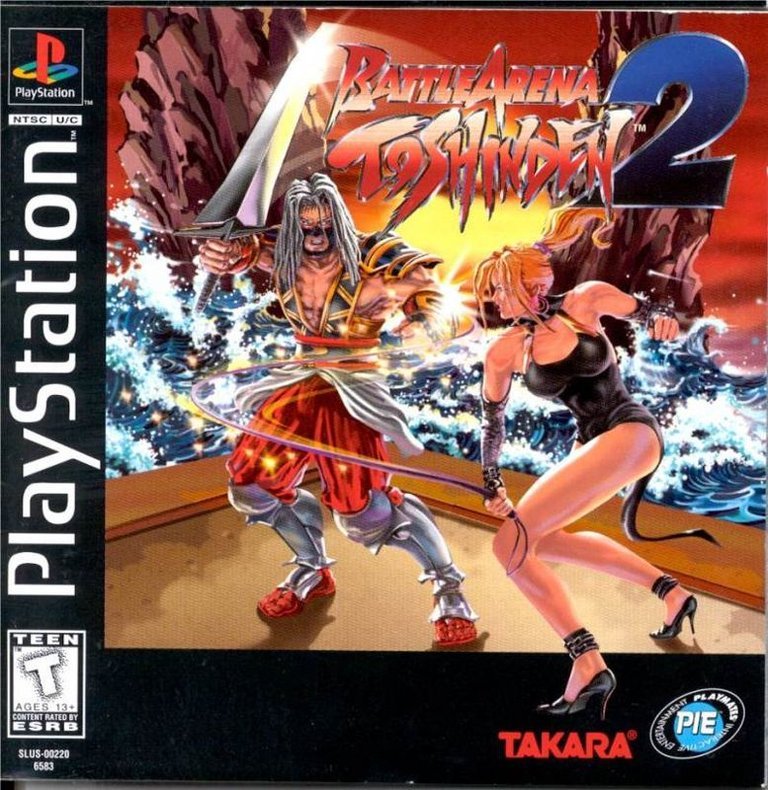
Description
Battle Arena Toshinden 2 is a 3D fighting game set in a fantasy world with anime-inspired aesthetics. As the sequel to the original, it expands the roster to 15 fighters, introduces new combat mechanics like running attacks, ground attacks, and Overdrive moves, and refines gameplay to be more tactical and balanced, replacing the free-form combo system with a simpler one and slowing 3D movement for strategic depth.
Gameplay Videos
Where to Buy Battle Arena Toshinden 2
PC
Battle Arena Toshinden 2 Free Download
Battle Arena Toshinden 2 Guides & Walkthroughs
Battle Arena Toshinden 2 Reviews & Reception
ign.com (60/100): Battle Arena Toshinden 2 just isn’t that impressive.
Battle Arena Toshinden 2 Cheats & Codes
PlayStation
Button sequences entered at title screen or during gameplay as specified; GameShark codes require a GameShark device.
| Code | Effect |
|---|---|
| R1, L2, X, L1, R2, Circle | Unlock Uranus and Master characters (US version) |
| L1, L2, Triangle, R1, R2, Square | Unlock Uranus and Master characters (Japanese version) |
| Circle, R2, L1, X, L2, R1 | Unlock Sho and Vermillion characters (US version, controller 2) |
| Square, R2, R1, Triangle, L2, L1 | Unlock Sho and Vermillion characters (Japanese version, controller 2) |
| Up, Down, Up, Down, Up + Triangle | Skip to final boss at title screen |
| Hold Circle + Triangle + Square + X, press Select, then press Select again while holding | Remove display elements (continue, options, reset, life bars, overdrive bars) |
| Up, Down, Up, Down, Left, Right, Left, Right + Triangle + Circle | Easy super move for character Eiji |
| 80161474 0008 | Infinite Health for Player 1 |
| 80161476 3201 | Infinite Health for Player 1 |
| 8016147C 0002 | Infinite Health for Player 1 |
| 8016147E 1020 | Infinite Health for Player 1 |
| 80161A9C 0008 | Infinite Overdrive Meter on Fill-Up for Player 1 |
| 80161A9E 3201 | Infinite Overdrive Meter on Fill-Up for Player 1 |
| 80161AB0 000C | Infinite Overdrive Meter on Fill-Up for Player 1 |
| 80161AB2 1020 | Infinite Overdrive Meter on Fill-Up for Player 1 |
| 801653D0 0008 | Infinite Overdrive Meter on Fill-Up for Player 1 |
| 801653D2 3201 | Infinite Overdrive Meter on Fill-Up for Player 1 |
| 801653D8 0002 | Infinite Overdrive Meter on Fill-Up for Player 1 |
| 801653DA 1020 | Infinite Overdrive Meter on Fill-Up for Player 1 |
| 80161A50 0008 | Infinite Overdrive Meter on Fill-Up for Player 1 |
| 80161A52 3201 | Infinite Overdrive Meter on Fill-Up for Player 1 |
| 80161A74 0005 | Infinite Overdrive Meter on Fill-Up for Player 1 |
| 80161A76 1020 | Infinite Overdrive Meter on Fill-Up for Player 1 |
| 8018070A 2400 | Infinite Overdrive Meter on Fill-Up for Player 1 |
| 801C84A8 00B5 | Infinite Purple Energy Bar for Player 1 |
| 801C8F00 00B5 | Infinite Purple Energy Bar for Player 1 |
| 801C8F00 00B5 | Empty Part of Player 1 Life Bar Flashes Red |
| 80161474 0008 | Infinite Health for Player 2 |
| 80161476 3201 | Infinite Health for Player 2 |
| 8016147C 0002 | Infinite Health for Player 2 |
| 8016147E 1420 | Infinite Health for Player 2 |
| 80161A9C 0008 | Infinite Overdrive Meter on Fill-Up for Player 2 |
| 80161A9E 3201 | Infinite Overdrive Meter on Fill-Up for Player 2 |
| 80161AB0 000C | Infinite Overdrive Meter on Fill-Up for Player 2 |
| 80161AB2 1420 | Infinite Overdrive Meter on Fill-Up for Player 2 |
| 801653D0 0008 | Infinite Overdrive Meter on Fill-Up for Player 2 |
| 801653D2 3201 | Infinite Overdrive Meter on Fill-Up for Player 2 |
| 801653D8 0002 | Infinite Overdrive Meter on Fill-Up for Player 2 |
| 801653DA 1420 | Infinite Overdrive Meter on Fill-Up for Player 2 |
| 80161A50 0008 | Infinite Overdrive Meter on Fill-Up for Player 2 |
| 80161A52 3201 | Infinite Overdrive Meter on Fill-Up for Player 2 |
| 80161A74 0005 | Infinite Overdrive Meter on Fill-Up for Player 2 |
| 80161A76 1420 | Infinite Overdrive Meter on Fill-Up for Player 2 |
| 8018070A 2400 | Infinite Overdrive Meter on Fill-Up for Player 2 |
| 801EC090 0114 | Full Blue Super Meter for Player 2 |
| 801EC0A0 0114 | Full Blue Super Meter for Player 2 |
| 80161486 2400 | Infinite Health for Player 1 and Player 2 |
| 80161ADE 2400 | Infinite Overdrive Meter on Fill-Up for Player 1 and Player 2 |
| 80161AE2 2400 | Infinite Overdrive Meter on Fill-Up for Player 1 and Player 2 |
| 801653E2 2400 | Infinite Overdrive Meter on Fill-Up for Player 1 and Player 2 |
| 80175E4E 2400 | Infinite Overdrive Meter on Fill-Up for Player 1 and Player 2 |
| 80161A8A 2400 | Infinite Overdrive Meter on Fill-Up for Player 1 and Player 2 |
| 80037A98 7A2C | Player 2 has weird colors |
| 8005EB68 D964 | Backgrounds are weird |
PC
Button sequences entered at title screen; registry edit requires modifying Windows registry.
| Code | Effect |
|---|---|
| R1, L2, WK, L1, R2, SK | Unlock Master and Uranus characters (PC version) |
| SK, R2, L1, WK, L2, R1 | Unlock Vermillion and Sho characters (PC version) |
| Edit registry key HKEY_LOCAL_MACHINE\SOFTWARE\GameBank\Toshinden2 and set “GOBUKU” to hex:02,00,00,00 | Enable all fighters |
Battle Arena Toshinden 2: The Refinement of a Flawed Pioneer
Introduction: A Sequel Seeking Its Footing
When Battle Arena Toshinden exploded onto the nascent 3D fighting scene in 1995, it did so with a audacious claim: “true 3D” movement where fighters could sidestep and circle opponents in a fully three-dimensional arena. It was a graphical showcase for the fledgling PlayStation, a “Saturn killer” in Sony’s marketing, and a commercial smash. Yet beneath its revolutionary sheen lay a game with notoriously loose controls, abusable defensive mechanics, and a combo system that felt more accidental than intentional. Battle Arena Toshinden 2 (BAT2), released a mere year later in late 1995, is not the paradigm-shifting sequel one might expect. Instead, it is a fascinating and deeply contradictory work—a game dedicated to methodically repairing its predecessor’s fundamental flaws while simultaneously failing to capture the zeitgeist that made the original a phenomenon. It represents a crucial, if stumbling, step in the evolution of 3D fighters, trading the raw, chaotic “wow” factor of its predecessor for a slower, more tactical, and ultimately more balanced, yet less thrilling, experience. This review will dissect how BAT2 attempted to fix what wasn’t broken in the eyes of many fans, why it ultimately felt like a refinement rather than a revolution, and how its legacy became a cautionary tale about sequels, platform transitions, and the relentless pace of 3D fighting game innovation in the mid-90s.
Development History & Context: From Console Exclusive to Arcade Anchor
The original Toshinden was a rapid, six-month development effort by Tamsoft, a newly formed studio under the Takara toy conglomerate. It was conceived as a PlayStation exclusive to capitalize on Sony’s new hardware. For its sequel, Takara and Tamsoft made a decisive strategic shift: Battle Arena Toshinden 2 was developed for the arcade first. It ran on Capcom’s Sony ZN-1 hardware—the same board that would later power Star Gladiator and the Street Fighter EX series—and was distributed in arcades worldwide by Capcom in late 1995. This arcade-first approach was a clear attempt to bolster the game’s credibility and commercial viability in the competitive Japanese coin-op market, a arena where Virtua Fighter 2 reigned supreme.
The development team, led by Director Shintarō Nakaoka and featuring returning talent like character designer Miho Furukawa and composer Yasuhiro Nakano, faced a new technological and design calculus. The PlayStation’s graphical capabilities had been stretched to their limit by the original’s “90,000 polygons per second” boast. For the sequel, a conscious trade-off was made: while character models and lighting effects (notably improved Gouraud shading and dynamic light-sourcing) were enhanced, the backgrounds regressed from fully 3D environments to layered 2D parallax scrolling, a technique also used by Tekken 2. This sacrificed the original’s immersive arenas for greater performance and detail on the fighters themselves—a decision that would be noted by critics as a visual downgrade.
The game’s core design philosophy shifted from “showcase” to “competitor.” The developers explicitly targeted the gameplay imbalances of the first title. The infamous invulnerability frames during dodge-rolls were removed, 3D movement was slowed to prevent屏息 (屏息 – literally “holding one’s breath,” used here to mean reckless, untouchable circling), and a new “Overdrive” super meter system was introduced. The roster was expanded from 10 to 15 fighters by adding Tracy and Chaos as new starting characters, demoting final boss Gaia to a playable character (now without his armor), and introducing new sub-bosses (Uranus) and final bosses (Master, hidden Vermilion). This was a game being engineered for balance and depth, but in an environment where Namco’s Tekken 2 and Sega’s Virtua Fighter 2 were redefining expectations for speed, fluidity, and mechanical complexity.
Narrative & Thematic Deep Dive: Conspiracies Within Conspiracies
BAT2’s story is a dense, baroque tapestry of betrayal and hidden agendas that attempts to elevate its fighting game premise into a soap opera of global shadow governance. The narrative framework is a direct continuation, centering on the fallout from the first tournament’s abrupt ending.
The Core Conflict: The tournament’s sponsor, Gaia, was not merely a sadistic organizer but a high-ranking executive (“Divine Four”) of the omnipotent Secret Society (linked to the Gerard Foundation). His true goal was to use the Toshinden not as a bloodsport, but as a recruiting drive to amass a personal army powerful enough to overthrow the Society’s merciless, psychic leader, Master, whom Gaia saw as a depraved tyrant. His failure to persuade any of the previous year’s warriors (Eiji, Kayin, Sofia, et al.) to his cause, combined with the betrayal of his rival executive Uranus, led to his exposure as a traitor. The first game ended with Gaia’s purported death and Uranus assuming control.
The Trap is Set: One year later, Uranus—now revealed as a ruthless, androgynous “angel of death”—invites all the previous participants back to a new Toshinden. However, the invitations are laced with threats against their loved ones. Uranus’s true, chilling aim is not to rebuild the tournament under her rule, but to systematically eliminate every last warrior who might pose a future threat, including the hunted Gaia. It’s a death tournament disguised as a revival.
Character Motivations Recontextualized: The single-player narrative provides brief, poignant vignettes for each returning fighter, reframing their participation as coercion or desperate personal quest:
* Eiji Shinjo returns to finally claim the title and hopefully find clues about his brother, Sho.
* Kayin Amoh, shattered by the revelation that his adoptive father’s killer was Sho, has adopted his victim’s orphaned daughter, Naru. Uranus has captured Naru to force Kayin’s entry.
* Sofia seeks answers about her own mysterious past and its connection to the Secret Society, now focusing on the insane executive Chaos.
* Ellis, whose final battle with Gaia revealed him to be her father, is torn between cold denial and paternal concern as his life is threatened.
* Gaia, having discarded his power armor (Basara), wanders in exile, training for a final, direct confrontation, knowing Uranus will find him.
The Antagonist Triad: The new hierarchy is clear. Uranus (sub-boss) is the immediate, vicious orchestrator of the tournament. Master (final boss) is the distant, psychic tyrant pulling the strings. And looming over all is the hidden final boss, Vermilion, an agent of “the Organization”—a rival criminal syndicate—who observes the chaos, hinting at a larger, multi-factional cold war beyond the ring.
URA’s Divergence: The Sega Saturn exclusive, Battle Arena Toshinden URA, completely replaces this plot with a new, cyberpunk-tinged mystery involving a stolen android (Replicant) patterned after Sho Shinjo and a serial killer targeting fighters. This schism highlights the fragmented, multiplatform chaos of the era, where a “sequel” on one console told a drastically different story.
Thematic Undercurrents: The narrative explores themes of institutional corruption vs. personal redemption (Gaia’s mutiny), the exploitation of the individual by shadowy systems (Uranus’s threats), and the search for identity and family (Ellis, Kayin, Eiji, Sofia). It’s surprisingly dark and political for a fighting game of this era, though its delivery is typically minimal—limited to character bios and brief intro/outro cinematics.
Gameplay Mechanics & Systems: The Quest for Balance
The core of BAT2 is a study in deliberate, corrective design. The developers at Tamsoft clearly listened to criticisms of the first game and made sweeping changes to prioritize tactical combat over chaotic evasion.
1. The Overdrive Gauge & New Move Types: The most significant addition is the Overdrive meter. By landing attacks, players build a glowing gauge. When full, pressing all four attack buttons unleashes a powerful, cinematic Overdrive Attack—a super move that could turn the tide of a round. This created a clear risk/reward resource management layer. Additionally, every character received new special attacks and running attacks (attacks performed while sprinting), and the ability to strike downed opponents with ground attacks, closing a major tactical hole in the original.
2. The Death of the “Invincible Dodge”: The single most important mechanical change was the nerfing of 3D side-stepping. In Toshinden 1, a well-timed dodge-roll granted complete invulnerability, allowing players to recklessly circle opponents with little penalty. BAT2 removed this invincibility, making side-steps pure evasion that could be punished. This immediately made movement a tool for positioning and spacing, not an automatic defensive panacea, and forced players to commit to offensive or defensive actions more carefully.
3. Combo System Simplification: The original’s “free-form” combo system, where stringing together hits felt inconsistent and often impossible, was replaced with a preset, light-to-heavy combo structure (e.g., Light Attack > Light Attack > Hard Attack > Special). This made combos more reliable and accessible but also more predictable and less creative. It was a pragmatic fix that moved the game closer to the standardized combo systems of Street Fighter and Tekken, but at the cost of some of the original’s experimental feel.
4. Ring Outs & Tactical Resolution: The ring-out rule was subtly but importantly changed. If both players fall out simultaneously, the one who fell last wins. This prevented cheap, mutual-ring-out ties and added a final layer of desperation to edge-guarding battles.
5. The “Tactical” Shift: The cumulative effect of these changes was a game that felt slower, heavier, and more deliberate. Where the original was a frenetic, 3D chaos fest, BAT2 is a methodical duel. Missed attacks are more heavily punished, positioning is paramount, and resource management (the Overdrive gauge) is key. Critics noted this: “BAT 2 is more tactical than the original… opponents are able to capitalize on individual missed attacks.” (MobyGames). However, this also meant the exhilarating, freewheeling speed of the first game was gone, replaced by a combat pace that, while more balanced, often felt sluggish compared to the 60fps silky smoothness of Virtua Fighter 2 and the blistering pace of Tekken 2.
Flaws Persisting: For all its improvements, BAT2 could not shake core criticisms. The combo system remained simplistic, the animation was still perceived as choppy compared to rivals, and the camera, while dramatic, could be disorienting, making distance judgment difficult. The game also retained a certain “floatiness” in character movement that never quite felt grounded.
World-Building, Art & Sound: A Gorgeous, Inconsistent Facade
If BAT2’s gameplay was a tale of compromise, its presentation was a story of sublime artistic ambition tempered by technical constraints.
Visual Direction & Character Design: The game’s most enduring strength is its anime-infused aesthetic. Character models, designed by Tsukasa Kotobuki, are tall, slender, and ornate, dripping with late-90s edge. From Duke’s flamboyant knight armor to Sofia’s dominatrix-inspired whip and lingerie, from Chaos’s psychotic, scythe-wielding madness to Tracy’s modern police uniform, each fighter is a distinct visual statement. The polygon counts and texturing on characters were impressive for the time, with notable Gouraud shading and transparent effects (like Sofia’s translucent form in the bonus disc) creating a sleek, almost cel-shaded look ahead of its time.
Arena Design & The Background Sacrifice: Here lies the great trade-off. To achieve better character detail and lighting, the fully 3D, explorable arenas of the first game were replaced with multi-layered 2D parallax scrolling backgrounds. While some, like Rungo’s mining canyon or Duke’s European castle, are beautifully painted and thematically rich, they are undeniably flat. The sense of “being in a space” is diminished. Critics were keen to note this regression: “the detailed arenas” of the first game were replaced with “low-quality background art” (Intelligent Gamer’s Fusion on the PC port). The dynamic camera, which swoops and rotates dramatically during special moves, often felt like it was trying to inject life into these static dioramas.
Sound Design & Music: The soundtrack, composed by Yasuhiro Nakano and Fumio Tanabe, is a high-energy mix of techno, rock, and industrial tracks that perfectly match the game’s over-the-top aesthetic. Tracks like “Overdrive” and “The Crucible” are unforgettable, driving the pace of battle. The sound effects are crisp—clashes of metal, whip cracks, and energy blasts have weight. However, the voice acting is a notorious low point. Limited to grunts, attack cries, and a few select phrases (most infamously Sophia’s piercing, cringe-inducing laugh), it is often cited as some of the worst in gaming history, a black mark on an otherwise polished production. The PC port’s removal of the intro movie was also lamented.
Reception & Legacy: The “More of the Same” Syndrome
Battle Arena Toshinden 2 enjoyed generally positive but not superlative critical reception upon its 1996 PlayStation launch, averaging around 67-73% depending on platform. The consensus was a frustrating, nuanced chorus: “It’s good, but…”
Contemporary Critical Divide:
* The Praises (80-92%): European magazines like Consoles Plus (92%) and Fun Generation (90%) lauded it as a must-own for beat-’em-up fans, praising the fantastic backgrounds, spectacular camera work, dynamic gameplay, and the sheer quantity of content (15 fighters). Mega Fun called it “one of the most beautiful Beat ’em Ups” from Sony. They saw a pinnacle of the series’ arcade-style spectacle.
* The Measured (70-80%): The majority of reviews, including Electronic Gaming Monthly (81%), Game Players (83%), and Video Games (80%), acknowledged its improvements—better balance, new moves, Overdrive—but felt it was too similar to the original and couldn’t compete with the year’s giants. The common refrain was that it didn’t wow like the first game and was overshadowed by Tekken 2 and Virtua Fighter 2.
* The Harsh (16-62%): A significant minority, including CVG (62%), IGN (60%), and especially The Video Game Critic (a brutal 16%), attacked its persistent flaws. They cited choppy animations, sluggish controls, a repetitive, shallow combat loop (mashing specials), and a failure to evolve beyond graphical modest improvements. GamePro succinctly labeled it “more of the same,” criticizing the limited combos and reliance on trading special attacks.
The Commercial Picture: Commercially, it was a solid success. It sold 435,712 units in Japan and 133,491 in the US, adding up to nearly 570,000 units—respectable, but a clear step down from the original’s reported 1.2 million+ combined sales. It was not a ” Greatest Hits” title in the West, indicating it didn’t reach the same saturation.
The URA & PC Ports: A Story of Decline: The Saturn version, Toshinden URA, and the Windows port by Kinesoft, served only to erode the game’s reputation.
* Toshinden URA (Saturn): This exclusive was critically panned. Reviewers scourged its “muddy and choppy” enhanced textures, game-breaking glitches (characters could ring out themselves, instant-kill special moves), and horrific character balancing. GameSpot‘s Jeff Gerstmann declared you could beat the hardest difficulty by “mashing on one button with your eyes closed.” New character Ronron was called “one of the worst fighting game characters ever created.” URA proved the Toshinden engine was brittle and Tamsoft’s balancing act was failing.
* Windows Port: While offering higher resolutions and full control remapping, it was seen as a lazy, unoptimized port of the PlayStation version. It lacked the intro movie, had poor pad/keyboard support, and the sound was criticized. German magazines were particularly harsh (PC Player: 29%), feeling it was a dated console game poorly shoehorned onto PC. Gaming Entertainment Monthly infamously preferred the press kit’s bullwhip to the game itself.
Legacy: A Bridge, Not a Destination
Battle Arena Toshinden 2 occupies a fascinating historical position. It is not a classic like Tekken 2 or Virtua Fighter 2. Instead, it is:
1. The Balancer: It took the wild, unbalanced mechanics of the original and made them coherent. Its changes—slower movement, removal of dodge invincibility, Overdrive gauge—directly influenced the more measured gameplay of Battle Arena Toshinden 3.
2. A Snapshot of a Transitional Moment: It represents the exact point where the “wow” factor of early 3D fighters was being replaced by demand for depth, speed, and technical mastery. It failed to make that leap itself, but its attempts are instructive.
3. The “Plus” Precedent: The Japanese-exclusive Toshinden 2 Plus re-release, with its graphical tweaks, AI improvements, and balance changes, signaled an awareness that the base release needed more polish—a route many modern games now take via DLC or “Game of the Year” editions.
4. The End of an Era for the Series: Its middling reception and the catastrophic failure of URA meant the Toshinden series never again achieved the prominence or acclaim of its debut. It would be forever compared to, and found wanting against, the titans Namco and Sega had unleashed.
Conclusion: A Flawed, Necessary Step
Battle Arena Toshinden 2 is a game caught in an impossible bind. It was a sequel tasked with fixing the very innovations that made its predecessor a landmark. By removing the invincible dodge-roll, slowing the pace, and adding structured combos and the Overdrive meter, Tamsoft created a more tactically sound, balanced, and fair fighter. Yet, in doing so, they sanded away the exhilarating, chaotic, and groundbreaking freedom that defined Toshinden 1. The result is a profoundly competent but unexciting experience.
Its art and sound remain arresting—the anime character designs and pulsing techno soundtrack are top-tier. Its narrative, while convoluted, shows a commitment to world-building rare for its genre. But these strengths cannot fully compensate for gameplay that feels sluggish next to its peers, a combo system that lacks depth, and a presentation that took a technical step back in its arenas.
Historically, Battle Arena Toshinden 2 is not a must-play classic, but a crucial case study. It demonstrates the growing pains of a young genre and a studio trying to mature its baby. It is the game that tried to build a solid foundation from a flashy prototype, and in so doing, lost some of its soul. For historians and completists, it is an essential piece of the 3D fighting puzzle—the moment the pioneer realized it needed to become a craftsman. For the modern player, it remains a fascinating, visually striking, but ultimately dated artifact, a reminder that in the relentless evolution of competitive games, refinement is not the same as excellence, and a sequel’s greatest success can sometimes be to highlight what was lost.
Final Verdict: 6.5/10 – A balanced, beautiful, but hollow sequel. It fixed many problems but lost the spark, leaving it in the shadow of giants and marking the beginning of the end for its series’ relevance.