
- Release Year: 2005
- Platforms: Browser, Macintosh, Windows
- Publisher: Molleindustria
- Developer: Molleindustria
- Genre: Card, Concentration, Educational, Puzzle, Tile game
- Perspective: Top-down
- Game Mode: Single-player
- Gameplay: Board game, Cards, Mental training, Tile matching puzzle, Tiles
- Setting: 20th century, Historical, Italy, Political
Description
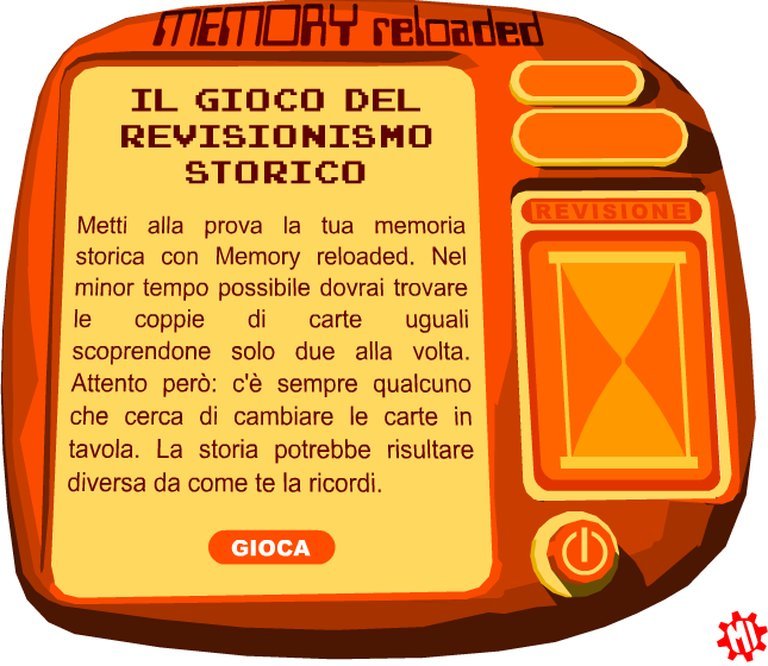
Memory Reloaded is an educational puzzle game that adapts the classic ‘Memory’ card-matching mechanic to critically examine historical revisionism. Players match pairs of cards featuring historical figures and events, but as the ‘revisione’ meter advances, the images subtly transform—such as Hitler morphing from a killer to a poor fool or concentration camps becoming sunflower fields—to demonstrate how historical narratives can be altered over time, with references rooted in 20th-century struggles including Italian-specific contexts.
Memory Reloaded: A Digital Palimpsest of Historical Memory
Introduction: The Children’s Game That Unsettles History
In the mid-2000s, as first-person shooters and sprawling open-world RPGs dominated headlines, a diminutive Flash game emerged from an Italian indie collective that would quietly become one of the most conceptually devastating interventions in video game history. Memory Reloaded—initially released as MEMORY reloaded – il gioco del revisionismo storico in 2005, followed by the English-language Memory Reloaded: the downfall in 2010—takes the foundational childhood game of “Memory” (matching pairs of face-down cards) and weaponizes its mechanic against the fluid, malleable nature of historical narrative. Created by the hacktivist studio Molleindustria, led by Paolo Pedercini (a.k.a. Paolo Molleindustria), the game is not an experience of fun or escapism, but a deliberate, chilling act of simulated propaganda. Its thesis is stark: memory is not a vault but a battlefield, and the past is perpetually rewritten by those who control its present-day representation. This review argues that Memory Reloaded is a landmark of “hacktivist gaming” and a seminal work of critical software, using the simplest of interactive tropes to model the terrifying ease with which unambiguous historical atrocities are sanitized, reframed, and ultimately erased.
Development History & Context: Molleindustria’s Critical Agenda
The Studio and Its Vision: Molleindustria (literally “loose industry”) was founded in the early 2000s as a reaction against the commercial, often politically inert, mainstream game industry. The collective’s self-professed mission was to create “fun” games with a “contemporary critical environment,” tackling subjects like precarious labor, Catholic Church propaganda, sexual identity, and the spectacle of terror. Pedercini, a trained programmer with a background in media theory, approached game design as a form of applied critical theory. Memory Reloaded is the crystallization of this philosophy: it is a “counter-strategy” to what Pedercini identifies as the “spectacular rendering of history” in mainstream “simulations” like JFK Reloaded.
Technological Constraints & Aesthetic Choice: Developed in Adobe Flash—a platform synonymous with web-based, easily distributable, often ephemeral games—the choice was both pragmatic and ideological. Flash allowed for rapid development, zero-cost distribution via browser, and a stark, vector-based aesthetic that mirrored the game’s thematic focus on clean, manipulative visual rhetoric. The “fixed/flip-screen” perspective and minimal UI strip away all extraneous simulation, forcing the player to confront the raw, semantic content of the cards. This was not a limitation but a deliberate formal choice: the game’s visual modesty denies the player the immersive ” spectacle” that Pedercini critiques in history-themed AAA titles.
The Gaming Landscape of 2005/2010: The original 2005 Italian release coincided with a global political climate still reeling from the Iraq War (2003) and the “War on Terror,” where narratives of “Axis of Evil,” pre-emptive war, and the rehabilitation of former dictators (e.g., the nuanced re-examination of Pinochet in some circles) were heavily contested. The 2010 English version, The Downfall, explicitly updated these references to the polarized politics of the late Bush/early Obama era, including the Palestinian resistance/terrorism dialectic. This timing confirms Pedercini’s assertion that the game is about the “active revisionism” of “huge and unambiguous historical events” happening in real-time media cycles.
Narrative & Thematic Deep Dive: The Mechanization of Memory
Core Mechanic as Thesis: The genius of Memory Reloaded lies in its transformation of the Memory game’s core loop. The goal remains matching pairs, but the act of recall is sabotaged by the game’s central innovation: the “revisione” (revision) meter. As the player flips cards and time passes, the images on the unseen cards silently metamorphose. This is not a random glitch but a predetermined, systematic erasure and replacement of meaning.
- The Chilling Metamorphoses: As described in the source material, the transformations are specific and ideologically charged:
- “Western Imperialism” card becomes “Western Altruism.”
- Benito Mussolini transitions from a fierce fascist dictator to a “remarkable statesman.”
- Adolf Hitler is smoothed from a “killer” to a “poor fool.”
- Nazi Concentration Camps are refashioned as benign “Sunflower Fields.”
- In the Italian context, Italian Partisans (resistance fighters) are revised into “Communist Brigands.”
- Palestinian Resistance Fighters become “Terrorists.”
Themes of Semantic Warfare: These changes represent several interlocking themes:
1. The Euphemization of Atrocity: The transformation of “Concentration Camp” to “Sunflower Field” is the ultimate act of linguistic and visual sanitization, replacing an emblem of industrialized murder with a pastoral idyll. This mirrors real-world historical revisionism that rebrands pogroms as “cleansing” or civilian casualties as “collateral damage.”
2. Rehabilitation of Tyrants: The softening of Hitler and Mussolini’s images taps into the “great man” theory of history revision, where complex, monstrous figures are reduced to pitiable, misguided, or even competent leaders, obscuring their ideologies and crimes.
3. Reframing Resistance: The shift from “Partisan” or “Resistance Fighter” to “Brigand” or “Terrorist” demonstrates how the legitimacy of anti-colonial or anti-fascist struggle is contingent on the victor’s narrative. The same act—armed opposition—is heroism or criminality based purely on who writes the history.
4. The Illusion of Objectivity: Pedercini states the game demonstrates that “history is an extremely flexible narration that depends on the balance of power created in the present.” The player, believing they are engaging in a neutral cognitive exercise (matching pairs), is actually complicit in the revision process. Their failure to match pairs before the revision completes “wins” them a revised, falsified history.
Dialogue & Conclusion: The game has no traditional dialogue. Its “narrative” is delivered through the stark, silent transformation of icons. The final screen, after the player either matches all pairs or succumbs to the revisions, presents a “summary of the history as revised during the game.” This is the punchline—the player is shown the new, “correct” history they have helped construct. There is no victory condition against the revision; the game’s structure ensures the revision always wins, simulating the player’s powerlessness against well-funded, institutional propaganda.
Gameplay Mechanics & Systems: Deconstructing the “Matching” Trope
Core Loop & The Illusion of Agency: The gameplay is deceptively simple:
1. A grid of face-down cards (typically featuring historical figures/events) is presented.
2. The player flips two cards per turn, attempting to find matches.
3. Successfully matched pairs remain face-up and are removed from play.
4. The Twist: Cards that remain face-down visually change as the “revisione” meter progresses. A card flipped early showing “Hitler – Killer” might, when flipped later alongside its pair, now show “Hitler – Poor Fool.”
Systems Analysis:
* The Revision Meter: This is the game’s hidden, governing algorithm. It is a countdown timer disguised as a simple progress indicator. Its advancement is inexorable and unrelated to player skill. It represents the relentless, temporal pressure of modern media cycles and political agendas that outpace reflective historical scholarship.
* Card Transformation Logic: The changes are not random. They follow a clear ideological binary: Aggressor -> Victim / Oppressor -> Benevolent Actor / Resistance -> Terrorism. The pairs must still match, so if “Western Imperialism” turns into “Western Altruism,” its paired card (presumably a matching symbol of the same concept) also transforms to maintain the pair. The game’s database contains the “original” and “revised” states for each card pair.
* UI & Feedback: The UI is minimal. The “revisione” meter is the primary feedback mechanism. There is no score, no timer for the matching itself, and no “game over” screen in the traditional sense. The only feedback is the silent visual corruption of the cards and the final summary. This austerity removes all gamified rewards, focusing pure attention on the semantic decay.
* Innovation vs. Flaw: The innovation is in the systemic metaphor. The “flaw,” if one can call it that, is the game’s deterministic nature. The player cannot stop the revision. This is not a bug but the central, despairing message: in the battle for historical narrative, individual memory is fragile, and organized, institutional revisionism is a tide that cannot be held back by a single player’s recall. The game is an exercise in helplessness.
World-Building, Art & Sound: Minimalism as Canvass for Terror
Visual Direction & Art Style: The game employs a crude, vector-art aesthetic typical of early Flash. Historical figures are rendered in simple, often caricatured lines. This simplicity is crucial. It makes the images feel like clip art or propaganda posters—easily reproducible, devoid of nuanced human detail, perfect for mass dissemination and manipulation. The color palette is muted, with the revised versions often adopting warmer, softer tones (e.g., the sunflower yellow) to enhance their appeal, while the “original” harsher images use stark blacks and grays.
Sound Design: Sound is sparse. The primary audio is a simple, repetitive click when flipping cards—the sound of interrogation, of turning pages, of a ticking clock. This auditory minimalism mirrors the visual style, preventing any emotional cushioning. There is no dramatic score to signal the horror of the transformations; they occur in near silence, which makes them more unnerving.
Atmosphere & Contribution to Experience: The atmosphere is one of cold, clinical dread. The combination of the childlike game mechanic, the bland visuals, and the silent transformations creates a profound cognitive dissonance. The player is not fighting monsters in a dark dungeon; they are watching the bureaucratic, administrative process of history being redacted in real-time. The lack of traditional “fun” elements forces the player into the role of a horrified archivist or a complicit bureaucrat, manually (via mouse clicks) assisting in the revision.
Reception & Legacy: Academic Canonization of a Flash Artifact
Critical & Commercial Reception: By conventional metrics, Memory Reloaded was a blip. It had no commercial release; it was freely available on Molleindustria’s website and Newgrounds-type portals. It received no mainstream reviews and has only a single, middling player rating on aggregators like MobyGames (3.8/5 from 1 vote). Its impact was not in sales or scores, but in academic and activist circles.
Academic Citations & Critical Discourse: The supplied source material explicitly notes that Molleindustria’s work, and Memory Reloaded specifically, has been cited in over 1,000 academic papers. Alessandro Ludovico’s essay, provided in the sources, is a key text, positioning the game within “digital media” theory and “hacktivism.” Scholars have analyzed it as:
* A critical software piece (following the tradition of Cory Arcangel orJODI).
* An exemplar of “games for change” or “activist games” that use procedural rhetoric (Ian Bogost’s concept) to make an argument about how systems (like historical narrative) work.
* A counter-monument to traditional historical simulation games, which Pedercini argues often obscure their own modeling biases behind a facade of “accuracy” and “expert consultants.”
* A pedagogical tool for teaching media literacy, propaganda techniques, and the constructed nature of history.
Influence on the Industry: While not directly spawning clones, Memory Reloaded‘s influence is felt in the “art game” and “serious game” movements. It prefigured later works that use minimalist, familiar mechanics to deliver political messages (e.g., Anna Anthropy’s Dys4ia, various “papers, please” -like games about bureaucratic oppression). It stands as a foundational text for the idea that game mechanics can be metaphors for ideological processes. Its legacy is also in the model of the developer-as-critic, with Molleindustria’s later works like The superb idea (a satire of exploitative startup culture) and Unmanned (a critical take on drone warfare) continuing its tradition.
Conclusion: The Indelible Palimpsest
Memory Reloaded is not a game to be “beaten” or “enjoyed” in any conventional sense. It is a digital palimpsest—a document where the original text is perpetually being scraped away and overwritten. Its power derives from the brutal simplicity of its metaphor: if the foundational act of recalling the past can be so easily corrupted, what hope is there for collective memory? The game’s绝望 (despair) is its point. It rejects the “game feel” that might soften its message, instead offering a sterile, algorithmic view of historical revisionism as a quiet, administrative process.
In the canon of video game history, it occupies a unique niche. It is not a genre-defining Doom or a culturally ubiquitous Super Mario Bros. Instead, it is a critical touchstone, a work that demonstrates the medium’s unparalleled capacity to model complex ideological arguments through interactive system. It proves that a game need not have a thousand polygons or a 100-hour campaign to be intellectually monumental. Its legacy is secure in the lecture halls and academic journals where its quiet, relentless mechanic continues to teach a vital lesson: Never trust the archive. Always check the revision meter.
Final Verdict: 9/10 — A masterpiece of critical design. Its historical and cultural significance far outweighs its technical simplicity or commercial visibility. It is an essential, haunting artifact for anyone seeking to understand video games as a medium for critical thought.