
- Release Year: 1997
- Platforms: Windows
- Publisher: Lagarto
- Developer: Lagarto
- Genre: Card, Strategy, Tactics, Tile game – Mahjong, Tile game – Riichi mahjong
- Game Mode: Single-player
- Gameplay: Cards, Tiles
- Average Score: 75/100
Description
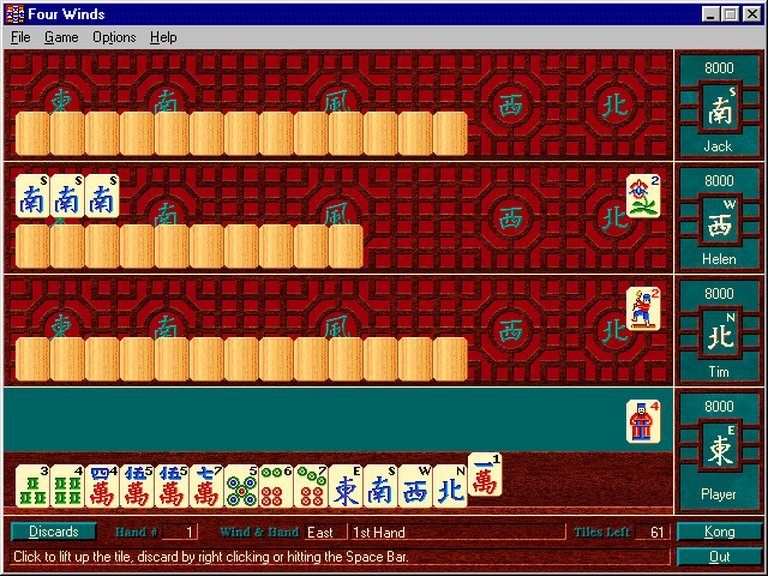
Four Winds Mah Jong is a digital adaptation of the traditional Chinese tile game, designed for single-player engagement against three computer-controlled opponents. Released in 1997 for Windows, it offers a wide range of customizable rule presets—including Chinese Classical, Modern (Hong Kong), Japanese Classical, and Western versions—along with a comprehensive help file and tutorial to cater to both novice and experienced players, providing a versatile and authentic Mah Jong experience in a strategic, tactics-based format.
Four Winds Mah Jong Cracks & Fixes
Four Winds Mah Jong Patches & Updates
Four Winds Mah Jong Reviews & Reception
homeoftheunderdogs.net (75.3/100): Overall, Four Winds is a solid Mah Jong game that looks, plays, and sounds great.
retro-replay.com : Four Winds Mah Jong transports you straight into the heart of the classic Chinese tile game.
Four Winds Mah Jong: A Definitive Analysis of Digital Mahjong’s Most Scholarly Simulation
Introduction: The Keeper of a Thousand Rules
In the vast canon of video game history, few titles occupy as peculiar and vital a niche as Four Winds Mah Jong (1997). While the Western world largely reduced the ancient Chinese pastime of Majiang to a solitary tile-matching puzzle, this unassuming shareware title from the Finnish studio Lagarto stood as a bulwark for authenticity. Its raison d’être was not entertainment in a conventional sense, but preservation, education, and simulation. Four Winds Mah Jong is not merely a game about playing Mahjong; it is a comprehensive digital archive of the game’s global rule variants, a programmable AI opponent, and an interactive textbook. This review argues that Four Winds Mah Jong‘s true legacy lies not in its commercial success—which was modest at best—but in its unprecedented, systemic dedication to documenting the sprawling, contradictory, and fascinating ecosystem of Mahjong rules, making it an indispensable tool for enthusiasts and a quiet landmark in the digital preservation of intangible cultural heritage.
Development History & Context: The Scholar in the Shareware Scene
The Studio and The Visionary: Lagarto was a small Finnish software house, and Four Winds Mah Jong was its flagship project, conceived and largely programmed by Arto Tenkanen. His vision, as detailed in the extensive knowledge base hosted on the game’s official site (4windsmj.com), was explicitly scholarly. The goal was to create a rule reference system first, and a game second. This is evident in the titanic effort to document rule variations from Chinese Classical to Japanese Riichi, from European Classical to American Modern, and even regional oddities like Korean Style and Taiwanese 16-tile. The development was a “several years long game development project with close co-operation with Mah Jong gamers around the world,” involving beta testers listed across four continents.
Technological Constraints & 1997 Gaming Landscape: Released in July 1997 for Windows, the game was a product of the 2D, CD-ROM shareware boom. Its technical execution—clean, readable tile graphics, MIDI soundscapes, and a resolutely 2D interface—was perfectly suited to its purpose. It made no attempt to compete with the 3D accelerations of Quake or the narrative FMV of Myst. Instead, it prioritized clarity, customizability, and data density. In an era where “Mahjong” on a Western PC meant the solitaire tile-matching game (e.g., Mahjong Solitaire from 1991), Lagarto’s commitment to the four-player, rummy-like competitive game was a deliberate act of correction and education. The game’s shareware model allowed it to reach a dedicated, global audience of enthusiasts without the marketing push of a major publisher.
Narrative & Thematic Deep Dive: The Story is the Rulebook
Four Winds Mah Jong possesses no conventional narrative. There are no characters, no plot, no cinematic set-pieces. Its “story” is emergent, systemic, and entirely player-driven, but its true narrative is the history and philosophy of Mahjong itself, which the game painstakingly documents.
The Documented History as Narrative: The included knowledge base is a masterclass in concise cultural history. It traces Majiang’s unlikely origins from 19th-century China, debunking myths of ancient Confucian origins. It charts the schism between “Classical” and “Modern” (Hong Kong) styles, the Japanese adoption and innovation (Riichi, sacred discard), and the peculiar, almost baroque evolution of American Mahjong with its “Cleared-Hand” rules, Charlestown, and ever-changing limit hands. This text doesn’t just list rules; it tells the story of a game in flux, shaped by gambling laws, cultural exchange, misinterpretation, and national pride. The theme is one of living tradition versus ossification—the game constantly evolving in the hands of its players, a process the game’s own rule editor empowers the user to continue.
Player-Driven Stories: Within each match, the narrative emerges from the interplay of the four “seats” (East, South, West, North). The drama is in the tension of the discard pile, the psychology of a Riichi declaration, the collective sigh when a player wins on a dangerous single-out tile. The AI opponents, while lacking named personalities, embody playing styles: the Beginner discards openly, the Defensive player plays safely, the Expert balances offense and defense, and the Limit Maker gambles on high-scoring rare hands. These are not characters with dialogue, but with tactical philosophies, creating stories of cunning vs. recklessness, patience vs. aggression, all framed within the ritualistic flow of tile drawing and discarding.
Gameplay Mechanics & Systems: The unparalleled Rule Engine
This is where Four Winds Mah Jong achieves its masterpiece status. Its core gameplay loop is standard for four-player Mahjong: draw a tile, discard one, aiming to form a winning hand of four sets (pungs/kongs/chows) and a pair. The revolution is in total systemic customizability.
1. The Rule Preset Library: The game ships with meticulously implemented presets:
* Chinese Classical: The “original” complex scoring with point-scoring for basic sets and a payment scheme where East pays and receives double.
* Chinese New Style / Hong Kong: Focuses on faan (doubles) with a settling table, rewarding self-drawn wins and penalizing the discarder.
* Japanese Classical & Modern: Introduces Riichi (ready declaration), Dora (bonus tiles), and heavy penalties for open hands, with a distinctive payment system where the discarder pays all losers.
* European Classical: A simplified, popular Western variant.
* American Modern: Incorporates the “Cleared-Hand” rule (only one chow allowed, often pure one-suit hands), jokers, and the Charleston (a tile exchange phase).
* Taiwanese 16-tile: The radical variant requiring five sets, dramatically changing hand construction.
* Korean Style: Often omits the Bamboo suit.
2. The Custom Rule Editor: This is the game’s killer feature. Users can modify every single parameter: scoring patterns, doubling conditions, limits, payment schemes, dead wall size, flower/season rules, and even the number of tiles in the wall. This allows for the creation of “house rules” or the faithful reproduction of obscure regional variants mentioned in old rulebooks. It transforms the game from a static product into a Mahjong simulation platform.
3. AI and Difficulty: The four AI types provide a meaningful difficulty curve. The “Limit Maker” is particularly fascinating as a simulation of a specific, high-risk playstyle common in some gambling circles. However, the AI lacks true “personality” in the sense of bluffing, table talk, or evolving strategies—it’s a tactical calculator, not a social actor. This is the game’s one notable absence compared to some later titles.
4. UI and Flow: The interface is a model of functional clarity. The tile graphics are crisp and unambiguous. The meld area clearly displays called pungs/kongs/chows. Discards are laid out in a grid. The scoreboard is comprehensive, showing all scoring elements and their multipliers. The context-sensitive help is superb, allowing a player to click on any scoring term or rule and get an instant definition from the integrated knowledge base. The tutorial is equally thorough, walking a novice through wall-building, dealing, drawing, discarding, calling, and the final scoring ritual.
Innovative & Flawed Systems: The innovation is the entire rule-agnostic engine. A flaw, shared with most Mahjong simulations, is the lack of social dimension—no multiplayer (LAN or online in 1997 was rare, but still), no voice chat, no avatar-based table presence. The “story” is purely in the tiles. Also, the AI, while competent, cannot replicate the nuance of human table talk, tells, or collusion.
World-Building, Art & Sound: Atmosphere Through Abstraction
Four Winds Mah Jong does not build a world in the fantasy or sci-fi sense. Its setting is the timeless, placeless Mahjong parlor.
- Visuals: The graphics are utilitarian but aesthetic. Tiles are rendered in a clean, pseudo-traditional style. Backgrounds are simple textures: wood grain, jade green, felt. There is no attempt at 3D tables or realistic hands. The artistic direction prioritizes readability and calm. The Bauhaus and Classic themes mentioned in the credits offer slight visual variety but maintain this functional minimalism. The atmosphere is one of quiet concentration, not vibrant casino energy.
- Sound: The MIDI soundtrack, composed by Timo Seppänen, is a key part of the experience. It features gentle, pentatonic melodies on synthesized instruments like koto or flute, creating a serene, contemplative mood that perfectly suits the strategic depth of the game. Sound effects are limited and functional: the clack of a tile on the table, a soft chime for a winning hand. It avoids being intrusive, instead reinforcing the meditative quality of the play.
- Contribution to Experience: The combination of clear visuals, calming music, and intuitive UI creates a “flow-state” environment. The player is not distracted by flashy animations or convoluted menus. The focus is entirely on the state of the wall, the discards, the opponents’ melds, and the complex mental calculation of one’s own hand and potential scoring. The world built is one of pure, abstract strategy, where culture is present not in decorative clichés but in the precise terminology (Pung, Kong, Chow, Riichi, Faan) and the correct implementation of rituals (the way melds are placed, the structure of the dead wall).
Reception & Legacy: The Scholar’s Acclaim
Critical & Commercial Reception (1997-2000s): MobyGames records a single average player rating of 2.8/5 from 1 rating (as of the provided data), indicating near-total obscurity in the mainstream gaming press. However, in the niche communities of Mahjong enthusiasts, its reception was rapturous. The review from Home of the Underdogs (a curator of notable indie/shareware titles) giving it a 7.53/10 from 56 votes and calling it “excellent” was typical. The quotes on the official site’s gallery from C|net Shareware Gold and Mahjong News praise its “professional” execution and “gorgeous” presentation, precisely because it treated a complex board game with the depth and respect usually reserved for strategy wargames or flight sims.
Evolution of Reputation: Its reputation has only grown among cognoscenti. In retrospect, it is seen as the definitive digital reference tool for pre-2000s Mahjong variants. While later games like Hong Kong Mahjong (mentioned in the Underdogs review) might have had more “personality,” Four Winds had infinitely more authority and scope. Its reputation is that of a textbook or encyclopedia, not a blockbuster.
Influence on the Industry & Subsequent Games: Its direct influence is subtle but profound. It established a blueprint for the “simulation-first” approach to board/card game adaptations. Any serious digital Mahjong client that followed—for tournament play, AI training, or rule research—had to at least match its rule customization depth. It demonstrated that the market for such a tool existed. Furthermore, its comprehensive, multilingual rule documentation set a standard for clarity. The game’s official website, with its Knowledge Base, remained a cited resource for years. It directly precedes the era of specialized, often free, Mahjong clients like Tenhou (for Japanese Riichi) and Majsoul, which dominate online play today. Four Winds can be seen as the last great monolithic, single-player focused, all-variants-in-one simulator before the fragmentation of the online, rule-specific era.
Conclusion: The Canonical Scholar
Four Winds Mah Jong is not a game one plays for thrills or epic storytelling. It is a tool, a museum, and a sandbox. Its place in video game history is not in the pantheon of genre-defining bestsellers, but in the hall of quietly monumental achievements in digital preservation.
Its thesis—that the true, competitive, four-player game of Mahjong with its myriad global rule sets warranted a serious, customizable, and educational digital representation—was not only proven correct but executed with exhaustive diligence. Arto Tenkanen and Lagarto did not just program a game; they coded a compendium. They built a system where the rules themselves are the primary content, and the AI is the compliant, if unspeaking, opponent.
The game’s minor commercial failure and low meta-scores on sites like MobyGames are irrelevant. Its success is measured in the thousands of players it educated, the rule variants it documented before they could be lost to globalization, and the standard it set for depth in digital board game adaptation. In its pixel-perfect tiles and its endless rule menus, Four Winds Mah Jong achieves a unique form of beauty: the beauty of comprehensive understanding. It is the Rosetta Stone for digital Mahjong, and for that, it earns its place as an essential, if understated, artifact of 1990s shareware ingenuity and a lasting tribute to the world’s most beautifully complex tile game. Verdict: An indispensable scholarly simulator, a masterpiece of systematic design, and the definitive digital archive of 20th-century Mahjong rulecraft.