
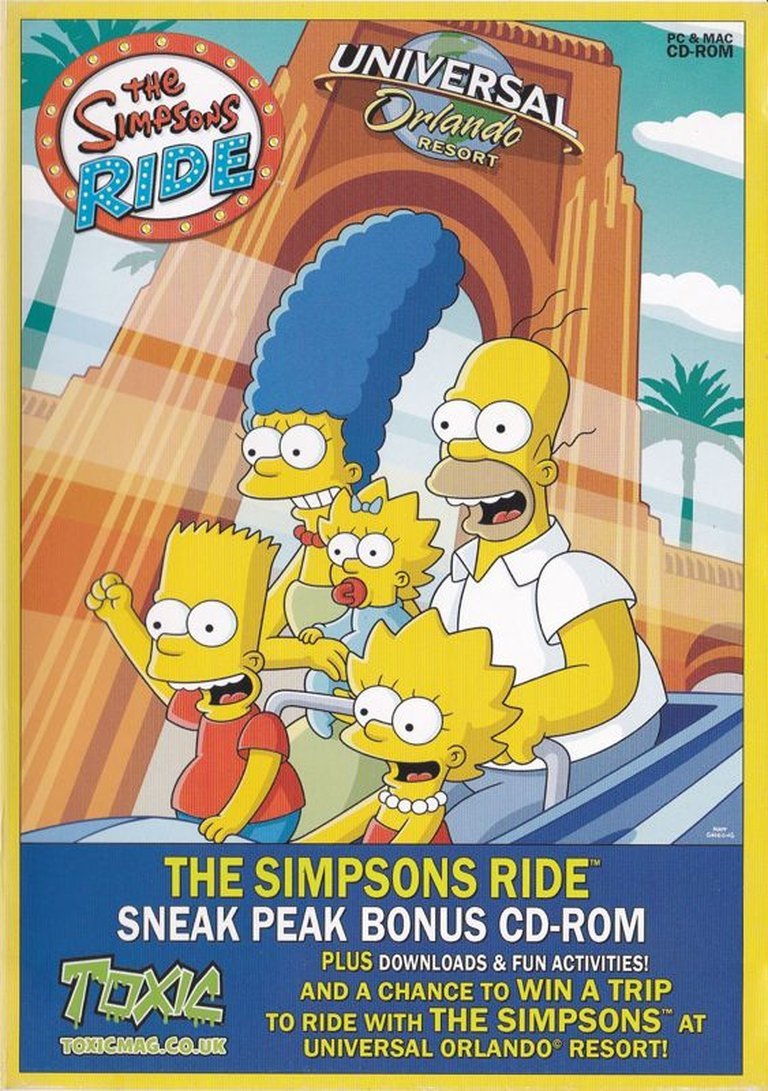
Description
The Simpsons Ride: Preview CD-ROM is a 2008 free promotional game tied to the opening of The Simpsons Ride at Universal Studios Florida. It features a comprehensive trivia quiz with 90 questions across easy, medium, and hard difficulties, alongside Simpsons-themed video clips, wallpapers, and ride descriptions, all set within the humorous world of Springfield.
The Simpsons Ride: Preview CD-ROM (included game): Review
Introduction
In the late 2000s, as digital distribution began its inexorable rise, the physical CD-ROM lingered as a vector for promotional ephemera—a tangible souvenir bridging corporate marketing and fan engagement. Nestled within this transitional era exists The Simpsons Ride: Preview CD-ROM (included game), a title that is less a “game” in the conventional sense and more a meticulously crafted piece of licensed merchandise. Released in 2008 to promote the debut of Universal Studios Florida’s new attraction, this disc serves as a fascinating time capsule. It encapsulates a specific moment when theme park marketing, television fandom, and PC gaming culture collided within the constraints of a 52-66 MB CD-ROM. My thesis is this: while mechanically negligible as a gameplay experience, the Preview CD-ROM is an invaluable historical artifact. It reveals the logistics of late-era physical promotion, the parameters of a major franchise’s licensing at the time, and the persistent, nostalgic power of The Simpsons brand to transform a simple quiz into an object of collector’s desire.
Development History & Context
The development story is sparse, a reflection of the project’s nature. The game was developed by Expansive Media Ltd, a UK-based studio with a portfolio largely comprising edutainment and promotional titles (as seen in related games like The Wizard CD-ROM). The publisher was Toxic, a magazine publisher known for bundling software with its publications. The project was not conceived as a standalone commercial product but as a value-add for the May 2008 issue of TOXIC Magazine in the United Kingdom.
Technological & Market Context: 2008 was a pivotal year. Steam was gaining traction, digital storefronts were emerging, and broadband was making large downloads feasible. Yet, physical media persisted in specific niches: retail game copies, and crucially, magazine cover discs. These discs were a lifeline for casual and young audiences, offering demos, shareware, and exclusive content. For a licensed property like The Simpsons, a cover disc was a direct channel to a mass, family-oriented audience. The technological constraints were those of the late-CD-ROM era: a fixed 650-700 MB capacity (vastly underutilized here), reliance on outdated multimedia frameworks (likely ActiveX or simple DirectX), and a design philosophy centered on “plug-and-play”—no installation, no configuration, full-screen operation with a point-and-select interface. The “game” had to be idiot-proof for a child opening the magazine.
Licensing & Vision: The vision was inherently dual-branded. Twentieth Century Fox Film Corporation (holders of the Simpsons license) and Universal Studios (UK) (promoting the new ride) both approved the content. The creative directive was clear: generate excitement for the new theme park attraction by leveraging the show’s existing fanbase. This explains the content’s composition: video clips from the show, wallpapers, a ride description, and a quiz that tests fan knowledge. There was no aspiration to innovate in game design; the goal was brand reinforcement and data capture via the online draw entry for an Orlando holiday.
Narrative & Thematic Deep Dive
There is no traditional narrative or plot. The “experience” is a menu-driven interface presented by Krusty the Clown in a brief, animated introduction (as seen in the screenshots). The thematic core is pure promotion, wrapped in the comforting, satirical patois of Springfield.
- The Premise: The user is implicitly a Simpsons fan being given a “sneak peak” (as the disc’s title suggests) at the upcoming theme park ride. The narrative is extradiegetic: you, the player at your computer, are being invited to the virtual gates of Universal Studios.
- Character & Dialogue: The only “character” directly interacting is Krusty, whose appearance immediately sets the tone of cynical, corporate-associated humor. His presence signals that this is an officially sanctioned, yet ironically self-aware, piece of Simpsons content. The quiz questions themselves are fragments of the show’s vast dialogue and lore. For example, questions about “Who shot Mr. Burns?” or “What is Homer’s middle name?” directly reference canonical episodes. These fragments become the game’s sole narrative substrate.
- Underlying Themes:
- Nostalgia & Canon: The quiz leans heavily on the show’s golden age (1990s), testing knowledge of classic episodes. This targets the adult fan who grew up with the series, not a new child viewer.
- The Commodification of Fandom: The entire disc is a transaction. The fan receives exclusive (at the time) wallpapers and a quiz; the corporate entities (Fox, Universal, Toxic) receive engagement, brand exposure, and entries for a sales lead-generating contest.
- The Transition of Spectacle: The ride itself replaces Back to the Future, a cornerstone of 90s pop culture. This CD-ROM documents the passing of the torch, promoting a new simulator ride based on a long-running show to an audience that remembers the cultural context of the ride it replaced.
Gameplay Mechanics & Systems
Mechanically, the title is almost an anti-game, defined by its profound simplicity and lack of systems.
- Core Gameplay Loop: Select “QUIZ” from the main menu → Choose Difficulty (Easy, Medium, Hard) → Answer 30 multiple-choice questions one at a time → View final score with a breakdown of correct/incorrect answers → Return to main menu.
- Combat/Progression: None. There is no character, no health, no points to spend. “Progression” is purely cognitive: moving from one trivia question to the next. The only metric of success is the percentage score at the end.
- Questions & Content: The pool is static and finite. As the source explicitly states, “the questions do not change from one playthrough to the next.” There are 90 questions total (30 per tier). This makes the quiz a solvable puzzle after 1-3 plays, destroying any long-term replay value. The questions range from easy (“What color is Homer’s shirt?”) to esoteric (“What is the name of the bar where the nuclear plant workers go?”).
- User Interface (UI): Point-and-select. The entire experience uses a fixed, top-down, flip-screen visual style. The background image is a static, pre-rendered shot of the Simpson family living room or another iconic set piece, never changing. Questions are presented in a text box. This is not a dynamic UI but a digital page-turner, mimicking an interactive book or kiosk.
- Innovation & Flaws:
- Innovation: None in game design. The only innovation is in promotional integration—the seamless blending of a game-like experience with a marketing message and a prize draw.
- Flaws: Extreme limitations. No random question banks, no leaderboards, no timer, no penalty for wrong answers, no unlocks. The “game” is a repetition tank; its entire content can be consumed in under an hour. The lack of feedback during the quiz (only at the end) is a missed opportunity for engagement.
World-Building, Art & Sound
The world is not simulated; it is represented.
- Visual Direction: The asset pool is derived entirely from pre-existing Simpsons television production materials and Universal’s ride promotional renders. The “world” is the iconography of the show: the couch gag living room, the nuclear plant, Moe’s Tavern. The fixed backgrounds are static, low-resolution (for the time) JPEGs. The art direction has zero original creation; it is curated appropriation. The Krusty intro is a simple, possibly re-purposed, animation.
- Atmosphere: The atmosphere is one of cheap nostalgia. It feels like a high-quality screensaver or a screensaver-based quiz. There is no ambiance, no sense of place beyond a static image. The experience is sterile and functional, aiming only to present information (ride previews, videos) and facilitate the quiz.
- Sound Design: Presumably uses short, recognizable sound bites from the show for menu clicks and possibly correct/incorrect answer jingles. However, given the CD-ROM’s size and the nature of the screenshots (which show no sound options), audio is likely minimal, MIDI-based, or absent altogether. The promotional video clips would contain the show’s audio. The overall soundscape is not a designed element but a leftover from source assets.
Reception & Legacy
Critical & Commercial Reception: There is no recorded critic or player review on major aggregators like MobyGames. This is telling. The disc was not reviewed as a game because it was not perceived as one. Its reception was measured in distribution metrics (millions of magazine copies) and draw entries, not review scores. Within the gaming press of 2008, it would have been ignored as non-news.
Evolution of Reputation: Its reputation has evolved from “free bonus in a magazine” to a curated artifact of preservationist interest. On platforms like the Internet Archive (where it is preserved as “The Simpsons Ride Sneak Peak Bonus CD-ROM”) and My Abandonware, it is valued not for play but for historical and archival value. It represents:
1. The last gasps of the magazine cover disc as a mainstream distribution method.
2. A specific, tangible promotional strategy for a theme park ride.
3. A snapshot of Simpsons licensing before the franchise’s gaming presence became more digitally focused (e.g., The Simpsons: Tapped Out in 2012).
4. A contrast to the contemporaneous The Simpsons Game (2007), a full-scale console/PC title developed by EA. That game was a narrative, platforming adventure; this is a static quiz. Together, they bookend the franchise’s approach to gaming in the late 2000s: big-budget console titles and hyper-targeted promotional micro-games for specific marketing channels.
Influence & Industry Place: Its influence is indirect. It exemplifies a model now largely obsolete: the offline, physical, bundled micro-game. Today, this would be a Flash/HTML5 web mini-game, a mobile app ad, or a YouTube pre-roll. It did not influence game design but rather the marketing-gaming nexus. Its legacy is as a primary source document for historians studying:
* Promotional ephemera in the digital age.
* The logistics of licensed software for peripheral distribution.
* The cultural footprint of The Simpsons at the end of its first major broadcast era.
Conclusion
The Simpsons Ride: Preview CD-ROM (included game) is a paradox: a “game” with no gameplay to speak of, a “title” whose primary function is advertisement, and a “product” whose historical value inversely correlates with its interactive worth. As a piece of interactive entertainment, it is a near-total failure—a stagnant, repetitive quiz with a static interface and zero replayability. As a historical artifact, it is a perfect, unadulterated specimen of its time and purpose.
It captures the exact moment a major corporation (Universal), a media giant (Fox), and a magazine publisher (Toxic) collaborated to use the nascent “casual PC gaming” space not for fun, but for direct marketing. It speaks to a world where getting a CD-ROM with your magazine was a thrill, where a theme park ride’s success could be bolstered by a 30-question trivia test, and where The Simpsons was such a dominant cultural force that simply slapping its imagery on a disc guaranteed an audience.
Its place in video game history is not in the canon of greats but in the archaeological record. It is a touchstone for understanding the symbiotic, often commercial, relationship between multimedia franchises and the gaming medium’s peripheral spaces. To play it today is not to have fun, but to observe—to see the raw, unvarnished mechanics of promotion laid bare. For that, it is an exceptionally detailed and important footnote, worthy of preservation and analysis, even if its “game” is best left unplayed after the first, novelty-filled quiz.
Final Verdict: 1/10 as a game. 9/10 as a historical document. A curious, static monument to promotional gaming circa 2008.