
- Release Year: 2005
- Platforms: Windows
- Publisher: DreamCatcher Interactive Inc.
- Genre: Special edition
- Game Mode: Single-player
Description
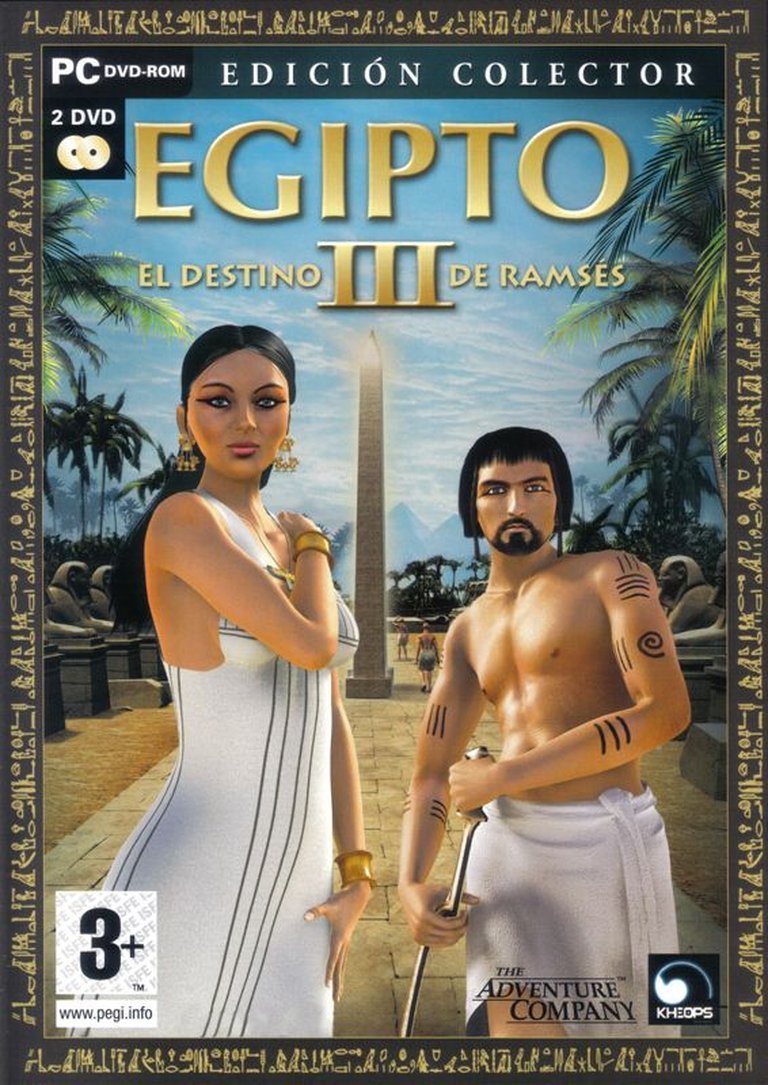
Egypt III: The Fate of Ramses is a graphic adventure game set in ancient Egypt during the reign of Pharaoh Ramesses II. Players assume the role of Maya, a priestess sent to investigate the mysterious halt in construction of an obelisk that is essential for extending the Pharaoh’s reign, solving intricate riddles and puzzles based on historical elements to fulfill the Oracle’s conditions and restore Egypt to glory. The DVD Collectors Edition includes the base game, known as The Egyptian Prophecy in North America, along with bonus content such as a documentary database, making-of video, galleries, and a bonus DVD with additional footage.
Gameplay Videos
Egypt III: The Fate of Ramses (DVD Collectors Edition) Guides & Walkthroughs
Egypt III: The Fate of Ramses (DVD Collectors Edition): Review
1. Introduction: The Final Obelisk in a crumbling Temple
In the mid-2000s, the golden age of the European point-and-click adventure was a fading memory, a period of profound transition and consolidation. Into this uncertain landscape stepped Egypt III: The Fate of Ramses (released in North America as The Egyptian Prophecy), the intended finale of a once-prominent trilogy. Its arrival, under the banner of Kheops Studio—a phoenix risen from the ashes of the legendary but defunct Cryo Interactive—was laden with the weight of legacy and the scars of industry turbulence. This collector’s edition, bundling the base game with a trove of historical documentaries and behind-the-scenes footage, is more than a product; it is a meticulously curated time capsule. It captures a specific moment when passionate developers, armed with a deep reverence for history and a dwindling market for graphic adventures, fought to tell one last story beneath the Egyptian sun. This review will argue that Egypt III, in its DVD Collectors Edition form, is a project defined by profound contradictions: a game of stunning archaeological authenticity hamstrung by dated gameplay, a narrative of grand mythological scale undermined by pacing issues, and a technical product born from chaos that ultimately stands as a poignant, if flawed, monument to a bygone era of narrative-driven gaming.
2. Development History & Context: From Cryo’s Ashes to Kheops’ Dawn
The story of Egypt III is intrinsically linked to the seismic collapse of its progenitor. The original Egypt series was a flagship franchise for Cryo Interactive, a French studio that, in the 1990s, pioneered the fusion of historical education with graphical adventure gaming through partnerships like the one with the Réunion des Musées Nationaux. However, Cryo’s ambitious expansion led to bankruptcy and liquidation in 2002. DreamCatcher Interactive, seeking to establish a European development arm, acquired many of Cryo’s key assets and teams, including the team working on the next Egypt title.
As detailed in the historical record, the game was announced in April 2003 as The Egyptian Prophecy for North America and Egypt III: The Fate of Ramses in Europe, with a projected E3 2003 showing. The initial development under DreamCatcher Europe was short-lived. In the summer of 2003, DreamCatcher shuttered the inherited Cryo development divisions. As noted by Adventure Gamers, the game “seemed destined for cancellation.” From this professional ashes arose Kheops Studio, founded by Benoît Hozjan and other laid-off developers, many of whom had already been deeply involved in the Egypt III project. In a remarkable turn, Kheops secured a contract from DreamCatcher to complete the game they had started. As Hozjan stated, “most of the team had already been involved in the game before its development was interrupted.” The development thus “quietly resumed” by early 2004, with Jeuxvideo.com reporting it was nearing completion by January of that year.
This tumultuous origin directly shaped the final product. Kheops maintained a core commitment to historical authenticity, continuing the series’ tradition by consulting with archaeologist Jean-Claude Golvin, as they had for Egypt II. However, they notably did not have the collaboration of the Réunion des Musées Nationaux, a key partner for the first two games, suggesting a shift in focus or resources. Furthermore, the studio explicitly targeted “casual gamers,” a demographic perception that would later clash with critical expectations for depth and challenge. The 2004 release (and the 2005 DVD Collectors Edition) thus represents a bridge: built by veterans of the classic Cryo model, but under the new, less stable paradigm of independent studio work-for-hire, aiming for a broader, less hardcore audience.
3. Narrative & Thematic Deep Dive: The Pharaoh’s Bargain and the Priestess’s Quest
At its narrative core, Egypt III presents a tightly wound, mythologically charged premise. The venerable Pharaoh Ramesses II, at sixty years old, faces mortality. He petitions the Oracle of Amun for an extension of his reign—a divine bargain with profound consequences. The god agrees, but sets a monumental condition: a majestic obelisk must be raised to the heavens before the Shemu season (the harvest season) arrives. This sets up a classic race-against-time structure infused with theological weight. The player assumes the role of Maya, a priestess sent by the Pharaoh to investigate why construction on the obelisk has mysteriously halted.
The plot is a descent into supernatural intrigue and forgotten history. Maya’s investigation reveals that the stoppage is not due to engineering failure, but to ancient, supernatural forces—a turn noted by Jeuxvideo.com as the game “fait dans le surnaturel” (dealing with the supernatural). The narrative weaves together several key threads:
* Divine Bargain & Hubris: Ramesses’s pact is an act of profound human hubris, attempting to cheat death and alter cosmic order. The narrative explores the fallout of such a bargain, where mortal ambition collides with divine will.
* Priestly Duty vs. Supernatural Threat: Maya is not a warrior but a priestess, a scholar and a conduit. Her quest is one of diagnosis and ritual as much as physical exploration. She must uncover forgotten rites, decipher prophetic texts, and confront entities that defy the natural world, embodying the series’ theme of historical mystery blending with mythology.
* Restoration of Ma’at: The ultimate goal extends beyond completing an obelisk; it is about restoring cosmic balance (Ma’at). The halting of the obelisk represents a rupture in the order of Egypt and the favor of the gods. Maya’s journey is thus one of healing a spiritual and political wound.
* Female Protagonist in a Patriarchal Setting: In a series and a historical setting dominated by male pharaohs and gods, Maya stands out as a capable, central female protagonist. Her agency is crucial; she is the primary actor saving the dynasty, navigating a world of male priests and a dying male king.
The dialogue and writing, credited to Laure Nollet and Alexia Lang, aim for a tone of solemn epicness tempered by the practical concerns of an investigator. The challenge lies in balancing exposition about Egyptian religion and history with the urgency of the plot. Critically, the game’s length and perceived simplicity—with Jeuxvideo.com calling it “short and easy”—suggest the narrative, while conceptually rich, may not develop its themes with the depth or pacing required for a truly epic feel, potentially reducing a cosmic crisis to a series of sequential puzzles.
4. Gameplay Mechanics & Systems: The Point-and-Click Crucible
As a graphic adventure game in the classic point-and-click tradition, Egypt III’s core loop is investigative: explore pre-rendered 3D environments, collect inventory items, combine them, and use them on environmental hotspots to solve puzzles and progress the story.
- Core Loop & Puzzles: The gameplay is fundamentally about environmental interaction and inventory management. Puzzles are predominantly logic-based, requiring players to: 1) find items hidden in intricate, often cluttered scenes; 2) understand their function within the context of Egyptian rituals or technology; and 3) apply them in the correct location. A significant critique from Dan Ravipinto of Adventure Gamers was the “cluttered environments,” which can lead to pixel-hunting frustration, a common pitfall in games with highly detailed, painterly backgrounds. The puzzles are designed to reflect Maya’s priestly role—they involve aligning sacred symbols, restoring ritual objects, and activating ancient mechanisms—which reinforces narrative but can feel obscure without clear tutorials.
- Interface & User Experience: The interface is a hallmark of its time: a static toolbar at the bottom of the screen with verbs (Look, Take, Use, etc.) and an inventory. Ravipinto also criticized a “slow interface,” likely pointing to loading times between panoramic scenes and the deliberate pace of cursor-driven interaction, which can feel sluggish compared to modern standards or even some contemporaries. This slowness may be a technical artifact of streaming large, detailed backgrounds from DVD-ROM.
- Character Progression: There is no traditional character progression (no leveling, skill trees, or stat upgrades). Progression is purely environmental and narrative-based. “Advancement” is measured by the percentage of the obelisk completed, a direct reflection of the central quest’s completion. This fits the “casual gamer” target, removing RPG complexity but also limiting player investment in Maya’s personal growth.
- Innovation & Flaws: The primary innovation lies in its commitment to historical verisimilitude within a supernatural framework, supported by the consultant Golvin. However, mechanically, it is a conservative entry. Its major flaws are endemic to the sub-genre at the time: reliance on opaque puzzle logic, a lack of meaningful failure states (most errors simply prevent progress without consequence), and an overall linearity that channels the player down a prescribed path. The game’s short length, as noted by multiple critics, is both a mercy (it doesn’t overstay its welcome) and a critique (it lacks depth and exploration).
5. World-Building, Art & Sound: A Monumental (Yet Static) Egypt
This is where Egypt III and its Collectors Edition arguably achieve their greatest success: the evocation of ancient Egypt as a lived-in, mythic space.
- Visual Direction & Pre-rendered 3D: The game employs stunning pre-rendered 3D graphics for its locations. Each screen is a meticulously painted tableau, showcasing vistas of Thebes, the construction site of the obelisk, sacred temples, and subterranean tombs. The artists, Franck Letiec and Jean Lamoureux, leverage the medium to create dramatic lighting, colossal architectural scale, and a color palette of desert golds, sun-bleached whites, and deep, shadowy interiors. The “Gallery with designs, screenshots, cinematics and music” included in the collector’s edition is a testament to this artistic ambition, offering a curated museum of the game’s visual development. However, this static beauty comes at a cost: environments are non-interactive backdrops until hotspots are moused over, and the transition between static screens can be jarring.
- Atmosphere & Setting: The atmosphere is one of solemn awe and creeping dread. The bustling, sun-drenched world of the living Pharaoh contrasts sharply with the silent, oppressive darkness of tombs and the unsettling, supernatural phenomena halting the obelisk. The setting feels authentic due to the archaeological consultation, with accurate depictions of Egyptian art, architecture, and religious iconography grounding the more fantastical elements.
- Sound Design & Music: The audio, composed by Olivier Louvel and Benoît De Mesmay, is a critical component of the atmosphere. It features:
- Ambient Soundscapes: Wind across deserts, distant temple chants, dripping water in crypts.
- A Memorable, Evocative Score: Music that swells with Egyptian motifs (harps, percussion, modal melodies) during moments of revelation or danger, and falls to somber, atmospheric pads during exploration.
- Voice Acting: The game features voice acting (noted in the collector’s edition as having “French voices, English subtitles” for the making-of, implying the game itself likely had localized audio). The quality is typical of the era for European adventures—earnest and clear, but not always nuanced. Maya’s performance carries the required gravitas for a priestess on a divine mission.
The collector’s edition bonus content directly amplifies this strength. The documentary database and making-of video (with French audio/English subs) provide crucial context, explaining the historical and archaeological research that informed the art design. The gallery of designs and music allows players to appreciate the craft behind the world. The standalone bonus DVD (PAL) suggests a desire to present the game’s art and production as a cinematic experience, worthy of a home theater viewing, further cementing its status as a curated historical artifact.
6. Reception & Legacy: A Niche, Divided, but Preserved Legacy
Egypt III: The Fate of Ramses received a “mixed or average” reception, as quantified by its Metacritic score of 73/100. This masks a significant critical divergence.
- Critical Divide:
- The Positive (76% – 4Players, 70% – Gamezebo, 7.5/10 – GameZone): These reviews likely praised the atmospheric world-building, strong historical theme, and engaging premise for fans of the genre. Gamezebo’s review, even five years later, found merit in its puzzle-adventure credentials.
- The Negative (29% – GameStar, 4/10 – Gamekult & Joystick, 5/10 – MeriStation): These reviews panned the clunky interface, pixel-hunting, simplistic puzzles, and short length. The German GameStar’s scathing 29% is particularly damning for a game marketed on its visuals and theme.
- The Middle (14/20 – Jeuxvideo.com, 63% – PC Games DE): The French press, perhaps more forgiving of its national adventure game tradition, saw it as a “pleasant Egyptian adventure” that was short and easy but competent within its niche.
- Commercial & Cultural Context: The game was “targeted primarily at casual gamers,” a strategy that likely alienated hardcore adventure fans seeking intricate puzzles while failing to attract a broader audience in a market increasingly dominated by action and FPS titles. Its release in 2004/2005 placed it at the tail end of the point-and-click boom. The very existence of the DVD Collectors Edition with its extensive bonus materials suggests DreamCatcher (or Kheops via Microïds later) was aware of its niche appeal and aimed to create a premium product for collectors and enthusiasts, a strategy common in film and music but rare for mid-tier PC adventures.
- Legacy & Influence:
- As a Series Finale: It concludes the Egypt trilogy, which was among the last major historical adventure series from the Cryo/Kheops lineage. Its narrative closure provides a definitive end to the story of the Egyptian Prophecies.
- Kheops Studio’s Path: Kheops Studio did not vanish. They became a reliable, if not blockbuster, developer of narrative adventures, pivoting to other historical and literary licenses like Jules Verne (Return to Mysterious Island, Voyage) and other mysteries (Cleopatra: Riddle of the Tomb, Nostradamus). Egypt III can be seen as their proof of concept for continuing the “Cryo adventure” model independently.
- Preservation Through Curation: The 2005 DVD Collectors Edition is its own legacy. By bundling the game with a “Documentary database,” “making-of video,” and a “Bonus DVD video” playable on a home player, it transcended being a mere game. It became a multimedia package about the making of a game about ancient Egypt. This approach to preservation—treating the game’s production history as valuable content—is surprisingly forward-thinking. It mirrors the director’s commentary or behind-the-scenes feature common in film collections, granting the title a longevity and scholarly interest it might not have had as a budget re-release.
- Industry Influence: Its direct influence on other major studios is negligible. However, as part of the late-era European adventure wave (alongside titles from companies like Futureplay and Microïds), it represents the last gasps of a specific business model: the moderately budgeted, historically-themed, CD/DVD-point-and-click adventure. Its fate—caught in corporate restructuring, saved by a startup—is a microcosm of the era’s industry volatility.
7. Conclusion: A Preserved Relic of a Lost Craft
Egypt III: The Fate of Ramses (DVD Collectors Edition) is not a forgotten gem nor a catastrophic failure. It is a professional, historically-informed, and aesthetically accomplished graphic adventure that is fundamentally at odds with its own time and its target audience. Its greatest strengths—its commitment to a vast, authentic, and atmospheric world—are also the source of its weaknesses, as that world is populated by static screens, cluttered with items for pixel-hunting, and traversed via a lethargic interface. Its narrative, rich with mythological stakes, is delivered in a short, linear, and forgiving experience that prioritizes accessibility over challenge.
The true significance of this specific edition lies in its curatorial intent. Released one year after the base game, the Collectors Edition is an act of preservation and reinterpretation. It frames Egypt III not just as a game to be played, but as a cultural artifact to be studied. The documentary database on Egyptian history, the making-of video detailing the archaeological consultations, and the gallery of concept art transform the player from a mere consumer into an archivist and enthusiast.
In the grand tapestry of video game history, Egypt III occupies a crucial, if quiet, niche. It is the closing chapter of the Cryo legacy and a manifesto for Kheops Studio’s survival. It is a testament to the enduring, if shrinking, appeal of the historical adventure in an era of 3D action. And finally, through this very DVD Collectors Edition, it is a game that was consciously packaged to be remembered—a digital obelisk, built not to please a god, but to stand as a meticulously documented monument to a craft that was, even then, becoming a thing of the past. Its Metacritic score of 73 is apt: it is perfectly average within its genre constraints, yet its existence and this special edition speak to a passion and preservationist spirit that elevates it above the simple arithmetic of critical consensus. It is a worthy, if flawed, finale to a trilogy and a fascinatingly preserved document of a transitional moment in adventure game development.