
- Release Year: 1998
- Platforms: DOS, Linux, Windows
- Publisher: Atari Interactive, Inc., Nightdive Studios, LLC, Sold Out Sales & Marketing Ltd., Tommo Inc.
- Developer: MicroProse Software, Inc.
- Genre: Compilation
- Game Mode: Single-player
- Average Score: 82/100
Description
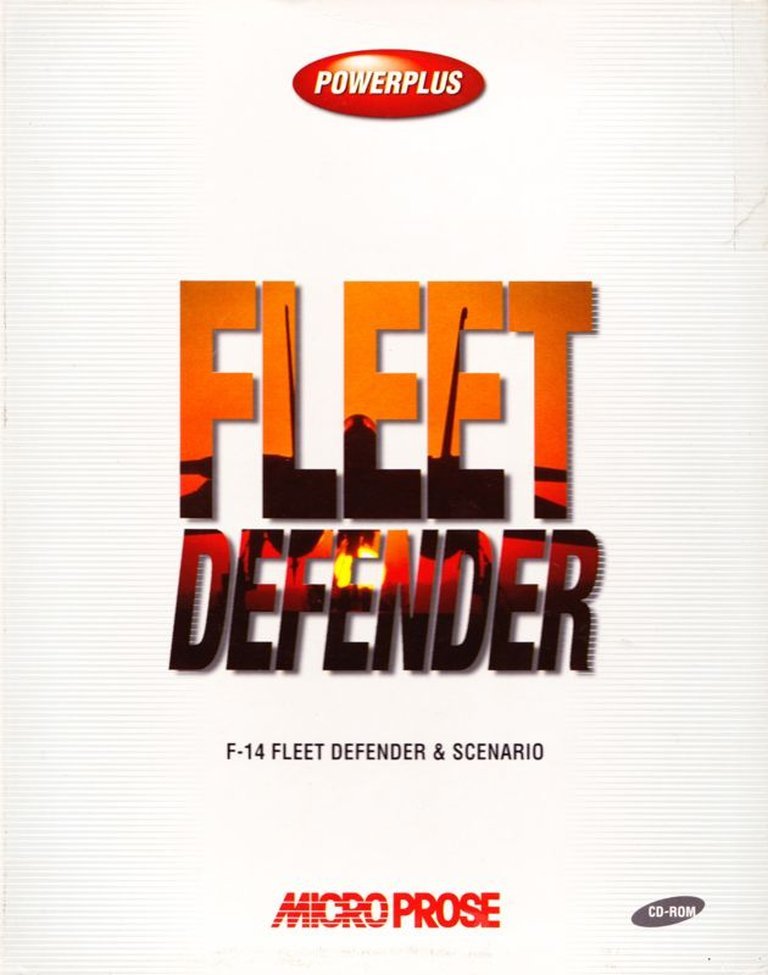
F-14 Fleet Defender / Fleet Defender: Scenario is a compilation of MicroProse’s 1994 combat flight simulator and its 1995 expansion, where players pilot the F-14B Tomcat in detailed carrier-based missions. The game emphasizes long-range AIM-54 Phoenix missile engagements over close-quarters dogfights, set across various theaters including the Oceana training area, North Cape, and the Mediterranean region, with realistic air traffic control and wingman management.
F-14 Fleet Defender / Fleet Defender: Scenario Guides & Walkthroughs
F-14 Fleet Defender / Fleet Defender: Scenario Reviews & Reception
gamepressure.com (80/100): One of the most famous flight simulators of the years 1994/95.
homeoftheunderdogs.net (84/100): Now this is it. This is one member of the 1994/95-ruling triumvirate of flight simulators.
F-14 Fleet Defender / Fleet Defender: Scenario: Review
Introduction: The Apex of ’90s Naval Air Combat Simulation
In the pantheon of 1990s combat flight simulators, three titles formed a formidable triumvirate that defined the genre’s ambition: TFX, Tornado, and Fleet Defender. Among these, MicroProse’s 1994 offering holds a unique and hallowed place. It was not merely a game about flying a fighter jet; it was a painstaking, often daunting, simulation of being a vital cog in a U.S. Navy Carrier Battle Group during the tense twilight of the Cold War. Fleet Defender and its 1995 expansion, Scenario, represented the zenith of MicroProse’s “tactical” design philosophy, shifting the focus from lone-wolf dogfighting to the complex, networked ballet of fleet defense, where the F-14 Tomcat’s primary weapon was not its agility but the long-range, über-lethal AIM-54 Phoenix missile.
This review synthesizes the legacy of this seminal title, from its groundbreaking development to its enduring, if niche, influence. My thesis is clear: Fleet Defender was a flawed masterpiece of immense ambition. It successfully translated the immense operational complexity of naval aviation into a (barely) playable PC experience, pioneering systems that would become staples in future sims. Yet, its sheer difficulty, technical demands, and occasional design eccentricities prevented it from achieving mainstream success, cementing instead a reputation as a “simulator’s simulator”—a title revered by purists but intimidating to all others. The 1998 compilation, F-14 Fleet Defender / Fleet Defender: Scenario, serves as the definitive digital preservation of this artifact, bundling the core experience with its crucial expansion and stripping away the later multimedia additions to present the raw, unadulterated simulation.
Development History & Context: MicroProse’s Naval Gamble
The Studio and the Vision: By 1994, MicroProse, under the creative leadership of Sid Meier and Jeff Briggs, was the undisputed king of the deep-sim genre. Following the success of F-15 Strike Eagle III and F-117A Nighthawk Stealth Fighter, the studio sought to tackle a new domain: the U.S. Navy’s carrier-based air superiority. The project was helmed by a team including Scott Spanburg (Producer), Christopher Clark, Scott Elson, Michael J. McDonald, Detmar Peterke, George Wargo, and Ned Way (Designers), with Terrence Hodge as Artist and Lawrence T. Russell as Writer. Their stated goal was unprecedented: to simulate the F-14 Tomcat not as a solo interceptor, but as the fleet defender—the long-range, radar-guided shield for the carrier group.
A Design Crucial Choice: The F-14B Over the F-14A: One of the most telling anecdotes from the game’s development comes from the manual itself, as cited on Wikipedia. The team initially modeled the powerful F-14B variant, even in scenarios where the earlier F-14A would have been historically accurate. Why? Because the original F-14A was, in their words, “unforgiving and ‘not much fun’ in an entertainment flight simulator.” This is a critical insight into their design ethos: they prioritized a playable, empowering experience over strict historical purism. The F-14B’s more powerful GE F110-GE-400 engines provided the必要 acceleration and climb to make the simulation feel viable to a non-test-pilot audience.
Technological Constraints and Innovations: Fleet Defender was a game that pushed the boundaries of the average 1994 DOS PC. According to the DOS Days technical breakdown, it required a minimum of a 386 CPU, 4MB RAM (with 8MB and a 486 recommended), and, most critically, Expanded Memory (EMS). The game could use up to 9,344 KB of EMS to enable textured aircraft/ground objects and digitized speech. Without sufficient EMS, these features would be disabled, degrading the experience significantly. This reliance on EMS/XMS memory management was a hallmark of the era’s most ambitious sims.
Technologically, the game was a showcase:
* Scale: It shattered MicroProse’s previous limit of 8 active aircraft. Fleet Defender could manage 70 active aircraft simultaneously, all operating from mission start. This included player wingmen, AWACS, tankers, and enemy CAP and strike groups, all following their own AI-driven scripts. As Computer Gaming World noted in 1994, it dispensed with the “you alone… engage the entire third world” fantasy.
* Graphics: It was MicroProse’s first title to use texture mapping on aircraft and ground objects, giving the Tomcat and its surroundings a visual depth previously unseen in their sims. The VGA (640×480, 256 colors) sky also featured dynamic time-of-day color shifts.
* Audio: It introduced digitized speech to the lineup, with the RIO, wingmen, carrier LSO, AWACS, and “HAWKEYES” (presumably E-2C Hawkeye controllers) all providing critical, voiced instructions and callouts.
* 3D Engine: The game used MicroProse’s proprietary 3D engine, rendering polygons for terrain, ships, and aircraft. The water texture, however, was famously problematic, creating a “shimmering mass” effect at certain altitudes—a noted visual flaw.
The Gaming Landscape: Released alongside TFX (1993) and Tornado (1993), Fleet Defender competed in a golden age of “study sims.” These games demanded manual-reading, systems-learning, and tactical patience. The market was hungry for authenticity, and MicroProse delivered it in spades, even if it meant alienating casual players.
Narrative & Thematic Deep Dive: The Absence of Story, The Presence of Doctrine
Unlike narrative-driven games, Fleet Defender does not have a plot in the traditional sense. There are no characters with arcs, no scripted cinematic story beats. Its “narrative” is emergent, born from the Cold War doctrinal context and the scenarios it presents.
Thematic Core: The BVR (Beyond Visual Range) Mindset: The game’s overriding theme is the tactical reality of the 1980s Navy/Marine Corps F-14 community: the Phoenix as primary weapon. The player is not a hotshot dogfighter but a tactical controller, managing the AWG-9 radar’s numerous modes (TWS – Track While Scan, STT – Single Target Track, PD – Pulse Doppler) to find, identify, and engage multiple threats at ranges of up to 100 miles. The game’s design forces this mindset. As the Computer Gaming World review stated, it’s a “tactical flight simulator” where the goal is to “fire, but never forget”—launch your Phoenixes at maximum range and disengage before the enemy’s shorter-range missiles become a threat. Getting into a turning fight with a MiG-29 or Su-27 was often a path to disaster, perfectly simulating the Tomcat’s “flying brick” maneuverability limitations.
Scenarios as Thematic vignettes: The campaigns are not stories but operational sandboxes reflecting contemporary fears:
1. Oceana: A training theater, introducing basic CAP (Combat Air Patrol) and interception procedures.
2. North Cape: A classic Cold War flashpoint, pitting U.S. carriers against Soviet forces in the Norwegian Sea, defending against Backfire bomber raids and Bear D reconnaissance planes.
3. Mediterranean: A multi-domain conflict involving the Balkans and North Africa, featuring a wider variety of Soviet-client state aircraft.
4. Scenario Expansion Theaters:
* Indian Ocean: Focuses on protecting shipping lanes from Soviet naval aviation based in Aden and Somalia.
* Korean Peninsula: A high-tension scenario mirroring the real-world standoff, with North Korean MiG-21s and MiG-23s supported by Soviet advisors.
These settings are not backdrops for a story but the raison d’être for the F-14’s existence. The “plot” is always: Soviet/Warsaw Pact aircraft have penetrated your defensive perimeter. Your job is to stop them before they reach the carrier.
Easter Eggs and Artistic License: The game’s development team injected whimsical elements that break the hard-sim realism, revealing a desire for fun. The Codex Gamicus entry and user lore mention a secret mission where an “unknown contact” turns out to be a flying saucer, a Bermuda Triangle homage with lost TBF Avengers, and a dragon in the North Cape theater. These aren’t narrative elements but playful deviations that became legendary among players, showcasing the developers’ personalities breaking through the rigid simulation shell.
Gameplay Mechanics & Systems: A Symphony of Complexity
Fleet Defender‘s gameplay is a dense web of interconnected systems. Mastery requires a commitment akin to learning a new language.
The Dual-Cockpit Paradigm: The most significant mechanical innovation was the seamless control of both Pilot and Radar Intercept Officer (RIO). While the pilot flies the jet, the RIO manages the AWG-9 radar, which is the game’s central nervous system. The player can freely switch between the two stations, each with its own dedicated screen in the cockpit view.
* Pilot View: Primary flight instruments (ADI, HSI, VSI, airspeed/mach, fuel), weapons status, and a basic radar altimeter. The pilot handles launch authorization (the “Master Arm” switch), employs electronic countermeasures (chaff/flare), and flies the aircraft.
* RIO View: This is the command center. The screen displays the AWG-9’s various modes:
* TWS (Track While Scan): The workhorse. Scans a volume of airspace, automatically building tracks on multiple contacts, providing closure rate, altitude, and identity (if IFF is interrogated). The player assigns Phoenix missiles to these tracks.
* STT (Single Target Track): Locks a single contact for finer data and automatic missile guidance.
* PD (Pulse Doppler): For looking down into ground clutter to spot low-flying targets.
* Map display: For navigation and situational awareness of the entire battlespace.
Managing the radar—scanning, prioritizing contacts, assigning missiles, and breaking lock to scan again—is the primary cognitive load. It’s a constant, high-pressure tactical puzzle.
Weapon Systems & Tactics:
* AIM-54A Phoenix: The star. A heavy, long-range, active-radar homing missile. In-game, it’s your best and often only reliable weapon against superior numbers of agile Soviet fighters. The tactic is “launch, climb, and run.” You launch at max range (often 60-80 miles) and immediately turn away to increase separation, letting the missile’s motor and radar do the work. It’s not a guaranteed kill; range, aspect angle, and electronic countermeasures matter.
* AIM-7M Sparrow: A semi-active radar homing missile. Requires the launching aircraft’s radar to “illuminate” the target until impact. Useful in TWS mode against multiple targets, but less effective than the Phoenix and more vulnerable to jamming.
* AIM-9L Sidewinder: An infrared heat-seeker. Your last-ditch, close-in weapon. Deadly in the hands of someone who gets on an enemy’s tail, but useless against a head-on or turning target.
* AIM-7/9 vs. Gun: The M61A1 Vulcan cannon is present but, per the Home of the Underdogs review, “Gun difficulty has been increased on Authentic weapon setting” in patches. In the dense, fast-paced battles, getting into gun range was often suicidal against multiple threats.
Wingman and Group Control: A major leap from previous MicroProse sims. You are not alone. You can command your entire flight (typically 4 aircraft) with a rich set of commands via the RIO’s data-link screen or keyboard shortcuts:
* Formations: Tight, Spread, Diamond, VIC.
* Tactics: Engage (broad attack), Coverme (intercept threats targeting you), TacEngage (tactical engagement, managing fuel/ammo), Pax (go passive), Home (RTB).
* Specific Orders: Attack a specific bandit (callsign), jettison stores, set fuel state.
This transformed the F-14 from a single aircraft into a command node for a tactical unit.
Campaign Structure & Mission Builder: The original game’s three theaters (plus two from Scenario) each contain several campaign strings. Missions are pre-built but dynamic in execution. The Scenario expansion’s killer feature was its Mission Builder. This allowed players to create custom missions, placing aircraft, ships, waypoints, and objectives—an immense tool for creativity that extended the game’s lifespan exponentially. The DOS Days file list shows campaign files (.CMP) in the CAMPAIGN directory, evidence of this structured but flexible approach.
Interface & Learning Curve: The interface is entirely diegetic. Every button, switch, and screen is part of the cockpit. There is no “arcade” HUD overlay for targeting; you look at your radar screen. The learning curve is a cliff. The manuals (noted by Home of the Underdogs as “full of inaccuracies”) were inadequate, necessitating community-created guides like Robin G. Kim’s A Player’s Guide to Fleet Defender. The game expects you to understand radar theory, missile kinematics, and carrier landing patterns. It is, as the review states, “not for beginners.”
World-Building, Art & Sound: Painting the Cold War Sky
Setting & Atmosphere: The game’s world is the open ocean and its contested airspace. The three primary theaters—North Cape (icy, rugged Scandinavian coastline), Mediterranean (sun-drenched, with distinct European and African terrain), Oceana (featureless blue ocean for training)—are rendered with a consistent, functional aesthetic. The atmosphere is one of high tension and isolation. You are a lone Tomcat, hundreds of miles from the carrier, scanning a vast, empty horizon for pixelated specks that could be a Tu-95 Bear reconnaissance plane or a flight of MiG-29s. The sound of your RIO’s voice crackling over the radio (“TALLY, bandit, ten o’clock high!“) or the carrier’s LSO (“Bolter, bolter, bolter!“) is more atmospheric than any orchestral score.
Visual Style (VGA Era): The graphics are a product of their time and hardware. The texture-mapped aircraft were a revelation. The F-14’s silhouette, with its variable-sweep wings and distinct intakes, is recognizable even in 256-color polygons. Ground objects (buildings, ships, SAM sites) are simple but effective. The sky dome with its time-of-day color changes (from dawn pinks to midday blues to dusk oranges) is a standout atmospheric touch. The major flaw, repeatedly noted, is the water rendering, which creates a distracting, shimmering heat-haze effect at low altitude, breaking the illusion of a vast ocean.
The cockpit is a masterpiece of functional art. It’s a multi-screen affair (pilot left, RIO right), densely packed with switches, labels, and displays. The game includes a labeled diagram (CPBBL1.PIC, etc. in the DOS Days file list) to help you find the “Master Arm” or “Chaff/Flare” buttons. It feels less like a video game menu and more like an engineering schematic.
Sound Design & Music: The audio is split into two layers:
1. Digitized Speech: This is the game’s most immersive feature. The voices (wingmen, AWACS, carrier controllers) are clear, with that distinctive ’90s MIDI-digitized grit. They provide critical information and constant feedback, making the world feel alive. The inclusion of a “HAWKEYES” controller (the E-2C’s crew) is a level of detail rarely seen.
2. Environmental & Effects Sound: Engine roars, missile launches, gunfire, and explosions are competent but unexceptional for the era, as Home of the Underdogs notes.
3. Music: Composer Michael Bross provided a sparse, synth-driven soundtrack that plays during menu screens and the campaign overview. It’s atmospheric but forgettable—the game’s true audio identity is the chatter of the radio and the whine of the Tomcat’s engines.
Reception & Legacy: The Purist’s Choice
Critical reception at launch was strong, particularly among hardcore sim publications. Computer Gaming World’s June 1994 review (by Tom Basham and Mark Estephanian) was ecstatic, calling it a simulator that “pushes the envelope of desktop computers” and praised its “very good balance between game play and pure graphic orgasm.” They specifically highlighted the accurate flight envelope, extensive wingman controls, and very good enemy AI. Their conclusion: “Fleet Defender is an outstanding simulator that will serve to reestablish MicroProse as a major player in the flight sim wars.” This was high praise, positioning it as a worthy successor to F-15 Strike Eagle III.
However, its commercial reach was limited by its difficulty. It could not compete with the more accessible TFX (Tornado was also notoriously complex). It was a game for the committed few who would pore over the manuals and practice carrier landings for hours.
Legacy and Evolution:
* The Scenario Expansion (1995): This was not merely an add-on but a vital complement. It added two new, highly requested theaters (Indian Ocean, Korean Peninsula), six new campaigns, new squadron skins, and—most importantly—the Mission Builder. This tool gave the game near-infinite replayability, allowing the community to create and share custom scenarios, from historical replays to fantastical “what-if” conflicts.
* Fleet Defender Gold (1995): The definitive 1995 release. It bundled the base game, the Scenario disk, added the two new theaters to the base campaign structure, incorporated all patches (up to version 2.0), and included multimedia extras: interactive tutorials, a “Flight Deck” documentary, and more. This is the version many cite as their first exposure.
* F-14 Fleet Defender / Fleet Defender: Scenario (1998 Compilation): This is the subject of our review—a budget re-release by Sold Out Sales & Marketing (later rights acquired by Tommo/Nightdive). It’s essentially the Gold version minus the multimedia presentations. It includes the Win95 installer and digital manual but is otherwise the pure DOS game, updated to version 2.0 with all Scenario content. It’s the cleanest, most accessible digital package, later found on GOG and Steam.
* Preservation: The game’s legacy is secure due to digital preservation efforts. It’s available on GOG ($1.19) and Steam, packaged by Nightdive Studios with DOSBox pre-configured. This has introduced it to a new generation of retro sim enthusiasts.
* Influence: Its DNA is clear in later MicroProse/Matrix Games titles. Andy Hollis, a key designer on Fleet Defender, later worked at Jane’s Combat Simulations and designed Jane’s F/A-18, which inherited much of the F-14’s radar and tactical gameplay philosophy. The emphasis on BVR combat, complex radar management, and fleet-tactical command would also be hallmarks of later, even more complex sims like Falcon 4.0 (1998) and the Digital Combat Simulator (DCS) series.
Conclusion: A Daunting but Foundational Monument
F-14 Fleet Defender / Fleet Defender: Scenario stands as one of the most ambitious and uncompromising air combat simulators ever created for the consumer market. It is not a game you “play” in the conventional sense; it is a simulation you operate. Its genius lies in its faithful translation of the F-14 Tomcat’s doctrinal role into a compelling, if brutally difficult, gameplay loop centered on radar management, long-range missile tactics, and fleet coordination.
Its flaws are inextricably linked to its strengths. The daunting learning curve, the finicky EMS memory requirements, the shimmering water, and the sometimes-awkward interface are the price of admission for a simulation that made you feel, however tenuously, like a real Naval Aviator. The lack of a traditional narrative is a feature, not a bug; the story is the Cold War, and you are a single, vital participant.
The 1998 compilation is the perfect vessel to experience this history. It offers the complete, patched simulation (base game + Scenario) without the extraneous multimedia baggage of Gold, focusing purely on the mechanics that mattered. For the historian, it is a time capsule of 1994/95 simulation design at its most audacious. For the player, it is a challenging, rewarding, and ultimately profound experience that demands respect and patience. It may not be the “best” flight sim by today’s standards, but in its specific niche—the tactical, carrier-based, BVR air defense simulator—it remains, as Home of the Underdogs declares, a title with “no kin to this very day.” It is a demanding monument to a specific time, place, and technology, and its preservation is a victory for gaming history.