
- Release Year: 2014
- Platforms: Windows
- Publisher: UIE Inc.
- Genre: Compilation
- Game Mode: Single-player
- Gameplay: Simulation
- Setting: Various
Description
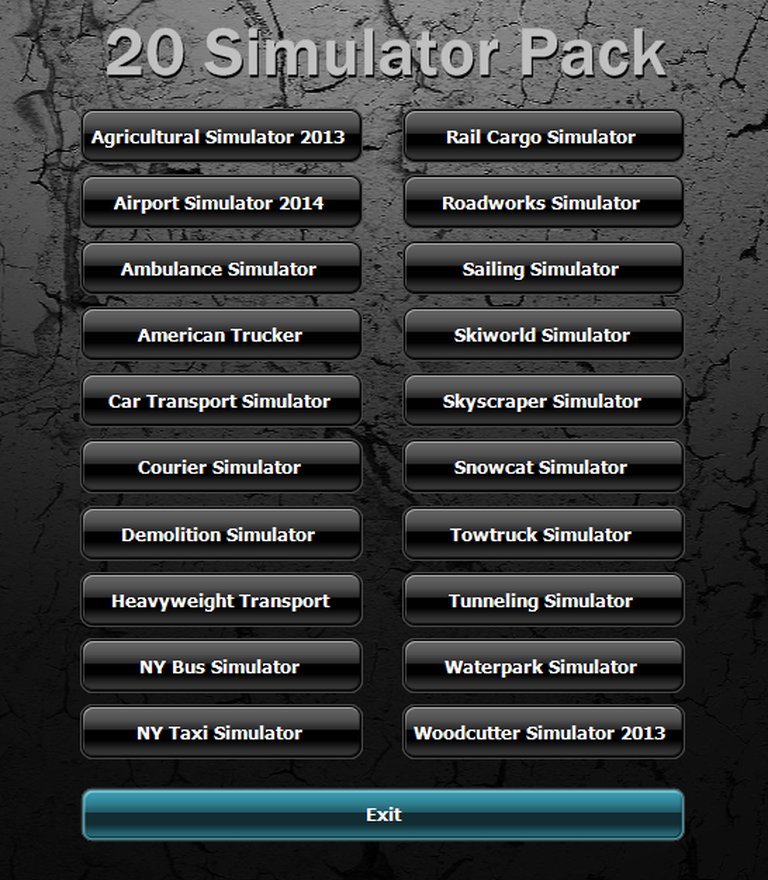
World of Simulators: Ultimate Edition is a 2014 Windows compilation package that bundles twenty complete simulation games, offering players a diverse array of virtual experiences across various fields such as agriculture, transportation, emergency services, and construction, all designed for single-player offline enjoyment with keyboard and mouse controls.
Gameplay Videos
World of Simulators: Ultimate Edition: A Monument to the Mundane
Introduction: The Aggregation of Absorbing Simulation
In the sprawling, often-overlooked annals of PC gaming, there exists a peculiar subgenre: the hyper-specific, often-budget simulation title. These are games that promise not epic fantasy or military glory, but the meticulous, sometimes Sisyphean, recreation of a single job or activity—from driving a European truck to felling trees. World of Simulators: Ultimate Edition, released in 2014 by the enigmatic UIE Inc., stands not as a singular creative vision but as a colossal monument to this niche. It is a curated museum, a time capsule, and a bargain-bin magnum opus rolled into one DVD-ROM case. This review posits that World of Simulators: Ultimate Edition is less a “game” in the traditional sense and more a significant historical artifact; its primary value lies in its function as a definitive, physical anthology of the early-2010s’ explosion of low-fidelity, high-commitment simulation software. Its legacy is one of aggregation, offering an unprecedented—if overwhelming—lens through which to view a specific, industrious corner of game development that thrived outside the spotlight.
Development History & Context: The Era of the Engine License
To understand Ultimate Edition, one must first understand its ecosystem. The game emerged circa 2013-2014, a period marked by two crucial factors:
1. The Democratization of 3D Engines: The rise of affordable, accessible middleware like Unity and Unreal Engine 3 (and its impending successor) meant that small studios and even solo developers could produce 3D games with a level of graphical competency previously requiring massive budgets. This directly fueled the “simulator” boom, where a small team could license a generic vehicle model, build a rudimentary open world or route, and release a game focused on procedural tasks.
2. The Digital Storefront Gold Rush: While Ultimate Edition itself was a physical compilation, its component parts were almost certainly born for Steam’s Early Access program or various low-cost digital storefronts (such as those operated by publishers like UIE Inc. itself). The model was simple: identify a real-world vehicle or job (a tow truck, a snowcat, a NYC taxi), create a basic model and environment, implement a few core mechanics (drive, pick up, deliver), and sell it for $10-$20. Critical reception was often secondary to fulfilling a niche desire.
UIE Inc., the publisher credited, is a shadowy figure in this context. During this era, various entities used names like “UIE,” “UIG Entertainment,” or “Top Wild Games” to publish compilations and budget titles, often aggregating games developed by small, contract-based European studios—frequently from Germany, Poland, or the Czech Republic—where simulation traditions run deep. There is no evidence of a singular, visionary creator behind Ultimate Edition; it is a commercial product born of spreadsheet logic, identifying a market for “20 games in one!” and assembling the pieces accordingly.
The technological constraints were profound. The included titles, most bearing a 2013 date, likely run on proprietary or lightly modified versions of existing engines. Graphics are dated even for 2013, with low-poly models, simplistic textures, and minimal draw distances. The “innovation” lay not in technical prowess but in scope and accessibility: Ultimate Edition made it physically and financially simple to sample the entire genre’s output at once.
Narrative & Thematic Deep Dive: The Anti-Story
World of Simulators: Ultimate Edition presents a fascinating case study in the * deliberate absence of traditional narrative. There is no plot, no protagonist, no antagonist, and no dialogue beyond perhaps sparse tutorial text or in-game radio chatter. The thematic core, therefore, is not conveyed through story but through *mechanic and context.
Each contained simulator is a fragmented narrative of labor. The player is an anonymous everyman (or everywoman, given the “Everyone” ESRB rating) performing a specific, often socially essential, function:
* Agricultural Simulator 2013 & Woodcutter Simulator 2013 speak to humanity’s primordial relationship with resource extraction and land.
* Ambulance Simulator and New York Taxi/ Bus Simulator touch on urban service, urgency, and the rhythm of city life.
* Demolition Simulator and Tunneling Simulator represent the constructive/destructive cycle of civilization.
* Ski World Simulator and Water Park Simulator capture the leisure industry’s infrastructure.
The unifying theme is systemic immersion over heroic narrative. The “story” is the player’s own journey from incompetence to mastery within each micro-system. It’s a treatise on the dignity, monotony, and complexity of ordinary work. The anthology format amplifies this: by juxtaposing the serene pace of a Sailing Simulator with the chaotic traffic management of a Courier Simulator, it creates a tapestry of modern occupational life. There is no moral, no climax—only the quiet satisfaction of a job completed, a route mastered, a cargo delivered intact. This is the “world” of the title: not a fantasy realm, but the interconnected, global network of mundane yet vital professions.
Gameplay Mechanics & Systems: A Symphony of Repetition and Realism
Deconstructing the gameplay of Ultimate Edition means analyzing the common DNA of its twenty offspring. The core loop across nearly all titles follows a predictable but potent formula:
- Assignment/Scenario: The player receives a task: transport X from A to B, demolish structure Y, harvest field Z.
- Preparation: Often minimal. This might involve selecting a vehicle (in titles like American Trucker or Heavyweight Transport), checking a map, or simply starting at a designated spawn point.
- Execution: The heart of the experience. This is a test of spatial awareness, procedural memory, and patience.
- Vehicle Control: The primary challenge. Physics engines range from arcade-simple (Roadworks Simulator‘s digger) to punishingly realistic (Sailing Simulator, Skyscraper Simulator‘s crane). Mastering steering, braking, and auxiliary controls (crane arms, tow hooks, harvester blades) is a skill requiring hours.
- Environmental Navigation: Maps are typically small-to-medium scale, open-world-lite environments. Challenges involve obeying (or ignoring) traffic laws, navigating narrow roads or construction sites, and dealing with weather (Snowcat Simulator).
- Task Completion: Often a simple “reach zone” or “interact with object” trigger. The depth comes from the process, not the goal.
- Completion & Reward: A score, monetary reward, or simple “job complete” message. Progression systems are rare but present in titles like Agricultural Simulator 2013 or Woodcutter Simulator 2013, where money earned can buy better equipment, creating a light meta-game.
Innovative Systems: It would be generous to call any single system “innovative.” The innovation is in the aggregation and normalization of the format. Ultimate Edition treats each job simulator as a valid, equal game type. The closest to a unique feature is the seamless, menu-driven switching between these vastly different systems, a precursor to the “game pass” mentality but curated around a specific aesthetic/philosophy.
Flawed Systems: The compilation is a showcase of common genre flaws:
* Repetitive Grind: Many titles lack sufficient scenario variety. After three taxi runs, the 20th feels identical.
* Obtuse UI/UX: Menu systems are often clunky, imported directly from their original, less-polished releases. Map and objective clarity is frequently poor.
* Janky Physics: Especially in construction titles (Demolition, Tunneling, Skyscraper), the physics interactions between vehicle and environment are unpredictable, leading to frustration.
* Lack of Meaningful Progression: With few exceptions, success in one simulator provides no tangible benefit in another. They exist in isolated bubbles.
World-Building, Art & Sound: The Aesthetic of the Functional
The visual and auditory presentation is a direct product of the technological and budgetary constraints. It defines the genre’s “look and feel.”
Visual Direction: The art style is 100% functional realism. Assets are low-to-medium polygon counts, textures are often stretched and blurry, and environmental detail is sparse. The world is built out of necessity, not artistry. However, this creates a peculiar, almost found-footage authenticity. The bland office park in Courier Simulator, the identical suburban houses in New York Bus Simulator, the generic industrial ports in Rail Cargo Simulator—they feel depressingly, accurately real in their lack of distinction. The aesthetic is one of simulated banality.
Atmosphere & Sound Design: Sound is critical and often the most “finished” element. Engine noises (from the roar of a American Trucker‘s diesel to the whine of a Snowcat‘s tracks) are robust and provide crucial audio feedback. The soundscape is dominated by vehicle noise, wind, and environmental ambiance (seagulls at the Airport, water splashing in the Sailing Simulator). Music is almost entirely absent, replaced by the immersive, often monotonous, sounds of the job. This audio design sells the illusion of being there, doing the work. The world doesn’t feel “lived-in” with NPC stories, but it feels occupied by the machinery of its own purpose.
Reception & Legacy: The Ghost in the Compilation
Critical Reception at Launch: World of Simulators: Ultimate Edition exists in a critical void. As evidenced by the empty critic and user review pages on Metacritic and MobyGames, it was utterly ignored by the professional press. This was not an anomaly; it was the norm for such compilations. They were catalog items, sold on Amazon listings and discount Steam sales, targeted at a specific, non-discriminating audience: curious newcomers to the genre or hardcore simulation completionists. Its “ESRB: Everyone” rating marks it as family-friendly in content, but its impenetrable difficulty and lack of guidance would likely frustrate a child.
Commercial Reception: Its commercial fate is obscure but can be inferred. As a physical DVD-ROM release in 2014, it was already slightly behind the digital curve. It likely sold modestly through bargain bins, online retailers like Amazon (where the listing persists), and perhaps as a staples-ordered item. Its existence suggests a publisher betting on volume and low overhead.
Evolving Reputation & Influence: The game’s reputation has not evolved; it has remained static, a buried artifact. However, its influence is indirect but significant:
1. Validation of the Micro-Genre: By packaging twenty of these titles together, UIE Inc. implicitly argued that each was a complete, sellable product worth equal footing. It helped cement the “Single-Job Simulator” as a viable subgenre.
2. Precursor to Subscription Models: The anthology format prefigured the modern game-pass mentality. It offered “all you can play” of a specific niche for a one-time fee.
3. Archival Value: For historians and genre enthusiasts, Ultimate Edition is a priceless snapshot. It collects titles like Agricultural Simulator 2013 and Woodcutter Simulator 2013, which might otherwise be lost to broken links or dead servers. It provides a direct, unmediated sample of the low-budget simulation boom’s output.
4. The “So-Bad-It’s-Good” Cult Potential: While not documented, such a compilation is ripe for ironic playthroughs and comedic critique, joining the pantheon of famously janky games celebrated for their earnest weirdness.
Its direct lineage can be seen in later, more polished compilations like the World of Simulators: Deluxe Edition (2017) and the console push for World of Simulators on PlayStation 4 (2020). UIE/UIG Entertainment was clearly building a brand from this bundle.
Conclusion: A Curious Artifact of Gaming’s Laborious Underbelly
World of Simulators: Ultimate Edition is not a “good” game by any conventional metric. It is clunky, repetitive, aesthetically dated, and narratively void. Its individual components are often shallow, frustrating, and forgettable. To evaluate it as such, however, is to miss its point entirely.
Its genius, if one can call it that, is in its curatorial scope and unapologetic taxonomy. It is a museum of a very specific game development philosophy: that the act of simulating a real-world job, any job, has intrinsic value for a certain player. It strips away all pretense of being an “experience” and presents itself as a toolkit of occupations.
Its place in video game history is as a primary source document. It is the Rosetta Stone for the early-2010s simulation boom, a period where the barrier to entry for 3D game creation dropped low enough that anyone with a niche interest could make a playable, if flawed, version of it. It represents the peak—or perhaps the logical conclusion—of that trend: a physical box containing twenty such attempts, a wholesale liquidation of a development ethos.
For the historian, it is indispensable. For the masochistic completionist, it is a staggering challenge. For the average player, it is a bewildering, $9.99 thrift store curiosity. Its ultimate verdict rests on what one values: a tightly crafted experience, or a sprawling, messy, and profoundly honest document of gaming’s most mundane and diligent impulses. In the latter sense, World of Simulators: Ultimate Edition is nothing short of ultimate.