
- Release Year: 1999
- Platforms: Windows
- Publisher: Nick Jr.
- Developer: Nick Jr.
- Genre: Educational, Puzzle
- Perspective: 1st-person
- Game Mode: Single-player
- Gameplay: Color matching, Puzzle, Shape Matching
- Average Score: 100/100
Description
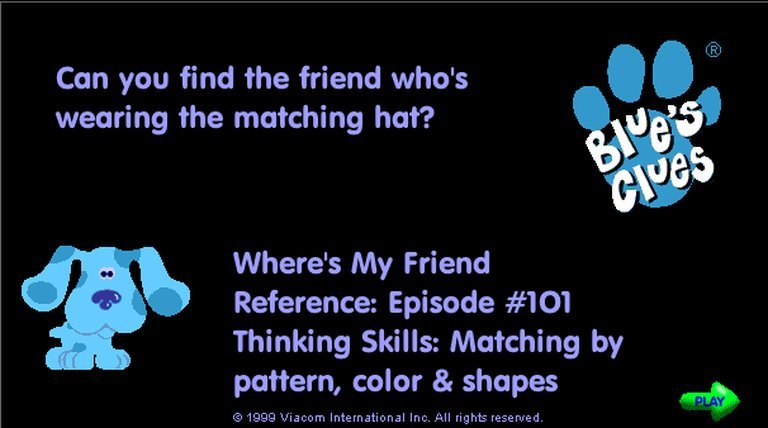
Blue’s Clues: Where’s My Friend? is an educational puzzle game based on the ‘Snack Time’ episode of the children’s television series. Players help Steve and Blue locate a specific chick among a group by observing the distinctive hats each wears, with hats becoming increasingly similar but differing in color as the game progresses. This challenges preschoolers to develop shape and color recognition, logical thinking, and observational skills in a fun, interactive format originally released as a web game on Nick Jr.’s website.
Gameplay Videos
Blue’s Clues: Where’s My Friend? Reviews & Reception
myabandonware.com (100/100): I love this game and show
Blue’s Clues: Where’s My Friend?: A Review of a Lost Artifact in Preschool Edutainment History
Introduction: A Handwritten Clue in the Digital Margin
In the golden age of mid-to-late 1990s children’s software, few franchises commanded the cultural and commercial authority of Blue’s Clues. The revolutionary television show, with its deliberate pacing, direct address to the viewer, and puzzle-solving narrative structure, became a blueprint for interactive learning. Its migration to the personal computer was not merely a cash-grab but a logical extension of its core philosophy. Within this ecosystem, Blue’s Clues: Where’s My Friend? represents a fascinating, albeit faintly documented, singularity. Released in 1999 for Windows and originally distributed as a free web game via Nick Jr.’s online portal, it stands apart from the premium, boxed CD-ROM adventures from Humongous Entertainment that defined the series’ retail legacy. This review argues that Where’s My Friend? is not a forgotten title due to lack of quality, but a deliberate micro-experiment—a distilled, ephemeral lesson in pattern recognition and categorical thinking that perfectly encapsulates the show’s pedagogical heart while highlighting the precarious nature of early web-based edutainment. Its significance lies not in its complexity, but in its purity and its role as a digital ghost, accessible only through archival efforts, reminding us of a era where “software” and “website activity” were distinct, fragile categories.
Development History & Context: From Living Room to Browser Window
The Nickelodeon Digital Strategy (1998-1999)
To understand Where’s My Friend?, one must first divorce it from the more famous Humongous Entertainment titles (Blue’s Birthday Adventure, Blue’s ABC Time Activities, etc.). While Humongous produced the flagship, narrative-driven CD-ROM experiences for sale in stores, Nickelodeon’s Nick Jr. division maintained a parallel, complementary track for its online presence. The late 1990s saw web portals like Nick Jr. and Disney’s club sites becoming crucial engagement tools, offering free, lightweight mini-games to retain audience attention between TV broadcasts and promote the larger software products. Where’s My Friend? is a product of this specific strategy: a browser-native (or simple downloadable executable) game, built to run on the modest hardware of the day (Windows 95/98), with a file size of a mere 2MB—an infinitesimal blip compared to the 50-100MB CD-ROMs of its commercial cousins.
Studio Vision & Technical Constraints
Developed and published directly by Nick Jr., the game bears the hallmarks of internal, rapid-prototype development. There are no credits for designers or programmers on MobyGames, suggesting a small, in-house team likely composed of web developers and early childhood educators working under tight deadlines. The technological constraints were those of Shockwave or early Java applets: limited color palettes, simple vector or low-bitmap graphics, linear animation, and a focus on clickable hotspots over complex scripting. The choice of subject matter—matching chicks by their hat shapes and colors—is brilliantly suited to these constraints. It requires minimal animation, uses a limited sprite set (chicks with different hat assets), and revolves around a clean, binary input (mouse click). This was not a limitation but a design imperative: create an engaging, pedagogically sound activity that could load in seconds over a 56k modem.
The 1999 Gaming Landscape for Preschoolers
In 1999, the “edutainment” market was booming but bifurcated. On one side were the premium, immersive “worlds” from Humongous (Putt-Putt, Freddi Fish, the main Blue’s Clues titles) and The Learning Company. On the other were thousands of simple, free web games, often of questionable quality, serving as digital sugar-rush distractions. Where’s My Friend? existed in a valuable middle ground: it carried the full weight and trust of the Blue’s Clues brand—the iconic characters, the familiar narrator’s implied presence—but was stripped of the exploration, inventory, and narrative branching of its CD-ROM siblings. It was, in essence, a “game-show” mini-game transplanted directly from the TV series’ “Snack Time” episode into a standalone digital format.
Narrative & Thematic Deep Dive: The Epistemology of a Chick Chase
Plot as Pure Pedagogy
The narrative premise, as documented, is exquisitely simple: derived from the Blue’s Clues episode “Snack Time,” Steve and Blue require the player’s help to find a specific chick. One chick (the seeker) describes the chick they are looking for based on its hat (e.g., “I’m looking for my friend who has a hat with a yellow stripe and a blue circle”). The player’s job is to scan a field of similar chicks and identify the correct one. This is not a story in the conventional sense; it is a procedural narrative, where the “plot” is the cognitive challenge itself, and the resolution is the moment of recognition. The emotional arc is the familiar Blue’s Clues loop: invitation -> challenge -> investigative work -> triumphant affirmation. The game replicates the show’s signature “You’re a great helper!” validation upon each correct answer.
Characters as Pedagogical Agents
Steve and Blue are not merely sprites; they are the game’s framing devices and guides. Steve’s voice (implied through text prompts like “Let’s help!”) provides the instructions and the query from the seeking chick. Blue’s presence is the validating constant—her signature “ba-woof!” and visual excitement upon finding a clue (or the correct chick) provides positive reinforcement. The chicks themselves are a fascinating study in minimalist character design. They are visually identical except for their hats, which function as primary signifiers. This design choice is profound: it eliminates all extraneous variables (facial expressions, posture, color of plumage) to force the child to focus only on the described attribute set. They are blank slates upon which categorical attributes are projected.
Dialogue as Instructional Scaffolding
The game’s “dialogue” is a masterclass in scoped instruction. The seeking chick’s description uses basic, compound descriptors: “hat with a red square” or “hat with a green triangle and a yellow star.” The language is concrete, visual, and avoids abstraction. As the game progresses, the complexity increases not by adding more chicks, but by making the hats more similar. The source notes that “hats get more similar, but with different colors.” This is the critical pedagogical pivot: from simple discrimination (red vs. blue) to perceptual narrowing and attentional control. The child must learn to inhibit the instinct to pick the most different chick and instead parse the specific combination of shape and color amidst visual noise. It’s a stealth lesson in managing cognitive load and resisting intuitive but incorrect heuristics.
Underlying Themes: Categorization, Perception, and Trust in Process
Beneath the surface, the game is a meditation on categorical thinking. It teaches that objects can be grouped and identified by shared, defining properties. More subtly, it inculcates a trust in a systematic process: listen to the full description, examine all options, compare attributes, select. There is no penalty for hesitation, no timer (as far as records indicate), no punitive sound for wrong answers—only the gentle, persistent prompt to “try again.” This mirrors the show’s core tenet: thinking is valuable, the process matters more than speed, and mistakes are learning opportunities. The theme of friendship is the affective wrapper: you are helping Steve and Blue help their chick friends, making the cognitive labor socially meaningful.
Gameplay Mechanics & Systems: Elegance Through Extreme Fidelity to Source
Core Gameplay Loop: A Perfect Virtuous Cycle
The loop is a masterpiece of focused design:
1. Prompt: A chick describes the target’s hat (shape + color combination).
2. Scan: Player observes a grid (likely 3×3 or similar) of chicks with varying hat attributes.
3. Selection: Player clicks the chick whose hat matches the full description.
4. Feedback: Immediate, unambiguous feedback. A correct choice triggers a positive sound/animation (Blue’s bark, chick celebration). An incorrect choice prompts the seeker chick to reiterate or slightly rephrase the description, and the player tries again.
5. Progression: After a set number of correct identifications (likely 5-10), the game either increases difficulty or presents a celebratory screen. The loop repeats indefinitely or until a soft endpoint, typical of web-based minigames.
There are no extraneous systems: no points to accumulate, no unlockables, no branching paths. The game’s entire “progression system” is the dynamic adjustment of stimulus similarity. This is pure, unadulterated mastery learning within a single cognitive domain.
Combat? Character Progression?
These standard game pillars are absent by design. There is no combat, no avatar, no statistics, no economy. “Progression” is purely intrinsic and cognitive: the player’s own perceptual and categorical skills improve as the visual arrays become more challenging. The game is not about growing a character; it is about refining the player’s own thinking. This is a defining feature of the best preschool educational games: the player’s cognitive development is the character progression.
User Interface (UI) and Innovation
The UI is almost certainly a “direct manipulation” interface of the highest order. The screen is likely dominated by the chick array, with a character portrait (the speaking chick) and a text box (or audible speech bubble) for the description. The innovation is in its paradigm of fidelity. It doesn’t try to be a “game” in the traditional sense. Instead, it faithfully adapts a 30-second segment of a TV show into an interactive form. The innovation is contextual portability: taking the show’s “clue-finding” mechanic and making it the sole activity. The flaw, from a traditional gaming perspective, is its ephemeral nature and lack of meta-game structure—it is a pristine tool, not a toy box.
Flawed Systems: The Price of Simplicity
The most significant “flaw” is its inherent disposability. Without a save function, narrative wrapper, or collection mechanic, its playtime is measured in minutes, not hours. This was likely intentional for a web game, but it means the title has no “sticky” factor. There is no reason to return once the core cognitive challenge is met. Furthermore, the game’s existence is precarious; as noted, it was taken down from Nick Jr.’s site and survives only through third-party archives and abandonware sites. Its very architecture is a lesson in digital obsolescence.
World-Building, Art & Sound: Aesthetic Consistency Over World Simulation
Setting & Atmosphere
The setting is not a “world” but the Blue’s Clues living room and backyard as a two-dimensional, static backdrop. The atmosphere is one of warm, safe familiarity. The color palette is the show’s signature pastels—soft blues, yellows, reds, and greens—non-threatening and high-contrast enough for developing vision. There is no atmospheric soundscape of wind or distant traffic; the space is a cognitive sandbox, stripped of all but essential environmental cues.
Visual Direction: Iconic Fidelity
The art direction’s sole mandate is iconic fidelity to the TV show’s aesthetic. The chicks are simple, rounded, friendly shapes. The hats are clear geometric forms (circles, squares, triangles, stars) in primary and secondary colors. This is not artistic expression for its own sake; it is a functional, cognitive design choice. The shapes must be distinguishable. The colors must be distinct. The composition must direct attention to the hat. Every pixel serves the learning objective. Compared to the lush, painted backgrounds of the Humongous CD-ROMs, this is minimalist, but for its purpose, it is perfectly optimized.
Sound Design: The Unseen Narrator
Sound design is likely sparse but critical. It would include:
* A short, melodic fanfare for correct answers.
* A gentle, non-judgmental “oops” or re-prompts for errors.
* The signature sounds of Blue (bark) and possibly Steve (cheerful voice clips).
* Possibly a simple, looping ambient track from the show’s library.
The brilliance is in its economy. Sound is used solely for feedback and brand reinforcement, never as a distraction. It creates a “sonic brand space” that feels immediate and connected to the television experience.
Reception & Legacy: The Whisper of a Forgotten Clue
Critical and Commercial Reception (1999)
Here, the historical record is almost entirely silent. There are no contemporary critic reviews on MobyGames or elsewhere. Its “commercial” performance is incalculable, as it was a free, unbranded promotional item. It existed outside sales charts, its success measured in web traffic and engagement metrics that are now lost. Within the context of the Blue’s Clues brand, it was one of dozens of such micro-games, a drop in the ocean of Nick Jr.’s online content strategy. Its lack of documentation is its most telling feature; it was considered disposable utility, not a product.
Evolving Reputation and Abandonware Revival
Today, Where’s My Friend? survives on the fringes of preservation. Its listing on MobyGames shows only one collector, and My Abandonware hosts it with a modest 2MB download and a handful of nostalgic comments (“I love this game and show,” “I’ve always wanted to replay this game”). Its reputation is not as a “great game” but as a potent memory trigger for a specific cohort who experienced it in real-time. Its legacy is therefore anthropological rather than critical. It is a perfect artifact of a specific moment: the mass migration of children’s media onto the open web, the era of Shockwave and simple downloads, and the strategy of using free digital content to sustain brand loyalty.
Influence on the Industry and Subsequent Games
Its direct influence is difficult to trace. The more influential titles were the retail CD-ROMs. However, its design philosophy—extracting a core interactive mechanic from a transmedia property and offering it for free in a lightweight format—became the standard for the next two decades. Look at the modern successor: the flood of Blue’s Clues & You! mobile mini-games on app stores. They are the direct descendants of Where’s My Friend?—simple, focused, brand-centric, often free with ads or as part of a subscription. Where’s My Friend? was an early proof-of-concept for this “micro-game as engagement hook” model that now dominates digital kids’ media.
Conclusion: A Perfect, Precarious Clue
Blue’s Clues: Where’s My Friend? is not a lost masterpiece in need of rediscovery. It was never intended to be a masterpiece. It was, instead, a perfect pedagogical artifact and a historical specimen. As a game, it is a near-flawless execution of a single, well-defined learning objective, wrapped in the warm, trusted branding of a children’s television landmark. Its strengths—focus, fidelity to source, cognitive clarity—are also the source of its historical obscurity; it had no commercial shelf life, no complex systems to analyze, and no cultural footprint beyond its temporary slot on a website.
Its ultimate value is as a counterpoint to the more ambitious Blue’s Clues CD-ROM adventures. Those games sought to create sprawling, exploratory digital playspaces. Where’s My Friend? rejected that ambition entirely, positing that the most powerful digital interaction might be the simplest, most focused one—a direct translation of a thinking skill exercise from screen to interface. It is a testament to the show’s creators’ understanding that the “clue” itself is the game.
In the pantheon of video game history, it occupies a tiny, almost invisible niche. But in the specialized history of transmedia education and early web-based children’s software, it is a crucial, well-preserved example. It reminds us that not all impactful games are sprawling RPGs or cinematic action titles. Some of the most significant are the quiet, considerate ones that taught a child, for five minutes on a slow computer, how to listen, categorize, and trust their own mind—and then vanished, leaving only a footprint in the digital sand, waiting for someone to come along and ask, “Where’s My Friend?” The answer, thanks to archival toil, is now, finally, found. Its place in history is secure as a pristine fragment of a bygone digital ethos: simple, kind, and profoundly effective.