
- Release Year: 2001
- Platforms: Windows
- Publisher: Innonics GmbH
- Developer: Innonics GmbH
- Genre: Puzzle
- Game Mode: Hotseat
- Gameplay: Game show, quiz, trivia
Description
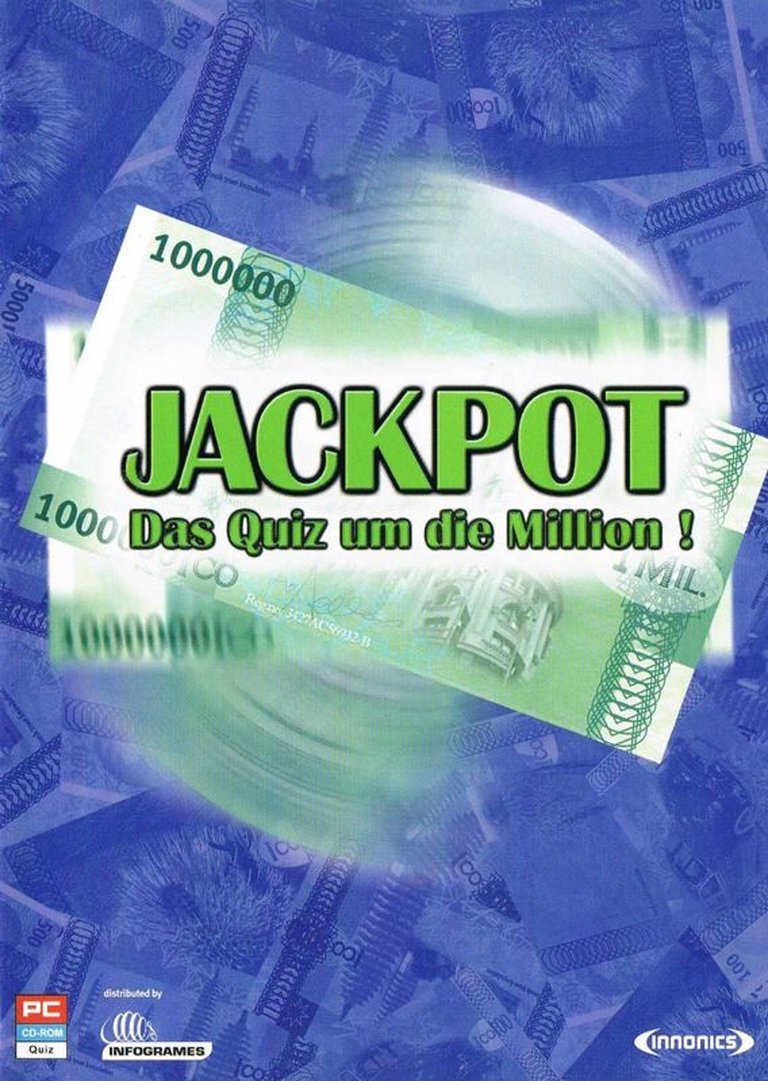
Jackpot: Das Quiz um die Million! is a 2001 Windows CD-ROM game that simulates a television quiz show for up to four players taking turns in ‘hot seat’ mode. Contestants must rapidly answer over 1500 questions spread across 14 different categories, with speed being a key factor to improve their overall high score and climb the virtual prize ladder.
Jackpot: Das Quiz um die Million! Reviews & Reception
gamearchives.net : punches above its weight as a replayable, community-driven trivia engine
Jackpot: Das Quiz um die Million!: A Historical Deep Dive into Germany’s Obscure Quiz Game Phenomenon
Introduction: The Million-Dollar Question of Obscurity
In the annals of video game history, few genres capture the zeitgeist of a specific moment quite like the wave of Who Wants to Be a Millionaire? adaptations that crested globally in the early 2000s. While Eidos Interactive’s polished, host-narrated versions dominated charts and living rooms, a quieter, more granular experiment unfolded on German PCs. Jackpot: Das Quiz um die Million! (released April 11, 2001) is not a mere clone but a distinct, almost contradictory artifact: a game that distills the high-stakes tension of Günther Jauch’s iconic RTL show into a raw, database-driven engine of trivia. It is a title defined by what it lacks—3D hosts, lavish production, official branding—and what it pioneers: a robust, community-focused question editor that predates the user-generated content (UGC) revolution. This review argues that Jackpot is a critical case study in regional adaptation, technological constraint, and prescient design, representing a German development studio’s earnest, if commercially overshadowed, attempt to capture a cultural moment. Its legacy is not in blockbuster sales but in its role as a forgotten conduit between TV quiz mania and the participatory, editable trivia platforms that would later flourish on mobile and PC.
Development History & Context: The German Quiz Wave and Innonics’ Gamble
The Studio and the Catalyst
Jackpot: Das Quiz um die Million! was developed and published by Innonics GmbH, a German studio active from the late 1990s until its insolvency in March 2002. Innonics’ portfolio, which includes titles like Diggles: The Myth of Fenris and Thandor: The Invasion, reveals a company comfortable with genre diversity. With Jackpot, they pivoted decisively into the explosive casual and family market, capitalizing on an unprecedented television phenomenon.
The direct catalyst was the German adaptation of the British quiz format, Wer wird Millionär? (Who Wants to Be a Millionaire?), which premiered on RTL in September 1999 with host Günther Jauch. The show became a national obsession, turning trivia into high-drama television. This created an immediate, lucrative market for interactive adaptations. While Eidos Interactive secured the official international license and produced localized versions (released in Germany as Wer wird Millionär? – Das Spiel), the market was ripe for unofficial entries that could offer different interpretations of the format.
Technological Constraints and Design Philosophy
The game was built for the Windows 98/ME/2000 ecosystem, requiring a minimum of a Pentium processor, 64MB RAM, DirectX 7.0a, and a 4X CD-ROM drive. These were modest specs for 2001, but the 700MB CD-ROM medium presented a key constraint: the choice between lavish audiovisuals or vast content. Innonics unequivocally chose the latter. The result is a fixed/flip-screen visual presentation—a static, 2D interface that flips between screens for different actions. This was not a technical failing but a deliberate, cost-effective design choice that prioritized the question database. While Eidos’ PS2 version featured a 3D modeled host (a generic Jauch lookalike), Innonics opted for a text-and-sprite-based “studio” aesthetic, likely to avoid prohibitively expensive licensing and animation costs.
The business model was standard commercial retail (CD-ROM in a keep-case), distributed in Germany, Austria, and Switzerland via a partnership with Infogrames Deutschland GmbH, as announced on March 30, 2001. This deal highlights the perceived commercial viability of the “Millionaire” brand, even for an unofficial title. The game’s official listing on databases like OGDB confirms its German regional exclusivity (language: German text and voice output).
A Crowded Landscape
2001 was the peak of the “Millionaire” adaptation rush. Eidos’ series was in its second or third edition. Other competitors included Super-Quiz: Das Spiel um die Million (also 2001, by Planet Intermedia/SYBEX), which featured 3,000 questions across 8 categories. Jackpot distinguished itself by emphasizing category count (14) and a stated focus on fast answering to improve high scores, positioning itself less as a strict ladder-climber and more as a dynamic trivia engine. It existed in a ecosystem also populated by digitized Trivial Pursuit titles and precursors to the Buzz! series, carving a niche through its specific German market focus and its unique editing tools.
Narrative & Thematic Deep Dive: The Unscripted Drama of Knowledge
Jackpot possesses no traditional narrative with characters and plot. Its “story” is an emergent, procedural drama generated by the player’s knowledge and the game’s systems, directly mirroring the televised tension of Wer wird Millionär?.
The Implied Arena
The player is an unnamed contestant in a simulated TV studio. The atmosphere is built through sparse UI elements: a score ladder that glows as you ascend, category icons, and a minimalist podium. The absence of a visible, voiced host (a stark contrast to Eidos’ versions) is the game’s most significant narrative absence. There is no “Ist das Ihre endgültige Antwort?” delivered by a familiar voice. The pressure must come from within the player and the ticking clock, not from an antagonistic or charismatic presenter. This creates a more internal, less theatrical experience.
Thematic Exploration: Knowledge as Capital
The core theme is unequivocal: knowledge is a quantifiable, monetizable currency. The “million” in the title is not just a prize but a metaphor for ultimate intellectual validation. The 14 categories—ranging from likely staples like History, Geography, and Sports to more niche or culturally specific German interests—form a taxonomy of valuable information. Answering quickly (“verbessern Sie Ihre Highscore durch schnelles Antworten“) adds a layer of performance anxiety, framing trivia not just as correctness but as speed and decisiveness under pressure.
The multiplayer “hot seat” mode adds a social, competitive narrative. Friends become rivals; a wrong answer isn’t just a lost point but a moment of public hubris. The themes of meritocracy (the smartest wins) and humility (the vast question pool will inevitably expose your ignorance) are central. There is also a subtle, perhaps unintentional, theme of digital preservation and ownership. The included question editor allows players to curate their own knowledge domains, challenging the game’s own authority as the sole arbiter of trivia. This empowers players to inject personal, local, or contemporary knowledge into the game’s world, a thematic reflection of the internet’s nascent culture of communal information sharing.
Gameplay Mechanics & Systems: A Raw Trivia Engine
Core Loop and Modes
The gameplay is a pure question-answer cycle. The main innovation lies in its three distinct modes, which offer different narrative framings:
1. “Millionen-Quiz” (Million Quiz): The classic mode, implying a ladder structure where questions increase in value/difficulty towards a theoretical million-point goal.
2. “Fun-Quiz”: The hot-seat multiplayer mode for up to 4 players. Here, the “game show” framing is strongest, with players taking turns and competing for the highest score across a session.
3. “Schnellrate-Quiz” (Quick-Quiz): A solo mode against the clock, emphasizing the speed element mentioned in the description.
The loop is: Select Mode & Category → Receive multiple-choice question (typically 4 options) → Select answer (with optional “Joker”/lifeline as per the Booklooker description) → Immediate feedback (correct/incorrect) → Score update → Next question. The game ends after a set number of questions or when a player reaches a target score.
Progression, UI, and the Standout Feature: The Editor
Progression is purely score-based, tracked in a local high-score list (with the intriguing, era-appropriate promise that “the smartest heads are published on the homepage,” suggesting a now-defunct online leaderboard). The UI is functional and clear, built for readability. The fixed-screen layout means no scrolling; information is presented in discrete panels. The flip-screen transition provides a basic sense of event progression but can feel sluggish.
The defining system, and the game’s primary historical significance, is its integrated Question Editor. Users can:
* Create entirely new multiple-choice questions.
* Assign them to any of the 14 categories.
* Define the correct answer and distractors.
* Potentially export these custom question packs (a form of early UGC sharing, likely via file exchange).
This feature is revolutionary for its time and context. It transforms Jackpot from a static product with a finite 1,500 questions into a platform. It anticipates the modding communities of The Sims and the level editors of later games, and directly prefigures the user-created quiz packs that became standard in the Buzz! series and the entire mobile quiz app genre (e.g., Kahoot!). It is a tool for community-driven content creation, allowing players to keep the game perpetually fresh with personalized trivia—from 90s pop culture to niche German history.
Flaws and Omissions
The game’s simplicity is also its weakness. Compared to the official Eidos Wer wird Millionär? titles, it lacks:
* Authentic Lifelines: The “Joker” mentioned in retail descriptions is vague; it likely doesn’t replicate the iconic 50:50, Ask the Audience, or Phone-a-Friend mechanics.
* Atmospheric Tension: No host voice, no iconic music stings, no “final answer” ritual. The tension is purely cognitive.
* Strategic Depth: The ladder progression is less defined than the show’s guaranteed safety nets (sums for questions 5 and 10). It’s a pure score attack.
* Polish: Controls are keyboard/mouse-based; the flip-screen transitions can be slow; the graphics are barebones.
World-Building, Art & Sound: Studio Sterility and MIDI Moods
Visual Direction: The Minimalist Studio
The “world” is a literal interpretation of a quiz set: podiums, a score display, category selection screens. Rendered in 2D sprites with a fixed perspective, it aims for a clean, readable interface at the expense of immersion. The art is profoundly functional. There is no attempt at 3D depth, lighting effects, or a visible audience. This aligns with the “editor-first” philosophy: the visuals exist to present text clearly. The aesthetic is comparable to late-90s/early-00s edutainment titles—inoffensive, slightly dated, but not distracting. The “atmospheric studio scenario” promised on packaging is conveyed more through sound than sight.
Sound Design: The Echoes of Television
This is where the game’s Wer wird Millionär? inspiration becomes most palpable. The sound design relies on classic quiz show cues:
* A dramatic, ascending synth theme for question reveals.
* A decisive, positive “ding” for correct answers.
* A low, negative buzzer for wrong answers.
* Applause and celebratory jingles for high scores or round completions.
While likely using basic MIDI instrumentation (a technical limitation of the era), these sounds successfully trigger the Pavlovian tension associated with quiz shows. The “original moderators-stimme” (original host’s voice) claimed on some retail listings is almost certainly a generic German voice actor, not Günther Jauch himself, but its inclusion (even if limited to prompts) was a significant effort for a budget title.
Synthesis: Austerity as a Feature
The visual and auditory austerity paradoxically serves the gameplay. The simple graphics ensure instant comprehension of the question and choices. The focused soundscape keeps the player’s attention on the trivia itself. It creates a “pressure cooker” environment not through spectacle, but through the starkness of the challenge. It is the antithesis of the multimedia spectacle of the TV show; it is the pure, unadorned quiz stripped to its cognitive core.
Reception & Legacy: Obscurity and the UGC Foreshadow
Contemporary Reception: A Blip in the Wave
Jackpot exists in a black hole of contemporary reception. MobyGames records zero critic or player reviews and a “MobyScore” of n/a. It was “Collected By” only one registered user as of the latest data. Its commercial performance is not documented, but its obscurity is evident. It was utterly overshadowed by:
1. The official, heavily marketed Eidos Wer wird Millionär? series.
2. Other regional adaptations that had stronger branding or distribution.
3. Its own confusing naming, potentially leading to mix-ups with the distinct but similar Super-Quiz: Das Spiel um die Million (which had 3,000 questions) or the vastly different Quiz Millionär by cerasus.media/Limesoft (which had 5,555 questions and a more developed editor, per the GameArchives review).
The March 2001 Infogrames partnership press release suggests confidence, but the game vanished quickly. Innonics’ subsequent insolvency in 2002 cut short any long-term support or sequel potential. Retail listings (like Amazon.de and Booklooker) show it as a forgotten used-item, sold for €1-2, a fraction of its original price.
Evolution of Reputation: A Rediscovered Artifact
Its reputation has evolved solely through digital preservation and archival efforts. Its addition to MobyGames by user “Rainer S.” in 2017 is its primary lifeline to history. Retrospective analysis (informed by comparing it to its better-documented cousin, Quiz Millionär) reveals its strengths.
Its legacy is two-fold:
1. A Snapshot of Regional Adaptation: It exemplifies the messy, localized gold rush that followed a global TV format. It shows how German developers tried to capture a local phenomenon with limited resources and without the official license, creating a “budget alternative” with its own identity.
2. An Unsung Pioneer of User-Generated Content: The integrated question editor is its most brilliant and overlooked feature. Years before Steam Workshop, before LittleBigPlanet, and contemporaneous with The Sims modding, Jackpot put powerful content creation tools in the hands of its players. This directly prefigures the community-driven quiz packs of the Buzz! series (which launched in 2005) and the entire business model of modern trivia apps like QuizUp and Kahoot!, which rely on user-created quizzes. It understood that a trivia game’s longevity depends not on the developer’s question bank, but on the community’s collective knowledge.
Influence and Place in History
Its direct industry influence is minimal due to its obscurity. It did not spawn clones. However, in the broader history of quiz games and UGC, it is a significant footnote. It demonstrates that the desire to customize and share trivia was present on the PC in 2001, not just on consoles or mobile devices later. It stands as a testament to the German PC gaming scene’s diversity during the casual boom—a scene producing both polished edutainment and raw, community-focused experiments alongside the dominant Anglo-American blockbusters.
Conclusion: verdict on a Forgotten Framework
Jackpot: Das Quiz um die Million! is not a lost masterpiece. It is, by any contemporary metric, a flawed, visually sparse, and technically modest quiz game that failed to compete with licensed juggernauts. Its near-total obscurity is justified. However, as a historical artifact, it is profoundly revealing.
It captures a moment of transitional design. It uses the technological constraints of the CD-ROM/Windows 98 era (fixed screens, MIDI audio) not as a crutch but as a foundation to prioritize database scale (1,500 questions, 14 categories) and player agency (the question editor). It represents a different philosophy from the cinematic, host-driven adaptations: a quiz game as a neutral engine for knowledge, not a reenactment of a TV show.
Its definitive verdict must be contextual. As a game for its time: 6/10—functional but unpolished, easily outclassed. As a historical document and a design prototype: 9/10—a brilliant, ahead-of-its-time tool that understood the community-driven future of trivia gaming.
In the pantheon of Millionaire adaptations, Jackpot is the quiet, academic cousin who stayed home to build a better questionnaire while everyone else went to the TV studio. Its place in history is not on a shelf of classics, but in the archives as evidence of an alternative path—one where the power to ask the questions was, even then, being quietly handed to the players. For the historian, it is essential. For the casual player, it is a curious, dry relic. For the designer, it is a lesson in how a simple, overlooked feature can be the most visionary part of an otherwise forgettable game.