
- Release Year: 2021
- Platforms: Linux, Macintosh, Windows
- Developer: Nemlei
- Genre: Adventure
- Perspective: 3rd-person (Other)
- Game Mode: Single-player
- Gameplay: Visual novel
- Setting: Fantasy
Description
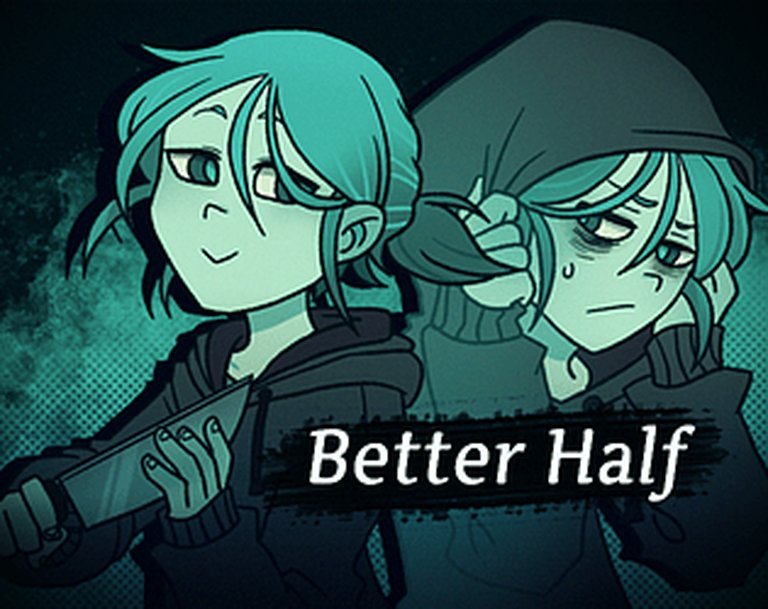
Better Half is a fantasy visual novel developed by Nemlei that follows Thiu, a man plagued by depression who seeks a magical cure, only to have his soul split into two beings: his original depressed self and an artificially created happy half. Forced to coexist, they navigate their conflicting personalities and shared existence in a darkly comedic narrative that explores mental health, self-loathing, and the journey toward self-acceptance, all set against a backdrop of unreliable mages and emotional turmoil.
Gameplay Videos
Where to Buy Better Half
PC
Better Half: A Descent into the Self—A Definitive Retrospective
Introduction: The Unflinching Mirror
In the vast and varied ecosystem of video games, few titles dare to wield psychological vulnerability not as a aesthetic garnish, but as the very core of their mechanical and narrative skeleton. Better Half, a 2021 visual novel from the elusive developer Nemlei, is such a title. Released quietly on itch.io and later catalogued by preservationist sites like MobyGames, it represents a calculated, minimalist departure from mainstream expectations, using the constrained format of a Ren’Py engine project to deliver a story that is as clinically precise in its depiction of depression as it is darkly, uncomfortably funny. This is not a game about saving the world or mastering combat; it is about the monumental, often Sisyphean, task of learning to tolerate the person staring back from the mirror. My thesis is this: Better Half is a landmark in the “personal visual novel” subgenre, a brutally honest and structurally clever work that uses its fantasy premised absurdity to dissect the mundane hell of self-loathing, achieving a profound emotional resonance that belies its 23,000-word page count and modest technical footprint. It is a miserable comedy about self-loathing that, against all odds, leaves the player with a fragile, hard-won glimmer of hope.
Development History & Context: The Solitary Alchemist
Better Half emerges from the solo or small-team development ethos that defines the itch.io golden age.credits point to “Nemlei” as the sole auteur—handling art, story, and coding—with contributions for music (Yshwa), sound (Cafofo), and font licensing. This is the definition of an auteur project, where creative vision is unfiltered by committee. The game was built with Ren’Py, the open-source visual novel engine that has democratized storytelling in games. Its technical constraints—fixed or flip-screen visuals, menu-driven interfaces—are not limitations here but deliberate stylistic choices that focus the player’s entire attention on the textual and character-driven experience.
The game’s release in March 2021 places it in a specific cultural moment. It followed the global turmoil of the COVID-19 pandemic, a period that forced unprecedented introspection and exacerbated mental health struggles for millions. Simultaneously, it preceded Nemlei’s breakout hit, The Coffin of Andy and Leyley (2023), which would grant them wider recognition for their signature blend of crude humor, familial horror, and stark emotional honesty. Better Half can thus be seen as a crucial, raw prototype for the thematic and tonal palette that would later be refined in more ambitious projects. It exists outside the commercial pressures of Steam’s visual novel scene, initially exclusive to itch.io, marking it as a pure, unadulterated expression of its creator’s interests—a “miserable comedy” crafted for an audience that “hate[s] themselves.”
Narrative & Thematic Deep Dive: The Anatomy of a Split Soul
Premise & Plot: The narrative is deceptively simple. Thiu, a young man mired in clinical depression—evidenced by suicidal ideation and visible self-harm scars—seeks a magical cure. After a first mage dismissively suggests alcohol and drugs, he ignores the warning and consults a second, whose solution is catastrophically literal: she splits his soul in two. The result is two distinct beings: “Sad Thiu” (the original, Continuously despairing) and “Positive Thiu” (a superficially cheerful, often oblivious counterpart). The game’s plot is the forced cohabitation of these two halves as they are attended by a small cast of neighboring characters—Lacy, Lua, Tal, and Vivian—and must navigate a supernatural contract with the mage that threatens to shorten both their lifespans.
Character Dissection: The brilliance lies in how the halves embody and externalize internal dialogues.
* Sad Thiu is not a caricature of misery. His voice is weary, sarcastic, and painfully self-aware. His trauma is visceral and present. He represents the part of depression that understands its own toxicity but feels powerless to change.
* Positive Thiu is equally complex. His relentless optimism is not a cure but a coping mechanism—a “toxic positivity” that minimizes and invalidates Sad Thiu’s pain. His “happiness” feels brittle, defensive, and often cruel in its ignorance. The game masterfully avoids making either half the clear “villain”; they are two dysfunctional survival strategies trapped together.
* The supporting cast serves as mirrors and catalysts. Lua, the second mage, embodies the irresponsible, consequences-be-damned fantasy of a quick fix. Vivian (a shopkeeper) and Tal offer glimpses of mundane, stable connection, highlighting how far removed from “normal” social function Thiu’s halves are. Lacy is a wildcard whose interactions can path the story toward its most transgressive or tender directions.
Themes & Dialogue: The dialogue is a masterclass in economical, voice-driven writing. Every line from the Thius reinforces their fractured psyches. The central theme is integration versus fragmentation. The game asks: Is the goal to “cure” the sad half with the happy one, or to forge a new, unified whole from the shattered pieces? It explores self-forgiveness as an active, contentious process (“Be kind to yourself” is a choice, not a given). The dark humor (“miserable comedy”) arises from the absurdity of the premise juxtaposed with the grim realism of the internal monologues. The story carries a potent message about the value of life being a conclusion one must argue oneself into, not an innate truth. It is, as noted in community discussions, “depressing and hopeful” precisely because the hope is not magical—it is earned through a series of painful, mundane choices to cooperate rather than annihilate.
Gameplay Mechanics & Systems: The Architecture of Choice
As a visual novel with menu-driven interfaces, Better Half’s “gameplay” is pure narrative decision-making. Its systems are deceptively simple but thematically integrated.
* Core Loop: Read text presented over static character sprites and backgrounds. At key junctions, choose from dialogue or action options. These choices are almost exclusively binary (“Together” vs. “Separate” paths), tracking an invisible variable toward one of the game’s four endings.
* The “Together” Mechanic: The most significant systemic innovation is the tracking of “together” choices. When both Thius present options simultaneously (often arguing), the player chooses a path. Accumulating a threshold of these cooperative choices (e.g., picking “together” options 3+ or 6+ times) locks the narrative into the Merge or Couple routes. This is not a morality meter but a integration meter. Choosing to mock oneself or be kind, to stay or merge, are acts of internal synthesis.
* Endings Structure (from Wiki):
1. Halved End: Opting for separation. The halves live apart, their lives still shortened, but finding solace in not being alone. It’s a sad, pragmatic compromise—a life “okay-ish” but incomplete.
2. Merge End: The “neutral/good” ending. The Thius reunite, integrating their experiences. Thiu gains hard-won hope, secures a job, and rebuilds connections, though the struggle remains (“he still talks to himself”).
3. Couple End: The radical, queer-coded alternative. The halves choose to remain distinct but romantically entwined, “tricking” the mage Lua to live together in a new city. It celebrates finding wholeness in difference, wasting life “happily” with one’s other self.
4. Bad End: A consequence of failing the “trick Lua” check in the Couple route. Positive Thiu succumbs to Lua’s experiment; Sad Thiu, bere