
- Release Year: 2011
- Platforms: Android, iPad, iPhone, Linux, Macintosh, Nintendo Switch, OnLive, Windows Apps, Windows Phone, Windows
- Publisher: Big Fish Games, Inc, Cateia d.o.o., G5 Entertainment AB, K.I.D. d.o.o., Layernet GmbH, Libredia GmbH, Ocean Media d.o.o., UIG Entertainment GmbH
- Developer: Cateia d.o.o.
- Genre: Simulation, Strategy, Tactics
- Perspective: Diagonal-down
- Game Mode: Single-player
- Gameplay: City building, construction simulation, Time management
- Setting: Egypt (Ancient)
- Average Score: 54/100
Description
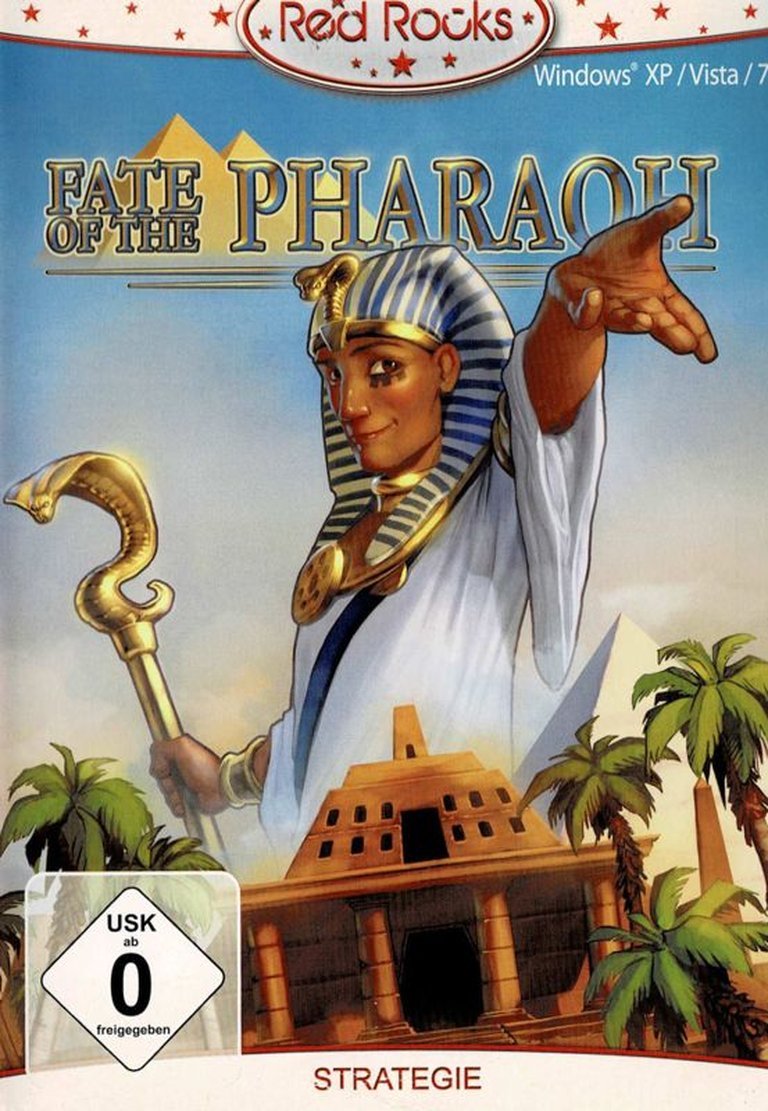
Fate of the Pharaoh is a casual city-building simulation game set in ancient Egypt, where players engage in strategic construction and time management to develop prosperous settlements. Featuring colorful cartoon graphics, Egyptian-themed music, and a whimsical storyline, the game offers quick, challenging levels designed for short play sessions with a focus on managerial decision-making.
Where to Buy Fate of the Pharaoh
PC
Fate of the Pharaoh Free Download
Fate of the Pharaoh Guides & Walkthroughs
Fate of the Pharaoh Reviews & Reception
metacritic.com (42/100): unless you’re really in the mood for a bland, overpriced resource management game, there’s really no reason to check this one out.
opencritic.com (67/100): A little casual strategy action isn’t always a bad thing, and if you like to peck out some commands to your workers to collect resources, build structures, and generally keep everyone happy Fate of the Pharaoh may be your jam.
ladiesgamers.com : Fate Of The Pharaoh is a perfectly enjoyable game, though without much of a challenge.
gaming-age.com : unless you’re really in the mood for a bland, overpriced resource management game, there’s really no reason to check this one out.
Fate of the Pharaoh: A Sandstone-Sandbox of Casual Comfort
Introduction: The Gilded Cage of Casual Kingdom-Building
In the sprawling ecosystem of the city-building genre, few titles carry the gravitational weight of Pharaoh (1999), Sierra’s intricate masterpiece of ancient Egyptian urban planning and crisis management. Enter Fate of the Pharaoh, a 2011 release from Croatian indie studio Cateia Games, not as a direct successor but as a fever dream of that classic’s DNA filtered through the lens of 2010s casual mobile gaming. It is a game that consciously, or perhaps necessarily, abdicates the throne of strategic depth to instead rule a kingdom of bite-sized, stress-free tasks, where the greatest threat to your civilization is a slightly grumpy citizen or a misplaced cobra. This review posits that Fate of the Pharaoh is not a failed attempt at hardcore strategy, but a deliberate, if ultimately derivative and shallow, artifact of its time—a perfectly competent time-management toy that embodies the era’s pivot to accessibility over complexity, and whose legacy is defined by its own calculated limitations.
Development History & Context: Forging a Casual Sceptre
The Studio and Its Vision: Cateia Games, founded in 2006 in Rijeka, Croatia, emerged as a purveyor of polished, mid-core casual games for the burgeoning downloadable and mobile markets. Their portfolio—including Twin Moons, Kingdom Tales, and Kaptain Brawe—reveals a studio specializing in bright, cartoonish aesthetics and straightforward, goal-oriented gameplay loops. Fate of the Pharaoh fits squarely within this lineage. The project was led by Ivan Bralić (Executive Producer/Art Direction/Level Design), with a small team of 13 developers handling programming, art, and design (Credits, MobyGames). Their vision, as stated in official blurbs, was to create a “fun and beautiful strategy/management game” set in ancient Egypt, focusing on “restoring peace and prosperity” through construction and resource management.
Technological and Market Context: Released in August 2011 for Windows, the game arrived at the zenith of the “casual revolution.” Platforms like Big Fish Games, the primary publisher, and later iOS (2012) and Android (2013), were dominated by time-management and light simulation titles (Diner Dash, Build-a-Lot). The technological constraints were not of hardware power but of design philosophy: games needed to be instantly understandable, playable in short bursts, and forgiving. Fate of the Pharaoh runs on a custom engine, presenting a fixed, diagonal-down perspective with vibrant 2D art over simple 3D buildings—a cost-effective style that prioritized readability and charm over technical ambition. Its later ports to Nintendo Switch (2021) and Linux (2023) speak to a niche, evergreen appeal in the “casual strategy” subgenre, though the Switch port received notably lower scores (64% average vs. 76% on Windows), hinting at control and value mismatches on a console platform.
Narrative & Thematic Deep Dive: A Kingdom of Whispers and Aliens
The narrative of Fate of the Pharaoh is less a story and more a skeletal premise, a thematic coat of paint thinly applied to the game’s mechanics.
Plot and Characters: The setup is classic pulp adventure: after a long war, Egypt lies in ruins, and the player, as the Pharaoh’s unnamed loyal adviser, must restore the golden cities. The “Pharaoh” is a distant, unseen figurehead. The only named voice is a single, dedicated voice actress (Lauren Bennett) who likely provides generic “task complete” barks or brief introductory lines. There is no antagonist beyond abstract “greedy invaders” who have already fled, and no unfolding drama. The world is a static stage for the player’s actions.
Dialogue and Thematic Underpinnings: Dialogue is virtually non-existent beyond quest text boxes. The themes are archaeological kitsch: a sanitized, adventure-movie version of Egypt focused on building, not bureaucracy or polytheism. Happiness is a numerical metric, not a societal tension. The most bizarre thematic element, a glorious piece of unintentional surrealism, emerges from the official Cateia Games description and is echoed in the GamingLives review: “MEET friends from outer space.” This hints at a nonsensical, possibly joke-based narrative beat involving aliens assisting in pyramid construction—a line so jarringly out of place it becomes the game’s most memorable “story” moment, representing either a lost sense of whimsy or a profound disconnect in thematic coherence. It underscores that the game’s “narrative” is merely a flimsy scaffold for the core loop, with no exploration of the weight of rebuilding a civilization, the politics of resource allocation, or the cultural significance of the structures being built. It is, in essence, an Egypt-themed Skinner box.
Gameplay Mechanics & Systems: The Micro-Management Treadmill
Fate of the Pharaoh is a pure, unadulterated time-management simulation, stripped of all systemic complexity.
Core Gameplay Loop: Each of the 44 levels is a single-screen, fixed-layout village with pre-defined building plots. The player’s entire input is point-and-click commands to a seemingly endless supply of anonymous workers. The loop is: 1) Gather Currency: Build “Tents” (the basic housing) which periodically generate tax coins. A pyramid icon appears over a full tent; clicking it sends a worker to collect the coin. 2) Gather Resources: Command workers to fetch Water (from wells) and Food (from farms/hunters), or to mine Stone and Wood. These resources are prerequisites for construction and upgrades. 3) Construct/Upgrade: Spend coins and resources to build new structures (houses, wells, farms, quarries, marketplaces) or upgrade existing ones. 4) Maintain Happiness: Citizens have needs (water, food, upgraded housing). Timely fulfillment increases a happiness meter; neglect decreases it. High happiness boosts tax income. 5) Clear Obstacles: Occasionally, wildlife (cobras, crocodiles, scorpions) block roads or buildings, requiring a worker to “fight” them (a quick click). 6) Achieve Level Goals: Each level has 1-3 specific objectives, usually “Build X of Y” or “Reach Z population/happiness,” sometimes with a monetary target.
Progression and Difficulty: New building types are unlocked linearly as the player progresses through the 9 chapters, not through tech trees or research. There are two explicit modes:
* Adventure: Features the “Time of Ra,” a strict level timer. Achievements are tied to completing levels within this time.
* Relaxed: No timer, though a “time bonus” is still awarded for speed. As the GamingLives review astutely notes, the game is so inherently easy that “I managed to complete every level with maximum time points on the first attempt.” The later levels become “frantic” due to the sheer volume of pop-up tasks, not due to underlying strategic depth or resource scarcity.
Innovation and Flaws: The game’s only notable mechanical “innovation” is the complete removal of worker limits. Unlike Pharaoh or Caesar III, where you manage a population cap and assign jobs, here you simply click a task and a worker materializes. This eliminates a layer of strategic planning but maximizes casual accessibility. The major flaw is extreme linearity and lack of systemic depth. There are no supply chains, no logistics networks (buildings must be placed in specific, pre-marked slots), no citizen pathfinding to worry about, and no random disasters. The challenge is purely about click efficiency and memory—remembering which building needs attention next. The “strategy” is rote memorization of level layouts and task sequences. The in-game encyclopedia is a superficial touch that adds atmosphere but no mechanical insight. The UI is clean but requires constant, rapid clicking, leading to fatigue—a “micro-management” experience that is tedious rather than deep.
World-Building, Art & Sound: A Vibrant, Vacant Facade
Visual Direction: The game employs a cheerful, saturated cartoon aesthetic. The fixed perspective shows a bright, sun-drenched Egyptian landscape with simple, colorful 2D sprites for buildings and citizens against a slightly more detailed 3D backdrop. It’s undeniably pretty and family-friendly, avoiding historical grimness. However, this aesthetic contributes to the feeling of a theme-park Egypt, devoid of the gritty, operational realism of Pharaoh‘s isometric cities. The world is a static backdrop; there is no day/night cycle, no seasonal change, and remarkably little life beyond the clicking citizens.
Sound Design: The soundtrack is described by multiple reviews as “cheerful and suitably Egyptian,” relying on traditionalMiddle Eastern melodies played on oud and flute. It is pleasant but repetitive, looping without dynamic shifts tied to gameplay states. Sound effects are functional: coin clinks, water splashes, cobra hisses. The voice acting, credited to Lauren Bennett, is minimal and likely restricted to the tutorial and occasional pop-ups, doing little to build character or narrative weight.
Atmosphere and Cohesion: The atmosphere is one of relaxed, sunny productivity. There is no sense of historical weight, religious significance, or existential threat beyond a timer. The art and sound work together to create a soothing, almost ASMR-like experience of clicking and building, rather than an immersive simulation of ancient stewardship. The disconnect between the “historical” setting and the “friends from outer space” blurb creates a tonal whiplash that prevents any cohesive thematic immersion. It’s an Egypt of facile iconography: pyramids, tents, cobras, and… aliens.
Reception & Legacy: A Capable But Forgettable Oasis
Critical Reception at Launch: The game garnered a respectable but not spectacular 74% average from critics on MobyGames (8 reviews). Reviews were consistently mixed, praising its accessibility and presentation while panning its lack of depth and challenge.
* Praise: It was widely acknowledged as a “perfectly enjoyable” (LadiesGamers, GamingLives), “solid” (Indie Game Reviewer, GameZebo) casual game with “beautiful graphics” and “bite-sized levels.” The tutorials were praised for their effectiveness.
* Criticism: The overwhelming consensus was its breathtaking simplicity and lack of replay value. GamingLives called it “Pharaoh for eight-year olds” and noted its “linear, on-rails” design. Christ Centered Gamer’s review is telling: they gave it 86% but explicitly stated, “It’s a real shame that I can’t recommend this game for Christians to play,” implying thematic or content concerns (likely the pagan setting, though the “aliens” may have factored in) that outweighed mechanical appreciation for a specific audience. The Gaming Age Switch review was scathing, calling it “bland, overpriced” and part of a series of “identical” reskins (Country Tales, Caveman Tales, Kingdom Tales), stating it offers “really no reason to check this one out.”
Evolution of Reputation: Fate of the Pharaoh has not undergone a critical rehabilitation. It is perpetually categorized as a competent but entry-level casual sim. On aggregator sites like OpenCritic, it ranks in the negative percentile, largely due to the newer, harsher Switch port reviews. Its reputation is that of a niche filler—a game you might pick up on a Steam sale for $2.49 during a casual sale, play for a few hours, and forget. It is never cited as an influential title. Instead, its legacy is as a proof of concept for the malleability of the Cateia “Tales” engine, demonstrating that by swapping art assets and minor mechanics (clearing rocks vs. asps), the same core game could be repackaged for Western, caveman, kingdom, and Egyptian settings with minimal development overhead.
Influence on the Industry: The game had no discernible influence on major studio city-builders like the Cities: Skylines or Anno series. Its influence is confined to the budget casual market, reinforcing the model of low-cost, low-depth, high-accessibility time-management games sold through portals like Big Fish and later mobile app stores. It represents the endpoint of a design philosophy that prioritizes short-term engagement and frictionless play over long-term strategic investment—a philosophy that would soon be superseded by more complex “cozy” games (Stardew Valley, Fae Farm) and the persistent dominance of hyper-casual mobile titles.
Conclusion: Verdict on a Sandcastled Kingdom
Fate of the Pharaoh is a game of profound contradictions. It is a technically competent but conceptually barren experience. It succeeds brilliantly at its stated, limited goal: to provide a colorful, stress-free, click-based time-management romp through a cartoon Ancient Egypt. For a child, a casual mobile gamer on a commute, or someone seeking a mindless 10-minute diversion, it achieves its purpose. The levels are short, the goals clear, the failure state almost nonexistent, and the aesthetic pleasant.
However, judged by the standards of its genre’s heritage—specifically against the towering complexity and systemic joy of Pharaoh (1999)—it is an emaciated imitation. It lacks the soul, the simulation depth, the narrative integration, and the lasting challenge that defines a classic. Its world is a shell, its systems a treadmill, its “story” a joke. The infamous “friends from outer space” line is the perfect metaphor: a bizarre, unearned piece of lore in a game utterly uninterested in lore, reflecting a development approach that values asset-swapping over world-building.
Its final verdict in the annals of gaming history is that of a competent footnote. It is not a bad game, but it is an utterly forgettable one. It exemplifies a specific, now-stagnant niche of the casual market, where re-skins of a single engine were the business model. For the historian, Fate of the Pharaoh is a valuable artifact showing the divergence of the “city-builder” genre into two paths: the deep, systemic simulation and the shallow, task-completion time-manager. It chose the latter path with confidence, but built its kingdom on sand. You will not remember the lessons it taught, only the soothing, repetitive sound of coins clinking into your treasury, until, like the game itself, you move on to something with more substance. The Pharaoh’s legacy, in this case, is one of pleasant, immediate oblivion.