
- Release Year: 2013
- Platforms: PlayStation 3, Windows, Xbox 360
- Publisher: Sidhe Interactive, Tru Blu Entertainment Pty Ltd
- Developer: Sidhe Interactive
- Genre: Sports
- Perspective: Diagonal-down
- Setting: New Zealand
- Average Score: 60/100
Description
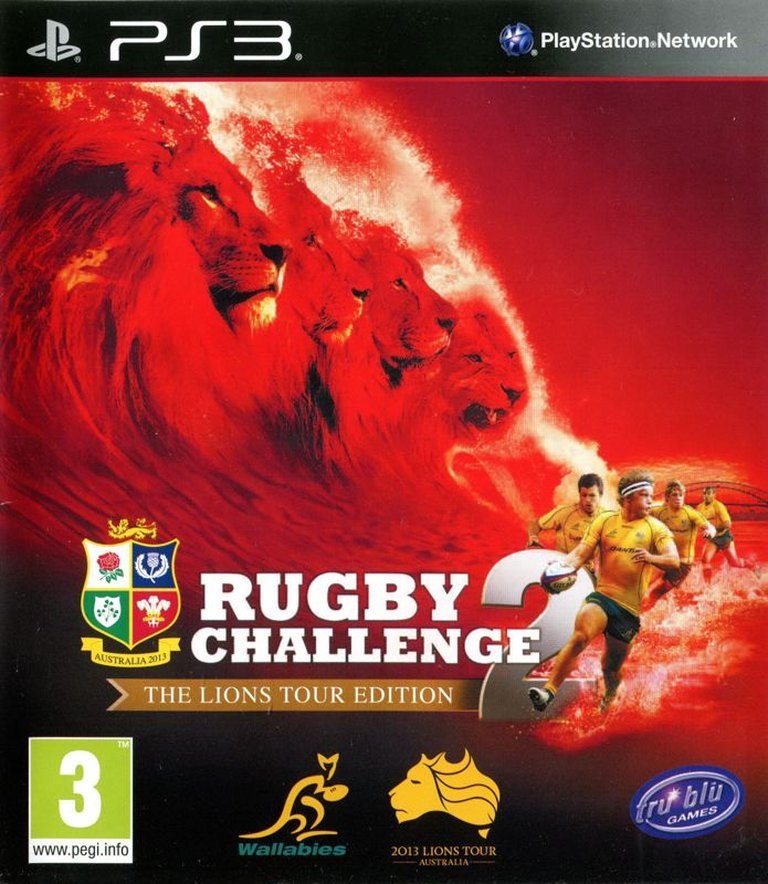
Jonah Lomu Rugby Challenge 2: Featuring the Lions Tour is a rugby union simulation game that immerses players in the sport through modes like single matches, competitions, and a multi-year career mode, with a focus on the 2013 British and Irish Lions tour of Australia. It features over 110 licensed teams and 50 stadia from around the world, including official representations of the All Blacks, Wallabies, and various competitions, alongside refined gameplay mechanics such as quick taps, mauls, and dynamic strategies, plus extensive customization options and commentary by Grant Nisbett and Justin Marshall.
Jonah Lomu Rugby Challenge 2: Featuring the Lions Tour Reviews & Reception
n4g.com (60/100): adds little to its predecessor and suffers from the same faults
Jonah Lomu Rugby Challenge 2: Featuring the Lions Tour: Review
Introduction: Handling the Oval Ball in the Digital Age
In the crowded pantheon of sports video games, the rugby union genre has always been a niche pursuit, a shadow to the colossal specters of FIFA, Madden, and NBA 2K. For every decade of gaming, there have been one or two titles striving to capture the brutal, nuanced, and strategic ballet of the oval ball. In the early 2010s, that title was unequivocally the Rugby Challenge series from New Zealand developer Sidhe Interactive. Its 2011 predecessor, Jonah Lomu Rugby Challenge, laid a competent, if flawed, foundation. Its 2013 sequel, Jonah Lomu Rugby Challenge 2: Featuring the Lions Tour—known variously as All Blacks Rugby Challenge 2 in New Zealand, Wallabies Rugby Challenge 2 in Australia, and simply Rugby Challenge 2: The Lions Tour Edition elsewhere—was the studio’s ambitious attempt to solidify that foundation into something definitive. Arriving in the narrow window to coincide with the historic 2013 British & Irish Lions tour of Australia, the game promised a “plethora of new content” and refined gameplay. My thesis is this: Rugby Challenge 2 is a fascinating, deeply conflicted artifact. It is a game of two halves—one a technically improved, content-rich simulation that finally began to grasp the depth of its sport, and the other a product hamstrung by insurmountable licensing limitations, persistent technical roughness, and an AI that betrayed its strategic ambitions. It stands not as a classic, but as a poignant, what-could-have-been milestone for a franchise with genuine passion behind it, ultimately overshadowed by the juggernauts of the sports genre and the eternal struggle for rugby game licensing.
Development History & Context: A Kiwi Studio’s Ambition
The Studio & The Vision: Sidhe Interactive, a Wellington-based developer, was uniquely positioned to tackle rugby. Operating from the heartland of the All Blacks, they possessed an intrinsic understanding of the sport’s culture and mechanics that a studio in, say, Vancouver or Frankfurt could never replicate. Their previous work included the well-received Rugby Challenge (2011) and the Rugby League Live series. Technical Director Tyrone McAuley, speaking in the official announcement, framed the sequel as a natural evolution: “It has been a wonderful opportunity to build on the foundation we established with the original game to create a deeper, more engaging, and higher quality experience.” The vision was clear: tighter controls, smoother animation, smarter AI, and crucially, “significant new Northern Hemisphere content” to complement the Southern Hemisphere focus of the first game.
The Technological & Market Context: 2013 was the twilight of the PlayStation 3/Xbox 360 generation, with the PlayStation 4 and Xbox One on the horizon. For a mid-tier sports title, this was a double-edged sword. The established install base was enormous, but the aging hardware presented constraints. Graphically, the game would never compete with the visual fidelity of EA’s FIFA or 2K’s NBA 2K on the same platforms. The era was also defined by the online multiplayer shift; online 4v4 support via PSN, Xbox LIVE, and Steam was a stated goal, a significant feature for a niche sports title relying on community longevity.
The Licensing Gauntlet: This is the game’s defining, crippling context. Rugby union’s licensing is notoriously fragmented and expensive. Official team, competition, and stadium licenses are controlled by separate entities—World Rugby, national unions (RFU, FFR, NZRU, etc.), and competition organizers (Sanzaar for Super Rugby, Premiership Rugby, LNR for Top 14). Sidhe, through publisher Tru Blu Entertainment, secured a impressive but patchy roster: the All Blacks, Qantas Wallabies, USA Eagles, Georgia, the British & Irish Lions 2013 tour, Super Rugby teams, Aviva Premiership, Top 14, Pro D2, RaboDirect PRO12, ITM Cup, and Ranfurly Shield. The glaring absences, repeatedly lamented by fans in the game’s official forums, were the Springboks (South Africa), the Six Nations teams (Ireland, Wales, Scotland, England beyond the Lions), and the Currie Cup. As developer “milla” (likely a Sidhe community manager) bluntly stated in response to fan pleas: “South African licences were not available, despite Tru Blu’s best efforts.” This created a bizarre schism: a global rugby game missing its most successful and popular national team and one of its oldest and deepest domestic competitions. It was a fatal blow to the “definitive” claim.
The Rush to the Lions Tour: The game’s subtitle and primary marketing hook was the 2013 British & Irish Lions tour of Australia. Announced in March 2013 for a June 13th console release (with a delayed PC Steam release on July 24th/25th), development coincided directly with the real-world tour (June 22nd – July 6th). This was a brilliant, opportunistic marketing move—capturing the peak of rugby’s quadrennial Lions fervor—but it also suggests a tightly constrained development cycle focused on integrating this specific, time-sensitive license rather than a broader, more balanced global expansion.
Narrative & Thematic Deep Dive: The Story Is The Game Itself
Rugby Challenge 2 possesses no traditional narrative. There is no story mode, no character arcs, no scripted drama. Its narrative is purely systemic and contextual, emerging from the licenses and modes it offers. The thematic core is the celebration of rugby union’s global tapestry and its most mythical team, the British & Irish Lions.
The Lions Tour as Narrative Framework: The inclusion of the full 2013 Lions tour is the game’s headline act. It’s not just a team; it’s a rugby institution—a quadrennial odyssey of Four Nations players united under a single banner. In Career Mode, players can take the Lions on their exact tour schedule against Queensland Reds, NSW Waratahs, Brumbies, and finally the test series against the Wallabies. This provides a pre-built, historically resonant narrative arc: the underdog (a composite team vs a world power) on a hostile away tour. The game attempts to weave in this context through the structure, if not through in-game storytelling.
National Identity Through Licensing: The game’s factions are its teams, each carrying the weight of real-world identity. Leading the All Blacks onto the field with the Kapa o Pango haka, running out for the Wallabies to Waltzing Matilda, or facing the Barbarians’ black and white hoops—these are the game’s “characters” and its emotional beats. The omission of South Africa, Wales, Ireland, and Scotland is not just a roster gap; it’s a narrative void. A truly global rugby story cannot exclude the Springboks, the immortalized 1995 World Cup winners, or the Celtic nations that form the bedrock of the Lions. The game’s thematic statement is therefore incomplete, a rugby world map with a large, blank southern and western section.
Career Mode: The Emergent Saga: The “vastly expanded multi-year Career Mode” is where the game’s personal narrative is written. Here, you take control of a club or national team (from the licensed pool) and manage them across seasons. The addition of transfers and player development, confirmed by developer responses to fan requests, was a critical step forward from the first game’s static, repetitive seasons. For the first time in the series, you could shape a squad, buy and sell players, and see them grow or decline. This systemic storytelling—the rise of a young fly-half, the decline of a veteran lock, the drama of a relegation battle or a championship quest—is the game’s true narrative engine. It’s a blank canvas limited only by the licensed team pool.
Dialogue & Cutscenes: The game’s presentation, particularly its cutscenes, was a noted criticism. As Rob Kershaw of The Digital Fix stated in his 6/10 review, “repetitive cutscenes” marred the experience. These were generic, recycled animations of players celebrating or shaking hands that lacked the dynamism and specificity of EA’s FIFA or even the better contemporary WWE games. The dialogue is non-existent beyond the commentary.
Gameplay Mechanics & Systems: Arcade Sensibility, Sim Aspirations
Sidhe’s gameplay philosophy has always walked a line between arcade accessibility and simulation depth. Rugby Challenge 2 takes tangible steps toward the latter but retains an energetic, sometimes chaotic, arcade soul.
Core Loop & Pace: The game is fast. Very fast. The “Fifa-esque” model noted by critics means a focus on responsive passing, swift rucks, and rapid transitions. This pace is exhilarating for casual players and captures the breakneck tempo of modern rugby sevens more than the grueling forward-war of a test match. The trade-off is a sense of physical weight and positional strategy can be sacrificed.
Significant New Systems (The “Refined Gameplay”): The Wikipedia-sourced feature list details the mechanical additions, which are substantive:
* Quick Taps & Quick Lineouts: These add tactical flexibility, letting players avoid costly kick-to-touch or set-piece delays, rewarding game management.
* Mauls from Lineouts: A huge addition. Lineouts are no longer just a static lift-and-catch; they can now transition into a driving maul, a core, fundamental element of modern rugby that was missing from the first game.
* Interceptions: This dramatically changes defensive strategy. Passive zonal coverage becomes risky; defenders can now actively read and jump passing lanes, making ball security a skill.
* Contesting at the Breakdown & Removing Players: This addresses a major criticism of the first game. The ruck is no longer a foregone conclusion. Players can now legally jackal (contest the ball) and, uniquely, be “removed” from the ruck (likely via a more aggressive clear-out). This adds a vital layer of contest and risk/reward to every tackle.
* Number 8 Scrum Pickups: Another fundamental rugby mechanic added. The No. 8 can now pick the ball from the back of the scrum, enabling classic running moves like a “pick-and-go” directly from the set-piece.
* Dynamic In-Game Strategies: This is the big-ticket simulation feature. The game purports to allow on-the-fly adjustment of attacking and defensive patterns. While the depth of these strategies compared to a hardcore sim like Out of the Park Baseball is unclear from sources, their inclusion is a statement of intent toward tactical complexity.
AI & Exploitability: This is the Achilles’ heel. The N4G aggregator review snippet states the original’s “AI was too easy to exploit,” and there’s no strong evidence this was fully resolved. Forum posts from 2013 complain of “cheesy” tactics—spam running, ineffective defensive AI. A sports sim’s longevity is built on a CPU that presents a genuine, varied challenge that forces the player to adapt using the full suite of tools. If the AI can be beaten with a single, repetitive strategy, the strategic depth added by interceptions and breakdown contests is rendered moot.
UI & Controls: The diagonal-down perspective is standard for the era. Controller support is robust, with full XInput support as per abandonware notes. The PC version includes a separate Settings Editor executable, a common Sidhe practice, allowing deep tweaking of game rules, camera angles, and behavior—a fantastic feature for hardcore fans wanting to mod their experience toward greater simulation.
Innovation vs. Flaw: The innovations are clear: the breakdown system, lineout mauls, and dynamic strategies are significant leaps for the series. The flaws are equally clear: persistent AI issues, graphical/modeling shortcomings, and the catastrophic licensing gaps that undermine the game’s global aspirations.
World-Building, Art & Sound: Authenticity on a Budget
Visuals & Atmosphere: Sources consistently paint the graphics as functional but unspectacular. The My Abandonware description admits “it’s not blowing any minds.” Character models are noted as a weakness in the original and by implication here. Stadiums, of which there are over 50, are a mixed bag. Licensed venues like Twickenham, Eden Park, or the Stade de France would carry authenticity, but the likely use of generic stands for unlicensed competitions (like the absent South African Currie Cup) would break immersion. The atmospheric dressing—national anthems (including the All Blacks’ haka), crowd chants—is mentioned as a “nice touch” by abandonware, suggesting Sidhe prioritized these iconic audio/visual signifiers where they had the license to do so.
Sound & Commentary: This is a major highlighted feature. The game features real-time commentary from the legendary New Zealand duo of Grant Nisbett (the voice of the All Blacks for decades) and Justin Marshall (former All Black great). For French-speaking markets, commentary is provided by Éric Bayle and Thomas Lombard. This is a coup for a niche title and adds immense authenticity for fans in those regions. However, the N4G-linked critic review from The Digital Fix called the commentary “dull,” suggesting the lines may be limited or delivered without enough energy. The sound design for tackles, scrums, and crowd roar is likely competent for the era but not award-winning.
Licensing as World-Building: As argued in the Narrative section, the game’s world is built almost entirely on its licenses. The 110+ teams from sanctioned competitions create a believable, if geographically spotty, rugby world. You can play a Heineken Cup (RaboDirect PRO12/European club) final, a Super Rugby derby, an ITM Cup match, or a Bledisloe Cup test. This creates a satisfying “fantasy rugby” experience, simulating competitions that would never meet in real life. But every time you search for the Springboks or the Aviva Premiership’s (now Premiership Rugby) English national teams (beyond the Lions), the world feels artificially truncated, a constant reminder of the business realities that shape this digital sport.
Reception & Legacy: Mixed Reviews, Unfulfilled Potential
Critical Reception at Launch: Reception was mixed to negative, a fact starkly laid out on Wikipedia. The only quoted critic score is 6/10 from The Digital Fix, which praised the improved Career Mode but savaged “poor licensing, repetitive cutscenes and dull commentary.” NZGamer’s 7.4/10 was more forgiving, noting improvements over the first game but questioning the long development gap. The absence of widespread critic coverage on major outlets (IGN, Gamespot, Eurogamer) speaks to the game’s niche status. The one positive review snippet found on N4G from XCLANN (8.8/10) is an outlier with no cited source, suggesting passionate fan advocacy rather than mainstream acclaim.
Community & Fan Reception: The official website’s comment sections from 2013 are revealing. They are a torrent of passionate, specific requests: “Where is South Africa?”; “Add transfers and contracts”; “Fix the repetitive career mode itinerary”; “Add try dives”; “Add Rugby 7’s”. This is not a fanbase asking for minor tweaks; it’s a knowledgeable rugby community pointing out fundamental omissions and flaws. The developer responses (“milla”) are polite but often defensive or constrained (“licenses not available”). This created a palpable tension: a dedicated studio seemingly trying to meet fan demands but visibly handcuffed by licensing and, perhaps, resources.
Evolution of Reputation: In the decade since, the game’s reputation has calcified into that of a cult classic for a specific audience. For rugby fans on PC in the 2010s, it was often the only viable option. Its “abandonware” status (available for free download on sites like My Abandonware) has cemented it as a preserved artifact. Its legacy is twofold:
1. The Last Stand of the Mid-Tier Rugby Sim: It represents the final, most ambitious attempt before the genre’s near-complete abandonment by major publishers. EA stopped after Rugby 08. Following Rugby Challenge 2, Sidhe released Rugby Challenge 3 in 2016 (with even more licensing issues) and Rugby Challenge 4 in 2023, but these iterations struggled for relevance and visibility against the broader sports gaming landscape.
2. A Benchmark for Passionate Design: Within its constraints, it pushed the genre forward. The breakdown mechanics, lineout mauls, and dynamic strategies set a new baseline for rugby game systems that successors would build upon. The extensive customization tools, allowing players to edit rosters and create leagues, became essential for the community to “fix” the licensing gaps themselves.
Influence on the Industry: Its direct influence is minimal due to the genre’s obscurity. Indirectly, it proved there was a dedicated, albeit small, market for a rugby game with sincere gameplay ambitions. Its biggest impact may be historical: it is now the reference point for what a “good” rugby game looked like in the 2010s, a standard that future entrants (like the recent Rugby 25 from Nacon) are inevitably measured against.
Conclusion: The Final Whistle
Jonah Lomu Rugby Challenge 2: Featuring the Lions Tour is a game defined by what it is not. It is not a graphical powerhouse. It is not universally licensed. It is not a perfect simulation. It is not a commercial blockbuster. What it is, however, is the most comprehensive, mechanically ambitious, and sincerely crafted rugby union video game of its generation.
Its triumphs are real: the introduction of genuine set-piece and breakdown depth, a vastly improved and meaningful Career Mode, and a core gameplay loop that, for all its arcade speed, funnels players into making rugby-specific decisions. The inclusion of the British & Irish Lions tour was a masterstroke of topical marketing that delivered a unique, narrative-ready campaign.
Its failures are equally, if not more, real. The licensing gaps are not minor; they are chasms that swallow the game’s claim to being the “definitive” experience. The AI’s susceptibility to exploitation undercuts its new tactical systems. The presentation, from repetitive cutscenes to inconsistently energetic commentary, lacks the polish of its big-budget sports rivals.
Its place in video game history is that of a highly competent niche title. It is not a landmark like Madden NFL ‘94 or FIFA International Soccer, which defined genres for decades. Instead, it is the peak of a quiet, passionate corner of the medium—the rugby sim. For the thousands of fans who码 (spent) hours in its Career Mode, editing in their missing South African or Welsh heroes, it is a beloved, flawed gem. It is a testament to Sidhe Interactive’s understanding of the sport and a casualty of the brutal economics of sports licensing. To play Rugby Challenge 2 today is to engage with a time capsule: a vision of what rugby gaming could have been with full institutional support, and a reminder that sometimes, the most important games are not the best-selling ones, but the ones made with the most heart for the fans who truly love the sport. It won the battle for gameplay depth but lost the war for comprehensiveness, leaving a legacy of promise unfulfilled, but a foundation that, for better or worse, has yet to be significantly surpassed.
Final Verdict: 7/10 – A Flawed Essential for Rugby Fanatics.