
- Release Year: 2019
- Platforms: Macintosh, Windows
- Publisher: JetDogs Studios Oy, S.A.D. Software Vertriebs- und Produktions GmbH
- Developer: JetDogs Studios Oy, Whalebox Studio
- Genre: Strategy, Tactics
- Perspective: Diagonal-down
- Game Mode: Single-player
- Gameplay: Time management
- Setting: Classical antiquity, Fantasy
Description
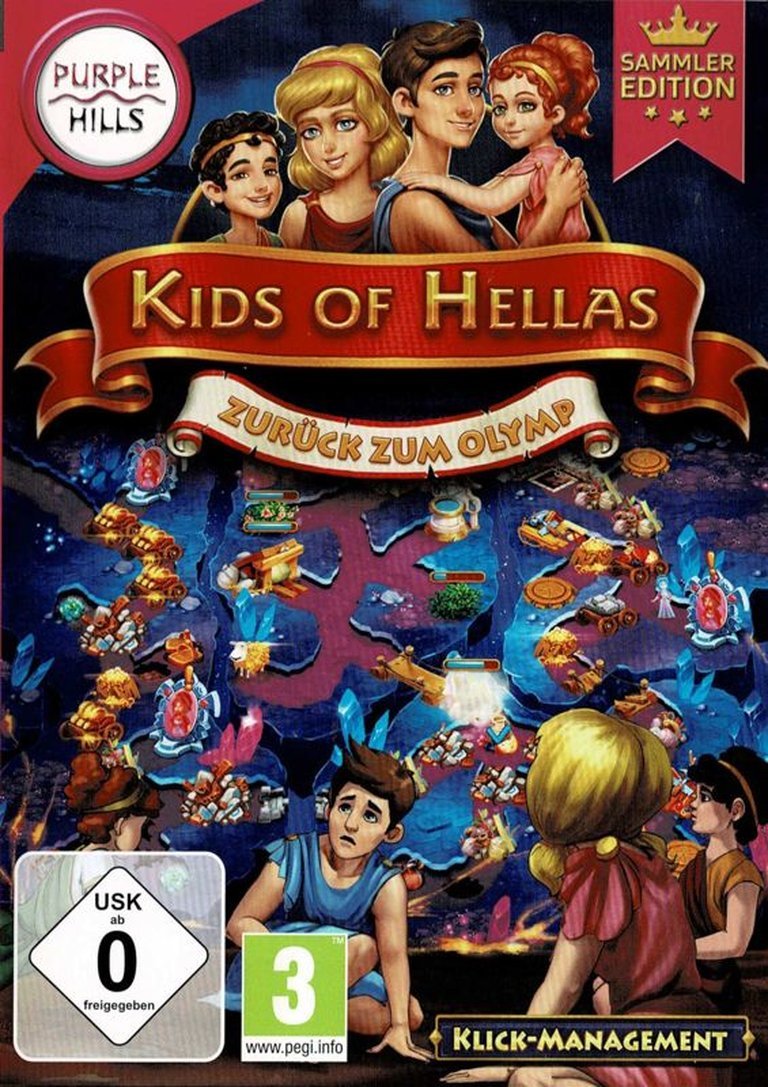
Set in a fantasy-infused rendition of classical antiquity, ‘Kids of Hellas: Back to Olympus’ follows the children of Zeus who, after being cast down to Earth by Hades’ envy-driven scheme orchestrated through the exiled sorceress Ate, must survive as mortals without their father’s memory or divine provisions, navigating a world stripped of their former comforts.
Gameplay Videos
Kids of Hellas: Back to Olympus (Collector’s Edition) Guides & Walkthroughs
Kids of Hellas: Back to Olympus (Collector’s Edition): Review
Introduction: A Divine Time-Management Odyssey
In the vast, crowded ecosystem of casual time-management and strategy games, where titles like Diner Dash and Farm Frenzy established the blueprint, a game must do more than simply present a novel skin to stand out. It must offer a compelling hook—a narrative or setting so resonant that it elevates the cyclical grind of resource gathering and task completion. Kids of Hellas: Back to Olympus (Collector’s Edition), released in February 2019 by the collaborative efforts of JetDogs Studios and Whalebox Studio, attempts exactly that. It stakes its claim not on mechanical innovation, but on the rich, enduring tapestry of Greek mythology, framing its resource-management loops as the epic struggle of divine children fallen to Earth. This review will argue that while Kids of Hellas is a proficient and aesthetically competent entry within its genre, its ultimate significance lies not in revolutionizing gameplay but in demonstrating the persistent viability of mythologizing the mundane—transforming the act of fetching water and arranging feasts into a narrative of familial restoration and heroic perseverance. It is a game that understands its audience’s desire for both light cerebral challenge and immersive fantasy, delivering a package that is pleasant, if not transformative, within the casual strategy canon.
1. Development History & Context: Building on a Foundation of Hercules
To understand Kids of Hellas, one must first appreciate the studio ecosystem from which it emerged. The primary developer, JetDogs Studios Oy, is a Finnish/Russian collaborative studio with a distinct pedigree in the casual “heroic quest” subgenre. Their most notable pre-existing franchise is the “12 Labours of Hercules” series, a long-running and successful line of time-management games that tasks players with completing the mythic labors of the Greek hero. This is not a coincidence but a deliberate branding strategy; Kids of Hellas is presented in its own marketing as “from the creators of ’12 Labours of Hercules’,” leveraging established consumer trust in their formula. The secondary developer, Whalebox Studio, consists of Russian artists and designers (as seen in the MobyGames credits: Alexander Denisov, Viktoria Ustichenko, etc.) who frequently collaborate with JetDogs, providing the visual craftsmanship for these projects.
The game’s development sits at a specific technological and market crossroads. Released in 2019, it targets low-to-mid-range PC hardware (minimum specs: 1.6 GHz processor, 512 MB RAM, DirectX 9.0), ensuring accessibility for a broad, non-enthusiast audience. The era was one of transition in casual gaming; while mobile had dominated for nearly a decade, the PC download market (via Steam, GameHouse, Big Ant Games, WildTangent) remained robust for “collector’s edition” titles that bundled digital goodies. The game’s genre—Real-Time Strategy / Tactics, with a Time Management core—places it in a niche with its own conventions: a diagonal-down isometric perspective, point-and-click interface, and a clear progression of levels with increasing complexity. It is not a game of grand strategy but of intimate, localized choreography.
2. Narrative & Thematic Deep Dive: The Fallen Princes and Princesses of Olympus
The narrative of Kids of Hellas is its primary selling point, a clever inversion of the classic hero’s journey. Instead of a single champion like Hercules, the protagonists are “Zeus’ children”—a collective of demigods and minor deities, implied to be the various personifications and spirits of youth, sport, and civic life (e.g., spirits of the Olympics, agriculture, the seasons). The inciting incident is rooted in classic Greek familial strife: Hades, god of the underworld, propelled by envy of his brother Zeus, manipulates the exiled sorceress Ate (the personification of moral blindness and ruin). Ate’s “wicked spell” does not kill the children but strips them of their divinity and memory, casting them down to the mortal realm of Hellas (ancient Greece), while simultaneously causing Zeus to forget their existence.
This premise establishes the core dramatic irony and emotional stakes: the players must guide these amnesiac, powerless divine youths not through epic battles, but through the arduous process of survival and societal rebuilding. Their journey is a reverse ascension. The narrative weaves through iconic mythological locales:
* The Mundane Earth: Starting with basic survival—gathering food, building shelter.
* The Snow Lands of the Minotaur: A labyrinthine challenge referencing the Minotaur’s domain.
* The Underworld (Hades’ Domain): A literal descent, confronting the lord of the dead—a high-stakes time management scenario where failure might mean permanent entrapment.
* The Sea Monsters (Charybdis): A nautical survival segment, echoing Odysseus’s encounters.
The Collector’s Edition bonus episode explicitly expands on the antagonist’s lore, promising confrontation with the “dark side of Ate” in a “world of dreams and nightmares,” suggesting a deeper dive into the psychological/mythological antagonist than the base game allows.
Thematically, the game explores restoration, community, and latent divinity. It reframes Greek myth from a top-down saga of gods to a bottom-up tale of displaced youth earning their way back. The “Olympic Games” serve as a central MacGuffin, transforming from a mythological event into a literal player-driven task: you must construct the games as a means of proving worth and attracting divine attention. This is a domestication of myth, making the epic accessible through resource chains. The story’s resolution hinges not on slaying a monster, but on demonstrating courage, resourcefulness, and civic virtue—values aligned with the time-management gameplay itself.
3. Gameplay Mechanics & Systems: The Precision of Divine Chores
As a real-time, point-and-select time-management strategy game, Kids of Hellas operates on a tightly defined set of mechanics, typical of its subgenre but executed with attention to the mythological theme.
Core Loop: Each level presents a map with defined resource nodes (fruit trees, stone quarries, fishing spots, etc.) and building/production sites (kitchens, temples, barracks). The player controls a small retinue of the fallen children (represented as cursor-following units). Using the mouse, the player issues sequential commands: a worker must be directed to gather wood, then that wood must be taken to a construction site to build a shelter, which then allows more workers to be housed, etc. The challenge is pathfinding optimization and priority management. Resources deplete over time (hunger bars, building decay), requiring constant replenishment. Failure states usually involve a key resource (like food) hitting zero.
Progression System: Levels are linear but often have branching paths or multiple objectives (e.g., “Gather 200 units of grain AND build 3 temples”). Success yields stars (typically 1-3 per level), which unlock subsequent levels and sometimes bonus content. The difficulty modes (including a “skilled player” difficult mode mentioned in marketing) likely increase the rate of resource decay, reduce starting resources, or add more complex inter-dependencies between resource chains.
Innovation/Flaws within the Genre: Within the constraints of the genre, Kids of Hellas does not introduce revolutionary mechanics. Its “innovation” is purely thematic integration. The resource types are mythologized: instead of generic “food,” you might harvest “ambrosia” or “olives”; instead of “wood,” “cypress timber”; currency might be “olive oil” or “sacred coins.” Buildings are temples, amphitheaters, and harbors. These substitutions make the familiar resource chains feel narratively congruent.
A potential flaw, common to the genre, is “click fatigue” and pathfinding issues. With numerous tiny sprites moving across cluttered isometric maps, mis-clicks can cascade into resource shortages. The game’s reliance on a diagonal-down perspective can sometimes obscure objects or create awkward click targets. The user interface, while presumably clear, must efficiently display multiple resource counts, objective trackers, and unit controls in a small space—a constant challenge for these games.
4. World-Building, Art & Sound: A Pleasant, Pastel Pantheon
The game’s presentation is where the thematic vision most clearly crystallizes. Marketed as having “stunning full HD graphics,” the art style is almost certainly bright, colorful, and cartoonishly stylized, appealing directly to its “Family Friendly” and “Kids” tags. This is not the gritty, dark antiquity of God of War but a welcoming, approachable Hellas. The character design for the “kids” likely features cute, exaggerated proportions, while the gods (Hades, Zeus) are rendered with imposing but not frightening grandeur. Environments range from lush coastal plains to icy mountain passes and the shadowy, purple-hued underworld, providing visual variety.
The sound design and music, while not detailed in sources, would follow genre conventions: light, rhythmic orchestral or folk-inspired melodies for gameplay, shifting to more ominous tunes for underworld sequences. Voice acting, if present (not confirmed in sources), would likely be functional and expressive, suitable for a casual audience. The “full audio” support listed for multiple languages (English, French, German, Russian) indicates a standard localization effort for European markets.
Atmosphere is built through environmental storytelling: crumbling columns hint at lost glory, cheerful villagers provide quests, and mythical creatures (minotaurs, Charybdis) are integrated as level hazards or objectives. The world feels alive but manageable, a puzzle box of mythological tropes waiting to be solved by efficient clicking.
5. Reception & Legacy: A Niche Success with a Clear Lineage
At launch, Kids of Hellas existed in a highly specific and underserved niche: PC time-management games with a strong mythological theme. Its direct predecessor in spirit and developer is the “12 Labours of Hercules” series, which itself is part of a larger wave of myth-based casual games from studios like Alawar (e.g., Heroes of Hellas). Its commercial performance is not documented in sales charts, but its persistent presence on multiple digital storefronts (Steam, GameHouse, Big Ant Games, WildTangent, Shockwave) and generally “Very Positive” Steam user review score (86% of 51 reviews) suggests it found its intended audience. The small review count indicates a cult following rather than mainstream success, typical for the genre.
Critical analysis is notably absent from the provided sources; MobyGames shows no professional critic reviews, only user ratings. This is common for games in this segment, which are rarely covered by mainstream gaming press. Its reputation, therefore, is built entirely on word-of-mouth within casual gaming communities.
Its legacy and influence are subtle. It does not represent a paradigm shift. Instead, it solidifies a successful formula: take a well-known mythos, strip it down to resource-gathering archetypes, and package it with collector’s bonuses. It demonstrates the value of franchise synergy—using the “12 Labours” brand to launch a parallel series. For historians, it is a clear data point in the evolution of the “casual strategy” or “time-management” genre from the late 2010s, showing its continued reliance on isometric perspectives, point-and-click control, and thematic reskinning of core mechanics. It likely influenced no major AAA titles but comfortably occupied a shelf space next to Fables of the Kingdom and Royal Envoy, proving that the market for “building a kingdom from scratch” mechanics, even in a mythological setting, was still viable years after the genre’s peak popularity.
6. Conclusion: A Competent Artifact of a Perennial Genre
Kids of Hellas: Back to Olympus (Collector’s Edition) is not a game that seeks to redefine its genre or captivate hardcore strategists. It is, instead, a masterclass in competent, focused execution within a narrow design corridor. It successfully translates the epic, familial drama of Greek mythology into the language of resource chains and task prioritization. The narrative provides just enough motivational backdrop to make the clicking feel purposeful; the art direction creates a cohesive, inviting world; and the game mechanics, while derivative, are polished enough to provide a satisfying, if repetitive, flow state.
Its place in video game history is that of a sturdy, niche artifact. It represents the late-period sustainability of the time-management genre on PC, the collaborative Eastern European/Finnish development model for casual games, and the enduring marketing power of classical mythology in interactive entertainment. For the player seeking a low-stress, mentally engaging puzzle with a charming mythological coating, it delivers. For the historian, it is a clear exemplar of a formula: take a beloved cultural framework, apply the timeless mechanics of “gather, build, manage,” and satisfy a dedicated community that finds profound enjoyment in the meticulous stewardship of a digital world—even if that world is populated by the forgotten children of Zeus. It is, in the end, a game about bringing order from chaos, a theme as relevant to its gameplay as it is to the story it tells. Verdict: A solid and themically engaging entry for fans of casual time-management games, but offering little to transcend its genre’s established conventions.