
- Release Year: 2000
- Platforms: Windows
- Publisher: Freeloader, IncaGold GmbH, media Verlagsgesellschaft mbH, Summitsoft Entertainment, uWish Games
- Developer: Dawn Interactive, The
- Genre: Driving, Racing
- Perspective: Behind view
- Game Mode: LAN
- Gameplay: Modifications, Power-ups
- Setting: Stadiums
- Average Score: 73/100
Description
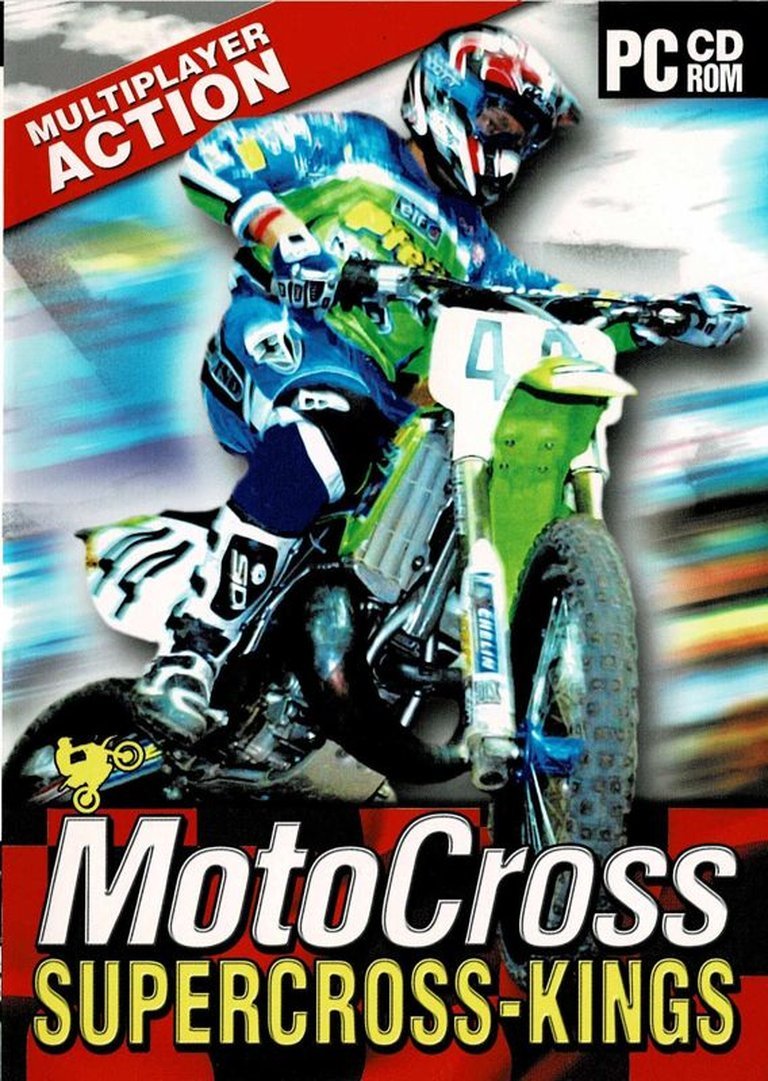
Supercross Kings is a motorcycle racing game where players compete in 6 international stadiums across over 12 grueling supercross races to achieve the title of Supercross King. The gameplay involves selecting teams, earning points for bike modifications and power-ups, and racing tracks in both forward and reverse directions, offering an intense off-road racing experience with real-time pacing and direct control.
Gameplay Videos
Supercross Kings Free Download
Supercross Kings Reviews & Reception
gamepressure.com (73/100): Supercross Kings is a fun, arcadeinfluenced take on the muddy world of Motocross motorbike racing where simple, speedy thrills and hilariously overthetop crashes are more important than boring realism.
metacritic.com (73/100): A mere $40 investment stands between you and one of the best arcade-style motorcycle racing games the PlayStation has to offer.
Supercross Kings Cheats & Codes
PlayStation
Press R1 at the ‘Select Event’ menu to display the cheat screen.
| Code | Effect |
|---|---|
| N0CR4SH | No crashes |
| B1GB1K3S | Big bikes |
| G14NTS | Giant riders |
| H0P | Extra hop button; press L1 to hop |
| H34DL3SS | Headless rider in practice mode |
| N0R1D3RS | No riders |
| M3RCVRY | Gravity from Mercury |
| V3NVS | Gravity from Venus |
| M00N | Gravity from the Moon |
| M4RS | Gravity from Mars |
| JVP1T3R | Gravity from Jupiter |
| S4TVRN | Gravity from Saturn |
| VR4NVS | Gravity from Uranus |
| N3PTVN3 | Gravity from Neptune |
| PLVT0 | Gravity from Pluto |
| SM4RTB0MB | Float; press L1 and other buttons to float |
| M0R3C4MS | Additional views |
| B1GSPR4Y | Big dirt sprays |
| BL0CKM3 | All riders block you |
| N00FFTR4CK | Cancel Off Track reset |
| SK1PP1NG0K | Cancel Skipping Track reset |
Nintendo 64
Press C-Up at the ‘Select Event’ menu to display the cheat screen.
| Code | Effect |
|---|---|
| N0CR4SH | No crashes |
| B1GB1K3S | Big bikes |
| G14NTS | Giant riders |
| H0P | Extra hop button; press L1 to hop |
| H34DL3SS | Headless rider in practice mode |
| N0R1D3RS | No riders |
| M3RCVRY | Gravity from Mercury |
| V3NVS | Gravity from Venus |
| M00N | Gravity from the Moon |
| M4RS | Gravity from Mars |
| JVP1T3R | Gravity from Jupiter |
| S4TVRN | Gravity from Saturn |
| VR4NVS | Gravity from Uranus |
| N3PTVN3 | Gravity from Neptune |
| PLVT0 | Gravity from Pluto |
| SM4RTB0MB | Float; press L1 and other buttons to float |
| M0R3C4MS | Additional views |
| B1GSPR4Y | Big dirt sprays |
| BL0CKM3 | All riders block you |
| N00FFTR4CK | Cancel Off Track reset |
| SK1PP1NG0K | Cancel Skipping Track reset |
Supercross Kings: The Forgotten Flattrack of PC Gaming
Introduction: Gassed Up and Going Nowhere
In the crowded stable of late-’90s/early-2000s motorsports titles, where giants like Motocross Madness and official licensed simulations frolicked, Supercross Kings (also known as MotoCross: Supercross-Kings) occupies a peculiar and dimly lit pit stop. Released for Windows on December 14, 2000, by the obscure Italian studio Dawn Interactive and a consortium of publishers (Freeloader, Summitsoft Entertainment, IncaGold GmbH, et al.), this title promised “6 stunning international stadiums and over 12 gruelling races.” Yet, its critical reception was an immediate and brutal 35% average based on the scant two professional reviews extant. Decades later, it survives primarily as an obscure download on abandonware sites, cherished by a tiny cadre of retro enthusiasts with a surprisingly high 4.7/5 user score on MyAbandonware. This review argues that Supercross Kings is not merely a bad game, but a fascinating case study in missed potential, a product of technological constraints and market saturation that offers a raw, unpolished glimpse into the arcade-motocross design philosophy of its era. Its legacy is one of profound obscurity, yet its very existence speaks to the persistent, if often poorly served, demand for accessible two-wheeled chaos.
Development History & Context: A Small Studio’s Big (But Bumpy) Jump
Supercross Kings emerged from Dawn Interactive, The, a studio led by Eugenio Vitale, who served as Producer, Director, and Art Director. The core team was a tight-knit group of Italian developers: Remigio Coco and Massimiliano Gori handled 3D programming, Riccardo Marchesini engineered the physics, and Anselmo Corsi, Fabio Catarzi, Francesco Lambiase, Luca Liguori, and Carlo Maria Masi rounded out the game and tools programming. The audio was crafted by Coco (SFX) and Joris Wittenberg (music), while Silvia Angelini and Simone Crescenzi provided 3D modeling and texturing support.
The studio’s pedigree, as seen in their other credited works (Extreme Trial Motocross, Silkolene Honda Motocross GP), reveals a clear specialization in budget-conscious, niche motorcycle titles. This was not a team crafting a flagship franchise but one operating within the tight financial margins of the European budget and shareware market. The technological constraints of 2000 were significant: running a full 3D motocross simulation on a Pentium II 300MHz with 64MB RAM (as per later system requirements cited on Gamepressure.com) required severe compromises in polygon count, texture fidelity, and physics complexity compared to the high-end consoles of the era.
The gaming landscape was brutally competitive. On PC, Rare’s Motocross Madness (1998) and its sequel (2000) set the gold standard for accessible, physics-driven fun with excellent track design and a vibrant feel. On consoles, EA Sports’ Supercross 2000 and Acclaim’s Jeremy McGrath Supercross 2000 battled for supremacy with official AMA licenses and real riders. Supercross Kings entered this arena with no notable license, no celebrity endorsement, and a tiny marketing footprint. Its release through multiple small publishers across Europe and North America (with staggered dates from 2000 to 2004, per MyAbandonware) suggests a slow, attritional rollout typical of low-budget titles trying to find any shelf space.
Narrative & Thematic Deep Dive: The Sport is the Story
Supercross Kings possesses no traditional narrative. There is no plot, no character arcs, no dialogue. The game’s “story” is the sport itself, distilled into its purest, most abstract form: become the ultimate Supercross King. The only characters are the abstract rider avatars and the six selectable teams (implied by the description to “choose your team”), which are purely statistical constructs rather than personalities.
The thematic core is progression through mastery and augmentation. The Championship mode is a simple ladder: win races to earn points, spend points on bike modifications and power-ups. This creates a stark, almost minimalist feedback loop where victory is monetized directly into performance. There is no context for why you are racing—no rivalries, no sponsors, no career trajectory. The “Kings” in the title is not a reference to a person or dynasty but a status attained by accumulating enough points to be the best across the 12+ races and 6 stadiums.
This absence of narrative is both a critical flaw and a thematic purity. It aligns the game with the arcade sports tradition of Track & Field or early SSX, where the joy is in the act of competition itself, stripped of all extraneous drama. However, where those games often employed charismatic presentation, Supercross Kings offers nothing but the track. The result is a profoundly impersonal experience. The player is a ghost in the machine, a pure agent of vector control on a dirt track. The theme is not “overcoming adversity” or “the glory of sport,” but mechanistic optimization: gather points, upgrade bike, repeat.
Gameplay Mechanics & Systems: Janky Foundations, Arcade Aspirations
Deconstructing the core loops reveals a game built on a shaky but functional chassis.
Core Race Loop: The player selects a team, enters a Championship or single race on one of 6 stadium tracks (each reversible, a modest but clever touch doubling content), and competes in a standard supercross format: navigate jumps, whoops, and rhythm sections to maintain speed and avoid crashes. The objective is simply to finish in a top position.
Progression & Customization: The only meaningful progression is the point system post-race. Points are awarded based on finishing position and are funneled directly into a bicycle upgrade tree. The source describes this as “modifications and power ups,” but the implementation is almost certainly rudimentary—likely simple stat boosts to acceleration, top speed, or handling. There is no rider skill tree, no team management, and no unlockable content beyond new parts. This creates a shallow but clear risk-reward dynamic: perform better now to make future races slightly easier.
Physics & Control (The Fatal Flaw): This is where the game fundamentally stumbles. Multiple sources converge on this weakness. The Internet Archive review bluntly states the “physics engine and AI are both pretty basic, to put it mildly.” Independent Zin’s scathing 25% review implies a complete lack of longevity due to these core flaws. The Squakenet review provides the most nuanced take, admitting “Graphically the game is more than well produced” but ultimately classifying it as an “arcade simulator” where “simple, speedy thrills and hilariously over-the-top crashes are more important than boring realism.” This is the key: the game seems to have aimed for an MX Unleashed or Madness-style balance of physics-based fun and arcade accessibility but landed in an awkward middle ground. The physics are likely neither sim-serious nor consistently silly, leading to a vague, unsatisfying feel. The AI is described as “basic,” suggesting rubber-band mechanics or predictable, brainless opponents that fail to provide meaningful challenge or illusion of competition.
User Interface & Input: The game supports keyboard and mouse, with optional “Other Input Devices” (likely generic gamepads). The UI is almost certainly functional but unremarkable, built for speed over style. The menu artist (Vitale himself) likely created a straightforward, utilitarian interface.
Innovations & Flaws: The reversible tracks are the only genuine innovation cited. Every other system—the upgrade mechanic, the team selection—is a rudimentary implementation of ideas done better elsewhere. The game is fundamentally flawed in its core tactile experience. Without satisfying controls or believable (or enjoyably ridiculous) physics, all other features—the points system, the multiple tracks—are rendered moot. It is a racing game that fails to excel at the act of racing.
World-Building, Art & Sound: Passable Presentation on a Budget
Visual Direction & Atmosphere: Eugenio Vitale’s art direction, with modeling by Angelini and Crescenzi, aimed for a clean, early-2000s 3D aesthetic. The description’s claim of “6 stunning international stadiums” is almost certainly an exaggeration born of marketing copy. The Squakenet review notes it “looks great with varied tracks,” while the Internet Archive calls graphics “passable.” This suggests competent, low-polygon stadium environments with basic textures—functional but lacking the atmospheric detail (mud splatters, crowd life, weather) of its contemporaries. The perspective is a standard “behind view,” offering a clear but unspectacular sightline. The world feels like a series of empty, geometric bowls, devoid of the gritty, lived-in feel of Motocross Madness‘s outdoor tracks or the stadium pomp of licensed games.
Sound Design: The audio credits are minimal: Remigio Coco on SFX with additional work from Corsi and Masi, and Joris Wittenberg on music. The Internet Archive review delivers the coup de grâce: “the noises are obviously looped.” This points to a severe budget limitation. Engine sounds are likely repetitive, one-note samples, and the music is probably generic, low-energy techno or rock tracks that fade into the background. There is no hint of dynamic audio reacting to jumps or crashes. The soundscape is a placeholder, contributing nothing to the tension or thrill of the race.
Together, the art and sound create an atmosphere of cheap, functional emptiness. The game looks and sounds like a prototype—a technical demo that accidentally got a release. It lacks the “vibe” that defines great arcade racers; it has no identity beyond being “that motocross game.”
Reception & Legacy: A Blip on the Radar, a Curio for the Dedicated
Critical & Commercial Reception: The professional reception was devastatingly minimal and negative. Only two reviews are recorded on MobyGames: Germany’s PC Player (45%) and Poland’s Independent Zin (25%). The German review’s summation is telling: it concedes the game is “naturally not as good as Motocross Madness” in driving feel, graphics, or track variety, but suggests it’s “good enough for a few quick laps during lunch break.” This frames Supercross Kings explicitly as a time-killer for the undiscerning, not a serious competitor. The Polish review is far harsher, calling it “bad even for a low-budget title” that offers only minutes of playtime before revealing its emptiness.
Commercial performance is impossible to gauge, but the dozens of publisher/logos, its inclusion in late-2000s European compilation discs (Hits Jeux 2008: Course, PC-Spiele-Box: Edition 2008), and its status as an abandonware darling suggest it sold poorly, lingered in bargain bins, and was eventually liquidated into multi-game packs.
Retrospective & Cult Status: The game’s modern reputation exists in two starkly separate spheres:
1. The Professional/Historical Record: It is a footnote. Mentioned only in lists of obscure motocross games or as a comparison point (“not as good as…”). It had zero influence on the industry. Its technical approach was rendered instantly obsolete by the next wave of titles.
2. The Abandonware/Retro Enthusiast Sphere: Here, it achieves a surprising 4.7/5 on MyAbandonware from 17 votes. This dissonance is explained by the Squakenet review’s perspective: for players who “don’t know any better and couldn’t care less what they race,” or who specifically seek a simple, no-frills arcade experience, the game’s jank becomes part of its charm. Its low system requirements, functional core, and complete lack of pretension make it an accessible curiosity. The common abandonware advice to “disable background music” (as noted in a MyAbandonware comment) speaks volumes—its flaws are so entrenched that users share workarounds to make it barely tolerable.
Its true legacy is as a cautionary tale of market saturation and development limitations. It exists in the long shadow of Motocross Madness, a game that perfected the accessible PC motocross racer just two years prior. Supercross Kings demonstrates what happens when a small studio attempts to chase a trend without the resources to match the leader’s polish or innovation.
Conclusion: A Perfectly Average Kingship in a Forgotten Kingdom
Supercross Kings is not the worst game ever made. It is not even necessarily the worst motocross game of 2000—that dubious honor likely belongs to other, more obscure titles. Its sin is a profound and crushing mediocrity. It is a technically competent but creatively and tactilely bankrupt experience. It takes the established framework of arcade motocross—upgradeable bikes, varied tracks, reverse racing—and executes each element at a bare-minimum level of functionality. The physics are unsatisfying, the AI is brainless, the sound is repetitive, and the world is visually generic.
Its thesis—that you can become “the ultimate Supercross King” by grinding for points—is mechanically sound but emotionally void. It offers no spectacle, no personality, no memorable moments. The thrills it provides are not emergent from its systems but are the thin, desperate thrills of a game that is technically just working.
In the grand tapestry of video game history, Supercross Kings is a single, frayed thread. It represents a fringe of the market where budget constraints completely neutered ambition, resulting in a product that is neither beloved nor reviled, but simply exists. Its recent cult status on abandonware sites is not a testament to its quality, but to the enduring, forgiving nostalgia of retro gamers willing to tolerate severe flaws for a dose of simple, low-stakes racing. For the historian, it is a vital datapoint showing the floor of early-2000s 3D sports game development. For the player, it is a curiosity—a 30MB time capsule of a time when even a flawed racing game could offer, in its own awkward way, the simple joy of guiding a digital bike over a digital jump, even if the landing feels like mud. Its final verdict is not a score, but a classification: a forgotten, functional, and fundamentally joyless artifact of a crowded genre’s dark age.