
- Release Year: 2010
- Platforms: Windows
- Publisher: Just For Games SAS, rondomedia Marketing & Vertriebs GmbH, THQ Inc.
- Developer: Virtual Playground Ltd.
- Genre: Strategy, Tactics
- Perspective: Diagonal-down
- Game Mode: Single-player
- Gameplay: Business simulation, Managerial
- Setting: Alcatraz, Law enforcement, Prison
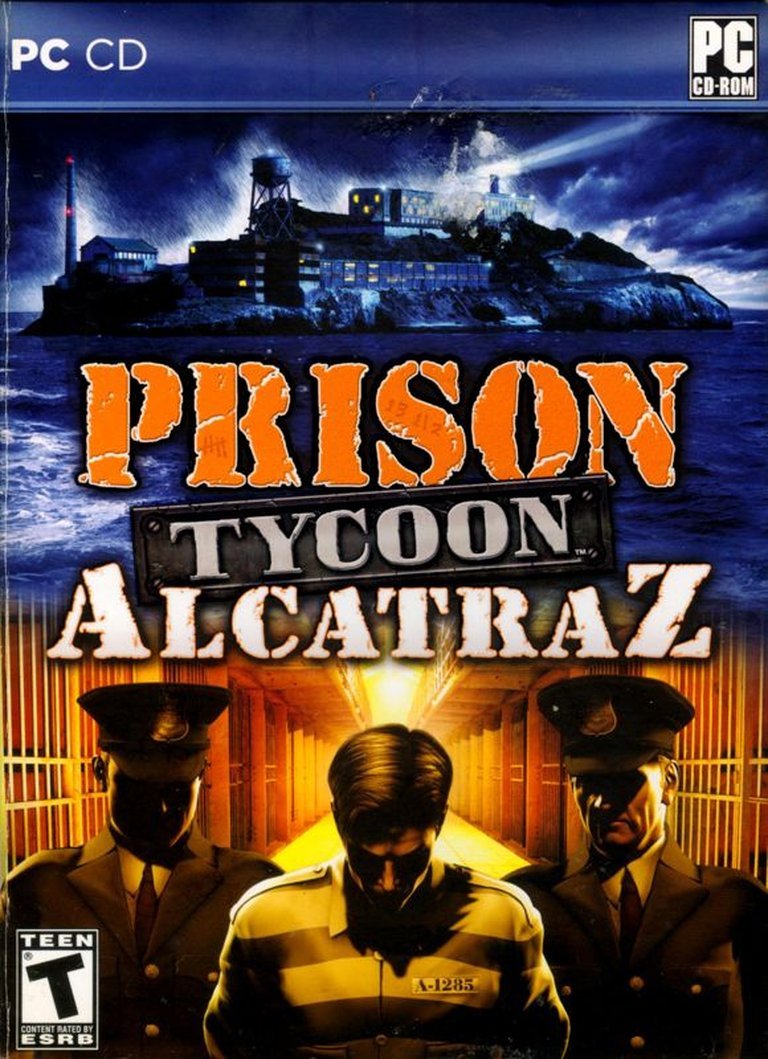
Description
Prison Tycoon: Alcatraz is the fifth installment in the Prison Tycoon series, placing players in control of the infamous Alcatraz island prison during its operational years from 1934 to 1963. Players must balance security (preventing escapes), finances (using prisoner labor for income), and inmate well-being (via staff and facilities) by constructing buildings, hiring personnel, and managing resources across the island’s unique layout. The game offers both free-play mode covering the prison’s full lifecycle and a campaign mode with time-based objectives to achieve specific security and operational standards.
Gameplay Videos
Where to Buy Prison Tycoon: Alcatraz
PC
Prison Tycoon: Alcatraz Free Download
Prison Tycoon: Alcatraz Cracks & Fixes
Prison Tycoon: Alcatraz Guides & Walkthroughs
Prison Tycoon: Alcatraz Cheats & Codes
Prison Tycoon (PC)
Press ‘Enter’ during gameplay, type ‘sleepworker’, and press Enter again to activate cheat mode. Then, type one of the following codes.
| Code | Effect |
|---|---|
| m | Adds $10,000 |
| F1 | Unlocks First Area |
| F2 | Unlocks Second Area |
| F3 | Unlocks Third Area |
| F4 | Sets prisoner mood to Happy |
| F5 | Sets prisoner mood to Passive |
| F6 | Sets prisoner mood to Bored |
| F7 | Sets prisoner mood to Angry |
| F8 | Sets prisoner mood to Hungry |
| F9 | Sets prisoner mood to Injured |
| ` | Sets game speed to Half |
| 4 | Increases game speed |
| 5 | Increases game speed further |
| 6 | Sets game speed to Fastest |
| X | Increases Security Rating |
Alcatraz (2010) (PC)
Create a file named ‘Ar.cfg’ in the game’s directory and paste the following text into it:
ScreenWidth 800
ScreenHeight 600
RunWorld worlds\intro.w
StartMenu 1
loadmodels 1
drawfps 1
drawsky 1
numconsolelines 0
DrawCharacterPaths 0
consolelog 0
RaportTextures 0
RaportSubsets 0
god 1
DebugCharacters 0
RaportVariables 0
DrawDisplace 0
debug 0
RaportTechs 0
Note: You may have to reconfigure some graphic options.
| Code | Effect |
|---|---|
| Ar.cfg | Enables God mode |
Prison Tycoon: Alcatraz: Review
Introduction
The legend of Alcatraz—the infamous “Rock” rising defiantly from the San Francisco Bay—has captivated the public imagination for decades. Its reputation as an inescapable fortress housing America’s most hardened criminals provides a compelling backdrop for any simulation game. Yet, Prison Tycoon: Alcatraz (2010), the fifth entry in the long-running Prison Tycoon series, squanders this potent premise. While it promises the thrill of managing history’s most notorious prison, the game instead delivers a monotonous, poorly executed experience that exemplifies the franchise’s decline. This review argues that despite its evocative setting, Prison Tycoon: Alcatraz fails to capture the tension, complexity, or engaging gameplay essential to a compelling management simulation, ultimately standing as one of the most lackluster entries in the genre.
Development History & Context
Prison Tycoon: Alcatraz was developed by Virtual Playground Ltd., a studio with a history of producing low-budget tycoon games, and published by ValuSoft (with regional releases by THQ Inc., rondomedia, and Just For Games SAS). Released in September 2010 for Windows, it arrived as the fifth installment in a franchise that had already established a reputation for mediocrity. The series, which began in 2005, consistently reused similar mechanics across its titles—Prison Tycoon 2: Maximum Security (2006), Prison Tycoon 3: Lockdown (2007), and Prison Tycoon 4: SuperMax (2008)—each receiving tepid to negative reviews. This context is crucial: Alcatraz was not a bold reinvention but a reskinning of existing templates, leveraging the historical cachet of Alcatraz to mask stale gameplay. Technologically, the game was unremarkable for 2010, with no significant engine upgrades from prior entries. It operated within the constraints of a budget development cycle, prioritizing asset reuse over innovation—a decision that would ultimately cripple its potential. The gaming landscape in 2010 was dominated by sophisticated simulations like Cities XL and Railroad Tycoon 3, making Alcatraz‘s rudimentary design feel increasingly archaic.
Narrative & Thematic Deep Dive
Prison Tycoon: Alcatraz eschews traditional narrative in favor of thematic simulation. Set between 1934 and 1963—the operational lifespan of the real prison—it tasks players with assuming the role of Warden. The core theme is the paradox of “escape-proof incarceration”: managing a prison where security is paramount, yet must be balanced against financial viability, inmate morale, and staff well-being. However, the game fails to explore this theme meaningfully. There are no characters, dialogue, or story arcs—only faceless prisoners and staff defined by abstract metrics: satisfaction, fatigue, productivity, and misconduct. Campaign mode introduces goals like “reach a security standard within six months,” but these feel arbitrary and disconnected from Alcatraz’s notorious history (e.g., the 1962 escape attempt). The absence of narrative depth reduces the experience to a hollow spreadsheet exercise. The game hints at themes of rehabilitation and punishment (e.g., hiring priests for counseling) but never engages with them beyond superficial mechanics. Ultimately, Alcatraz‘s thematic promise evaporates, replaced by a repetitive cycle of building, hiring, and extinguishing fires—a far cry from the dramatic tension its setting implies.
Gameplay Mechanics & Systems
At its core, Prison Tycoon: Alcatraz adheres to the standard tycoon template: players place buildings (cells, cafeterias, watch towers) on a grid from a menu, balancing three pillars:
1. Security: Hiring guards, constructing watch towers, and suppressing riots.
2. Finances: Generating income through prisoner labor (cleaning, cooking) while covering costs for staff and infrastructure.
3. Well-being: Employing doctors, priests, and recreation facilities to maintain inmate and staff happiness.
These systems are theoretically sound but executed with fatal flaws. The grid-based building is clunky, and the camera, described as “diagonal-down” with free movement, offers poor oversight. Players must constantly click through rooms to manage them, exacerbating the tedium. Prisoners exhibit 96 distinct appearances and 100+ animations, but their behavior is predictable: high misconduct leads to fights and riots, requiring manual guard intervention. This micromanagement quickly devolves into chaos, as the game offers no robust automation or tools to preempt crises. The UI is abysmal—lacking clear stat overlays, tutorials, or guidance—leaving players to guess why hiring a priest is necessary or how to reduce fatigue. Campaign mode, identical to free play but with time-limited goals, fails to inject variety. The result is a shallow, repetitive loop where success hinges on trial-and-error rather than strategic depth. As the German review from 4Players.de lamented: “There is no proper introduction […] one doesn’t know why one should take this or that step.”
World-Building, Art & Sound
The game’s greatest asset is its setting. Alcatraz Island is meticulously recreated, with recognizable landmarks like the lighthouse and cell blocks. However, this fidelity is undermined by poor execution. The art style is rudimentary, with low-poly textures and static environments that fail to evoke the prison’s oppressive atmosphere. Lighting and shadow are flat, and animations are stiff, making riots and fires feel cartoonish rather than threatening. Sound design compounds these issues. The repetitive, tinny soundtrack grates within minutes, while sound effects (clanging doors, distant shouting) lack immersion. Voice acting is nonexistent, replaced by cryptic text messages that further alienate players. The German review noted the “lack of overview” due to the camera limitations, while the overall aesthetic feels like a step backward from 2005’s original Prison Tycoon. Despite its historical ambition, Alcatraz fails to build a believable world, reducing the “Rock” to a sterile backdrop for flawed gameplay.
Reception & Legacy
Upon release, Prison Tycoon: Alcatraz was met with near-universal derision. The sole professional review, from 4Players.de, awarded it a scathing 31%, calling it “as bad as expected” from the series and criticizing its lack of multiplayer, poor tutorial, and monotonous design. Player reviews were equally brutal, with Steam users (where it re-released in 2015) giving it a 9% approval rating based on 21 reviews, citing broken mechanics and boredom. Commercially, it faded into obscurity, overshadowed by more polished simulations like Prison Architect (released in 2015). Its legacy is one of infamy: a cautionary tale of wasted potential. The series limped on with Prison Tycoon: Under New Management (2021), but Alcatraz remains a benchmark for tycoon-game mediocrity. Historically, it underscores how a compelling setting cannot salvage fundamentally flawed design—a lesson that continues to resonate in an era of crowdfunded prison simulations.
Conclusion
Prison Tycoon: Alcatraz is a profoundly disappointing experience that fails to live up to its iconic premise. While it captures the visual essence of the infamous prison, it does so with art direction and sound design that feel dated and uninspired. The gameplay, built on a foundation of balancing security, finance, and morale, is undermined by a clunky interface, poor camera controls, and a lack of depth that renders long-term play a chore. The absence of narrative or thematic exploration reduces Alcatraz’s rich history to a mere backdrop for repetitive micromanagement. Its critical and commercial reception—marked by scores in the 30s and a 9% positive rating on Steam—cements its status as one of the weakest entries in the Prison Tycoon franchise. In the pantheon of simulation games, Prison Tycoon: Alcatraz stands not as a classic, but as a cautionary artifact: a reminder that even the most compelling settings cannot rescue a game bereft of innovation, polish, or fun. For historians, it serves as a footnote in the genre’s evolution, but for players, it is best left unplayed.