
- Release Year: 1999
- Platforms: Macintosh, Windows 16-bit, Windows
- Publisher: Sierra On-Line, Inc.
- Developer: Sierra On-Line, Inc.
- Genre: Compilation
- Perspective: First-person
- Game Mode: Hotseat
- Average Score: 80/100
Description
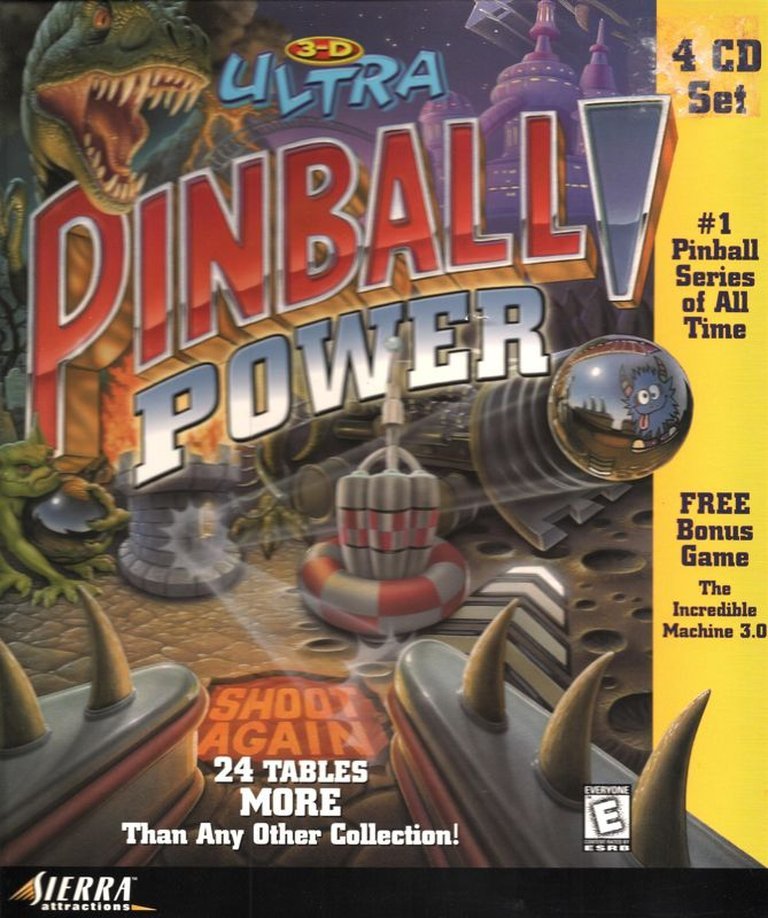
3-D Ultra Pinball: Power! is a 1999 compilation game that bundles together multiple pinball experiences: the space-themed 3-D Ultra Pinball, the horror-focused 3-D Ultra Pinball: Creep Night, the dinosaur-adventure 3-D Ultra Pinball: The Lost Continent, and the puzzle game The Incredible Machine 2. Additionally, it features a playable demo of 3-D Ultra Minigolf with three holes, offering players a diverse collection of pinball tables and puzzle challenges.
3-D Ultra Pinball: Power! Cheats & Codes
PC
Select a pinball table and begin game play. Press [Esc], type kermit, and press [Enter] to enable cheat mode. Press [Esc] and type one of the following codes, then press [Enter] to activate the corresponding cheat function.
| Code | Effect |
|---|---|
| kermit | Enable cheat mode |
| aloadofballs | 98 balls |
| extraball | Extra ball |
| joshuajein | Disable tilts |
| pickupball | Select and move ball with mouse |
| kickback | Ball always remain in play |
3-D Ultra Pinball: Power!: Review
Introduction
In the waning years of the 20th century, as personal computers embraced CD-ROMs and multimedia capabilities, Sierra On-Line’s Dynamix studio delivered a definitive ode to digital pinball: 3-D Ultra Pinball: Power!. Released in 1999 as a comprehensive compilation, this package gathered four landmark titles from the franchise—3-D Ultra Pinball (1995), Creep Night (1996), The Lost Continent (1997), and NASCAR Pinball (1998)—plus a demo of 3-D Ultra Minigolf and the full version of The Incredible Machine v3.0. More than a mere collection, it encapsulates a series that redefined what digital pinball could be: ambitious, thematically rich, and technically audacious for its era. Yet, as we revisit this artifact, we confront a paradox: a series that pushed boundaries while wrestling with fundamental flaws in physics and design. This review dissects Power!’s legacy, arguing that while its technical shortcomings are glaring, its creative ambition and cultural impact cement its status as a vital, if imperfect, pillar of 1990s gaming history.
Development History & Context
Dynamix and Sierra’s Vision for Digital Pinball
3-D Ultra Pinball emerged from the fertile creative ecosystem of Dynamix, a studio Sierra acquired in 1990 for $1.5 million. Under the leadership of Jeff Tunnell, Dynamix retained autonomy, allowing it to pivot from complex strategy games (like the beleaguered Outpost, which inspired the first pinball game) to accessible multimedia experiences. The vision was clear: leverage the CD-ROM revolution to create pinball simulations that transcended arcade limitations. As Dynamix’s Kyle Miller noted, the goal was to “escape from traditional arcade pinball” by integrating animation, multi-table narratives, and dynamic targets—spaceships, goblins, dinosaurs—that materialized organically on the playfield.
Technological Constraints of the Era
The original 3-D Ultra Pinball (1995) was a technological showcase for Windows 3.1/95, boasting pre-rendered 3D tables at 640×480 resolution and 256 colors—impressive for its time but inherently limited. Subsequent titles iterated on this engine: Creep Night (1996) refined the visuals with reduced dithering, while The Lost Continent (1997) and Thrillride (1998) scaled to 800×600 with 16-bit color. Yet, physics remained a persistent Achilles’ heel. As Hardcore Gaming 101 observed, the ball “floats like a balloon,” with flippers that send it “in almost random directions,” rendering precision shots nearly impossible. This stemmed from the era’s raw processing power—prioritizing visual spectacle over physical fidelity.
The Gaming Landscape at Launch
Power! arrived amid a renaissance for digital pinball. Microsoft’s bundled 3D Pinball: Space Cadet dominated desktops, but Dynamix’s series carved a niche through thematic depth. Competitors like Full Tilt! and Pinball Fantasies focused on arcade authenticity, while Ultra embraced “computer razzamatazz”: interconnected tables, metagames, and licensed properties (e.g., NASCAR). By 1999, the franchise had sold over 500,000 copies, reflecting a market hungry for genre innovation. Power! capitalized on this, positioning itself as the ultimate retrospective of a series that dared to reimagine pinball as a narrative-driven experience.
Narrative & Thematic Deep Dive
Four Worlds, Four Narratives
Power!’s strength lies in its thematic diversity, each game weaving a distinct narrative tapestry:
– 3-D Ultra Pinball: A sci-fi epic inspired by Outpost, the story centers on colonists building a starship across three interconnected tables (Colony, Command Post, Mine). Digitized voices guide players through challenges like “comet impacts” and “attacking tanks,” culminating in a launch sequence that merges pinball with strategy.
– Creep Night: A horror homage where players battle ghouls across three tables—Castle, Tower, and Dungeon. The narrative unfolds through tasks like defeating zombies or reanimating Frankenstein’s monster, with goblin taunts (“Wanna play?“) providing darkly comic relief.
– The Lost Continent: An Indiana Jones-style adventure where Professor Spector, Mary, and Rex Hunter escape a Heckla-controlled island. The 16-table journey through Jungle, Temple, and Chambers layers pinball with exploration, complete with voice-acted urgency (“Get to the temple!“).
– NASCAR Pinball: A licensed spectacle where players race as Dale Earnhardt or Bobby Labonte. The narrative is minimal—qualifying laps, pit stops—but radio chatter from pit crews (“Knock that wall down!“) injects personality.
Dialogue, Themes, and Tropes
Voice acting is a double-edged sword. Mission Control’s monotone in the original game and Mary’s repetitive directives in The Lost Continent can grate, yet goblin cackles in Creep Night become iconic. Thematically, the series subverts pinball’s arcade roots: Creep Night leans into horror tropes (haunted castles, mad scientists), The Lost Continent blends pulp adventure with ecological peril, and NASCAR merges sports with mechanical spectacle. As TV Tropes notes, it’s “When All You Have Is a Hammer…”: bonus modes often involve smacking temporary targets, reinforcing the idea that digital pinball could expand beyond traditional rules.
Gameplay Mechanics & Systems
Core Loops and Innovations
Each game refines pinball’s core loop with unique twists:
– Metagames: The original Ultra features a colony-building minigame; The Lost Continent uses “continues” as replay credits.
– Dynamic Elements: Temporary targets—e.g., swiveling cannons in The Lost Continent or magnetic ghosts in Creep Night—add unpredictability.
– Progression: The Lost Continent’s 16 tables advance through “levels,” while NASCAR’s garage-to-track sequence simulates race preparation.
Combat, Character Progression, and Flaws
“Combat” is abstract: hitting targets to defeat zombies or destroy robots. Progression is tied to score thresholds and table completion, rewarding persistence. Yet, the physics cripple depth. As Hardcore Gaming 101 lamented, the ball’s “floaty” behavior and useless nudge mechanics make advanced techniques (e.g., flipper passes) impossible. Multiplayer via “hot seat” (pass-and-play) mitigates this, offering social competition, but the core loop often devolves into random ball trajectories.
UI and Anti-Frustration Features
The UI is minimalist, with clear instructions and adjustable difficulty. Thrillride (included in some Power! editions) allows customizing ball counts and tilt warnings. A crucial anti-frustration feature—the “bozo ball” (replacing a failed launch)—prevents endless stalling. Still, repetitive speech samples and MIDI glitches (in early games) undermine immersion.
World-Building, Art & Sound
Settings and Atmosphere
Power!’s worlds are defined by their environments:
– Space Colony: Sterile, metallic surfaces with blue-tinted lighting in 3-D Ultra Pinball.
– Haunted Castle: Gloom-laden dungeons and cobweb-covered corridors in Creep Night.
– Prehistoric Jungle: Volcanic backdrops and ancient ruins in The Lost Continent.
– NASCAR Track: Pit garages and speedway vistas in NASCAR.
Each table is a self-contained diorama, complete with animated elements (e.g., collapsing bridges in Lost Continent or ghostly apparitions in Creep Night). The interconnected tables in Ultra and Lost Continent create a sense of place, with seamless warping between zones.
Visual Direction and Technical Limitations
Pre-rendered 3D graphics were a selling point, but age is unkind. Dithering creates grainy textures (especially in 256-color games), and scaling to higher resolutions pixelates elements. Thrillride’s 800×600 High-Color mode improves this, but animations remain choppy. Art direction compensates: Creep Night’ gothic spines and Lost Continent’s dinosaurs evoke B-movie charm, while NASCAR’s licensed drivers add authenticity.
Sound Design: Mixed Blessings
Digitized speech and sound effects are atmospheric but plagued by repetition. The original game’s MIDI music suffers from “stuck notes,” while Creep Night’s digitized tracks are richer. Flipper “pops” and laser “zaps” feel mechanical but lack the weight of real pinball. Yet, voice acting sells the horror (Creep Night’s goblins) and adventure (Lost Continent’s Mary), making the audio a defining feature despite flaws.
Reception & Legacy
Critical and Commercial Reception
Individual titles were commercial successes—3-D Ultra Pinball sold 250,000 copies by 1996—but critical praise was mixed. Creep Night scored 3/5 from MacUser for atmosphere, while The Lost Continent was lauded for ambition. Power! itself received an 80% critic average (MobyGames), with players rating it 4/5. Critics acknowledged its value as a “complete package” but noted dated physics. As Retro365 observed, the series “captured the essence of the arcade experience while bringing it into homes,” even if it “couldn’t dethrone Space Cadet.”
Influence and Evolution
Power! cemented the 3-D Ultra brand as a pioneer of thematic pinball. Its innovations—multi-table progression, licensed properties—paved the way for titles like Pro Pinball. The series’ technical legacy is dual-edged: it pushed 3D rendering and multimedia but exposed the difficulty of simulating physics. By 2000, with Thrillride’s Game Boy Color port (a top-down adaptation), the series shifted toward accessibility. Sierra retired the “3-D Ultra” label in 2001 after its acquisition by Vivendi, but Power! endures as a time capsule of 90s multimedia ambition.
Conclusion
3-D Ultra Pinball: Power! is a paradox: a compilation defined by both brilliance and imperfection. Technically, its physics are flawed, its visuals dated, and its audio repetitive. Yet, as a holistic experience, it remains unparalleled in its scope. The series’ genius lay in embracing pinball not as a arcade relic but as a canvas for storytelling—from sci-fi epics to horror romps. Power! is less a “best of” and more a “what if”: a vision of digital pinball as a world-building medium, complete with narratives, characters, and evolving tables.
For modern players, it is a museum piece—reminding us of an era when CD-ROMs promised boundless creativity. For retro enthusiasts, it is a love letter to a genre’s digital reinvention. In the end, Power!’s legacy is not in perfecting pinball, but in demonstrating its potential. As one critic noted, it’s “a great twist on an old classic,” and in the annals of gaming history, that twist resonates powerfully. Final verdict: A flawed masterpiece, but an essential landmark in digital pinball’s evolution.