
- Release Year: 2012
- Platforms: Windows
- Publisher: rondomedia Marketing & Vertriebs GmbH
- Genre: Compilation
Description
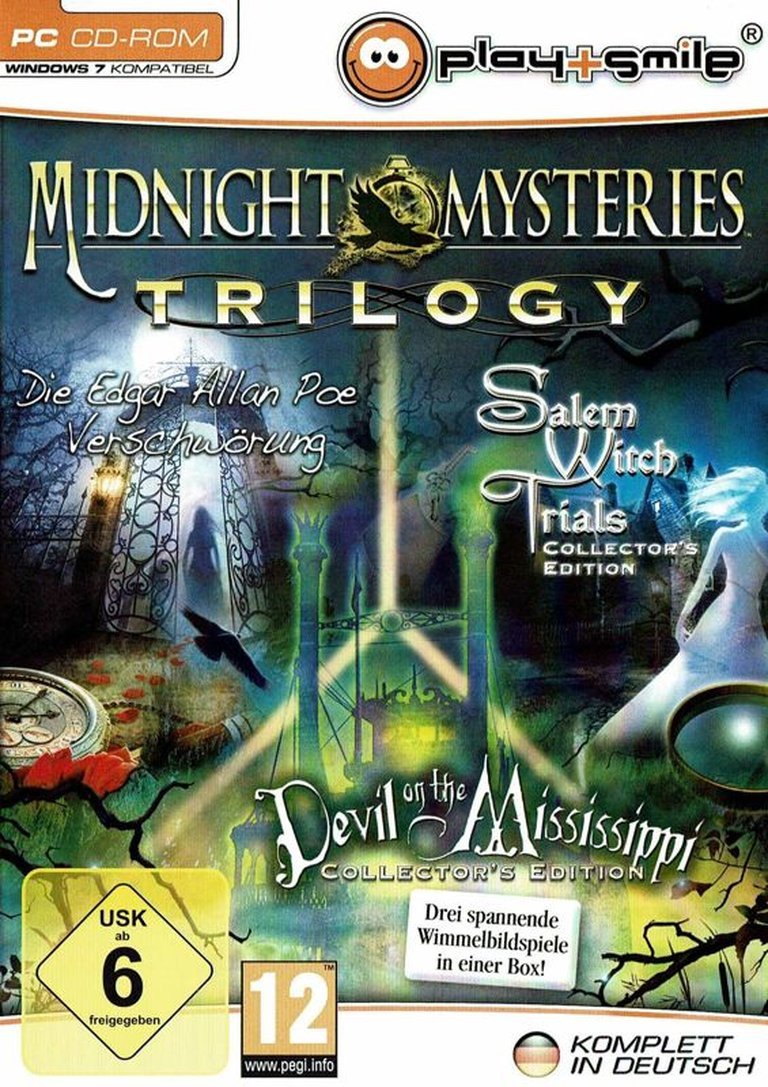
Midnight Mysteries Trilogy is a compilation of three hidden object adventure games that players explore as a writer encountering paranormal visits from famous historical figures. Journey through time to solve the mysteries surrounding Edgar Allan Poe’s suspicious death, uncover the secrets of the Salem Witch Trials through Nathaniel Hawthorne’s lineage, and navigate Mark Twain’s enigmatic encounters on the Mississippi River, piecing together clues to help restless spirits find peace.
Midnight Mysteries Trilogy Guides & Walkthroughs
Midnight Mysteries Trilogy: Review
Introduction
In the late 2000s, as casual gaming surged through digital storefronts, MumboJumbo’s Midnight Mysteries Trilogy (2012) emerged as an ambitious compilation bundling three hidden-object adventures: The Edgar Allan Poe Conspiracy (2009), Salem Witch Trials (2010), and Devil on the Mississippi (2011). This anthology reimagines the deaths of iconic historical figures—Edgar Allan Poe, Nathaniel Hawthorne, and Mark Twain—as supernatural cold cases, tasking players with aiding their restless spirits. While technically constrained by the era’s casual-gaming limitations, the trilogy weaves literary history into interactive mysteries with unprecedented depth. Its thesis lies in its dual identity: as both a product of its genre’s boom and a prescient exploration of narrative-driven storytelling within accessible frameworks.
Development History & Context
Studio Vision & Technological Constraints
MumboJumbo, a Dallas-based studio renowned for casual titles like Luxor, pivoted toward narrative ambition with Midnight Mysteries. Director Ben Gripkey’s vision was to elevate hidden-object games (HOGs) by embedding them in historically grounded, adult-oriented mysteries—a rarity in a market dominated by fantasy match-3 puzzles. Each title was developed in 6–12 month cycles, leveraging Flash-era simplicity to ensure accessibility on low-spec PCs (Windows XP/Vista, 256MB RAM). However, this constraint limited innovation; later titles in the series (e.g., Haunted Houdini) introduced refined mechanics, but the 2012 compilation retained the foundational duology’s unpolished design.
Gaming Landscape & Industry Impact
Released during HOGs’ golden age (2008–2012), the trilogy capitalized on the rise of digital storefronts like Big Fish Games. Its focus on American literary icons—Poe, Hawthorne, Twain—positioned it as a cultural curio, appealing to players seeking cerebral puzzles over mindless clicking. While technically rudimentary, MumboJumbo’s rapid iteration allowed for thematic experimentation, with Salem Witch Trials introducing time-hopping mechanics that preceded narrative games like Life is Strange. The trilogy’s legacy as a “literary HOG” pioneer, however, remains niche, overshadowed by its own constraints and the genre’s eventual saturation.
Narrative & Thematic Deep Dive
The Edgar Allan Poe Conspiracy: Gothic Betrayal
The inaugural game reimagines Poe’s 1849 death as a conspiracy orchestrated by his rejected fiancée, Elmira Royster, and her brothers. Haunting the player’s study, Poe guides them through his works—from The Raven to The Purloined Letter—to unearth evidence of murder. The narrative excels in blending Poe’s macabre motifs (pendulums, secret rooms) with historical intrigue, culminating in the revelation that Royster’s brothers silenced Poe to preserve their family’s honor. Themes of artistic persecution and the “myth of the doomed genius” resonate, though the plot occasionally leans on tropes like You Have Outlived Your Usefulness (villains eliminating accomplices).
Salem Witch Trials: Collective Guilt & Redemption
Nathaniel Hawthorne’s ghost anchors this sequel, tormented by his ancestor Judge Hathorne’s role in the 1692 witch trials. Players navigate two timelines—1692 Salem and Hawthorne’s 1850s present—to exonerate accused witches like Sarah Good. The narrative’s strength lies in its exploration of generational sin, symbolized by the scarlet “W” (Mark of Shame) branding victims. Puzzles, such as decoding colonial ledgers, reinforce the theme of historical erasure, while the reunion of Sarah and her daughter Dorothy (Together in Death) delivers catharsis. The game’s critique of mob mentality feels prescient, though its pacing falters during Puritan lore dumps.
Shared DNA: Conspiracy & Historical Reckoning
Both games frame history as unresolved trauma. Ghosts aren’t mere quest-givers; they’re victims demanding closure. This Conspiracy motif—intertwining factual ambiguity (Poe’s opium use, Hawthorne’s Puritan ties) with supernatural redemption—elevates the trilogy beyond disposable casual fare. Devil on the Mississippi furthers this by centering Twain’s feud with Shakespearean skeptics, but the anthology’s core remains the tension between historical truth and literary mythmaking.
Gameplay Mechanics & Systems
Core Loop: Hidden Objects & Time Travel
The trilogy epitomizes mid-2000s HOG conventions: static scenes cluttered with context-irrelevant items (e.g., a loket in a barn), logic puzzles (jigsaws, cryptograms), and linear dialogue trees. Salem Witch Trials innovates with era-specific clues—e.g., a colonial key unlocking a Victorian desk—but these moments are rare. The “Deduction Board” (a case-file interface connecting clues) hints at MumboJumbo’s detective ambitions, yet it’s often underutilized.
Innovations & Flaws
– Collectible Clues: Ravens (collectible hint providers) and pocket watches (time-travel devices) add meta-narrative flair but feel gimmicky.
– UI Clunkiness: Static cursors, pixel-hunt scenarios, and abrupt scene transitions frustrated players (per Steam reviews).
– Pacing Issues: Historical tangents (Poe’s deep-cut references) disrupt momentum, appealing to literature buffs but alienating casual players.
Mini-games like ferry-puzzles in Poe or cannon-aiming in Mississippi offer variety, yet their lack of consequence trivializes player agency.
World-Building, Art & Sound
Visual Atmosphere
The trilogy’s art leans into gothic melancholy, echoing Edward Gorey and Arthur Rackham. Poe’s rain-lashed cemeteries and Salem’s autumnal forests use painterly backdrops to evoke literary dread. However, Flash-era limitations—stiff animations, recycled assets—undermine immersion. The “Mark of Shame” (red “W”) in Salem and Poe’s raven motifs stand as rare visual triumphs.
Sound Design as Narrative
Voice acting is uneven (Poe’s ghost veers between gravitas and hamminess), but environmental audio excels. Poe’s creaking floorboards and Salem’s discordant trial strings mirror the era’s chaos. Philip Glass-esque piano loops in Mississippi sustain tension, elevating moments like Twain’s séance. Sound, not graphics, becomes the trilogy’s emotional anchor.
Reception & Legacy
Launch Reception
The 2012 compilation garnered scant coverage, but constituent titles earned mixed reviews:
– Steam: Poe Conspiracy holds “Mostly Positive” (72% of 62 ratings), praised for atmosphere but criticized for jank.
– VideogameGeek: Salem Witch Trials rated 5.5/10, citing “repetitive HOG tropes.”
Sales data is scarce, but re-releases (e.g., 2015 Steam listings) suggest niche longevity.
Industry Influence
While not revolutionary, the trilogy bridged HOG conventions with narrative ambition. Its “historical ghost” framing inspired clones like Dark Tales and Grim Legends. Later entries (Ghostwriting, 2015) expanded interactivity—letting players “rewrite” Dickens’ plots—a mechanic echoed in Dontnod’s Life is Strange. For historians, it represents a pivot toward story-driven casual games; for players, it remains a cult curiosity.
Conclusion
Midnight Mysteries Trilogy is a time capsule of late-2000s casual gaming—flawed yet fascinating. MumboJumbo’s marriage of literary detective work and supernatural drama remains its crown jewel, even as technical constraints and genre conventions curb its reach. Its greatest strength lies in recontextualizing American history as interactive myth, offering players agency over unresolved cultural trauma. For genre devotees and literary completists, it’s an essential artifact; for newcomers, its clunky mechanics may overshadow its thematic ambition. Like Poe’s ghost, it lingers—not as a masterpiece, but as a whisper of what casual storytelling could aspire to be.
Final Verdict: A 7/10 curio—best suited for HOG enthusiasts and history buffs. Its legacy endures in the DNA of narrative-driven casual games, proving that even constrained mediums can yield haunting, memorable experiences.