
- Release Year: 1996
- Platforms: Windows
- Publisher: McGraw Hill Home Interactive
- Developer: McGraw Hill Home Interactive
- Genre: Adventure, Educational
- Perspective: 3rd-person (Other)
- Game Mode: Single-player
- Gameplay: Puzzle elements
- Setting: House
- Average Score: 77/100
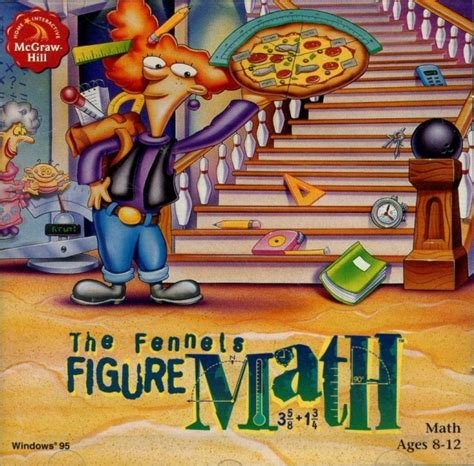
Description
The Fennels Figure Math is an educational adventure game set in a whimsical house filled with eccentric rooms built by Great-Great-Great Grandfather Bezel Fennel to store his strange global collections. Players control Baxter, who must explore themed areas like the North Pole Room, Jungle Room, and Backyard Trailer to find five missing food items for his Uncle Bobby’s chaotic party, solving predominantly mathematical puzzles while navigating quirky scenarios involving historical figures and absurd inhabitants.
Gameplay Videos
The Fennels Figure Math Free Download
The Fennels Figure Math Reviews & Reception
retro-replay.com : The Fennels Figure Math transforms fundamental math skills into a delightful, story-driven quest.
The Fennels Figure Math: A Curious Confluence of Quirky Narrative and Educational Ingenuity
Introduction
In the sprawling, often-overlooked landscape of 1990s edutainment, few titles dared to blend the surreal with the scholastic as boldly as The Fennels Figure Math. Released in November 1996 by McGraw Hill Home Interactive (MHHI), this Windows-exclusive adventure stands as a testament to an era when educational software developers recognized that engagement could be as critical as curriculum. The game invites players into the bizarre, collection-strewn mansion of the Fennel family—a household where ice sculptures coexist with theatrical ducks and alien artifacts. There, alongside the perpetually perplexed Baxter Fennel, one embarks on a quest to solve mathematical enigmas to secure snacks for a party attended by historical oddities like Albert Einstein and Attila the Hun. More than a simple math drill, The Fennels Figure Math is a whimsical, narrative-driven experience that recontextualizes arithmetic as an absurd, treasure-hunting adventure. This review dissects its creation, design, enduring quirks, and its peculiar place in the annals of educational gaming history.
Development History & Context
The Fennels Figure Math emerged from the ambitious venture of McGraw Hill Home Interactive, a division of the century-old educational publishing giant established in 1995 with a mandate to “equally emphasize education and entertainment.” Headquartered in Redwood City, California, MHHI targeted children aged 8–14, aiming to leverage the burgeoning CD-ROM market to create original, story-rich multimedia titles. The project, helmed by Producer Ardice Faoro and Project Manager Assaf Reznik, represented MHHI’s first foray into narrative-based mathematics education—a deliberate shift away from the rote-drilling methodologies dominating the genre.
The game’s creative core was writer Alan Silberberg, a veteran of Nickelodeon, Disney, The Muppets, and The Simpsons. Silberberg’s absurdist sensibilities defined the game’s DNA, crafting a lore centered on Great-Great-Great Grandfather Bezel Fennel, a globe-trotting eccentric who built his mansion as a mausoleum for curiosities. This backstory allowed for themed environments—each a self-contained puzzle box—while the party premise provided a tangible goal: find five food items. Technologically, the game was a product of its constraints. It utilized Smacker Video for FMV cutscenes, requiring Windows 95 or a Macintosh System 7.x, a 486/66MHz processor (or PowerMac), 8MB RAM, and a double-speed CD-ROM drive. The 78-person development team, including composers like David Low and animators like Jason Baskin, balanced technical limitations with creative ambition, ensuring the game remained accessible without sacrificing charm.
Released in November 1996 at a $40–$50 price point, it arrived amid a competitive edutainment landscape dominated by franchises like Math Blaster and JumpStart. MHHI positioned The Fennels Figure Math as an alternative: “a unique combination of story-telling with real math tools and math-problem solving skills instead of the traditional drill and practice approach,” as President Bill Nisen declared. Yet, despite its pedigree, the game would become a footnote in MHHI’s short-lived lifespan, which folded after releasing just a handful of titles like Dr. Sulfur’s Night Lab. Its legacy thus lies not in commercial dominance, but in its audacious fusion of curriculum and chaos.
Narrative & Thematic Deep Dive
The narrative framework of The Fennels Figure Math is a masterclass in absurdity, serving as both a vehicle for learning and a source of sustained engagement. The story opens mid-crisis: Uncle Bobby—a man who believes he was “raised by apes”—has thrown a soiree for guests plucked from history, including Einstein and Attila the Hun. The Fennel siblings, Baxter and Frizzie, arrive to discover they’ve forgotten the food. This setup, penned by Silberberg, injects urgency and humor. Baxter becomes the player’s avatar, a resourceful problem-solver, while Frizzie embodies passive frustration—a running gag where she “sits around,” forcing Baxter to shoulder the burden. This dynamic subtly reinforces perseverance without overt moralizing.
The plot unfolds as a nonlinear treasure hunt through Bezel Fennel’s mansion, each themed room posing a unique mathematical challenge. The narrative’s brilliance lies in its integration of math into the whimsical lore. For instance, the Jungle Room’s overgrown vines require calculating growth rates to clear paths, while the alien-infested Backyard Trailer demands decoding cryptic sequences using logic. Historical cameos, though tangential to gameplay, enhance the surreal tapestry. Einstein might offer a riddle about relativity, while Attila the Hun could bemoan the lack of mead. Silberberg’s dialogue crackles with playful anachronisms and wit, ensuring even tutorial moments feel character-driven.
Underpinning the absurdity are serious educational themes: critical thinking, estimation, data analysis, and the application of measurement tools (rulers, protractors) in real-world scenarios. The game aligns with National Council of Teachers of Mathematics (NCTM) standards, framing math not as an abstract subject but as a toolkit for navigating chaos. The basement “Pit” zone reinforces this, offering math drills as a reward rather than a chore. Ultimately, the narrative champions curiosity and problem-solving, proving that even when faced with ducks performing one-act plays, arithmetic is the ultimate key to survival.
Gameplay Mechanics & Systems
At its core, The Fennels Figure Math is a point-and-click adventure with a heavy emphasis on integrated mathematical puzzles. Players guide Baxter through the mansion, solving challenges to progress. The gameplay loop is elegantly simple: explore a room, identify a mathematical or inventory-based puzzle, solve it, and collect a food item. This structure ensures constant variety, with each themed area introducing new mechanics.
Math puzzles form the bulk of the experience, scaling from basic arithmetic to complex reasoning. Early challenges, like counting ice blocks in the North Pole Room, build confidence, while later tasks—such as determining the correct angle to launch a water balloon in the Teepee Lounge—demand spatial reasoning and estimation. Inventory puzzles, though fewer, add tactile variety; players might combine a thermometer and a jug to measure liquid capacity. The “Fennel Figuring Math machines”—custom-built contraptions resembling Rube Goldberg devices—transform abstract concepts into tangible, interactive tools. For example, a vine-measuring device in the Jungle Room requires players to input growth-rate calculations to calibrate a pruning mechanism.
The interface is tailored for accessibility. A mouse-driven cursor highlights interactive objects, with visual cues (e.g., glowing hotspots) guiding players. Inventory management is streamlined, with items usable via drag-and-drop. A hint system, activated by clicking Baxter’s head, offers subtle nudges without solving puzzles outright. Difficulty levels—adjustable by parents or auto-detected based on progress—cater to varied skill sets, ensuring players aged 7–12 remain challenged but not overwhelmed.
Yet, the design isn’t flawless. Backtracking through the mansion can feel repetitive, as players revisit rooms to re-examine clues. Frizzie’s passivity, while humorous, underutilizes her as a potential co-op character. Despite these minor hiccups, the gameplay excels at making math feel organic. Puzzles are never detached from the story; solving them directly impacts the narrative, creating a satisfying cause-and-effect loop that reinforces learning through consequence.
World-Building, Art & Sound
The Fennel mansion is a triumph of environmental storytelling, a character in its own right. Bezel Fennel’s legacy permeates every corner, transforming the house into a cabinet of curiosities. The North Pole Room, with its glacial blues and crystalline textures, evokes Arctic serenity while hiding puzzles of measurement. The Jungle Room overflows with tangled vines and vibrant greens, its humid atmosphere enhanced by dappled light effects. The Backyard Trailer—a retro-futuristic trailer park—introduces sci-fi whimsy, with bulbous aliens and flickering neon signs. The Teepee Lounge, featuring ducks in feathered costumes, leans into cartoonish absurdity, with spotlights and velvet curtains framing its stage.
Artistically, the game adopts a stylized, painterly aesthetic. Character models, like the wide-eyed Baxter and the perpetually bewildered Uncle Bobby, use expressive animations to convey emotion without detailed textures. Environments prioritize clarity over realism; bright color palettes and bold outlines ensure interactive elements (e.g., numbered plaques or levers) are instantly recognizable. This design choice, born of necessity for lower-end hardware, paradoxically enhances accessibility. Lighting effects—subtle shadows under ice sculptures, sunbeams through jungle canopies—add depth without overwhelming the UI.
Sound design, led by Musical Director Erik Holsinger, complements the visuals. Composers David Low and Russ Gustafson crafted a playful, eclectic score that shifts from jaunty jazz in the Teepee Lounge to tense, synth-driven melodies in the basement. Sound effects—crunching ice, squawking ducks, alien beeps—reinforce each room’s theme, while voiceovers (where present) inject personality into characters. Though limited by 1996 technology, the audio creates an immersive soundscape that makes the mansion feel alive.
Reception & Legacy
At launch, The Fennels Figure Math occupied a niche space in the edutainment market. Priced competitively at $40–$50, it received minimal mainstream coverage, and its legacy remains largely oral. No critic reviews survive in major archives like Metacritic, which lists it with a “tbd” score. However, it garnered a cult following among educators and parents for its innovative approach. My Abandonware and Retro Replay preserve it as a “hidden gem,” with users praising its humor and seamless integration of math into gameplay. Its collectibility is modest; only three players have logged it on MobyGames, reflecting its limited commercial footprint.
Yet, its influence is discernible in subsequent edutainment titles. Games like Go Figure! (2002) adopted similar narrative-driven math frameworks, while Castle of Dr. Brain (1991) shared its emphasis on logic tools. MHHI’s ethos—prioritizing story over drills—anticipated modern trends seen in titles like Math Blaster HyperBlast. The game’s preservation on platforms like the Internet Archive underscores its historical value, offering a window into 1990s educational software design.
Critically, it’s remembered for its creativity more than its execution. Retro Replay notes that while backtracking and Frizzie’s passivity are flaws, the game “strikes a commendable balance between artistic flair and practical design.” Its legacy lies in its authenticity: a product of a time when developers dared to teach calculus through alien code or geometry via duck theatrics. In an era of algorithm-driven personalization, The Fennels Figure Math feels refreshingly human—a quirkier, more chaotic ancestor to today’s gamified learning apps.
Conclusion
The Fennels Figure Math is a time capsule of edutainment ambition, a game where surreal storytelling and scholastic rigor collide with delightful unpredictability. Its greatest achievement lies in its ability to make mathematics feel like an adventure, not a chore. Through Bezel Fennel’s bizarre mansion and Silberberg’s witty narrative, players learn that logic, estimation, and problem-solving are keys to navigating even the most absurd scenarios—from appeasing Attila the Hun to measuring ice sculptures.
While its technical limitations and occasional pacing issues prevent it from being a timeless classic, its strengths are undeniable. The art direction, with its vibrant rooms and expressive characters, creates a world brimming with charm. The gameplay, anchored by meaningful puzzles, ensures that every solved equation feels like a victory. Most importantly, it embodied a philosophy that education need not be dry; it can be as whimsical as a duck performing Shakespeare or as thrilling as outsmarting an alien with protractor skills.
In the grand tapestry of video game history, The Fennels Figure Math occupies a unique thread—a testament to a moment when educational software dared to be as imaginative as it was instructive. For historians and gamers alike, it remains a curious, delightful relic: a reminder that sometimes, the best way to learn math is to get lost in a house where anything can happen.