
- Release Year: 2007
- Platforms: Windows
- Publisher: ak tronic Software & Services GmbH, Buka Entertainment, THQ Inc.
- Genre: Compilation
- Game Mode: Online PVP, Single-player
- Setting: World War II
- Average Score: 87/100
Description
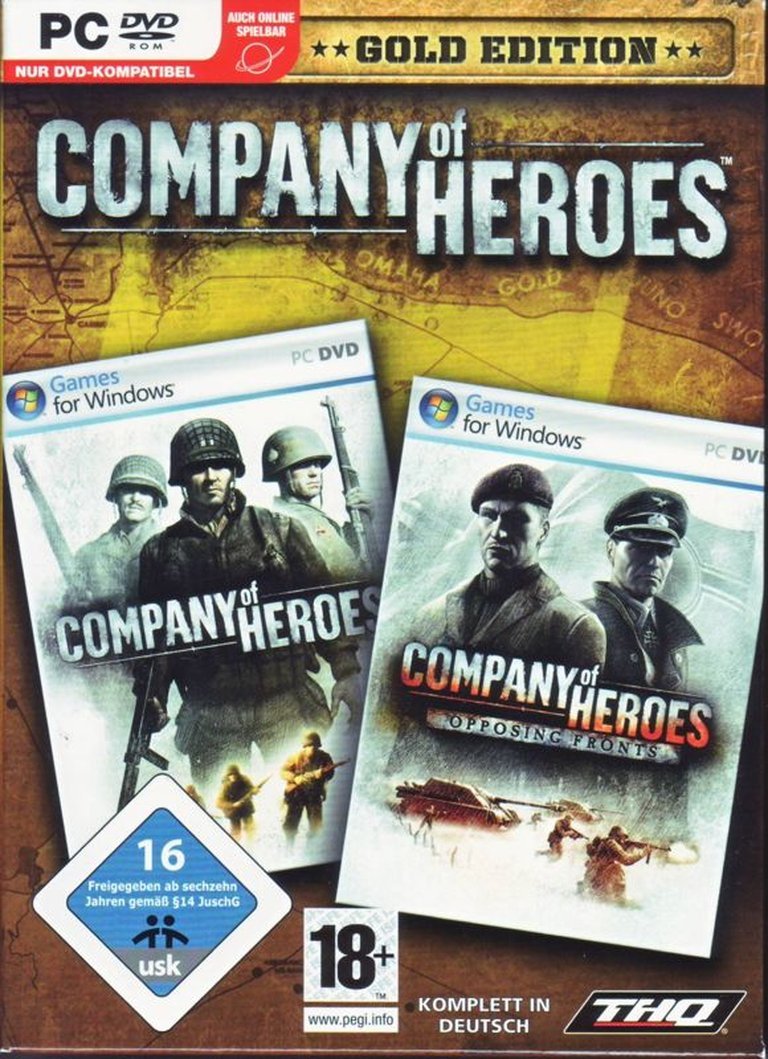
Company of Heroes: Gold Edition is a compilation of the acclaimed World War II real-time strategy game, bundling the original title and its expansion ‘Opposing Fronts’. Players engage in intense tactical battles across historically inspired European theaters, commanding Allied forces during the Battle of Normandy and liberation of France, or controlling German units in the expansion. The game emphasizes strategic resource capture, base building, and squad-based combat to achieve victory.
Company of Heroes: Gold Edition Cracks & Fixes
Company of Heroes: Gold Edition Patches & Updates
Company of Heroes: Gold Edition Mods
Company of Heroes: Gold Edition Guides & Walkthroughs
Company of Heroes: Gold Edition Reviews & Reception
retro-replay.com : Company of Heroes: Gold Edition stands as a benchmark in real-time strategy, combining fast-paced skirmishes with thoughtful resource management.
theblitz.club : Thoughtful decision making and using your mind to overcome obstacles is almost completely sacrificed to the god of pretty graphics.
Company of Heroes: Gold Edition Cheats & Codes
PC
Start the game with the -dev command line parameter. Then, press [Ctrl] + [Shift] + ` (tilde key) during gameplay to open the console. Enter the codes in the console.
| Code | Effect |
|---|---|
| FOW_Toggle | Toggles Fog of War on/off |
| FOW_RevealAll | Remove Fog of War |
| ee_bigheadmode(1) | Big Head Mode ON |
| ee_bigheadmode(0) | Big Head Mode OFF |
| setsimrate |
Set game speed (enter a number, e.g., 10 for normal speed) |
| taskbar_hide | Hide taskbar |
| taskbar_show | Show taskbar |
| statgraph() | Enable statgraph_channel codes |
| statgraph_channel(“fps”) | Display frames per second |
| restart | Restart game |
| abortgame | Quit game |
| Player_SetResource(Game_GetLocalPlayer(), RT_Manpower, 9999) | Adds 9999 manpower |
| Player_SetResource(Game_GetLocalPlayer(), RT_Munition, 9999) | Adds 9999 munition |
| Player_SetResource(Game_GetLocalPlayer(), RT_Fuel, 9999) | Adds 9999 fuel |
| Player_SetPopCapOverride(Game_GetLocalPlayer(), 1000) | Increases popcap limit to 1000 |
| Player_SetResource(Game_GetLocalPlayer(), RT_Command, 5) | Add 5 command points |
Company of Heroes: Gold Edition: Review
Introduction
Few video games transcend their genre to become cultural touchstones, but Company of Heroes: Gold Edition stands as an enduring monument to real-time strategy (RTS) excellence. Released in 2007 as a compilation bundling the 2006 original Company of Heroes and its 2007 expansion Opposing Fronts, this collection redefined World War II gaming by blending visceral tactical depth with cinematic spectacle. Over a decade and a half later, it remains a benchmark for immersive warfare simulations, earning universal critical acclaim and a passionate cult following. This review examines how Gold Edition achieved its legendary status—from its revolutionary mechanics to its harrowing depiction of war—and why it continues to influence strategy gaming today.
Development History & Context
Company of Heroes emerged from Vancouver-based Relic Entertainment, the studio behind the seminal Homeworld and Warhammer 40,000: Dawn of War. Under the leadership of producer John Johnson and designers Rob Cunningham and Josh Mosqueira, the team sought to craft a WWII RTS that prioritized squad-level tactics over abstract base-building. Development spanned over three years, peaking with 100 personnel working on the project—a colossal effort for 2006. Technologically, Relic debuted the proprietary Essence Engine, a groundbreaking system that enabled high-dynamic-range lighting, normal mapping, and advanced shaders. Coupled with the Havok physics engine, it delivered unprecedented realism: buildings collapsed dynamically, tank tracks churned mud, and debris scattered with lifelike force. This tech leap made Company of Heroes the first commercial game to support DirectX 10 via a 2007 patch, further cementing its innovative edge.
The 2006 gaming landscape was dominated by traditional RTS titles like Age of Empires III and Command & Conquer 3. Company Heroes disrupted this paradigm by focusing on tactical authenticity, eschewing resource-gathering micromanagement for territory-based control of strategic points. As THQ’s flagship title under the nascent “Games for Windows” initiative, it capitalized on growing PC gaming communities, while its mature ESRB rating (M for violence and strong language) signaled a departure from sanitized war narratives. The 2007 Opposing Fronts expansion, later bundled in Gold Edition, introduced the British and Panzer Elite factions, refining multiplayer balance and adding new mechanics like mobile HQs. By packaging both titles, Gold Edition offered a definitive, polished experience that maximized accessibility without compromising depth.
Narrative & Thematic Deep Dive
The campaign’s narrative unfolds through the eyes of Able Company (29th Infantry Division) and Fox Company (101st Airborne), chronicling their journey through Normandy’s pivotal battles. From the harrowing Omaha Beach landings to the brutal urban combat of Cherbourg and the claustrophobic bocage hedgerows of Operation Cobra, the game grounds its story in historical authenticity. Mission scripts, penned by writers like Duane Pye and Paris Qualles, emphasize the chaos of war over character arcs. Key figures like Captain MacKay and Sergeant Conti (later promoted to Lieutenant after MacKay’s death) are functional avatars rather than developed protagonists, their humanity conveyed through radio chatter and battle cries.
Dialogue excels in immersive authenticity. Soldiers bark orders in period-appropriate slang (“Contact front!” “Panzers, flank left!”), while German opponents like the formidable Tiger tank ace Hauptmann Shultz embody the ruthless efficiency of the Wehrmacht. The expansion’s campaigns—British artillery barrages against Caen’s ruins and Panzer Elite’s desperate counterattacks at Arnhem—parallel the Allied perspective, underscoring WWII’s multifaceted nature. Thematically, the game confronts war’s moral ambiguity: civilians flee burning villages, units sustain catastrophic losses (notably Able Company’s 80% casualty rate postscript), and victory is often pyrrhic. The narrative’s power lies not in storytelling but in environmental storytelling—cratered fields, shattered churches, and abandoned tanks silently recounting the cost of liberation.
Gameplay Mechanics & Systems
Company of Heroes revolutionized RTS design through its territory-control resource system. Instead of harvesting gold or lumber, players capture and hold map-based points generating three resources: manpower (for basic units), munitions (for upgrades and abilities), and fuel (for vehicles and heavy tech). This mechanic creates constant, fluid frontlines as players vie for supply routes, isolating enemy income by severing connections—a stark departure from static base-building.
Combat is built on squad-based tactics and cover mechanics. Infantry squads (4-6 men) gain defensive bonuses in light or heavy cover (walls, hedgerows) but are exposed in open terrain. Vehicles feature realistic armor facings; a Sherman’s frontal armor can shrug off bazooka fire, but its vulnerable side or rear invites penetration. The Havok physics engine elevates engagements: grenades blast craters, artillery scatters body parts, and engineers demolish bridges to trap armor. Veterancy incentivizes survival—American units gain experience through combat, while Germans “purchase” levels at the Kampfkraft Centre. Doctrinal abilities (e.g., American paratrooper drops or German Tiger Ace summons) add strategic depth, rewarding mastery of faction-specific philosophies.
The expansion introduces asymmetric factions. The British excel defensively with emplaced Howitzers and Churchill tanks, while their mobile Command Trucks allow dynamic base repositioning. The Panzer Elite prioritizes speed and versatility, with infantry doubling as anti-tank or anti-air specialists and FlaK 88s repurposing as long-range artillery. Multiplayer supports 2-8 players via Relic Online (THQ’s proprietary matchmaking), with modes like Victory Point Control (ticket-based attrition) and Annihilation (total base destruction). While criticized by wargamers for its “arcade” feel (e.g., troops standing in tank fire), its accessibility remains a strength.
World-Building, Art & Sound
Relic’s art direction achieves documentary-level fidelity. Normandy’s bocage landscapes, complete with hedgerow networks and sunken lanes, are meticulously recreated from historical archives. Textures on Sherman tanks, German Panther tanks, and Wehrmacht infantry uniforms exhibit painstaking detail, while destruction is both visceral and strategic: crumbling buildings provide temporary cover but also funnel fire lanes. The Essence Engine’s lighting and shadow effects, amplified by the DirectX 10 patch, evoke the oppressive gloom of battlefields at dawn or the glare of artillery explosions at dusk.
Sound design is equally immersive. Jeremy Soule’s score blends orchestral bombast with subtle tension, while weapon sounds—from the crackle of an MG42 to the thunderous boom of a Nebelwerfer—deliver tactile authenticity. Voice acting merits special praise: American soldiers grunt and curse authentically (“Goddamn Jerry bastards!”), while German officers bark commands in crisp, unaccented German. Environmental audio—distant artillery, whistling mortars, and panicked civilian screams—forges an atmosphere of relentless peril. Together, these elements transform every skirmish into a sensory warzone, where the crunch of tank treads over rubble feels as significant as strategic decisions.
Reception & Legacy
Company of Heroes launched to unanimous critical acclaim, aggregating 94% on GameRankings and 93% on Metacritic. Reviewers lauded its innovation: IGN hailed it as “PC Game of the Year,” while Eurogamer awarded a perfect 10/10, praising its “perfect storm of visuals, sound, and gameplay.” GameStar (Germany) scored the Gold Edition 87%, noting its “flotter und grafisch beeindruckender Gefechte” (fluid and graphically impressive battles). Commercially, it secured a Silver sales award from ELSPA (100,000+ UK sales) and propelled the series to over 4 million lifetime copies by 2013.
Its legacy is twofold: industry influence and longevity. Company of Heroes pioneered cover-based tactics and physics-driven destruction, inspiring titles like StarCraft II and Hearts of Iron IV. The modding community thrived, with Europe in Ruins and Eastern Front mods extending gameplay for years. Ports to Mac (2012), iOS/Android (2020), and Nintendo Switch (2023) introduced it to new audiences, while the series expanded with Company of Heroes 2 (2013) and 3 (2023). Yet debates persist: hardcore wargamers critique its simplified ballistics and “clickfest” pace, as one TheBlitz reviewer lamented, while others defend its accessibility as a gateway to deeper strategy. Regardless, Gold Edition remains the definitive entry—a masterclass in marrying historical gravitas with thrilling gameplay.
Conclusion
Company of Heroes: Gold Edition is more than a compilation; it is a timeless artifact of interactive storytelling and tactical design. By bundling the original’s visceral Normandy campaign with Opposing Fronts’ refined multiplayer, it delivers the complete Company of Heroes experience—flawed yet sublime. While its arcade-like combat may alienate purists seeking hyper-realism, its emphasis on squad cohesion, environmental destruction, and resource warfare remains unmatched. The Gold Edition’s true genius lies in its balance: a game that respects war’s brutality without sacrificing the adrenaline of RTS competition.
For historians, it is a digital archive of WWII’s pivotal battles. For gamers, it is a benchmark for immersive strategy. Its legacy endures not just in sequels or mods, but in every modern RTS that prioritizes tactical depth over mindless clicking. To this day, Company of Heroes: Gold Edition stands as a monument to interactive excellence—a testament to the power of games to both educate and exhilarate. Final Verdict: An unequivocal classic and an essential pillar of real-time strategy history.