
- Release Year: 2015
- Platforms: Linux, Windows
- Publisher: Zed-eX
- Developer: Zed-eX
- Genre: Action
- Perspective: Diagonal-down
- Game Mode: Single-player
- Gameplay: Puzzle elements, RPG elements
- Setting: Fantasy
- Average Score: 64/100
Description
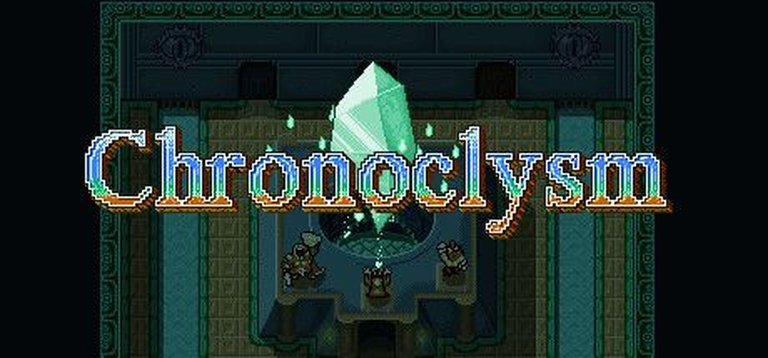
Chronoclysm is a fantasy action game set in a chaotic battle arena where time is repeatedly compressed, creating intricate paradoxes that reshape gameplay. Players engage in multiplayer combat for up to four players (local/online) by building armies of time warriors across rounds, using four unique classes with abilities that manipulate temporal causality. The game features a Steam Workshop-integrated level editor for custom solo puzzles, co-op challenges, and team battles, alongside extensive customization options and microtransaction-free gameplay.
Gameplay Videos
Where to Buy Chronoclysm
PC
Chronoclysm Reviews & Reception
metacritic.com (75/100): Chronoclysm is truly a nostalgic experience, for good or bad. The combat is fun, but is a little minimalistic.
hookedgamers.com (75/100): Chronoclysm is truly a nostalgic experience, for good or bad. The combat is fun, but is a little minimalistic.
Chronoclysm: Review
Introduction
In the crowded landscape of indie arena brawlers, Chronoclysm emerges not as a polished AAA contender, but as a raw, heartfelt passion project forged in the crucible of personal struggle. Developed solo by surger1 (Shane) during unemployment and untreated PTSD, this game channels therapeutic ambition into a chaotic time-bending battle arena. Its core premise—a “time paradox battle arena” where rounds echo forward, transforming missed attacks into future victories—promises gameplay that is as unconventional as its origins. Yet, while Chronoclysm delivers moments of brilliant, laughter-inducing chaos, it is equally defined by its limitations. This review dissects how a solo developer’s vision of shared, anarchic fun translates into a title that is both innovative and frustratingly incomplete, ultimately cementing its place as a cult artifact of the 2015 indie renaissance.
Development History & Context
Chronoclysm is the brainchild of Zed-eX, a pseudonymous solo developer whose journey is as integral to the game’s identity as its code. In a 2015 Reddit post, surger1 revealed the game was crafted amid personal turmoil: an unemployed, mentally ill individual using game design as solace. This context frames Chronoclysm not as a commercial product, but as an act of artistic expression—prioritizing gameplay purity over monetization or polish.
Technologically, the game leveraged the Unity engine, allowing cross-platform releases (Windows, Linux, and eventually macOS). However, solo development imposed stark constraints. Online multiplayer, a critical modern expectation, was deemed “too difficult” to implement initially. As surger1 explained on Steam, platform support faced hurdles—e.g., macOS builds required a Mac machine, a resource the developer lacked. This resulted in a staggered rollout: a free itch.io prototype in March 2015, followed by a $4.99 Steam launch with enhanced features in November 2015.
The 2015 gaming landscape was dominated by online shooters like Call of Duty and indie darlings like Hollow Knight. Yet, Chronoclysm harkened back to a pre-internet era, championing local multiplayer—a dying art. Its release paralleled the resurgence of couch co-op titles like TowerFall Ascension, but with a twist: a time mechanic that replaced randomness with calculated chaos. This niche positioning underscored the developer’s anti-corporate ethos, as surger1 insisted, “Not money, or politics, or an agenda. Just a game with depth for very little money.”
Narrative & Thematic Deep Dive
Chronoclysm eschews traditional narrative, focusing instead on emergent storytelling through gameplay. The “backstory” is vague—a “chaotic battle arena” where warriors battle across compressed timelines—but this ambiguity serves the game’s thematic core: time as both weapon and playground. Each round’s echo mechanic (“missiles become victory parcels”) creates a self-perpetuating loop of cause and effect, where players weaponize their own past mistakes. This mirrors real-life paradoxes, turning failure into opportunity.
Classes embody thematic duality:
– Mage: A balanced archetype symbolizing control, wielding ranged spells that arc through time.
– Builder: Represents adaptation, constructing bridges that rewrite spatial rules.
– Knight: Embodies inevitability, a slow-moving force that closes gaps with brutal certainty.
– Ninja: (Implied via Steam Workshop items) A specter of unpredictability, favoring stealth and traps.
Dialogue is nonexistent, replaced by the language of action—a sword slash, a crumbling bridge, a spell’s trajectory. The absence of text forces players to intuit meaning from the chaos, reinforcing the game’s focus on shared, wordless experiences. Thematically, Chronoclysm is a love letter to imperfection: in a world obsessed with optimization, it revels in the beauty of miscalculated attacks and time loops spiraling into absurdity.
Gameplay Mechanics & Systems
Chronoclysm’s genius lies in its “time compression” mechanic, a deceptively simple loop that evolves into a complex ballet of strategy and mayhem:
- Round Structure: Matches unfold in rapid, 30-second rounds. Players select a class, and actions (spells, sword swings, bridge-building) are recorded.
- Temporal Echoes: Subsequent rounds replay all prior actions. A missed missile might materialize mid-air; a bridge built in Round 1 could crumble under a foe’s feet in Round 3.
- Paradox Resolution: Players can “stop” echoes by interacting with them—e.g., shattering a past spell with a hammer blow.
This creates three core gameplay layers:
– Arena Battle: The flagship 2-4 player mode. Victory conditions vary (survival, capture the flag), but chaos is the constant. Classes counter each other: Knights disrupt Mages’ long-range dominance, Builders exploit Knights’ slowness. The 10 arenas—from lava pits to ice fields—add environmental hazards, turning the time mechanic into a three-dimensional puzzle.
– Challenges: 8 single-player stages that isolate the time mechanic into puzzle-like scenarios. For example, “Knight’s Folly” demands destroying targets by timing sword swings to coincide with echo projectiles. These highlight the system’s depth but feel repetitive without multiplayer dynamism.
– Survival: A co-op wave mode pitting 1-4 players against 11 enemy types and 3 bosses. Here, the time loop amplifies tension, as past botched attacks return to haunt players.
Innovations:
– Equipment System: 30+ items (e.g., “Time-Stop Amulet” or “Echo Boots”) let players tweak classes, enabling customization without bloating menus.
– Level Editor: A Steam Workshop-integrated tool lets players design paradox puzzles. User creations range from intricate mazes to chaotic four-player free-for-alls.
Flaws:
– Combat Minimalism: As Hooked Gamers noted, attacks lack depth. A Knight’s swing, a Mage’s fireball—options are few, leading to repetitive strategies.
– UI Clutter: The equipment screen overwhelms with tiny icons, and match settings (e.g., round length) are buried in submenus.
– Online Multiplayer Absence: The initial lack of online play (added later via Steam’s Remote Play) was a critical oversight, isolating solo players and limiting accessibility.
World-Building, Art & Sound
Chronoclysm’s world is a triumph of constrained ambition. The fantasy setting—crystalline arenas, floating islands—serves as a playground for the time mechanic rather than a narrative driver. Environments are designed for chaos: destructible bridges, teleporting platforms, and hazard zones (lava, spikes) turn every echo into a potential disaster.
Art Direction: Pixel art bridges 8-bit nostalgia with modern vibrancy. Characters are expressive—turtles with hammers, spectral knights—each class boasting multiple skins. The color palette is bold, avoiding the muted tones of many indie games, creating visual clarity amidst the temporal clutter. However, animation is rudimentary; a Mage’s spell-cast feels stiff, undermining the fluidity of combat.
Sound Design: Here, Chronoclysm falters. The chiptune soundtrack is technically authentic to its NES inspirations but grates with piercing, high-frequency notes. Sound effects—a hammer’s clang, a spell’s fizz—are functional but lack punch. As surger1 admitted, music was a low priority, with authenticity prioritized over memorability. The result is a soundscape that feels like a museum piece—technically correct but emotionally sterile.
Reception & Legacy
Chronoclysm launched to muted fanfare. On Steam, it garnered a paltry 7 user reviews at launch, with community forums pleading for online support. Critically, reception was mixed: Hooked Gamers awarded it 75/100, praising “nostalgic couch co-op” and “excellent visuals” but lamenting the “poor music” and lack of online play. Metacritic’s lone 75 score echoed these sentiments.
Commercially, it was a niche success. Priced at $4.99, it attracted budget-conscious players, particularly on itch.io, where it remains free. Steambase’s 43/100 player score underscores its divisive nature—loved for its chaos, criticized for its rough edges.
Legacy:
– Community Modding: The Steam Workshop became Chronoclysm’s lifeline. User-generated puzzles and arenas extended its lifespan, turning it into a sandbox for temporal experimentation.
– Influence: Its time-loop mechanic presaged games like Superliminal and Death’s Door, which similarly weaponized physics for puzzles. Yet, Chronoclysm’s true legacy is as a testament to solo dev tenacity. It proved that profound innovation could emerge from limited resources, even if polish suffered.
– Cult Status: Years later, it’s remembered as a “hidden gem” for local multiplayer. Reviews on Backloggd and Reddit praise its “howlingly hilarious” chaos, while acknowledging its flaws.
Conclusion
Chronoclysm is a paradox: a game both ahead of its time and constrained by the limitations of its creation. Its time-compression mechanic is a genuine innovation, transforming simple battles into dynamic, time-bending narratives. The art is vibrant, the local multiplayer is infectious, and the developer’s personal story lends it authenticity. Yet, these strengths are overshadowed by rough edges—mediocre sound, shallow combat, and a glaring lack of online support at launch.
Ultimately, Chronoclysm’s place in gaming history is secured not as a masterpiece, but as a flawed, human artifact. It embodies the spirit of 2015 indie gaming: experimental, personal, and unapologetically weird. For players seeking a chaotic, low-stakes brawler with friends, it remains a hidden treasure. For everyone else, it’s a fascinating case study of ambition triumphing over polish. In the end, surger1’s gamble paid off—Chronoclysm is less a game and more a time capsule of passion, echoing long after the final round ends.