
- Release Year: 2007
- Platforms: Macintosh, Windows
- Publisher: Insolita Studios
- Developer: Insolita Studios
- Genre: Action
- Perspective: Side view
- Game Mode: Single-player
- Gameplay: Platform
- Setting: Forest, Mountain, Rolling hills, Underground
- Average Score: 63/100
Description
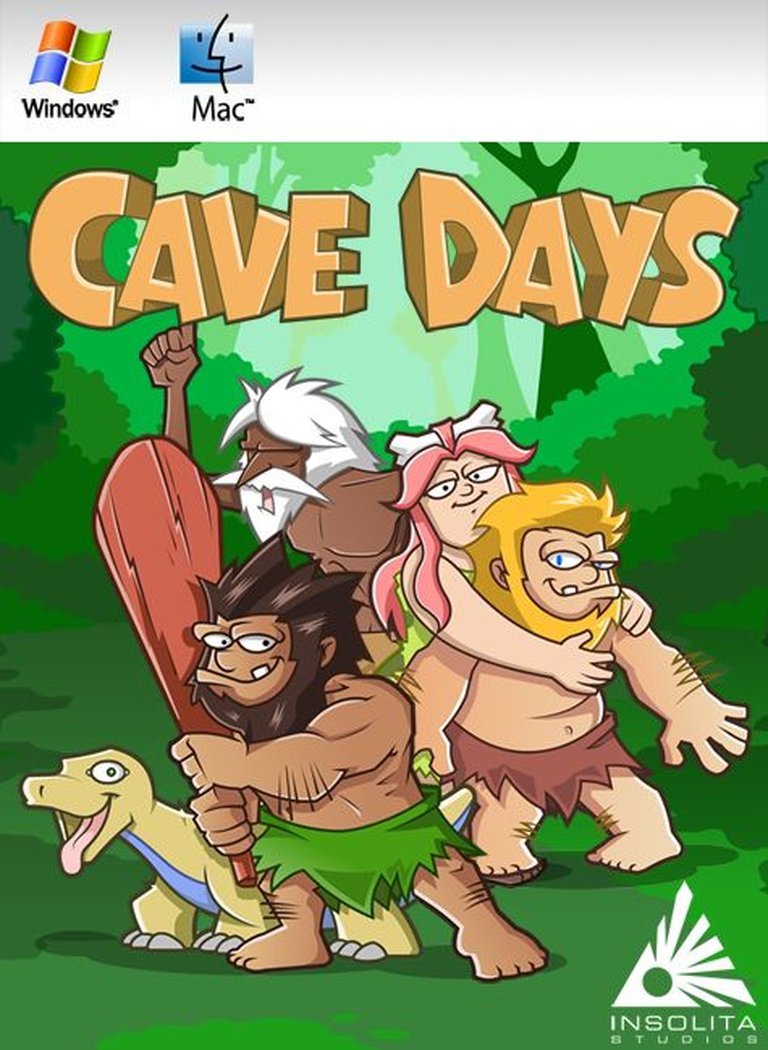
Cave Days is a humorous 2D platform game featuring two cavemen friends, Ugo and Dawson, living in a prehistoric world where they hunt dinosaurs and face the chaos brought by a husband-hunter woman. Players control the characters through 30 stages set in four unique scenarios—mountain, forest, rolling hills, and underground—completing objectives like hunting, collecting fruits, racing, and solving puzzles to gather gems and unlock paths. Gameplay includes jumping, attacking with clubs, using a backpack to carry items, and throwing objects, alongside environmental interactions with carnivorous plants, rock switches, and vines.
Cave Days Free Download
PC
Cave Days Guides & Walkthroughs
Cave Days Reviews & Reception
macworld.com : A fun, old-school platformer that’s great for fans of classic 8-bit games.
insidemacgames.com (60/100): All told, Insolita has done a great job making Cave Days a fun world to explore and a lot of fun to play.
Cave Days: Review
Introduction
In the pre-dawn of the indie renaissance, when pixel art was often dismissed as archaic and 2D platformers were increasingly overshadowed by the rising tide of 3D spectacle, Cave Days emerged in 2007 as a defiantly charming ode to gaming’s foundational roots. Developed by Brazilian studio Insolita Studios, this whimsical platformer follows the misadventures of two cavemen friends, Ugo and Dawson, whose lives are upended by the arrival of a “husband-hunter” woman. Far more than a simple “Mario in leopard skin” clone (as one reviewer astutely noted), Cave Days earns a place in history not for industry-shattering innovation, but for its masterful synthesis of accessible mechanics, pixel-perfect artistry, and a narrative that balanced slapstick humor with surprisingly poignant themes of friendship and aspiration. This review delves into the game’s development DNA, dissects its layered systems, and examines its legacy as a testament to the enduring power of thoughtful, small-team game design.
Development History & Context
Cave Days was born from the vision of Insolita Studios, a Brazilian collective of 12 creatives operating with the scrappy ingenuity characteristic of mid-2000s indie developers. Headed by Lead Game Designer Winston Petty and Lead Programmer Tiago Moraes, the team leveraged Macromedia Director MX—a choice that, while enabling rapid development, would later prove limiting. The engine restricted Cave Days to non-Universal Binary status on Mac, causing performance hiccups on Intel-based systems, a technological constraint noted in contemporary reviews. Released on January 25, 2007, the game arrived during a pivotal moment for PC gaming. The indie scene was gaining traction, catalyzed by titles like Cave Story (2004), but the mainstream remained dominated by AAA 3D epics. Cave Days occupied a unique niche: a commercially distributed, shareware-style platformer with bespoke pixel art, eschewing both the photorealism of big-budget studios and the freeware ethos of burgeoning indie darlings. Its Brazilian roots are most evident in its 2006 JogosBR government award for “Complete Game,” highlighting a burgeoning Latin American game development scene before it gained global recognition. The team’s previous collaborations on titles like Freekscape: Escape from Hell suggest a shared ethos of accessible, story-driven experiences, a vision Petty and Moraes refined into Cave Days‘s prehistoric playground.
Narrative & Thematic Deep Dive
At its core, Cave Days is a deceptively simple story about the collision of primal desires and modern anxieties. Ugo and Dawson are archetypal cavemen: Ugo, the hedonist, believes life is “about eating dinosaurs,” while Dawson, the dreamer, pines for “more than that.” This dynamic is upended by Ula, a “husband-hunter” whose arrival forces the duo into a series of escalating misadventures. The narrative unfolds through 30 stages punctuated by humorous cutscenes voiced by Brazilian talents Fabio Frood, Felipe Montanari, and artist Glauber Kotaki. The dialogue, sparse yet expressive, leverages caveman-speak (“Ugo hungry! Ugo eat!”) to amplify comedic effect while underscoring the characters’ childlike sincerity. Beneath the slapstick—Dawson’s shotgun wedding, Ula’s relentless pursuit—lies a layered exploration of gender roles, ambition, and companionship. Ula’s characterization subverts the “damsel in distress” trope; she is a proactive agent of change, driving the plot while Dawson’s romantic idealism clashes with Ugo’s pragmatic gluttony. The game’s environmental storytelling—Dawson painting rocks, Ugo hoarding dinosaur meat—reinforces themes of self-expression and survival. Even the T-Rex finale, a boss battle of absurd grandeur, symbolizes the primal chaos that threatens domestic bliss. Together, these elements transform Cave Days from a platformer into a fable about finding purpose in a world that oscillates between savage simplicity and social complexity.
Gameplay Mechanics & Systems
Cave Days distinguishes itself through its inventive layering of classic platformer mechanics with emergent object-based puzzles. Players control Ugo and Dawson across four distinct biomes—mountain, forest, rolling hills, and underground—navigating 30 stages with a branching structure. Progress hinges on collecting gems earned by completing diverse objectives: hunting dinos, gathering fruit, racing NPCs, painting rocks, or uncovering creatures under boulders. This variety prevents monotony, though critics like Total PC Gaming noted that objectives eventually “boil down to the same collect ‘x’ fruit” formula. Core actions include jumping, club-swinging combat, and a backpack system enabling item pickup, transport, and throwing. Players can knock out dinosaurs with clubs, then either sidestep them, hurl them into pits, or store them for later—a mechanic blending combat with puzzle-solving and resource management. Environmental interactions are a highlight: carnivorous plants act as cannons, rock switches activate platforms, and vines provide verticality. However, the controls suffer from quirks; the down key drops players through platforms, leading to accidental deaths, as Total PC Gaming lamented. Combat requires tactical thinking—jumping on dinos fails, forcing players to engage with the club-throwing system—but the enemy variety, from harmless red dinos to aggressive raptors and a final T-Rex, adds dynamism. Character progression is minimal, focusing on mastery of mechanics rather than stat boosts, a choice that aligns with the game’s accessible yet skill-based design. The UI is straightforward, with a map tracking progress and auto-saves after each level, though some reviewers found it lacking visual polish.
World-Building, Art & Sound
Insolita Studios crafted a prehistoric world that feels both mythic and lived-in. The four environments—lush forests, treacherous mountains, sun-drenched hills, and labyrinthine caves—are rendered in “highly detailed pixelart” with a retro flair, as touted on the official site. Artist Glauber Kotaki’s designs are expressive: Ugo and Dawson’s exaggerated jaws and club-wielding stances evoke Hanna-Barbera charm, while dinosaurs range from googly-eyed herbivores to spiky predators. The art direction prioritizes readability and personality over realism, using vibrant palettes to guide players through hazards like lava and geysers. Sound design complements the visuals perfectly. Wormhole Studios’ original soundtrack blends tribal percussion jaunty melodies, creating an atmosphere of playful adventure. Voice work, though limited, infuses characters with personality—Ugo’s guttural grunts and Dawson’s earnest exclamations make their friendship feel tangible. Environmental sound effects, from pterodactyl shrieks to splashing water, enhance immersion. The cutscenes, a standout feature, use static character portraits and simple animations to deliver surprisingly effective comedic timing, proving that budget constraints can inspire creative storytelling. Together, these elements forge a world that is both fantastical and relatable, where the “cave days” life isn’t just about survival—it’s about connection and joy.
Reception & Legacy
Upon release, Cave Days received mixed but generally positive reviews, averaging 66% on MobyGames based on four critical assessments. GameXtazy lauded its “cute graphics, charming story, and well-done gameplay,” awarding 80%, while Out Of Eight praised its “enhancements to the genre,” particularly the exploration levels and combat options, scoring it 75%. However, Total PC Gaming criticized repetitive level design and frustrating controls, giving it a mere 51%, and Macworld deemed it “unchallenging for experienced gamers,” rating it 60%. Commercially, it underperformed, with only a handful of players collecting it on MobyGames, though its dual Windows/Mac release demonstrated cross-platform ambition. Over time, Cave Days has been reevaluated as a cult classic of indie platforming. Its JogosBR award and inclusion in compilations of Brazilian game history cement its cultural significance within its home country. While it didn’t spawn sequels or direct imitations, its legacy lies in embodying the mid-2000s indie ethos: accessible, art-driven, and unapologetically fun. The branching level structure and object-based interactions prefigured design trends in later indies, and its emphasis on humor over challenge paved the way for titles like Pikuniku (2019). In an era chasing graphical fidelity, Cave Days remains a reminder that pixel art and heartfelt storytelling can create experiences as enduring as any blockbuster.
Conclusion
Cave Days is a flawed yet endearing relic of a bygone era, a game that wears its limitations like badges of honor. Its repetitive objectives and simplistic combat may test the patience of hardened platformer veterans, but these shortcomings are overshadowed by its infectious charm, inventive mechanics, and surprisingly mature themes. Insolita Studios crafted a world where cavemen’s struggles feel strikingly human, blending club-swinging action with genuine moments of camaraderie and absurdity. The pixel art and sound design remain fresh and engaging, while the branching level system and environmental puzzles showcase a team thinking creatively within technical constraints. Though it never achieved mainstream acclaim, Cave Days holds a vital place in gaming history—a testament to the power of small studios to create big-hearted experiences. It is not a masterpiece by industry standards, but it is a perfectly formed gem: a game that, like its caveman protagonists, finds joy in the simple act of living, and in doing so, reminds us why we fell in love with games in the first place. For anyone seeking a dose of unadulterated, pixelated fun, Cave Days is, to quote its protagonist, “good eat.”