
- Release Year: 2015
- Platforms: Linux, Macintosh, Windows
- Publisher: Camel 101, Kalypso Media Digital Ltd.
- Developer: Camel 101
- Genre: Strategy, Tactics
- Perspective: Diagonal-down
- Game Mode: Single-player
- Gameplay: Customization, Mecha combat, Persistent squads, Real-time tactics, Skill Tree, Squad-based
- Setting: Futuristic, Sci-fi
- Average Score: 50/100
Description
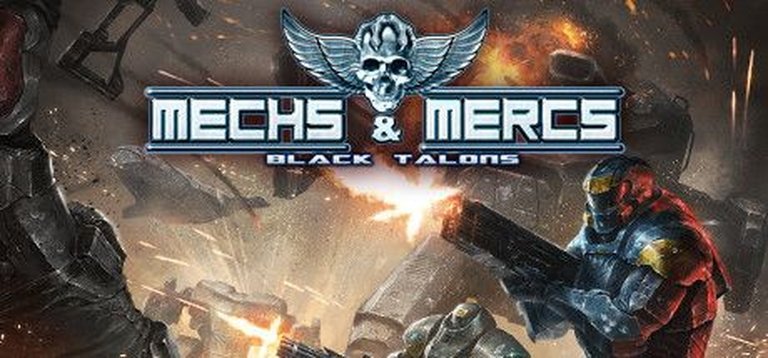
Mechs & Mercs: Black Talons is a real-time tactics game set in a futuristic sci-fi world where players command a mercenary squad aboard a space battlecruiser. As commander, you manage troops, customize mechs, navigate faction relations, and choose between main missions and side objectives in an occupied system, featuring persistent squads, specialized unit classes, and customizable equipment.
Gameplay Videos
Where to Buy Mechs & Mercs: Black Talons
Mechs & Mercs: Black Talons Free Download
Mechs & Mercs: Black Talons Mods
Mechs & Mercs: Black Talons Reviews & Reception
metacritic.com (58/100): Its really hard to rate this game, there are good things and bad
geekdad.com : if you are a fan of Mechwarrior or just clicking on units to send to their deaths, then I strongly recommend trying it out!
wolfsgamingblog.com : providing lackluster at almost every turn
Mechs & Mercs: Black Talons: Review
Introduction
The allure of towering mechs and morally ambiguous mercenary contracts has long captivated strategy gamers, promising a blend of tactical depth and sci-fi spectacle. Mechs & Mercs: Black Talons, released on January 9, 2015, by indie developer Camel 101, arrived amidst a resurgence of real-time tactics (RTT) games like XCOM: Enemy Unknown and Dawn of War II. It promised a unique blend of squad persistence, mech customization, and faction-driven diplomacy within a war-torn star system. Yet, despite its intriguing premise and ambitious scope, Black Talons ultimately emerges as a cautionary tale of unrealized potential—a game that aspires to greatness but is shackled by fundamental design flaws and technical shortcomings. This review deconstructs its legacy, revealing a product whose ambition far outpaced its execution.
Development History & Context
Camel 101, a Portuguese studio known for niche titles like Gemini Wars and later the psychological thriller Syndrome, developed Black Talons as a passion project for the RTT genre. Self-published on Steam with distribution support from Kalypso Media, the game was built on the Unity engine—a choice that enabled cross-platform releases (Windows, Linux, Mac) but constrained its visual fidelity. The release timing was critical: 2015 saw the peak of indie strategy innovation, with games like FTL: Faster Than Light and Darkest Dungeon redefining genre expectations. Yet, Camel 101’s ambition outstripped its resources. The studio’s vision, as detailed in pre-release interviews, was to create a “tactical mercenary simulator” emphasizing resource management and squad survival. However, limited manpower (a core team of ~10 people) and a constrained budget resulted in a game that felt both rushed and undercooked. The Unity engine’s limitations were evident in inconsistent performance and dated animations, while the competitive RTT landscape left little room for a title lacking polish or innovation. Contextually, Black Talons represented a gamble by a small studio to carve a niche in a crowded market, but its development history reveals a project grappling with scope creep and technical compromise.
Narrative & Thematic Deep Dive
Set in the same universe as Camel 101’s Gemini Wars, Black Talons casts players as the commander of the eponymous mercenary company, marooned in the Oberon system after the Tzanar Union conquers the planet Genai. The core narrative—escaping by aiding the Genai resistance—is a straightforward “stranded hero” trope. Missions involve escorting civilians, destroying AA turrets, and repelling invasions, but the narrative delivery is perfunctory, relying on text briefings and a single introductory cutscene. Character development is nonexistent; the Black Talons are faceless tools, and factions like the Noctae Republic or Uver Liberation Army exist as mechanical conduits for diplomacy rather than entities with depth.
Thematically, the game explores mercenary ethics through its faction-reputation system. Accepting contracts with one faction improves relations with them but worsens ties with their enemies, theoretically forcing players into morally ambiguous choices. Yet this system feels shallow. Hostile factions only spawn as random battlefield encounters, while friendly factions merely unlock unit recruits—no meaningful political consequences emerge. The persistent threat of betrayal or negotiation is hinted at but never realized, reducing mercenaries to hired guns rather than strategic actors. The narrative’s failure to capitalize on its rich setting—war-torn planets, corporate intrigue, and existential survival—leaves players with a hollow shell of a story, where missions feel like disconnected skirmishes rather than chapters in a larger saga.
Gameplay Mechanics & Systems
Black Talons’s core loop revolves around managing a mercenary company from aboard the battlecruiser Paladin. Players select squads for missions, customize loadouts, and upgrade ship systems (e.g., teleporters, orbital bombardments). In combat, the game emphasizes real-time tactics with a strict unit cap (typically 4-6 combatants), persistent squad progression, and mech deployment.
Squad Customization & Progression:
Five infantry classes (Recon, Engineers, Assault, Tactical, Support) each possess unique roles, weapons, and skill trees. Recon units offer stealth and scouting, Engineers build turrets, and Assault troops excel in close combat. Squads gain experience per mission, unlocking skills like enhanced accuracy or area-effect abilities. Customization is limited to weapon swaps and minor stat boosts, however—depth is sacrificed for accessibility. Mechs, though visually striking, suffer from poor balancing: they are prohibitively expensive to repair, offer marginal damage output compared to elite infantry, and lack meaningful customization beyond weapon swaps.
Combat & AI:
Combat is marred by systemic flaws. The cover system is fundamentally broken: obstacles provide defensive bonuses only from specific angles, leading to absurd scenarios where troops gain cover behind an enemy position but not from their own. Pathfinding is erratic, with units frequently getting stuck on terrain or structures. Squad AI is equally unreliable; soldiers routinely disobey orders, abandoning cover to charge enemies or ignoring retreat commands. Enemy AI is simplistic, relying on static positioning and predictable flanking attempts.
Faction Relations & Mission Design:
The faction-reputation system theoretically drives mission variety, but in practice, it encourages grinding side contracts to unlock unique recruits. Missions themselves are repetitive, often funneling players through narrow chokepoints into “meat grinder” assaults against fortified positions. Resource management (Command Points for defenses, credits for hiring/reinforcements) adds superficial complexity but no real strategic weight. The game’s pacing is lethargic, with slow unit movement encouraging tedious retreat-and-reinforce cycles to avoid permanent losses. Ultimately, Black Talons fails to deliver meaningful tactical depth, reducing strategy to trial-and-error trial against broken mechanics.
World-Building, Art & Sound
The game’s sci-fi setting is its strongest asset, featuring five diverse planets with dynamic weather (ion storms, snow, rain) that impact combat. Environments—from jungle canopies to urban ruins—are visually distinct, though repetitive asset reuse mars immersion. The Paladin cruiser serves as a functional hub, with upgradeable modules that provide a sense of progression.
Art Direction:
Mech and soldier designs are impressive, drawing inspiration from Warhammer 40K with chunky armor, plasma weapons, and hulking bipedal machines. Units like the “Northstar” mech or “Blackthorne” infantry showcase imaginative concepts. However, execution is inconsistent. Character models are blocky and low-poly, with stiff, unnatural animations—mechs move like cardboard cutouts, lacking weight or impact. Environmental textures are dated, and lighting is flat, robbing battles of atmosphere.
Sound Design:
Audio is a mixed bag. The soundtrack, composed by Gareth Coker (Ori and the Blind Forest), features haunting, ambient tracks that evoke a sense of cosmic isolation. Sound effects, however, are generic: weapon impacts lack punch, and voice lines are recycled clichés (“Contact!” “Regroup!”). Weather effects like rain and thunder provide environmental texture, but they rarely influence gameplay beyond minor stat adjustments. Ultimately, the art and sound fail to elevate the experience beyond functional mediocrity, leaving the rich world feeling under-realized.
Reception & Legacy
Black Talons launched to near-universal derision. Critic scores were abysmal: Hooked Gamers awarded it 30%, calling it “sloppily made” with “clunky and ugly” visuals and “tactics.” Eurogamer Italy (40%) deemed it “uninspired,” while Softpedia (45%) lamented its “rushed and incomplete” state. User reviews on Steam were mixed but tilted negative (43% positive), with common complaints about AI, balance, and narrative.
Legacy Influence:
The game did not influence the RTT genre. Its failures—broken AI, shallow faction systems, and lack of depth—became textbook examples of what not to do in indie strategy games. Camel 101 shifted focus to narrative-driven titles like Syndrome, abandoning the Black Talons universe. The only lasting legacy is its status as a budget title for experimentation: mods like “God Mode Plus” highlight its potential unfulfilled, while its inclusion in bundles (e.g., with Gemini Wars) makes it a footnote for collectors.
Conclusion
Mechs & Mercs: Black Talons is a profoundly frustrating experience. It embodies the dual-edged sword of indie development: ambition without polish, concept without execution. Its core ideas—persistent mercenary squads, faction diplomacy, and mech integration—are compelling, but they are buried under a avalanche of technical flaws and design missteps. The broken AI, nonsensical cover system, and lack of narrative cohesion render it a hollow shell of a tactical game. For hardcore RTT enthusiasts, it offers a curio: a glimpse of what might have been. For everyone else, it is a cautionary tale of ambition unfulfilled. In the annals of video game history, Black Talons will be remembered not as a classic, but as a missed opportunity—a reminder that even the most creative concepts require meticulous craft to succeed. Verdict: A deeply flawed tactical game with a compelling premise but ultimately unfulfilled potential.