
- Release Year: 2017
- Platforms: PlayStation 4, Windows, Xbox One
- Publisher: Electronic Arts, Inc.
- Developer: Criterion Software Ltd., EA Digital Illusions CE AB, Motive Studio
- Genre: Action
- Perspective: First-person / Third-person
- Game Mode: Online PVP, Single-player
- Gameplay: First-person, Mecha, Shooter, Space flight, Third-person
- Setting: Futuristic, Sci-fi
- Average Score: 68/100
Description
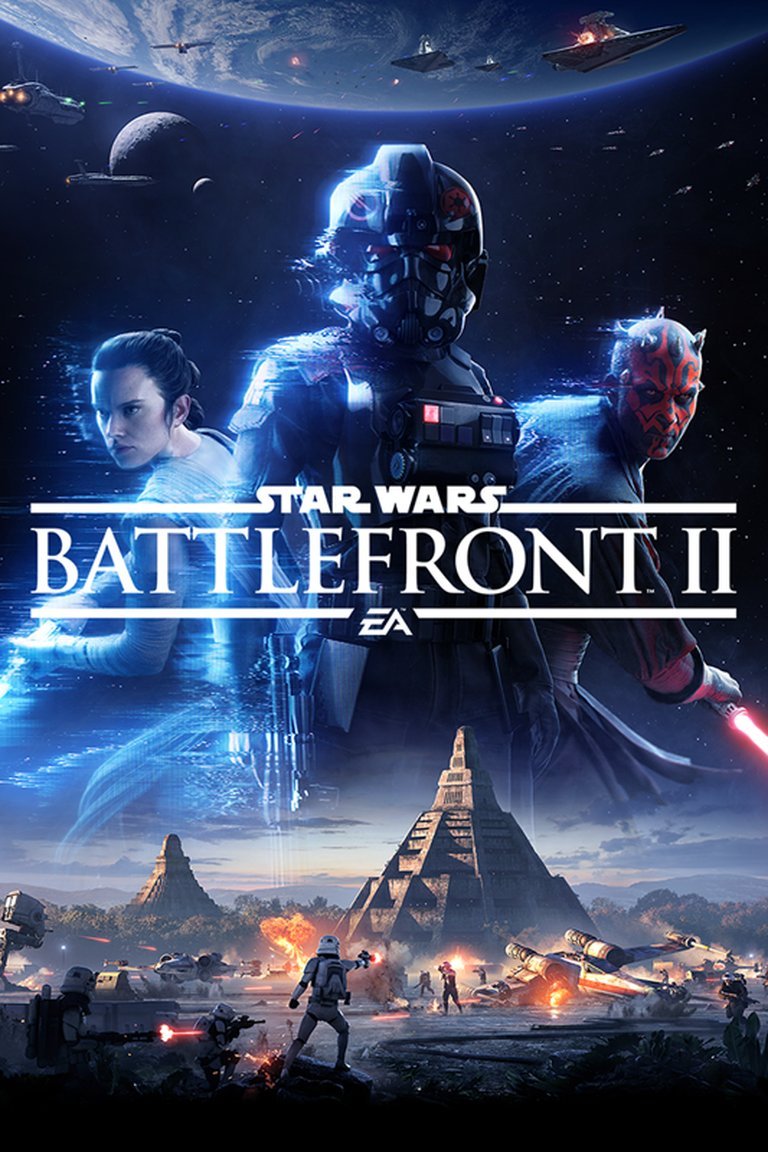
Star Wars: Battlefront II is a sequel that introduces an original campaign bridging the gap between Episodes VI and VII of the Star Wars saga, following Imperial special forces leader Iden Versio. Set during the aftermath of the Death Star’s destruction on Endor, the story explores Iden’s quest to avenge the Emperor and crush the Rebellion. Players experience a versatile third-person and first-person shooter, wielding diverse weapons, piloting starfighters like X-Wings and TIE Fighters, controlling walkers such as AT-STs, and even playing as iconic characters like Luke Skywalker, Leia Organa, and Han Solo.
Gameplay Videos
Where to Buy Star Wars: Battlefront II
PC
Star Wars: Battlefront II Free Download
Star Wars: Battlefront II Mods
Star Wars: Battlefront II Guides & Walkthroughs
Star Wars: Battlefront II Reviews & Reception
metacritic.com (68/100): DICE, Criterion and Motive join forces to give us a game worthy of the Force.
ign.com : Like a Jedi with hatred inside them, Star Wars Battlefront 2 is its own worst enemy.
geeksandgamers.com : Star Wars Battlefront II (2017) improves on everything that DICE did right and added a bunch of new content for Star Wars fans to sink their teeth into.
gamesradar.com : Star Wars Battlefront 2 has transformed from cautionary tale into cult favorite.
Star Wars: Battlefront II Cheats & Codes
Original (2005)
Pause game play, then enter the button sequence.
| Code | Effect |
|---|---|
| X, Y, X, Y | Level Select |
| Up, Up, Up, Left, Down, Down, Down, Left, Up, Up, Up, Left, Right | God Mode / Invulnerability |
| Up, Down, Left, Down, Down, Left, Down, Down, Left, Down, Down, Down, Left, Right | Unlimited Ammo |
| Down, Down, Down, Up, Up, Left, Down, Down, Down, Down, Down, Left, Up, Up, Up, Left | Low Resolution Soldiers |
| Up, Up, Up, Up, Left, Up, Up, Down, Left, Down, Up, Up, Left, Right | Disable HUD |
| Up, Up, Up, Left, Up, Down, Up, Up, Left, Down, Down, Down, Left, Up, Down, Down, Left, Right | Slow Motion Sounds |
| Left, Up, Down, Up, Up, Left, Down, Down, Down, Left, Up, Down, Down, Left, Right | Slow-Motion Sounds |
| Up, Down, Left, Down, Left, Right | Party-Time Jedi/Wampa Hit Effects / Funny Captions |
PC (2017 Remaster)
Enter console commands in the in-game console or via a config file.
| Code | Effect |
|---|---|
| UIDrawEnable | Toggles UI drawing |
| GameTime.MaxVariableFps | Caps maximum variable FPS |
| Window.PosX | Sets window X position |
| Window.PosY | Sets window Y position |
| Window.Width | Sets window width |
| Window.Height | Sets window height |
| Render.DrawScreenInfo | Toggles screen info overlay |
| Render.DrawDisplayInfo | Toggles display info overlay |
| Render.ResolutionScale | Adjusts render resolution scale |
| Render.ResolutionScaleMin | Sets min resolution scale |
| Render.ResolutionScaleMax | Sets max resolution scale |
| Render.DynamicResolutionScaleEnable | Toggles dynamic resolution scaling |
| Render.DynamicResolutionScaleTargetTime | Sets dynamic resolution target time |
| Render.VSyncFlashTestEnable | Enables V-sync flash test |
| Render.OutputBrightnessTestEnable | Enables output brightness test |
| Render.Dx12Enable | Enables DirectX 12 rendering |
| Render.DisplayMappingSdrLuma | Sets SDR luminance mapping |
| Render.DisplayMappingHdr10PeakLuma | Sets HDR10 peak luminance |
| Render.FrameSynthesis | Toggles frame synthesis |
| Thread.ProcessorCount | Sets thread processor count |
| Thread.MaxProcessorCount | Sets max processor count for threads |
| Thread.JobThreadPriority | Sets job thread priority |
| WorldRender.TransparencyShadowmapsEnable | Toggles transparency shadowmaps |
| WorldRender.MotionBlurEnabled | Toggles motion blur |
| WorldRender.MotionBlurRadialBlurMax | Sets motion blur radial blur max |
| WorldRender.MotionBlurQuality | Sets motion blur quality |
| WorldRender.MotionBlurMaxSampleCount | Sets motion blur max sample count |
| WorldRender.FrameSynthesisMode | Sets frame synthesis mode |
| WorldRender.EmitterSunTransmittanceMapEnabled | Toggles emitter sun transmittance map |
| WorldRender.EmitterSunTransmittanceResolution | Sets emitter sun transmittance resolution |
| WorldRender.LightTileCombineOutdoorLightEnable | Toggles outdoor light combining in light tiles |
| WorldRender.LightTileCsPathEnable | Enables light tile compute shader path |
| WorldRender.LightTilePsPathEnable | Enables light tile pixel shader path |
| WorldRender.PlanarReflectionEnable | Toggles planar reflections |
| WorldRender.InterpupillaryDistance | Sets interpupillary distance |
| RenderDevice.VSyncEnable | Toggles VSync |
| RenderDevice.TripleBufferingEnable | Toggles triple buffering |
| RenderDevice.RenderAheadLimit | Sets render-ahead limit |
| RenderDevice.DxDiagDriverDetectionEnable | Enables DirectX driver detection |
| RenderDevice.NvAftermathEnable | Enables NVIDIA Aftermath |
| RenderDevice.Dx11Dot1Enable | Enables DirectX 11.1 features |
| RenderDevice.Dx11Dot1RuntimeEnable | Enables DirectX 11.1 runtime |
| PerfOverlay.Enable | Enables performance overlay |
| PerfOverlay.DrawGraph | Toggles performance graph |
| PerfOverlay.DrawCpuGraph | Toggles CPU graph |
| PerfOverlay.DrawSimGraph | Toggles simulation graph |
| PerfOverlay.DrawGpuGraph | Toggles GPU graph |
| PerfOverlay.DrawFrameGraph | Toggles frame graph |
| PerfOverlay.DrawVblankGraph | Toggles V-blank graph |
| PerfOverlay.DrawFps | Enables FPS display |
| PerfOverlay.DrawSim | Toggles simulation metrics |
| PerfOverlay.DrawGpu | Toggles GPU metrics |
| PerfOverlay.DrawPixelThroughput | Toggles pixel throughput display |
| PerfOverlay.DrawPixelThroughputDisplayFormat | Sets pixel throughput format |
| PerfOverlay.DrawFcat | Toggles FCAT display |
| PerfOverlay.FcatWidth | Sets FCAT width |
| PerfOverlay.LegendDisplayFormat | Sets legend display format |
| PerfOverlay.FpsTimePeriod | Sets FPS calculation time period |
| PerfOverlay.FpsDisplayAlpha | Sets FPS display alpha |
| PerfOverlay.FpsDisplayFormat | Sets FPS display format |
| PerfOverlay.FpsDisplayScale | Sets FPS display scale |
| PerfOverlay.FpsDisplayOffsetX | Sets FPS X offset |
| PerfOverlay.FpsDisplayOffsetY | Sets FPS Y offset |
| PerfOverlay.FrameFileLogEnable | Enables frame file logging |
| NetworkPerfOverlay.Enable | Enables network performance overlay |
| NetworkPerfOverlay.DrawGraph | Toggles network performance graph |
| NetworkPerfOverlay.DrawNetworkDelayGraph | Toggles network delay graph |
| NetworkPerfOverlay.DrawNetworkVariationGraph | Toggles network variation graph |
| NetworkPerfOverlay.DrawPacketLossGraph | Toggles packet loss graph |
| NetworkPerfOverlay.Draw.FreqGraph | Toggles frequency graph |
| NetworkPerfOverlay.Draw.PacketQueueGraph | Toggles packet queue graph |
| NetworkPerfOverlay.DrawBehindTime | Toggles ‘behind time’ display |
| NetworkPerfOverlay.LegendDisplayFormat | Sets network legend format |
| NetworkPerfOverlay.GraphPos | Sets network graph position |
| Screenshot.Render | Triggers a render screenshot |
| Screenshot.Format | Sets screenshot format |
| Screenshot.LayerMode | Sets screenshot layer mode |
| PostProcess.DofMethod | Sets depth of field method |
| PostProcess.BlurMethod | Sets blur method |
| PostProcess.DynamicAOEnabled | Toggles dynamic ambient occlusion |
| PostProcess.DynamicAOMethod | Sets dynamic ambient occlusion method |
| PostProcess.ScreenSpaceRaytraceEnable | Toggles screen space ray tracing |
| PostProcess.ScreenSpaceRaytraceDeferredResolveEnable | Toggles SSR deferred resolve |
| PostProcess.ScreenSpaceRaytraceSeparateCoverageEnable | Toggles SSR separate coverage |
| PostProcess.ScreenSpaceRaytraceFullresEnable | Toggles SSR full resolution |
| list | Lists all available console commands |
Star Wars: Battlefront II: A Galaxy of Ambition and Contention
Introduction
Star Wars: Battlefront II (2017) occupies a unique, almost paradoxical space in gaming history. Released as the sequel to the 2015 reboot, it promised to deliver the ultimate Star Wars fantasy—epic multiplayer battles across iconic planets, a sweeping single-player campaign bridging Return of the Jedi and The Force Awakens, and a free-content philosophy replacing paid DLC. Yet its launch became infamous for one of the industry’s most explosive controversies: a predatory loot-box system that ignited a firestorm of criticism, government scrutiny, and a historic Reddit backlash. Today, after years of transformative updates, Battlefront II stands as a case study in redemption—a technically brilliant, deeply immersive experience marred by a deeply flawed monetization model. This review dissects the game’s legacy, from its ambitious development to its cultural impact, arguing that beneath its contentious surface lies one of the most faithful and mechanically satisfying Star Wars adaptations ever created.
Development History & Context
Conceived in the wake of the 2015 reboot’s lukewarm reception for its lack of a campaign, Battlefront II was developed by DICE (the Battlefield veterans) in collaboration with Motive Studios (handling the campaign) and Criterion Games (space combat). EA’s ambitious vision was twofold: to create a “definitive” Star Wars experience and to pioneer a new monetization frontier. The game ran on Frostbite 3, showcasing unprecedented scale—land battles seamlessly transitioned into space dogfights, with 20v20 ground clashes and 24v24 aerial combat.
The development landscape in 2017 was primed for conflict. Battlefront II arrived during the peak of “games-as-a-service” experimentation, with publishers aggressively testing player tolerance for microtransactions. EA’s initial decision to eschew a Season Pass—instead offering free, era-based content (Clone Wars, sequel trilogy)—seemed progressive, aiming to avoid the community fragmentation seen in its predecessor. However, this goodwill was undermined by a pre-release beta that revealed a progression system tied to loot boxes. The controversial “Star Cards” granted gameplay advantages (e.g., increased damage, health regeneration) through randomized drops, while heroes like Darth Vader required grinding 40+ hours or spending real money. This design philosophy clashed with Star Wars’ aspirational identity, turning lightsaber-wielding icons into paywalls and sparking a tidal wave of backlash that would reshape EA’s corporate strategy.
Narrative & Thematic Deep Dive
The single-player campaign, spearheaded by Motive Studios, centers on Iden Versio (voiced by Janina Gavankar), commander of Imperial special forces unit Inferno Squad. Spanning the pivotal year between Return of the Jedi and The Force Awakens, it explores the Empire’s collapse through a deeply personal lens. The narrative’s greatest strength is its perspective: as a loyalist who witnesses the Empire’s brutality firsthand, Iden’s disillusionment offers a compelling deconstruction of fascist dogma. Missions range from the tragic Battle of Endor—where Inferno Squad’s failure to protect the Death Star II underscores the Empire’s hubris—to Operation: Cinder, a genocidal retaliation ordered by Palpatine’s hologram.
The story’s ambition occasionally falters. Character arcs, particularly Gideon Hask’s (Paul Blackthorne) abrupt heel-turn, feel rushed. Yet standout sequences elevate it: a tense infiltration of Luke Skywalker’s vault on Pillio blurs the line between enemy and ally, while Iden’s defection during Vardos’ destruction humanizes her rebellion. The DLC “Resurrection” extends the narrative 30 years into the Sequel Trilogy, tying into Project Resurrection (the First Order’s child-conscription program) and culminating in a poignant sacrifice that bridges the original and new eras. Thematically, the game interrogates legacy—Iden’s arc questions whether familial duty outweighs ideological loyalty, while the campaign’s conclusion frames the Empire’s fall as a necessary rebirth for the galaxy.
Gameplay Mechanics & Systems
Battlefront II’s core loop is a triumph of mechanical design. Ground combat emphasizes class synergy: Assault troops lead pushes, Heavy units suppress with repeating blasters, Officers buff allies, and Specialists use ion tools to disable vehicles. Reinforcements—unlockable via “Battle Points”—add asymmetrical depth: Droidekas roll into firefights, Jet Troopers rain death from above, and AT-STs provide mobile artillery. This variety is complemented by seamless starfighter combat, where bombers straf capital ships while fighters duel in orbital debris.
The progression system, however, remains the game’s scarred legacy. Initially, loot boxes randomized Star Cards, creating a “pay-to-win” dynamic where real-world spending could unlock superior gear. A 2018 overhaul replaced this with a linear Skill Point system, tying upgrades directly to playtime. While this balanced fairness, it highlighted the original’s fundamental flaw: progression should reward skill, not RNG or wallet depth. Heroes, unlocked at 4,000 Battle Points, now serve as high-impact focal points in modes like Galactic Assault, where three heroes per team turn the tide. Capital Supremacy, a later addition, introduces 40-player objective-driven warfare on maps like Geonosis, blending conquest with hero-based strategy. Despite its rocky launch, the gameplay itself is a masterclass in Star Wars authenticity—blaster bolts hum with weight, lightsaber duels feel weighty, and AT-AT stomps shake the screen.
World-Building, Art & Sound
Battlefront II is a love letter to Star Wars’ visual and auditory tapestry. Environments are meticulously recreated: Endor’s forests bristle with Ewoks, Naboo’s lakes mirror the serene beauty of The Phantom Menace, and Jakku’s desert wastes evoke the desolation of a dying Empire. The art direction balances authenticity with imagination, introducing new locales like Vardos—a scarred Imperial homeworld—and Fondor’s orbital shipyards. Character designs excel, from Iden’s customized Inferno armor to the grimy realism of Rebel troopers.
Sound design elevates every encounter. John Williams’ iconic motifs swell during hero appearances, while Gordy Haab’s original score blends orchestral grandeur with imperial dread. Blaster fire, TIE fighter screeches, and the hum of lightsabers are rendered with pinpoint clarity, creating an audio-landscape that feels lived-in. Even minor details—like the clank of stormtrooper boots or the crackle of comms—immersion players in the galaxy’s gritty reality. This fidelity extends to space battles, where capital ships explode in showers of sparks and X-wings scream through nebulae. For all its controversies, Battlefront II is a sensory triumph, making players feel like they’ve stepped onto a film set.
Reception & Legacy
Upon release, Battlefront II received mixed-to-negative reviews. Metacritic scores hovered around 65–70%, with critics praising its multiplayer and visuals but decrying the campaign’s brevity (6 hours) and loot-box system. IGN’s launch review scored it 6.5/10, calling the progression “an unsatisfying grind.” The controversy, however, overshadowed discourse. EA’s infamous “pride and accomplishment” Reddit defense—regarding the 40-hour hero grind—became the platform’s most-downvoted comment (-667,000+), while Belgium and the Netherlands investigated loot boxes as gambling. EA’s stock plummeted $3 billion, and the game missed sales targets, selling 9 million instead of 10 million.
Yet redemption came through relentless post-launch support. Over 2.5 years, DICE delivered 15+ free updates: the Clone Wars era added Anakin Skywalker and Grievous, Capital Supremacy introduced large-scale land battles, and cosmetic-only loot boxes appeased critics. By 2019, IGN’s re-review scored it 8.8/10, hailing it “one of the best multiplayer adaptations of the Star Wars universe.” Its legacy is twofold: it spurred global regulatory scrutiny of microtransactions, and its live-service model set a precedent for free content. In 2025, a resurgence—fueled by Xbox Game Pass and Star Wars media—rekindled interest, with player counts peaking at 36,000. Modding communities continue to expand its lifespan, adding characters like Grogu and fixing exploits. Battlefront II is now remembered not for its launch failure, but for its improbable journey toward excellence.
Conclusion
Star Wars: Battlefront II is a game of stark contrasts: a technical marvel sabotaged by corporate greed, a heartfelt narrative buried under a monetization avalanche. Its multiplayer remains unparalleled in Star Wars authenticity, offering battles that feel like cinematic set-pieces come to life. The campaign, though flawed, provides a compelling character study in a galaxy often reduced to binary conflicts. And its post-launch redemption arc stands as a testament to developer perseverance.
Ultimately, Battlefront II’s legacy is cautionary and aspirational. It warns against prioritizing monetization over player experience but demonstrates how commitment to craft can salvage even the most tarnished projects. For Star Wars fans, it is an essential experience—an imperfect but deeply loving tribute to a galaxy far, far away. For the industry, it is a landmark: a game that nearly broke the ecosystem, only to become part of its healing. In the end, Battlefront II’s story is one of survival—much like the Rebel Alliance it chronicles—proving that even in the darkest times, hope can prevail.