
- Release Year: 2016
- Platforms: PlayStation 4, Windows, Xbox One
- Publisher: Bandai Namco Entertainment Europe S.A.S.
- Perspective: Third-person
- Game Mode: Online Co-op, Single-player
- Average Score: 90/100
Description
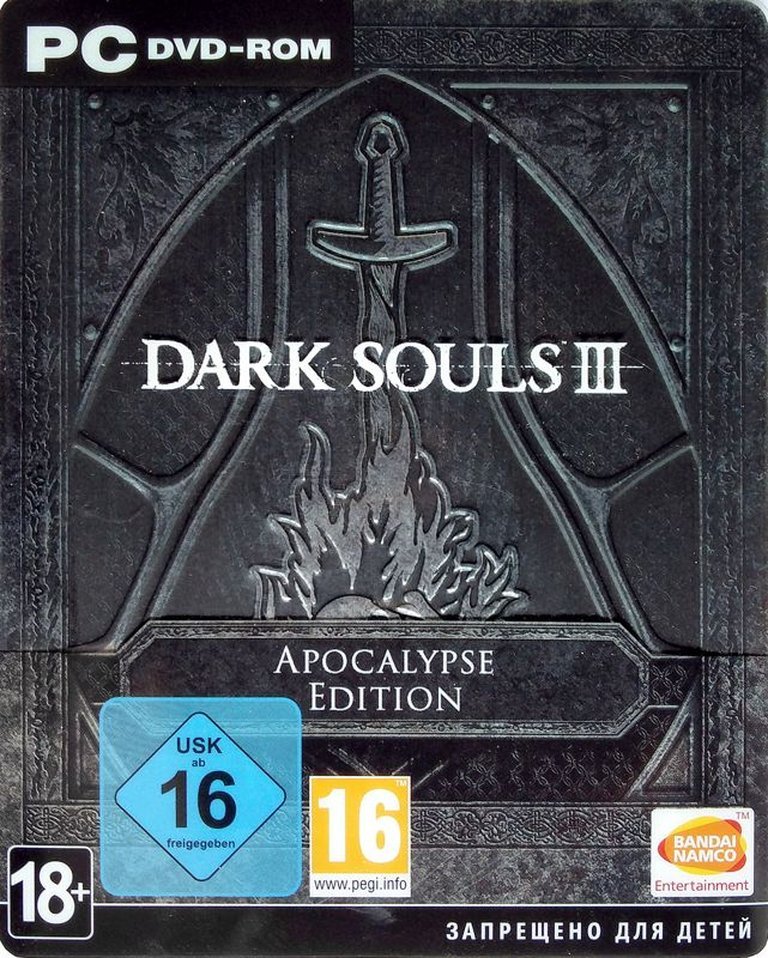
Dark Souls III (Apocalypse Edition) is the third and final chapter in the acclaimed Dark Souls series, set in a desolate fantasy world on the brink of collapse as the age of fire fades. Players step into the role of an unkindled warrior, tasked with a perilous journey to challenge gods, beasts, and the encroaching darkness to stave off apocalypse. This special edition enhances the experience with collectible physical extras, including an alternative steelbook case and the official soundtrack, while retaining the core gameplay of intense combat, deep exploration, and strategic magic use across a hauntingly atmospheric realm.
Dark Souls III (Apocalypse Edition) Patches & Updates
Dark Souls III (Apocalypse Edition) Reviews & Reception
metacritic.com (89/100): It is an achievement in game design and probably the best Souls game ever created by the masterminds of FromSoftware.
ign.com : Dark Souls 3 offers up tons of fierce weapons and a majestic, terrifying new land to explore.
pcgamer.com : Sprawling level design, thrilling combat, and masterful indirect storytelling make Dark Souls 3 the best Dark Souls yet.
opencritic.com (90/100): A content-packed, thrilling, exciting and moving rpg adventure sure to rekindle the fan bonfire.
impartialjudgement.com (93/100): Dark Souls III serves as a fitting finale to the series, refining its hallmark mechanics while introducing new elements that enhance the overall experience.
Dark Souls III (Apocalypse Edition) Cheats & Codes
PlayStation 4
| Code | Effect |
|---|---|
| L2, Square, Options, X (while holding Down-Button) | Unlimited souls |
Xbox One
| Code | Effect |
|---|---|
| LT, X, Start, A (while holding Down-Button) | Unlimited souls |
PC
| Code | Effect |
|---|---|
| Strong Attack Left, Use Item, Open Menu, Confirm (while holding Down-Button) | Unlimited souls |
Dark Souls III (Apocalypse Edition): Review
1. Introduction
In the pantheon of gaming, few series command reverence like Dark Souls. FromSoftware’s magnum opus, a symphony of despair, defiance, and cryptic lore, reaches its zenith with Dark Souls III—a game that doesn’t merely conclude a trilogy but redefines the very essence of its legacy. The Apocalypse Edition, a collector’s steelbook bundled with the original soundtrack, serves as both a physical artifact and a thematic echo of the game’s core: a world consumed by embers and ash. As the final installment in the core Dark Souls saga, Dark Souls III bears the weight of expectation, tasked with honoring its predecessors while carving its own identity. This review posits that Dark Souls III is not merely a worthy conclusion but a masterful synthesis of the series’ evolution—a grim, glorious, and unforgettable final act, elevated by the meticulous presentation of the Apocalypse Edition.
2. Development History & Context
Hidetaka Miyazaki, the visionary architect of Demon’s Souls and Dark Souls, returned to the director’s chair for Dark Souls III, reclaiming the reins after the ambitious but divisive Dark Souls II. Development commenced in mid-2013, concurrently with Bloodborne, though the two projects were handled by largely separate teams. Miyazaki’s vision was clear: to create a “turning point” for the franchise, refining the series’ formula while injecting new vitality. The game’s faster-paced combat—inspired by Bloodborne’s aggression—was tempered by a return to Dark Souls’ deliberate, methodical design. Technologically, FromSoftware leveraged the PS4/Xbox One generation to enhance visual fidelity, with Miyazaki noting the team’s focus on “withered beauty” and environmental storytelling. The gaming landscape in 2016 was primed for Dark Souls III; the “Soulslike” genre had proliferated, and Miyazaki’s name carried immense weight after Bloodborne’s critical triumph. Bandai Namco’s marketing emphasized the game’s finality, framing it as the definitive Dark Souls experience—a promise the Apocalypse Edition’s lavish packaging underscored for collectors worldwide.
3. Narrative & Thematic Deep Dive
Dark Souls III’s narrative unfolds with characteristic vagueness, a tapestry woven through item descriptions, environmental cues, and fragmented NPC dialogues. The player assumes the role of the Ashen One, an “Unkindled”—an undead failed to achieve Lordship and reduced to ash, resurrected by the tolling of a bell when the First Flame fades. The quest is twofold: retrieve the five Lords of Cinder who abandoned their thrones and force them to relink the flame, thereby staving off an age of darkness. The Lords themselves are tragic figures:
– Aldrich, Saint of the Deep: A cleric who devoured gods, embodying corruption and gluttony.
– Yhorm the Giant: A ruler who sacrificed himself to quell the Profaned Flame, only to be abandoned by his people.
– The Abyss Watchers: A legion fused with the blood of Artorias of the Abyss, locked in eternal civil war against their own dark nature.
– Lothric: The prodigal prince who rejected his duty, symbolizing apathy and despair.
– Ludleth the Exiled: A pyromancer who forced himself to become a Lord, highlighting desperation.
The narrative probes cyclical inevitability—the “Age of Fire” perpetuated by sacrifice, the encroaching “Age of Dark,” and the hollowing of humanity. Themes of decay permeate: kingdoms crumble, gods fall, and even fire itself withers. The DLC expansions (Ashes of Ariandel and The Ringed City) deepen this melancholy, introducing Gael—a knight who literally consumes the “blood of the Dark Soul” to paint a new world—underscoring the futility of eternal struggle and the bittersweet beauty of endings. The game’s ambiguity invites interpretation: Is relinking the flame a noble duty or a cruel prolongation of suffering? The answer, as with all Souls games, rests with the player.
4. Gameplay Mechanics & Systems
Dark Souls III refines the series’ gameplay into a blisteringly precise yet brutally fair experience. Combat is faster than Dark Souls II, borrowing Bloodborne’s aggression while retaining the weight of heavy armor and shields. Each weapon boasts unique “Skills”—special attacks consuming Focus Points (FP)—adding strategic depth. The dual Estus Flask system (HP and FP) allows build customization, rewarding diverse playstyles: pyromancers, sorcerers, and strength-builders alike thrive. The level design emphasizes verticality and interconnectedness, though it’s more linear than Dark Souls I. Bonfires serve as waypoints, and “Ashes” (discovered in the world) enable NPC summoning, reinforcing the theme of fleeting alliances. Stat progression streamlines the RPG elements, removing Dark Souls II’s Adaptability in favor of Luck, encouraging experimentation. Multiplayer remains robust, with covenants like the Watchdogs of Farron enabling PvP invasions. Boss fights are the pinnacle: the Soul of Cinder—a amalgam of all past Lords—serves as a breathtaking final gauntlet, merging the series’ combat history into one entity. Technical hiccups at launch (later patched) marred the experience, but the core loop—learn, die, adapt, conquer—remains as potent as ever.
5. World-Building, Art & Sound
Lothric is a world in terminal decay, where the “transitory lands of the Lords of Cinder” collide in a tapestry of ruin. Areas like the Undead Settlement—reminiscent of Dark Souls II’s Brightstone Cove—and the Cathedral of the Deep (a grotesque parody of faith) evoke visceral horror. The High Wall of Lothric’s gothic spires and Irithyll of the Boreal Valley’s wintry elegance contrast with the suffocating Profaned Capital, a testament to Yhorm’s failed heroism. The DLC’s Painted World of Ariandel and The Ringed City expand this melancholy, with Gael’s quest for painterly rebirth offering a rare glimmer of hope. Visually, the game embraces “withered beauty,” using ember effects and ash-streaked environments to evoke entropy. Character designs—from the Abyss Watchers’ lupine armor to Aldrich’s amorphous form—are hauntingly iconic. The sound design, led by Yuka Kitamura and Motoi Sakuraba, blends sorrowful piano melodies with bombastic orchestral tracks (“Gael, Painter of a New World” stands as a masterpiece). Ambient sounds—the creak of bone, the crackle of fire, the distant toll of bells—immerse players in Lothric’s decline. The Apocalypse Edition’s soundtrack amplifies this, turning the game’s auditory landscape into a standalone experience.
6. Reception & Legacy
Dark Souls III debuted to universal acclaim, holding a Metacritic score of 89/100. Critics lauded its combat, art direction, and narrative culmination, with IGN calling it “a worthy send-off” and Eurogame deeming it “essential.” Sales were staggering: 3 million copies shipped in its first two months, eclipsing Bandai Namco’s previous records and eventually surpassing 10 million by 2020. The Apocalypse Edition, while identical in content to the base game, became a collector’s staple, its steelbook and soundtrack symbolizing the franchise’s grandeur. DLC expansions were well-received but criticized for brevity; The Ringed City, in particular, was praised for its world-building and Gael’s poignant arc. Post-launch, the game’s reputation solidified as a high-water mark for action RPGs. Its influence permeated titles like Elden Ring, which inherited its combat framework and cyclical lore. Yet, critiques of linearity and occasional repetition remind players that even perfection has edges. Ultimately, Dark Souls III stands as a cultural touchstone, its legacy immortalized in the Apocalypse Edition’s steelbook—a relic of a world reduced to ash and embers.
7. Conclusion
Dark Souls III is not merely a game but a requiem for a genre, a meditation on endings, and a triumph of artistic vision. It masterfully balances the series’ punishing gameplay with narrative depth, culminating in a finale that honors its roots while forging new legends. The Apocalypse Edition, with its bespoke packaging and haunting soundtrack, encapsulates the game’s essence—a relic of a dying world, preserved in amber. While technical flaws and linear design mar its execution, they are negligible against the sheer power of its vision. As the Ashen One, players don’t just defeat bosses; they bear witness to the slow death of hope. In an industry obsessed with endless sequels, Dark Souls III offers a rare gift: a conclusion that feels both inevitable and profound. For the unkindled and the connoisseur alike, this is not just a game—it’s a legacy, ash-encased and eternal.