
- Release Year: 1998
- Platforms: Macintosh, Nintendo 64, PlayStation 3, PlayStation, PS Vita, PSP, Windows
- Publisher: ak tronic Software & Services GmbH, CyberFront Corporation, Infogrames Japan KK, MacSoft, Novitas GmbH, Pointsoft GmbH, Red Storm Entertainment, Inc., Red Storm Entertainment, Ltd., Syscom Entertainment Inc., Ubi Soft Entertainment Software
- Developer: Rebellion Developments Ltd., Red Storm Entertainment, Inc., Saffire, Inc
- Genre: Action, Simulation
- Perspective: First-person
- Game Mode: Co-op, LAN, Single-player
- Gameplay: Shooter, Tactical shooter
- Setting: 1990s, City – London, City – San Francisco, City – Sydney, Future now past
- Average Score: 89/100
Description
Tom Clancy’s Rainbow Six places you in command of an elite international counter-terrorism unit called Rainbow, led by John Clark, tasked with thwarting increasingly dangerous global threats. Starting with hostage rescue operations, your missions escalate to prevent catastrophic world events. The game emphasizes realistic tactical gameplay through its first-person shooter perspective, requiring careful planning based on intelligence and floor plans before executing assaults. Players can command up to four specialized teams, each equipped with a variety of gear from body armor to breaching kits and biosuits. With authentic weapons ranging from pistols to shotguns and grenades, players must coordinate team movements through go codes, engage terrorists directly, or execute stealth operations. The game also features multiplayer options, allowing players to test their tactical skills across various maps and mission types.
Gameplay Videos
Where to Buy Tom Clancy’s Rainbow Six
Tom Clancy’s Rainbow Six Free Download
Nintendo 64
PC
PSP
PlayStation
PlayStation 3
Tom Clancy’s Rainbow Six Cracks & Fixes
Tom Clancy’s Rainbow Six Patches & Updates
Tom Clancy’s Rainbow Six Guides & Walkthroughs
Tom Clancy’s Rainbow Six Reviews & Reception
metacritic.com (85/100): I’m not kidding when I say this — Rainbow Six is the most realistic, challenging, and fun game to play that was ever made.
imdb.com : THIS IS THE FATHER OF ALL TACTICAL GAMES.
ign.com (94/100): Red Storm comes out of nowhere and releases one of the finest action games ever made.
mobygames.com : Even in full armor your men can rarely take more than two or three shots with the average weapon before going down. Weapons are very deadly and accurate at the ranges they should be.
Tom Clancy’s Rainbow Six Cheats & Codes
PlayStation 1
Enter codes using a CodeBreaker device on a physical console or in an emulator that supports CodeBreaker.
| Code | Effect |
|---|---|
| 8005518A 2400 | Infinite Health |
| 800CBAF2 2400 | Infinite Time |
| 8007D430 0001 | Entire Team Invincible |
| 8007D434 0001 | All Levels Unlocked |
| 8007D43C 0001 | Display Cordinates |
| 8007D444 0001 | Show Credits |
| 8007D448 0001 | Hostages Can’t Die |
| 8007D44C 0001 | No Terrorists |
| 8007D458 0001 | All Doors Unlocked |
| 800810EC 0001 | Maxed Out Attributes |
| 8007D450 0000 | Victory Conditions Off |
| 80052BAE 2400 | Infinite Ammo |
| 800AE5B6 0063 | Infinite Ammo |
| 800AE8EA 0063 | Infinite Ammo |
| 800AEC1E 0063 | Infinite Ammo |
| 8007E7E0 0001 | Have All Levels Unlocked |
| 80080B68 000D | Have All Levels Unlocked |
| 80076074 0017 | Never Fail |
| 80076094 0000 | Never Fail |
| 800760BC 0000 | Never Fail |
| 8007F49C 0000 | Never Fail |
| 80080B9C 0000 | Never Fail |
PC
Press [Apostrophe] to display the console window, then enter the code.
| Code | Effect |
|---|---|
| nobrainer | Disable AI |
| teamgod | God mode for entire team |
| avatargod | Invincibility |
| 5fingerdiscount | Refill ammunition and inventory items |
| 1-900 | Large torsos when breathing |
| meganoggin | Character as a very large head |
| bignoggin | Big heads |
| explore | Toggle victory conditions |
| stumpy | Stumpy characters |
| silentbutdeadly | Fart mode |
| fastactionresponceteam | Fart mode |
| fastactionresponseteam | Fart mode |
| clodhopper | Large feet and hands |
| debugkeys | Activate debug keys |
| turnpunchkick | 2D players |
| FASTACTIONRESONSETEAM | ? |
N64
Enter the password at the password screen.
| Code | Effect |
|---|---|
| VZRFTMQ2G8SQ | Level Select (Recruit) |
| FZJFTMR2G8RQ | Level Select (Veteran) |
| 12D1S2Q22MQQ | Level 2 (Red Wolf) – Recruit |
| 1ZL1S2RF2MQQ | Level 2 (Red Wolf) – Veteran |
| BJDBC3Q22WQQ | Level 3 (Sun Devil) – Recruit |
| BJJBC3RF25QQ | Level 3 (Sun Devil) – Veteran |
| BZDBSMQZZ!QQ | Level 4 (Eagle Watch) – Recruit |
| BZJBSMRF28RQ | Level 4 (Eagle Watch) – Veteran |
| CJTCCQQ2FGSQ | Level 5 (Ghost Dance) – Recruit |
| CZBCS5RFFMRQ | Level 5 (Ghost Dance) – Veteran |
| K2TK65Q2F4SQ | Level 6 (Fire Walk) – Recruit |
| DJBDCYRFF5RQ | Level 6 (Fire Walk) – Veteran |
| T2TT68QGF!WQ | Level 7 (Lion’s Den) – Recruit |
| 5JR5L1QGGGSQ | Level 8 (Deep Magic) – Recruit |
| LZBDS8R2F8RQ | Level 8 (Deep Magic) – Veteran |
| 52T572Q4G4SQ | Level 9 (Lone Fox) – Recruit |
| MJB2D1R2G2RQ | Level 9 (Lone Fox) – Veteran |
| VJVVLJQGGWSQ | Level 10 (Black Star) – Recruit |
| 2ZB2T2R2GMQQ | Level 10 (Black Star) – Veteran |
| FJJFD3R2G5RQ | Level 11 (Wild Arrow) – Veteran |
| VZVVXMQ26!SQ | Level 11 (Wild Arrow) – Recruit |
| VZRFTMQ2G8SQ | Level 12 (Mystic Tiger) – Recruit |
| FZJFTMR2G8RQ | Level 12 (Mystic Tiger) – Veteran |
Tom Clancy’s Rainbow Six: Review
Introduction
In the crowded landscape of 1998’s first-person shooters, dominated by the arcade-like thrills of Quake II and GoldenEye 007, Tom Clancy’s Rainbow Six emerged not as a mere contender, but as a revolutionary force. Developed by Red Storm Entertainment and published under the Tom Clancy banner, this tactical shooter redefined the genre by prioritizing realism, strategy, and consequence over reflexes and firepower. Its legacy is undeniable: it launched a multi-billion-dollar franchise, influenced countless tactical shooters, and established a benchmark for military simulation. Yet, this groundbreaking debut was not without its flaws. This review will dissect Rainbow Six through its development, narrative, gameplay, art, and reception, arguing that while its execution was occasionally hampered by technical limitations and AI quirks, its core design philosophy of “one shot, one kill” realism and meticulous planning ensured its place as a landmark in video game history.
Development History & Context
Rainbow Six‘s genesis is a story of ambition meeting adversity. Conceived in 1996 by Red Storm Entertainment—co-founded by Tom Clancy—the game began as HRT, a simulation of the FBI Hostage Rescue Team. It evolved into Black Ops, shifting to an international counter-terrorism setting after Doug Littlejohns, Red Storm’s CEO and a former Royal Navy commander, emphasized realism over arcade action. The final title, Rainbow Six, was born from a conversation between Littlejohns and Clancy, inspired by the concept of a permanent, multinational counter-terrorist unit. The name “Rainbow” referenced Desmond Tutu’s “rainbow nation” vision, while “Six” denoted the rank of captain (O-6), despite protagonist John Clark’s higher rank.
Development was fraught with challenges. To ensure authenticity, the team consulted military advisors, used motion capture for animations, and scrapped unrealistic mechanics like jumping. By 1997, the project was severely behind schedule, forcing developers into a grueling “crunch” phase. Lead designer Brian Upton suffered a nervous breakdown, and network programmer Dave Weinstein was pulled over for driving under the influence due to exhaustion. A critical two-month overhaul in late 1997 addressed abysmal frame rates, while an E3 1998 demo showcasing AI teammates rescuing hostages independently generated buzz.
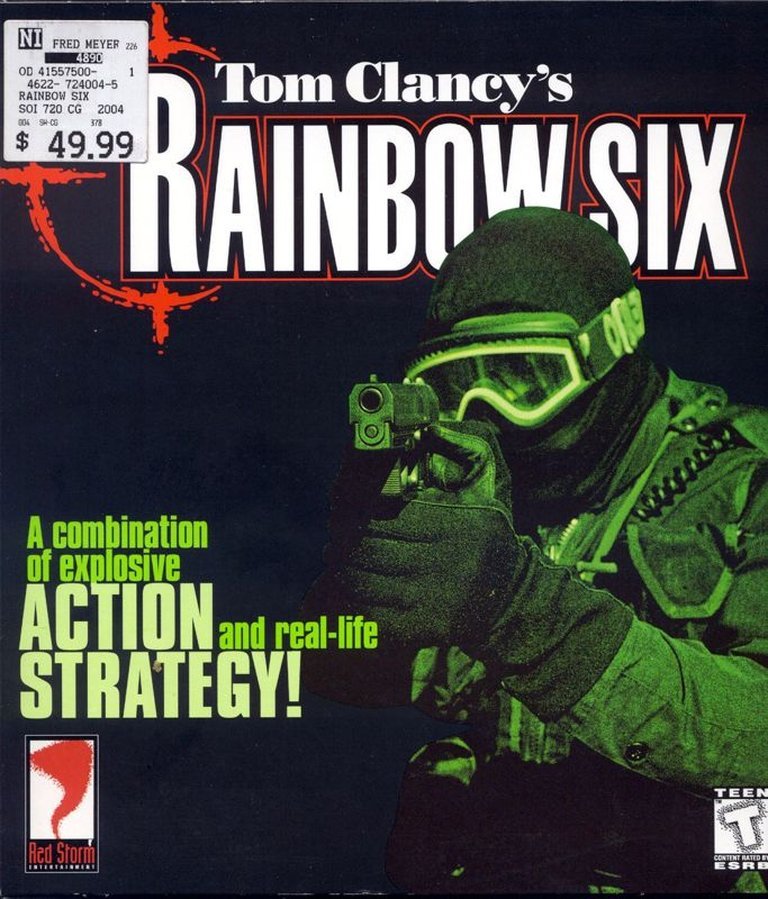
Tom Clancy’s involvement was minimal; he provided an early manuscript of his novel but otherwise let the team work autonomously. His only significant contribution was insisting on the inclusion of the heartbeat sensor from the book. The game’s box art—featuring a balaclava-clad operative—was actually a 1992 Heckler & Koch promotional photo of executive John T. Meyer, with the company’s permission. Despite setbacks, the PC version launched on August 21, 1998, with ports to Nintendo 64, PlayStation, Mac OS, Game Boy Color, and Dreamcast following later. Each port handled differently: Saffire rebuilt the N64 version to avoid frame dips, Rebellion stripped the PlayStation of key features, and Crawfish reimagined the Game Boy Color as a top-down 2.5D experience.
Narrative & Thematic Deep Dive
Rainbow Six adapts Tom Clancy’s novel of the same name but diverges significantly in plot and character. Set in 1999–2000, the game follows Rainbow, a covert international counter-terrorist organization led by former Navy SEAL and CIA officer John Clark. Rainbow responds to a surge in terrorism orchestrated by the Phoenix Group, a radical eco-terrorist organization. As missions progress, Rainbow uncovers a conspiracy: Phoenix is a front for Horizon Inc., a biotech firm run by billionaire John Brightling. Brightling, a misanthropic environmentalist, plans to exterminate humanity using “Brahma,” a manmade Ebola virus, to be released at the 2000 Sydney Olympics. His goal is to spare a select few—including U.S. Science Advisor Anne Lang—to rebuild Earth as a scientific utopia.
The narrative is delivered through mission briefings, which blend geopolitical intrigue with tactical objectives. Locations like the Democratic Republic of the Congo’s biolab or the Idaho compound where unethical human experiments occur ground the story in plausible, near-future realism. Characters are defined by their roles: Clark is the stoic leader, while operatives like Ding Chavez (named in the novel) embody professionalism. Unlike many games of the era, Rainbow’s team avoids clichés; members are veterans with military or police backgrounds, not “nubile young girls” or “young computer hackers.” The dialogue, though sparse, emphasizes operational urgency, briefing players on objectives like “Neutralize terrorists at the embassy” or “Rescue hostages from the theme park.”
Themes of global terrorism, environmental extremism, and the ethics of biotechnology permeate the story. Brightling’s plot critiques unchecked corporate power and eco-terrorism, while Rainbow’s multinational composition reflects post-Cold War cooperation. The game’s slogan, “Play as if 5.7 billion lives depended on it,” underscores its high-stakes narrative, framing each mission as a battle for global survival.
Gameplay Mechanics & Systems
Rainbow Six gameplay is a meticulous fusion of strategy and real-time action, centered on two phases: pre-mission planning and live execution. The planning stage is a masterpiece of depth. Players select up to four teams (each with a leader) from a roster of 20+ operatives, categorized by class: Assault (close-quarters combat), Demolitions (explosives), Electronics (gadgets), Recon (scouting), and Sniper. Each operative has unique skills and backstories, and death is permanent—losing a key team member like a demolitions expert can cripple later missions. Loadouts are chosen carefully: will you carry extra ammo, a heartbeat sensor, or breaching charges?
Planning involves plotting entry points, setting “go codes” for synchronized attacks, and configuring AI behavior. Teams follow waypoints, deploy equipment at designated spots, and hold positions until ordered. This phase is so vital that skipping it often leads to failure. Once the mission begins, players control one team leader directly, switching between teams on the fly. Combat is ruthlessly realistic: most weapons kill in one or two hits, and movement is deliberate. Stealth is paramount; a single misstep can alert terrorists, triggering a cascade of failures. Objectives range from hostage rescue to bomb defusal, with multiple approaches encouraged—silent infiltration or dynamic entry—but mandatory stealth in some missions.
The systems introduce significant tension. Injured operatives recover with reduced effectiveness, forcing resource management. AI teammates are generally competent but prone to pathfinding issues or blocking the player. Enemies react logically—patrolling, taking cover, or executing hostages if cornered—but their behavior can be inconsistent. Multiplayer on PC (via MPlayer.com and Zone.com) offered co-op and adversarial modes, adding replayability. Console ports varied: the N64 added split-screen co-op but reduced the campaign to 12 missions, while the PlayStation version gutted planning mechanics and team controls, leaving a “lone soldier” feel. Despite flaws, the core loop—planning, executing, adapting—remains gripping, rewarding patience over aggression.
World-Building, Art & Sound
Rainbow Six excels in creating a believable, tense world. Environments are grounded in reality: embassies, amusement parks, hydroelectric dams, and Olympic venues feel authentic, thanks to level designer John Sonedecker’s insistence on accurate architecture. No floating platforms or oversized doorways—just layouts designed for function, not combat. This realism extends to mission contexts, where briefings detail geopolitical tensions (e.g., the Phoenix Group exploiting post-Cold War instability). The absence of superhuman elements underscores the vulnerability of the player’s team.
Visually, the PC version holds up with crisp textures and subtle details— operatives’ eyes and breathing animations are visible in third-person. However, polygon counts are low by modern standards, and lighting is functional rather than atmospheric. Console ports suffered: the PlayStation’s graphics were “janky” and “aesthetically bankrupt” (IGN), while the N64 version ran at a stable framerate but with blockier models. The box art, a real Heckler & Koch photo, set a gritty tone.
Sound design is exceptional. Weapon reports are distinct—suppressed pistols vs. shotguns—and environmental audio (footsteps, glass breaking) enhances tension. Radio chatter provides real-time updates, with teammates calling out threats or positions dynamically. Bill Brown’s score is sparse but effective, using minimalist synth to underscore suspense. This auditory immersion makes infiltration sequences palpably nerve-wracking, as the crackle of a radio or the click of a safety catch can mean life or death.
Reception & Legacy
Rainbow Six was a critical darling on PC, with Metacritic aggregating an 85/100. Praise centered on its innovative planning, realism, and tension. IGN hailed it as “unlike any first-person shooter yet made,” while PC Gamer called it “undoubtedly one of the most original and best games of the year.” Multiplayer was lauded for its addictive team-based combat, though some noted quick kills could make small matches monotonous. Criticisms focused on AI glitches—teammates getting stuck, enemies overlooking nearby intruders—and occasional bugs. Raphael Liberatore of Computer Gaming World lamented “faulty AI and game-killing bugs” that marred what could have been “a benchmark game.”
Console ports divided audiences. The N64 version was well-received (GameRankings: 74%) for its streamlined controls and co-op, but the PlayStation port was widely panned (48%). IGN called it “a mighty fine example of how not to handle a port,” stripping away strategic depth. The Dreamcast port (73%) was praised for faithfulness but criticized for long load times. Sales were strong: over 200,000 PC copies in 1998, with the Gold Edition selling 321,340 more in 1999. It was nominated for PC Action Game of the Year at the Interactive Achievement Awards and won PC Gamer’s Best Action Game of 1998.
Legacy-wise, Rainbow Six redefined the tactical shooter genre. Its emphasis on planning, permadeath, and realism became a blueprint for titles like Counter-Strike and Call of Duty‘s Hardcore modes. It spawned a franchise with sequels (Rogue Spear, Vegas, Siege) and spin-offs, selling over 32 million units by 2016. The planning phase influenced strategy games, while its realistic combat set new standards for military simulations. Though later games like Rogue Spear refined its AI and mechanics, Rainbow Six remains the progenitor—a game that proved tactical shooters could be cerebral and thrilling in equal measure.
Conclusion
Tom Clancy’s Rainbow Six is a landmark achievement, a game that dared to challenge the reflex-driven shooter conventions of 1998. Its fusion of meticulous planning, lethal realism, and immersive world-building created an experience that remains tense and rewarding decades later. While technical limitations—especially in AI and console ports—prevent it from being a flawless masterpiece, its core design philosophy of “one shot, one kill” strategy and consequence-driven gameplay ensured its enduring influence. It established the tactical shooter as a viable genre, paved the way for Ubisoft’s long-running franchise, and proved that video games could simulate the high-stakes, methodical world of counter-terrorism. For historians and players, Rainbow Six is not just a game; it is a foundational text in the evolution of military simulation, a testament to how vision and ambition can transcend technical constraints. Its legacy endures not in perfection, but in the countless tactical shooters it inspired—a true classic that reshaped an industry.