
- Release Year: 2014
- Platforms: Linux, Windows
- Developer: Mateusz Viste
- Genre: Puzzle
- Perspective: Top-down
- Game Mode: Single-player
- Gameplay: Box Pushing, Grid-based movement, Puzzle solving
- Average Score: 40/100
Description
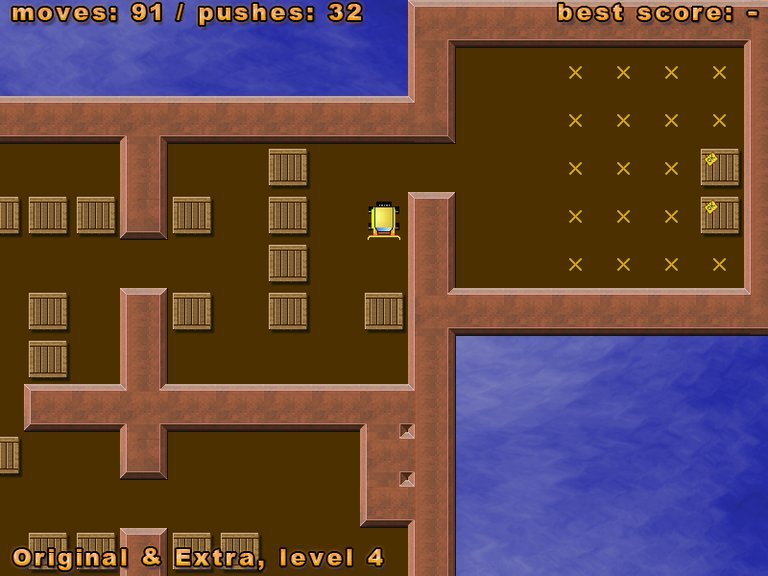
Simple Sokoban is a free, cross-platform puzzle game that reimagines the classic Sokoban experience with a focus on simplicity and portability. Set in a warehouse viewed from a top-down perspective, players push boxes onto designated storage locations using a mouse-controlled interface. The game features animated movements, unlimited undo operations, and the ability to play external level sets from .xsb files, all built in ANSI C89 with SDL for broad system compatibility.
Simple Sokoban Cheats & Codes
PC
| Code | Effect |
|---|---|
| U | to remove a bad move |
Simple Sokoban: Review
Introduction
In the pantheon of video game puzzles, few concepts have achieved the enduring elegance and punishing clarity of Sokoban. Conceived by Hiroyuki Imabayashi in 1981 and commercialized by Thinking Rabbit in 1982, its minimalist premise—pushing crates to designated storage locations in a warehouse—became a global phenomenon, selling over 4.1 million copies across 40+ official titles. Yet, as the gaming landscape evolved with graphical overhauls and complex mechanics, a quiet reverence for the original’s purity persisted. Into this niche steps Simple Sokoban, a 2014 freeware creation by Mateusz Viste. Stripped of narrative flair and visual excess, this open-source tribute aims to recapture Sokoban’s essence through portability, fidelity, and uncompromising playability. This review argues that while Simple Sokoban offers a technically sound and accessible entry point to the genre, its minimalist design ultimately reflects both the timeless appeal and the inherent limitations of the classic formula—a testament to Sokoban’s legacy more than a reinvention.
Development History & Context
Simple Sokoban emerged from the fertile ground of open-source development, spearheaded by Polish programmer Mateusz Viste. Released on April 15, 2014, for Windows and Linux, its creation was deeply rooted in the enduring legacy of Imabayashi’s original design. Viste’s vision, explicitly stated in the project’s documentation, was to create a “simple” Sokoban prioritizing “playability and portability across systems.” This ambition manifested in a deliberate technological choice: the game was written in ANSI C89, a strict, portable subset of C, and leveraged the Simple DirectMedia Layer (SDL) for cross-platform graphics and input handling. This approach ensured compatibility with decades-old hardware and modern systems alike, embodying the DIY spirit of the original 1980s PC puzzle scene.
The 2010s context is crucial here. During this period, indie puzzle games like Baba Is You and Stephen’s Sausage Roll were redefining the genre with meta-narratives and mechanical twists. Simple Sokoban, however, consciously rejected such trends. It positioned itself not as an innovator, but as a purist’s tool—a digital archive for the classic .xsb level format and a vehicle for the original’s unadorned challenges. This aligns with Viste’s credit to Thinking Rabbit’s Hiroyuki Imabayashi and level designer David W. Skinner, framing the game as a continuation of tradition rather than a departure. Yet, this fidelity also highlights a tension: while the original Sokoban was a commercial marvel that sparked a “puzzle game boom” in Japan, Simple Sokoban exists in a saturated market where countless clones exist. Its reliance on nostalgia and technical minimalism, rather than novelty, defines its place as a loving artifact rather than a contemporary contender.
Narrative & Thematic Deep Dive
Simple Sokoban, like its forebear, is a narrative void. There are no characters, dialogue, or overarching plot—only the silent, solitary act of pushing boxes. This absence is not a flaw but a core feature, forcing the player to confront the game’s thematic essence: order versus chaos. The warehouse setting, while never explicitly depicted, evokes a world of mundane labor transformed into existential puzzle. Each level is a microcosm of entropy, where misplaced crates represent disorder, and their correct alignment signifies restored harmony. This philosophical undercurrent resonates with the original’s inspiration: Imabayashi’s design was influenced by Hudson Soft’s Aldebaran #1, where players “push luggage to block radiation,” framing Sokoban as a battle against containment and misplacement.
The game’s title, “Simple,” underscores this thematic purity. By stripping away superfluous elements, Viste emphasizes the player’s role as a lone agent of logic—an anonymous “sokoban” (warehouse keeper) whose only reward is the satisfaction of a solved grid. This contrasts sharply with later Sokoban variants like Sokoban Legend: Land of Light and Darkness, which introduced combat and fantasy narratives. Here, the void becomes a canvas for introspection, as the player’s frustration and triumph are self-contained. The lack of story amplifies the game’s timelessness; it is not about saving the world, but about mastering the moment—a stark reminder of video games as pure problem-solving art.
Gameplay Mechanics & Systems
Simple Sokoban adheres rigidly to Imabayashi’s original rules, creating a gameplay loop defined by constraint and consequence. The player navigates a top-down grid, pushing boxes onto target locations. Three ironclad rules govern movement:
1. No Pulling: Boxes can only be pushed, never dragged.
2. One at a Time: Only a single box may be moved per turn.
3. Deadlock is Permanent: Misplaced a box into a corner or behind another? The puzzle may be unsolvable.
Viste’s implementation enhances these foundations with modern quality-of-life features. Animated movements smooth character transitions, avoiding the jarring instant-hops of 1980s ports. An unlimited undo operation allows players to reverse mistakes—a critical addition given the unforgiving nature of deadlocks. Most significantly, the game supports external .xsb level files, enabling players to access thousands of user-designed puzzles. This transforms Simple Sokoban from a mere clone into a versatile platform for the broader Sokoban community.
The UI is spartan but functional. A right-side menu displays level progress, scores, and options to reset, save, or load games. Controls use standard WASD keys, with mouse support for menu navigation. The level editor integration (via .xsb files) and ability to handle grids up to 62×62 demonstrate technical robustness. However, the core gameplay remains unchanged for over 40 years. While this fidelity preserves the genre’s challenge, it also highlights stagnation: no new mechanics like teleporters or switches (seen in titles like CyberBox) or dimensional twists (as in Hexoban). The result is a game that respects its lineage but offers little beyond what dedicated fans have already experienced.
World-Building, Art & Sound
Visuals in Simple Sokoban adhere to the genre’s tradition of functional minimalism. The world is rendered in a top-down, fixed-screen perspective with pixel-art sprites. Walls are solid blocks, boxes are simple crates, and targets are marked as blue dots. This austerity ensures clarity—players can instantly identify movable objects and goals without distraction. Configurable skins (via .png files) allow for minor aesthetic customization, but the core aesthetic remains a nod to 1980s home computer graphics, evoking the NEC PC-8801 origins of the original.
Sound design is nonexistent, aligning with the game’s “simple” ethos. The absence of audio reinforces the solitary, meditative atmosphere, focusing the player’s attention solely on spatial reasoning. This stands in contrast to later titles like Boxxle (Game Boy), which added chiptunes and sound effects. Yet, the silence is a deliberate choice: it mirrors the warehouse’s quiet isolation, making the clatter of a misplaced box feel audibly consequential in the player’s mind. The art and sound collectively serve as a canvas for logic, proving that in Sokoban, the environment is not a world to be explored, but a problem to be solved.
Reception & Legacy
Simple Sokoban’s reception was muted, reflecting its niche appeal. MobyGames records just two player ratings averaging 2.0/5, though no reviews accompany these scores, suggesting limited player engagement. Critically, it garnered little mainstream attention, overshadowed by graphically rich indie puzzles and the nostalgia-driven “remake boom” of the 2010s. However, its open-source nature fostered a dedicated following among puzzle purists and retro-computing enthusiasts. The GPL-licensed code and support for classic .xsb files positioned it as a valuable archival tool, preserving levels from the original Spectrum Holobyte Soko-Ban and Thinking Rabbit collections.
Legacy-wise, Simple Sokoban’s impact lies in its role as a living museum piece. It kept the 1982 formula accessible to modern players, particularly on Linux systems where it was distributed via Flatpak. Yet, it did little to advance the genre itself. Its most enduring contribution may be as a benchmark for minimalist design—proof that a game’s appeal can transcend graphical fidelity when mechanics are perfected. For instance, its emphasis on .xsb compatibility influenced later tools like the Sokoban Wiki’s level database. However, it lacks the creative mutations of games like Sokomania 2 (which added conveyor belts) or Puzzledorf (which introduced colored blocks), cementing its status as a faithful relic rather than an innovator.
Conclusion
Simple Sokoban is a paradox: a meticulously crafted tribute that simultaneously honors and exemplifies the limitations of its inspiration. As a technical exercise, it excels—portable, lightweight, and functionally flawless. Its adherence to Imabayashi’s original rules, augmented by modern conveniences like undo and .xsb support, makes it an ideal entry point for newcomers and a nostalgic playground for veterans. The game’s thematic purity—its silent, solitary focus on logical order—resonates with the enduring appeal of Sokoban as a test of spatial reasoning, not reflexes or narrative immersion.
Yet, this same fidelity is its greatest constraint. In a gaming landscape saturated with innovative puzzle designs, Simple Sokoban’s refusal to evolve renders it a historical artifact rather than a contemporary masterpiece. It captures the soul of Sokoban but not its potential. For players seeking the pure, unadulterated challenge of 1982, it is a perfect digital time capsule. For those expecting more, it is a reminder that some classics are best left as monuments—preserved in amber, revered for their purity, but ultimately superseded by the very evolution they inspired. In the annals of video game history, Simple Sokoban stands not as a revolution, but as a lovingly crafted epitaph for a genre defined by its beautiful, brutal simplicity.