
- Release Year: 2010
- Platforms: Windows
- Publisher: Bohemia Interactive a.s., IDEA Games a.s., Morphicon Limited
- Developer: Centauri Production s.r.o., First Reality
- Genre: Adventure
- Perspective: Third-person
- Game Mode: Single-player
- Gameplay: Inventory management, Point-and-click, Puzzle elements
- Setting: Cyberpunk, dark sci-fi, Futuristic, Post-apocalyptic, Sci-fi
- Average Score: 56/100
Description
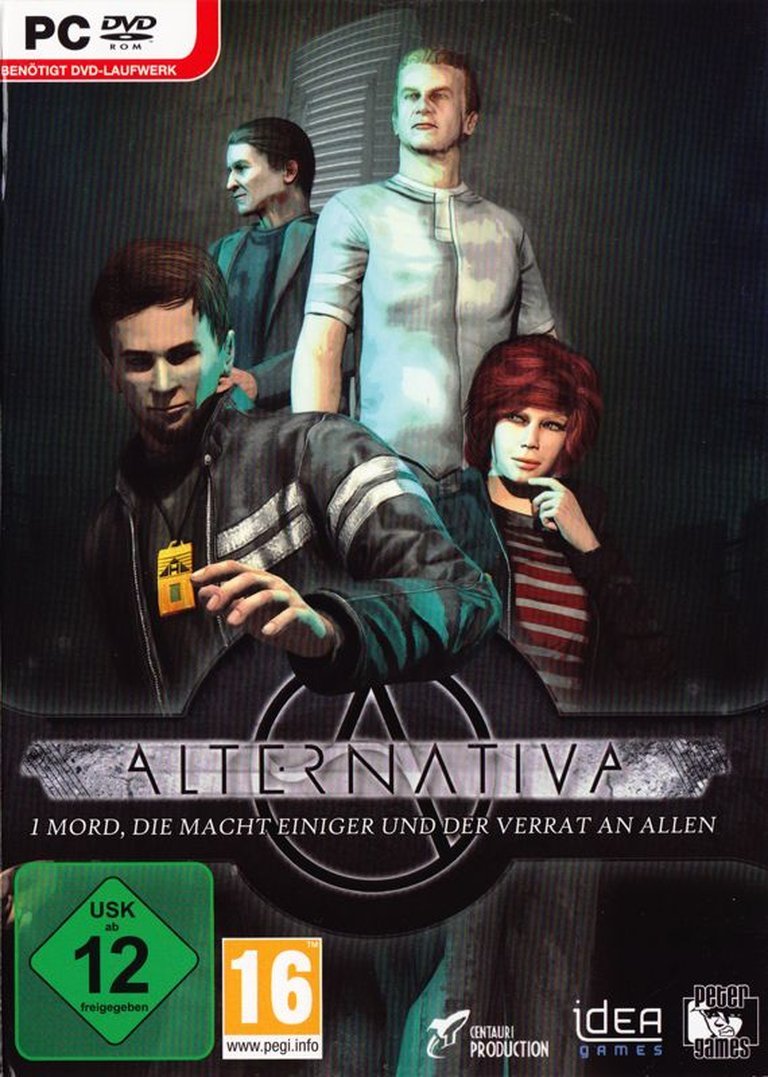
Alternativa is a dystopian adventure game set in the post-apocalyptic future of 2045 Prague, where a global government enforces control through androids while two corporations, Endora and Theolex, dominate mining/construction and technology sectors. The protagonist, Richard Boček, a fired construction worker, joins a resistance movement and becomes entangled in a plot involving murder, conspiracy, and dark revelations. Despite its grim narrative, the game incorporates puzzle-solving elements, dialogue choices that can trigger game over, code decryption challenges, and a unique sense of humor, all presented in 2.5D graphics with pre-rendered backgrounds and real-time 3D character models.
Gameplay Videos
Where to Buy Alternativa
PC
Alternativa Cracks & Fixes
Alternativa Guides & Walkthroughs
Alternativa Reviews & Reception
metacritic.com (63/100): AlternativA is a diamond in the rough: the themes are grown up, the puzzles solveable but the presentation seems old and the story isn’t consistent.
adventuregamers.com (55/100): AlternativA initially manages to impress with its unusually dark themes and derelict world, but there are just too many shortcomings to make it a memorable game.
Alternativa: Review
Introduction
In the shadowed expanse of 2045, where nuclear ash coats the ruins of Prague and corporate overlords reign with iron fists, Alternativa stands as a defiant yet flawed monument to the point-and-click adventure genre. Developed by Czech studios Centauri Production and First Reality and published by Bohemia Interactive in 2010, this dystopian odyssey promises a non-linear narrative of murder, power, and betrayal. Yet, while its cyberpunk atmosphere brims with potential, Alternativa ultimately emerges as a game of tantalizing promise and profound execution gaps—a curio beloved by niche audiences yet dismissed by mainstream critics as a “diamond in the rough” marred by technical and narrative inconsistencies. This review dissects Alternativa’s legacy, arguing that its ambitious world-building and philosophical depth are undermined by design choices that alienate even the most devoted adventure gamers.
Development History & Context
Alternativa emerged from the crucible of Czech indie development, spearheaded by Centauri Production—studio responsible for the acclaimed Memento Mori series. Acquired by Bohemia Interactive in September 2010, Centauri collaborated with First Reality to craft a vision of a post-apocalyptic future where narrative depth superseded graphical spectacle. The project’s roots trace to 2008, with development leveraging the proprietary CPAL3D engine, a hybrid 2.5D system blending pre-rendered backgrounds with real-time 3D character models. Technically, it was constrained by mid-2010 hardware demands (Pentium 4 2.0 GHz, 512 MB VRAM), prioritizing atmospheric storytelling over cutting-edge visuals.
The gaming landscape in 2010 was hostile to traditional adventures. As The Moment of Silence (2004) aged, players craved sci-fi innovation, with titles like Gemini Rue (2010) raising the bar. Alternativa positioned itself as an Eastern European response, emphasizing non-linear storytelling and mature themes. However, its budget (estimated under $1 million) forced compromises: a team of 40 developers handled scripting, art, and sound, but localization—particularly English voice acting—suffered. The result was a game caught between artistic ambition and technical limitations, released across Europe (digital and DVD-ROM) and later on Steam (November 2010).
Narrative & Thematic Deep Dive
Alternativa’s narrative is a tapestry of interconnected short stories set in a world ravaged by global war. In 2045, a totalitarian government rules from the ashes, enforcing order through android enforcers while two megacorporations dominate: Endora (mining/construction) and Theolex (technology/androids). The protagonist, Richard Boček, a construction worker fired without cause, stumbles into a resistance movement, uncovering a conspiracy involving murder, corporate espionage, and systemic betrayal.
The narrative brilliance lies in its non-structure. Players control up to four characters (including antagonists), with choices branching into divergent storylines. A pivotal airport decision—whether to trust Andy—splits the narrative: one path involves email forgery and cigar trading for clearance codes; another follows Andrea’s resistance-aided escape via license plate manipulation. This design echoes Blade Runner-esque themes of identity and rebellion, where loyalty is a currency and power is a weapon. Yet, the execution falters. Subplots (e.g., rape investigations, morgue visits) are introduced but abandoned, leaving “gaps in the story and background details” (Adventure Gamers). Dialogue choices carry high stakes—wrong answers can trigger instant arrest or death—but the branching paths feel superficial, with “unresolved plot gaps” (Adventure Gamers) and an “abrupt ending” that feels like “sequel bait” (Przygodoskop).
Themes of corporate oppression and individual resilience permeate every pixel. Endora’s arbitrary firings mirror real-world precarity, while Theolex’s androids symbolize surveillance capitalism. Yet, the game’s “dark themes” (Adventure Gamers) are undercut by tonal whiplash—moments of grim realism clash with jarring humor, like a PDA gag in a decaying city. The result is a world rich in concept but impoverished in cohesion.
Gameplay Mechanics & Systems
Alternativa’s core loop is a classic point-and-click adventure, but its mechanics reveal a tussling ambition and frustration. The interface—mouse-driven with context menus (“inspect,” “take/use,” “talk”)—is “smooth and intuitive” (Adventure Gamers), yet plagued by invisible triggers and illogical backtracking. For example, a character must walk to a precise hotspot to interact with an object, even if the player clicks adjacent to it, creating “painstakingly slow” movement (hfffoman, Steambase).
Puzzles range from clever to tedious. Code decryption combines environmental clues (calendar dates, chemical formulas) into solutions like “1132013,” while item combinations (e.g., taping a metal rod to a stone) offer tactile satisfaction. Yet, logic often yields to guesswork; a clock puzzle requires trial-and-error testing of positions (12:00, 4:00, 6:00), with no hint system. The dialogue system is a double-edged sword: choices shape outcomes, but wrong answers can lock content behind “game over” screens. Difficulty modes mitigate this—easy offers retries—but the system feels punitive, especially with “poor voice acting” (Adventure Gamers) that obscures character intent.
Inventory management is streamlined via a fixed PDA that stores items and databases, yet its utility is limited. Progression hinges on non-linear exploration, but the map forces repetitive travel between Prague’s underpopulated locales. Technical issues compound these woes: translation errors (e.g., awkward English subtitles), frozen interfaces, and bugs that require restarts. It’s a system that rewards patience but punishes experimentation.
World-Building, Art & Sound
Alternativa’s world is its greatest triumph. Post-apocalyptic Prague is rendered as a “gripping” (LEVEL) neo-fascist dystopia, where steam rises from alleyways, androids patrol rain-slicked streets, and flickering neon signs cast long shadows. The city’s “Soviet-inspired decay” (hfffoman) is meticulously detailed, with over 120 hand-modeled backgrounds depicting ruined ministries and corporate strongholds. This world-building extends to lore: Endora’s monopolies, Theolex’s android factories, and the resistance’s fragmented cells are woven through environmental storytelling, with PDA entries and data discs enriching the narrative.
Visually, the 2.5D aesthetic is a study in contrasts. Pre-rendered backdrops evoke the “future-retro” style of The Fifth Element, blending mundane objects with advanced tech. Character models, however, suffer from stiff animations and lip-sync issues, particularly during cutscenes. Sound design amplifies the atmosphere: droning ambient tracks and stilted voice acting (noted as “poor” by Adventure Gamers) heighten paranoia, but inconsistent mixing renders key dialogues inaudible. Adam Kuruc’s soundtrack is a highlight—melancholic piano scores underscore moments of despair—but its sparing use leaves the world feeling sonically sparse.
Despite these flaws, Alternativa’s art direction remains evocative. The oppressive palette of grays and sickly greens, juxtaposed with corporate blues, creates a “spine-chilling atmosphere” (Gamepressure) that lingers long after gameplay ends.
Reception & Legacy
At launch, Alternativa received a mixed reception. On Metacritic, it scored 63 (mixed), with critics praising its “unusually dark themes” (Adventure Gamers) but lamenting its “obsolete visuals” (LEVEL). Eurog Italy lauded its “credible alternative future,” while 4Players deemed it “mediocre—promises too much, delivers too little.” Player reviews on Steam are equally divided, with a “Mixed” rating (47% positive) citing “frustrating” puzzles and “dated graphics” (Steambase).
Commercially, Alternativa was a niche success. Released at $12.99 on Steam, it peaked at 1,900 concurrent players but never broke into mainstream sales. Bohemia’s acquisition of Centauri in 2010 fueled distribution hopes, but the game’s lack of profit quashed sequel plans—confirmed in 2012 via a Facebook post: “Originally, there was a plan for a sequel, but the game didn’t make a profit. Sorry.”
Legacy-wise, Alternativa endures as a cult favorite among cyberpunk enthusiasts. Its Eastern European perspective on dystopia influences titles like Cadenza: Fame, Theft and Murder (2017), while YouTube longplays (1,900–4,600 views) introduce it to new audiences. Yet, its flaws cement its status as a missed opportunity. Adventure-Treff’s comparison to The Moment of Silence—”better off playing the 6-year-old title”—underscores its overshadowing by genre giants. For every player praising its “complex dystopian story” (Steambase), another condemns its “brutally cut ending” (Przygodoskop). It remains a cautionary tale of ambition versus execution in the adventure genre.
Conclusion
Alternativa is a game of stark contrasts: its dystopian world is richly imagined, yet its puzzles are illogical; its non-linear narrative brims with potential, yet its conclusion is abrupt; its atmosphere is suffocatingly effective, yet its technical flaws undermine immersion. Centauri Production crafted a vision of corporate oppression and human resilience that resonates in an era of rising authoritarianism, but execution gaps—from invisible triggers to abandoned subplots—prevent it from achieving greatness.
For adventure gamers, Alternativa is a flawed gem worth exploring for its mature themes and cyberpunk aesthetic. For the industry, it serves as a reminder that ambition without polish can squander brilliance. In the pantheon of dystopian games, it may never reach the heights of Cyberpunk 2077 or Blade Runner, but its legacy endures as a testament to the power—and peril—of indie storytelling. In the end, Alternativa is less a finished novel and more a haunting sketch—a glimpse into a future that could have been, and a world that still begs to be fully realized.