
- Release Year: 2000
- Platforms: Windows
- Publisher: Vesa Halonen
- Developer: Vesa Halonen
- Genre: Action, Puzzle
- Perspective: Side view
- Game Mode: Co-op, LAN, Single-player
- Gameplay: Falling block puzzle, Power-ups
- Average Score: 80/100
Description
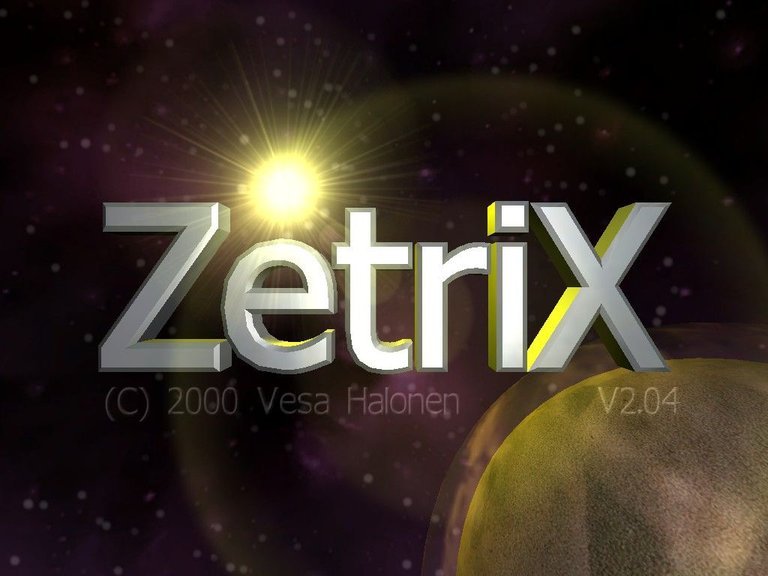
ZetriX is a freeware Tetris variant where players rotate and position falling blocks to clear rows, featuring customizable difficulty levels, multiple languages, table sizes, and two game modes: classic and enhanced. The enhanced mode introduces unique bonus tiles with special effects, while multiplayer options include duel, race, and co-op modes for two players via split-screen or TCP/IP, complemented by dynamic 3D graphics and background animations.
ZetriX Free Download
PC
ZetriX: Review
Introduction
In the pantheon of puzzle games, few names resonate with the universal appeal of Tetris. Yet, in 2000, a freeware gem named ZetriX emerged, seeking not to replace the classic but to refine it with audacious creativity. Developed by the enigmatic duo Vesa Halonen (code/graphics) and Tom Kaldyka (web design) under the studio Quadragan, ZetriX was more than a clone—it was a love letter to geometric chaos, amplifying Alexey Pajitnov’s blueprint with innovations that felt both inevitable and revelatory. Its legacy lies in how it balanced reverence for the original with boundary-pushing mechanics, all while democratizing fun as freeware. This review deconstructs ZetriX as a cultural artifact, a technical marvel of its era, and a masterclass in iterative design, arguing that its enhancements to multiplayer, visual dynamism, and strategic depth cement it as an unsung hero of the puzzle genre.
Development History & Context
ZetriX materialized in 2000, a pivotal year when PC gaming was transitioning from MS-DOS nostalgia to Windows-driven innovation. The freeware model—pioneered by games like Doom—empowered indie creators to bypass retail constraints, and Halonen/Kaldyka embraced this ethos with abandon. Their vision was clear: to distill Tetris’s addictive core while layering complexity for both novices and veterans. Technologically, the game pushed the limits of early 3D acceleration. Rendered in a “fixed/flip-screen” side-view perspective, it employed pseudo-3D effects for blocks and backgrounds—a feat that required optimizing for low-end machines. This was achieved through clever sprite scaling and particle effects, ensuring smooth performance even on hardware struggling with contemporary 3D titles. The gaming landscape at the time was saturated with Tetris imitations, but ZetriX stood out by prioritizing customization: ten languages, four difficulty tiers (from “Easy” to the punishing “Impossible”), and four board sizes. This accessibility, paired with multiplayer innovations, reflected Halonen’s desire to create a communal experience, mirroring the era’s rise in LAN parties and internet cafes. The game’s German origin (per IMDb) also highlights its role in bridging European indie scenes with global audiences.
Narrative & Thematic Deep Dive
As a pure puzzle game, ZetriX lacks a traditional narrative. Yet its thematic depth emerges through gameplay metaphors. The relentless cascade of blocks embodies humanity’s struggle against entropy—a race to impose order on chaos. The enhanced mode’s bonus tiles amplify this theme: the dynamite tile represents controlled destruction, the dollar tile signifies capitalism’s allure, and water tiles evoke environmental fragility. These mechanics transform the playfield into a microcosm of human agency, where choices ripple through systems. Multiplayer modes add layered narratives: Duel is a zero-sum battle of ego, Race a sprint against time, and Co-op a testament to collaboration. The absence of characters or dialogue is intentional; the game’s “story” is written in the player’s reflexes and strategic pivots. Even the shifting backgrounds—tunneling through wormholes or orbiting planets—suggest cosmic-scale themes of exploration and transcendence, turning each level into a metaphorical journey through the unknown.
Gameplay Mechanics & Systems
ZetriX’s genius lies in its dual-mode structure. Classic Mode faithfully replicates Tetris’s loop: rotate blocks, fill rows, and survive escalating speed. Its purity is a deliberate homage. Enhanced Mode, however, is where the game redefines the genre. Introducing irregularly shaped “bonus tiles,” it injects risk-reward dynamics:
– Dynamite: Clears surrounding blocks, enabling chain reactions but potentially destabilizing the stack.
– Dollar Sign: Grants 1,024 points, rewarding precision but creating a “greed” dilemma.
– Water Tiles: Raise or lower a liquid hazard, adding vertical pressure and forcing adaptive strategies.
These mechanics introduce emergent complexity, turning line-clearing into a multilayered puzzle. The controls—fully customizable via keyboard—allow players to map rotations to arrow keys, a quality-of-life nod to comfort. Difficulty scales are sharp but fair: “Impossible” mode demands lightning reflexes, while smaller board sizes (e.g., 10×10) favor tactical planning over endurance. Multiplayer is the crown jewel: split-screen local play or TCP/IP internet matches across three modes. Co-op stands out as a brilliant social experiment, where two players share a screen, requiring synchronized chaos. The UI, though minimalist, is functional, with score indicators unobtrusively positioned to avoid cluttering the action.
World-Building, Art & Sound
ZetriX’s world is one of kinetic abstraction. Visuals prioritize clarity over realism—blocks are rendered in bold, distinct hues to prevent shape confusion at high speeds. The true artistry lies in the background animations, which shift per level: from pulsing geometric patterns to interstellar wormholes. These are not mere window dressing; they subtly challenge focus, embodying the game’s thesis that even “simple” puzzles demand immersion. 3D effects on blocks and explosions add depth without compromising performance, a technical triumph for 2000. Sound design is equally purposeful: chimes for line clears, percussive beats matching gameplay tempo, and ambient tracks that evolve with stages. One Czech review (Freegame.cz) notes the “lovely” music and explosions, praising how audio enhances tactile satisfaction. The water tiles’ gurgling and dynamite’s concussive blasts turn the playfield into a symphony of destruction, making each action viscerally rewarding. This audiovisual cohesion elevates ZetriX beyond a mere time-waster, creating an atmosphere of joyful intensity.
Reception & Legacy
At launch, ZetriX was lauded as a freeware masterpiece. Critics praised its audacious enhancements: GameHippo.com awarded it a rare 10/10, calling it “S-U-P-E-R C-O-O-L and beyond all expectations.” Abandonia Reloaded celebrated its “lovely explosions” and “lovely music,” while Freegame.cz highlighted its 3D polish and addictive nature. Even the most measured reviews, like Freehare’s 4/5, recommended it unreservedly to Tetris fans. Commercially, freeware status ensured widespread distribution, with the Internet Archive preserving its 1.9MB download as a relic of a more open internet era. Its legacy endures in three ways:
1. Influence: Enhanced modes with power-ups foreshadowed modern titles like Puyo Puyo Tetris, while its multiplayer innovations prefigured cooperative puzzle games.
2. Accessibility: The GitLab port (2020) attests to its enduring appeal, with developers citing it as inspiration for open-source puzzle projects.
3. Historical Context: Released alongside titans like Deus Ex and Final Fantasy IX, ZetriX proved that freeware could rival AAA ingenuity. Its 91% MobyGames score (top 2,500 of 27,000 games) cements it as a cult classic, celebrated for democratizing high-quality puzzle experiences.
Conclusion
ZetriX is a testament to the power of iterative design. By respecting Tetris’s foundations while fearlessly innovating—from water mechanics to asynchronous multiplayer—it transcended “clone” status to become a genre landmark. Its visual flair, strategic depth, and communal spirit make it more than a puzzle game; it’s a time capsule of early 2000s PC culture, where creativity flourished outside corporate gatekeeping. While it lacks the narrative ambition of Baldur’s Gate II or the technical prowess of Quake III Arena, its purity of purpose earns it a revered place in history. For players, it remains a must-play—a reminder that the most enduring games are those that honor the past while boldly imagining the future. In the ever-expanding universe of puzzle games, ZetriX’s blocks still fall with the same addictive grace today as they did in 2000.